Section 2.6.6 in the 2012 Final EA for resource enforcement actions says that reducing or removing livestock “would be inconsistent with the current land use plans and/or Final Multiple Use Decisions (FMUDs) for the Owyhee Complex and with multiple use management.”
In a subsequent paragraph, the writers note that “changes to livestock grazing cannot be made through a wild horse gather decision, and are only possible if BLM first revises the land-use plans to re-allocate livestock forage to wild horses and to eliminate or reduce livestock grazing.”
What’s at stake?
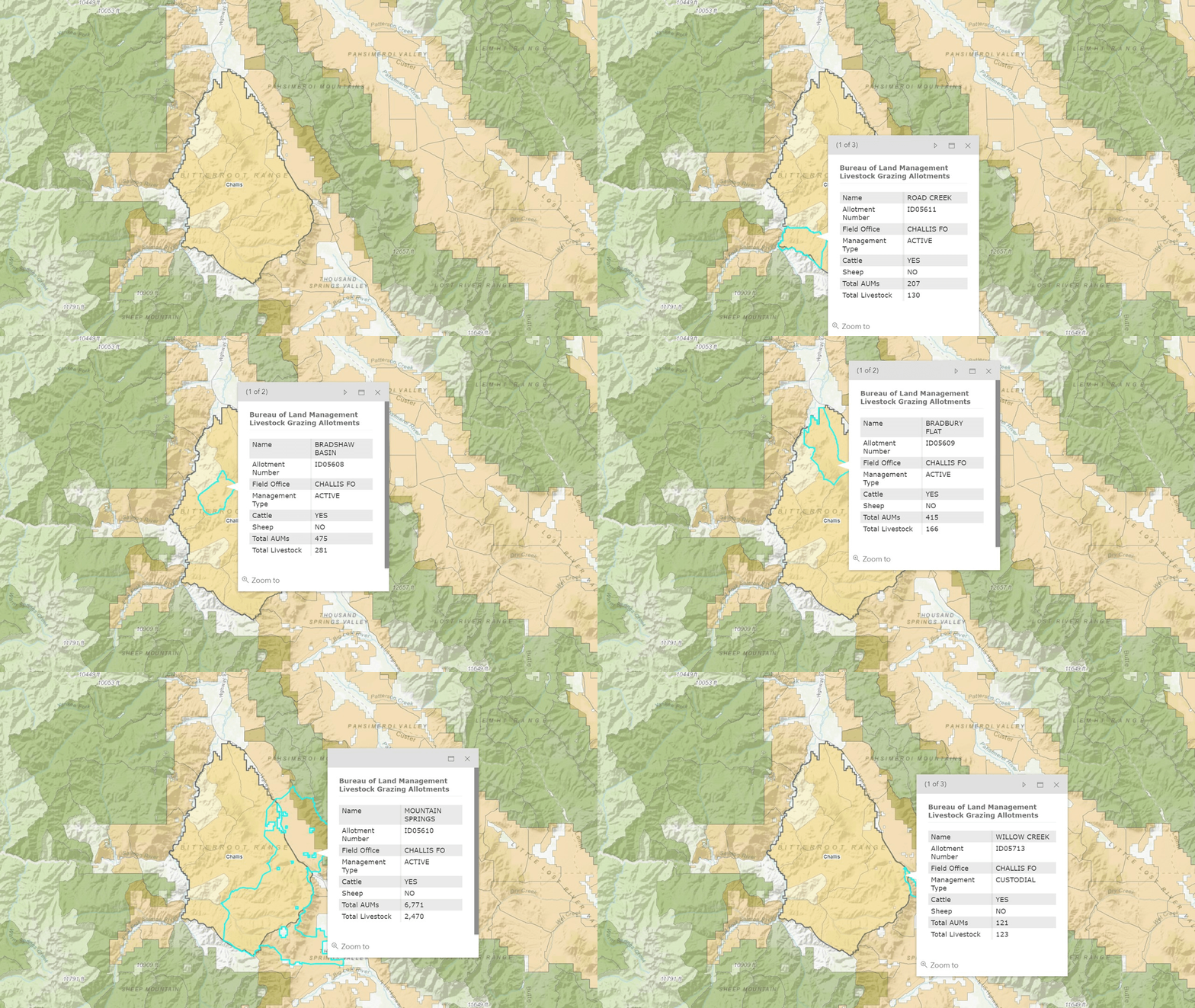
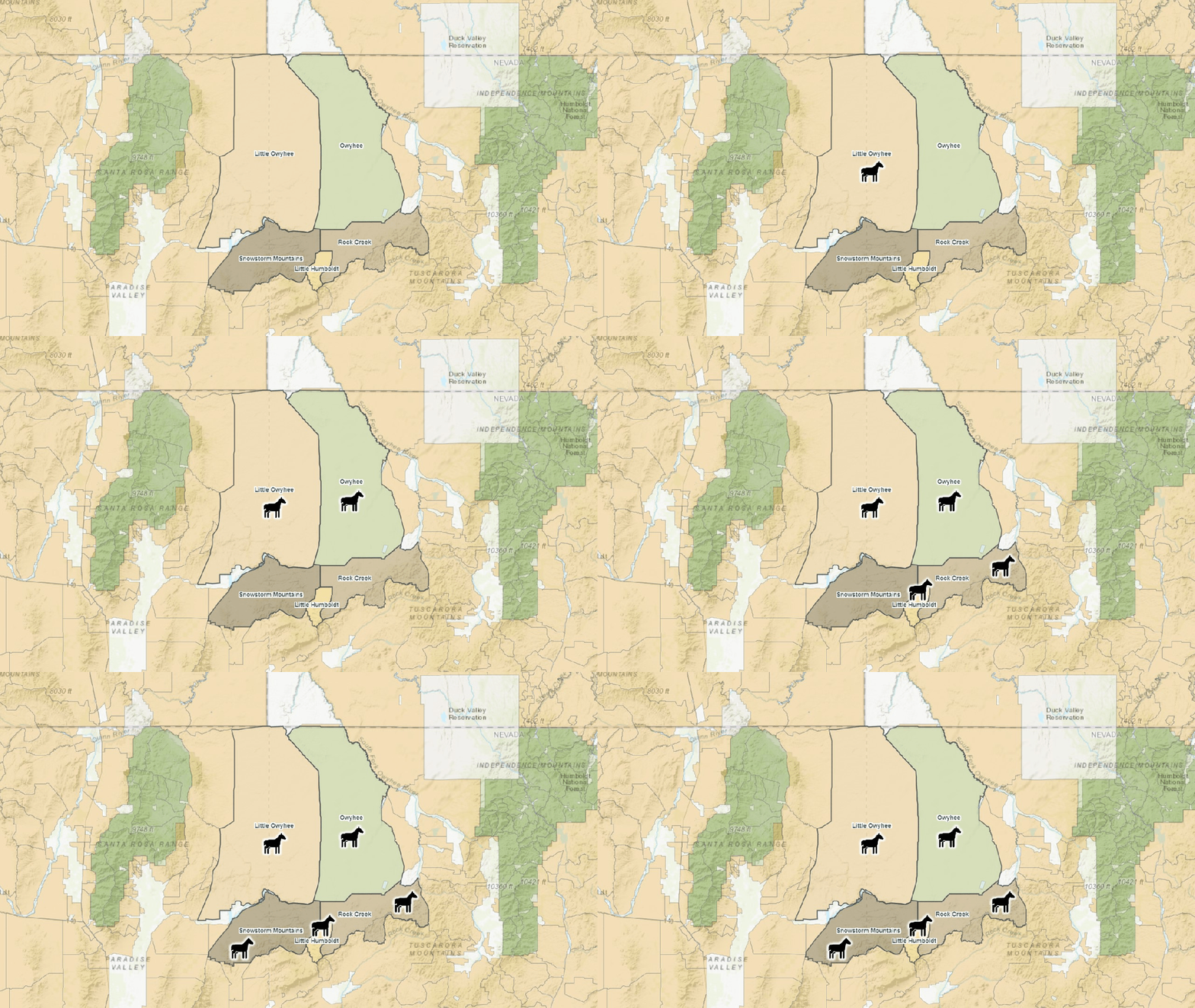
The five HMAs in the Complex overlap six grazing allotments, as shown in the map from Western Watersheds.

Table 5 in the EA provides HMA acres within the allotments. The forage available to livestock today is about 5% less than in 2012, so the current values were copied into the spreadsheet. Other values were taken from Table 5 or computed.
These figures can be used to estimate the forage assigned to livestock in each HMA, assuming the resource is evenly distributed across the allotments.
For example, Snowstorm Mountains intersects 69.3% of the Bullhead allotment, so the forage taken from the horses and sold to the ranchers is .693 × 12,050 = 8,351 AUMs per year.
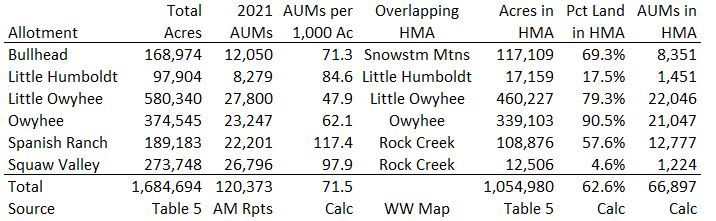
The sum of these estimates is 66,897 AUMs per year. This resource would support an additional 5,575 wild horses, meaning that 5,575 wild horses have been displaced from their home range by privately owned livestock, about 11% of the 50,000 horses in off-range holding.
This is why those facilities are full, or nearly so, and why the bureaucrats are searching for more.
The advocates would solve the problem by getting rid of the horses, not the livestock.
Confine the ranchers to their base properties and let them pay market rates to feed their animals. What do you suppose happens during the off season?
The current AML of 999 (across five HMAs) could rise to 6,574. It’s that bad. The stocking rate would be 6.2 wild horses per thousand acres, or 160 acres per horse.
Grazing seasons can be found in the Authorization Use reports from RAS, one for allotments managed by the Humboldt River Field Office and another for allotments managed by the Tuscarora Field Office.







 Western Horse Watchers Association