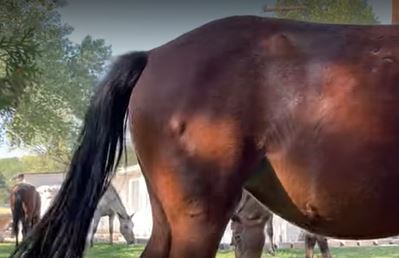
A stallion and yearling crossed the Verrazano Bridge to the mainland yesterday but were safely returned, according to a story posted today by the Maryland Coast Dispatch.
The bridge appears at 2:27 in this video.
Western Horse Watchers Association
Exposing the Hypocrisy, Lies and Incompetence of the Wild Horse Advocates
A stallion and yearling crossed the Verrazano Bridge to the mainland yesterday but were safely returned, according to a story posted today by the Maryland Coast Dispatch.
The bridge appears at 2:27 in this video.
The duly elected sodomite sent a letter to the BLM this week asking the agency to ensure the animals’ safety amid concerns about high temperatures and potential impacts to foals, according to a story by The Grand Junction Daily Sentinel.
Almost certainly he’s responding to requests and recommendations from groups that would be first in line to get rid of them with the Montana Solution.
An ecologist with the Colorado Sierra Club visited the HMA this month and found no evidence to support the BLM’s claims of wild horse malnourishment, arguing that upland habitats provide ample forage to support the population.
The article did not indicate how much of that resource had been assigned to privately owned livestock.
Operations will transition to helicopters tomorrow, according to the gather page.
Bitless is better. Auction begins at 6 PM today, pacific time.
RELATED: R3C Saddle-Started Horses Up for Adoption.
The action begins on July 23 with the southern herd roundup, as explained in the official guide, followed by the northern herd roundup on July 24.
The annual swim occurs on July 27.
The herd includes 150 adults and 60 to 70 foals according to the guide, putting the birth rate above 40%!
The growth rate probably exceeds 35% per year, assuming a 5% death rate.
Most of the foals will be auctioned. A few will be returned.
When the incident is over the island will resemble the Salt River and Virginia Range, where the advocates are ruining the herds with the Montana Solution:
The incident would qualify for an episode of Foal-Free Friday.
The next round of protests will occur on September 23 or 24.
The organizers are still pushing the Wild Horse and Burro Protection Act, which would replace helicopter roundups with capture by wrangler, despite the video from Day 2 of the Buffalo Hills roundup showing mistreatment of a foal by wranglers!
RELATED: Wild Horse Freedom Rallies Set for Next Month.
No horses were captured in July according to the gather page.
Helicopters take to the sky starting on Friday.
RELATED: Piceance Gather Page Found!
Here are the headlines on Drudge. The first link pointed to a story by CNBC.

The price of alfalfa-grass hay in this area went from $19 per bale last July to $36 per bale this July, an 89% increase.
Democrat supporters didn’t get a return on their investments in 2016 so now the party is under great pressure from our enemies, foreign and domestic, to destroy the country and its standard of living.
RELATED: Price of Hay Hits New Record.
The film premieres this weekend during a historical society fundraiser in Farmington, NM, according to a report posted yesterday by the Farmington Daily Times.
The JMA, consisting of the Carracas Mesa HMA and Jicarilla WHT, is jointly managed by the BLM and Forest Service.
The HMA covers 9,000 acres and the WHT contains 76,000 acres. The combined AML is 128 and the stocking rate allowed by plan is 1.5 wild horses per thousand acres.
The HMA does not appear on the Western Watersheds map but is on the west side of the WHT abutting the Colorado state line.
The WHT overlaps three allotments and is probably subject to permitted grazing.
The grazing status of the HMA is not known.
The story did not indicate if the film would discuss resource allocations, land-use plans and the mismanagement of areas set aside for wild horses.
Warning to those wearing “Stay Wild” caps: The article contains images of foals.
The incident, set to begin on August 7, increased the FY 2022 capture goal from 22,541 in the previous schedule to 22,991 in the latest schedule.
The EA for the new resource enforcement plan went through the planning process like red clover through a bull.
The project was created in ePlanning on February 24, no documents posted.
An announcement for the scoping phase does not appear in the project documents and cannot be found at the BLM news site. That step was skipped?
The Draft EA was released for public review on May 18, comments accepted through June 17.
The Decision Record was signed on July 7.
Maybe the permittees and their cheerleaders were big donors to the Biden Campaign?
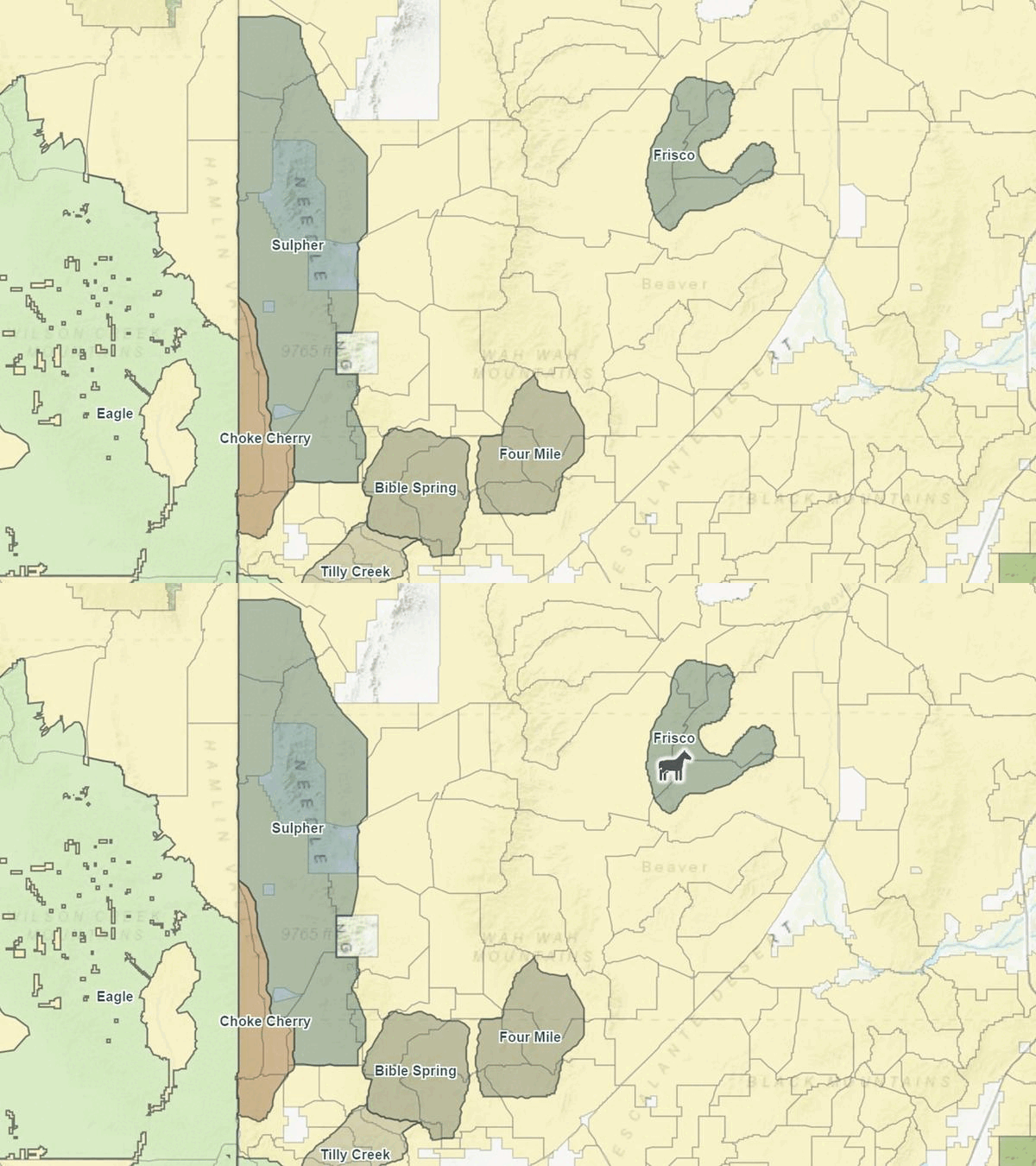
RELATED: Bible Springs Decision Released.
When they’re part of catch-treat-release. Otherwise they’re cruel and costly.

The advocates have no convictions. They’ll hop on any bandwagon that leads to greater use of the Montana Solution and more attention from the bureaucrats and ranchers.
RELATED: Bold Prediction for Fertility Control Solicitation.
Displaced from their home range by permitted grazing and placed into the inmate training program, two geldings and a mare will be offered in an online auction hosted by the BLM on July 14, from 6 to 8 PM pacific time.
The news release said the animals can be picked up on July 16 by appointment at the Rio Cosumnes Correctional Center in Elk Grove, CA.
Details at the R3C adoption page.
The infection has killed seventeen animals since mid June, according to a report dated July 6 by The Press-Enterprise of Riverside, CA.
The burros live in the foothills and canyons between Colton and Moreno Valley.
The incident follows an outbreak two years ago that killed over 40 animals.
The incident will begin on or about July 14, according to the BLM news release.
The capture goal is 1,900 and the removal goal is 1,800. Mares returned to the range will be treated with GonaCon.
Helicopters will push the horses into the traps and operations will be open to public observation.
The Complex includes the Maverick-Medicine HMA, Triple B HMA and Antelope Valley HMA west of US Highway 93.
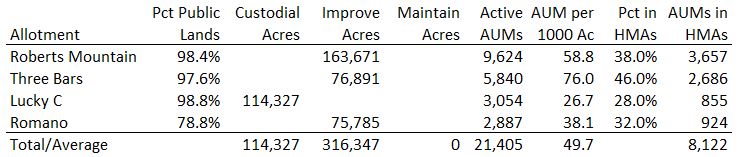
The 821 horses allowed by plan require 9,852 AUMs per year in an area covering over 1.6 million total acres. The Western Watersheds map shows the arrangement.
The current population is thought to be 3,475.
Table 2 in the 2017 EA for resource enforcement actions includes the Cherry Springs WHT in the Complex, with an AML of 68, but it is not mentioned in the announcement.
The HMAs are subject to permitted grazing. Livestock receive an estimated 49,188 AUMs per year, which would support an additional 4,099 wild horses.
Captured animals will be taken to the corrals in Fallon, NV and Sutherland, UT.
Gather stats and daily reports will be posted to this page.
The EA was posted with other project documents.
RELATED: Triple B Roundup Next?
The Decision Record, signed on July 7, authorizes the Proposed Action, which features removals of excess animals to low AML as quickly as possible, population suppression using PZP or GonaCon, IUDs, manipulation of sex ratios, and monitoring of herds with GPS tracking devices. Refer to Section 2.2.1 in the Final EA.
A roundup is not imminent but at least 750 wild horses will need to be removed from state, private and BLM-managed public lands in and around the Complex to ensure a healthy landscape, according to the news release.
The new resource enforcement plan, effective immediately, has a ten-year life.
The Complex intersects 16 grazing allotments.
Three HMAs and one HA are affected.
The DR and EA were posted with other project documents.
On the internet auction site with Gypsy Equestrian. Bidding in progress July 5-12.
Operations concluded yesterday, according to a statement at the gather page, with 390 horses captured, 369 shipped, ten deaths and one returned.
The total includes 147 stallions, 194 mares and 49 foals, based on the daily reports.
The total at the gather page was 380, based on 184 mares captured.
The capture goal was 383 and the removal goal was 353. Mares treated with fertility control may be returned to the HMA at a later date.
The death rate was 2.6%.
Foals represented 12.6% of the total.
Of the adults, 43.1% were male and 56.9% were female.
Body condition scores were not provided.
Video from Day 2 showing the mistreatment of a foal sparked outrage among observers and may have killed public support for the Wild Horse Protection Act (helicopter ban).
RELATED: BLM to Thin Buffalo Hills Herd Starting This Week.
UPDATE: The July 11 news release said up to 27 mares will be treated with GonaCon and returned to the HMA.
The project targets wild horses in and around the HMA, referred to in Section 1.1 of the EA as the HA. The HA covers 411,636 total acres, including 211,593 acres in the HMA.
The HA was marked with a blue border on Map 1, page 92 in the pdf. It extends into the Dugway Proving Grounds.
Lands outside the HMA are not managed for wild horses and have no AML.
The AML for the HA would be identical to the AML for the HMA but the stocking rate allowed by plan would be lower.
The 390 horses allowed by plan in the HMA require 4,680 AUMs per year. The forage assigned to wild horses in the HA would be identical.
The HA intersects four allotments, discussed previously.
Data for livestock grazing were presented in Table 6 of the EA, page 26 in the pdf.

The table indicates that four percent of Aragonite is inside the HA.
Map 2 in the EA, page 93, shows the allotment boundaries relative to the blue border.

Would you say that Aragonite, circled in red, is 4% inside the HA? Looks more like 95%.
How about North Cedar Mountain? Table 6 says 15%. Looks more like 90%.

The allotments represent forage taken from the horses and sold on the cheap to the public-lands ranchers. This is why AMLs are small relative to the available resources.
If you use the figures in Table 6, you will underestimate the forage assigned to livestock inside the HA.
If you use the eyeball estimates above for Aragonite and North Cedar Mountain, you come up with 17,068 AUMs per year assigned to livestock inside the HA.

That’s 3.6 times more forage than assigned to the horses.
The HA is managed primarily for livestock.
The forage assigned to livestock would support an additional 1,422 wild horses, for a True AML of 1,812.
The current population, thought to be 766 according to Section 1.1 of the EA, is well within this range.
The True AML could be achieved by confining the ranchers to their base properties and expecting them to pay the going rate to feed their animals.
But that’s not what’s going to happen.
The new resource enforcement plan, or livestock protection plan if you prefer, will get rid of as many horses as necessary to ensure the ranchers get their due.
The advocates would likely support the plan if it was limited to the Montana Solution and helicopters were only used for catch-treat-release.
RELATED: New Resource Enforcement Plan for Cedar Mountain Announced.
A foal born on the island will soon have a new name after a successful auction by the Assateague Island Alliance, according to a report published July 7 by The Dispatch of Berlin, MD.
A similar report last year gave the number of foals born in 2021 and the size of the herd.
Not so this year.
Those figures are no longer appropriate for the public domain.
The herd is still trying to recover from the darting program that was shut off in 2016.
The advocates point to the island as a paragon of wild horse management.
Western Horse Watchers was unable to find an announcement with the 2022 census results at the AIA home page, so they may be helping the Park Service with the cover-up.
Who knows?
RELATED: Park Service Goes Underground with Assateague Horse Census?
The 2016 incident, prompted by an exposé that turned public support away from the group, led to the removal of approximately 900 horses from the sanctuary, in harsh conditions during the winter.
ISPMB released a statement in 2018 in response to the actions.
The advocates eliminate that many horses every year with the Montana Solution, to the delight of the bureaucrats and ranchers, and will get rid of more if given the chance.
Some may be negotiating with roundup contractors right now to submit proposals for catch-treat-release.
If successful, the case brought by ISPMB against the Forest Service might actually help the horses.
The advocates should try that sometime.
RELATED: The Advocates Have No Scruples.