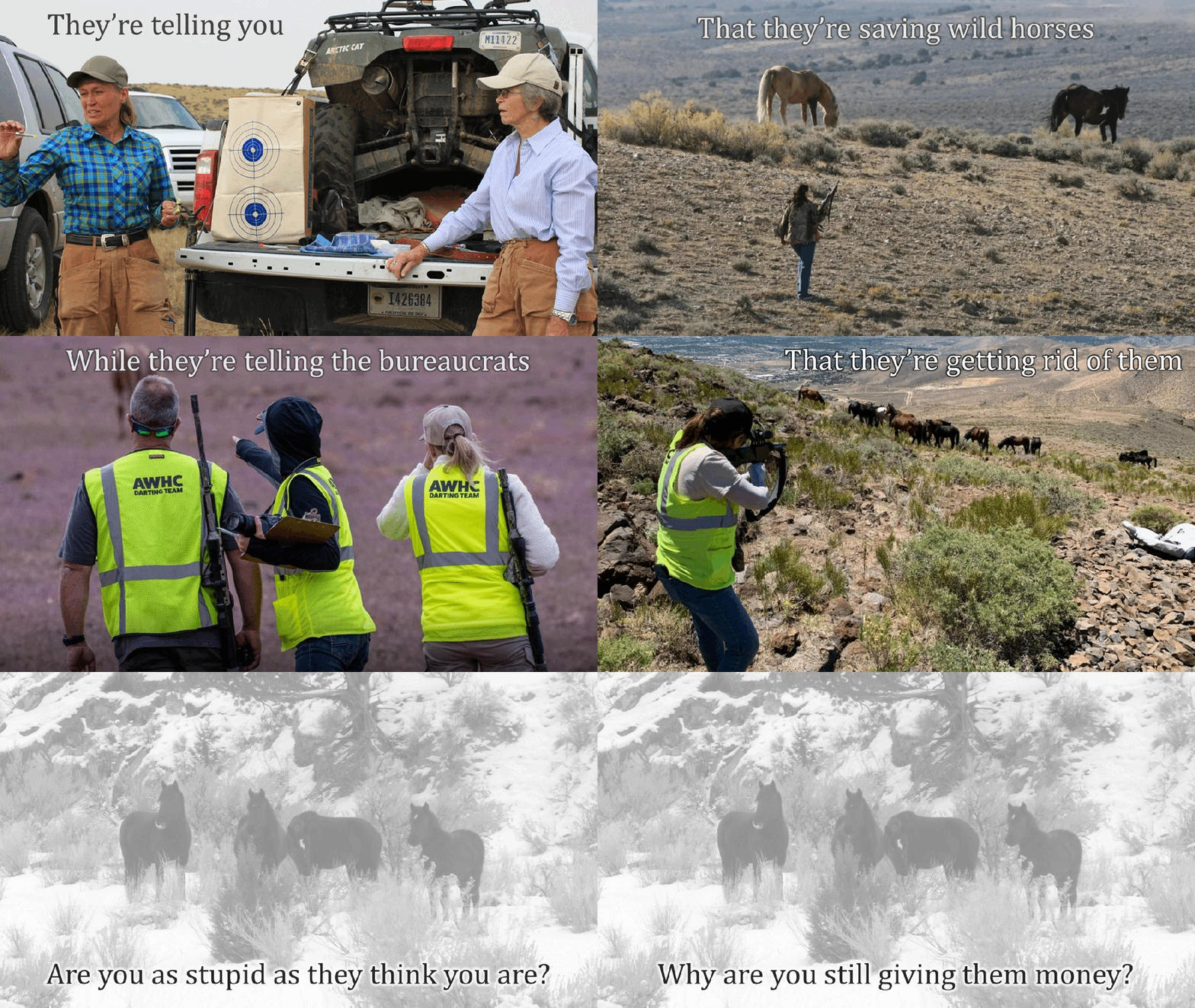
The Three R’s of HMAPs

1. Review the planning and decision documents that determine how the HMA is managed.

2. Ratify those provisions by copying them into the HMAP.  If the RMP assigns 86% of the authorized forage to privately owned livestock, then so shall the HMAP.  Describe how the horse population will be controlled to achieve the resource allocations on a continuing basis.

3. Reinforce the mismanagement of the HMA by putting the new HMAP out for public review, followed by minor revisions and approval.

RELATED: HMAPs Are Not the Answer.

Thriving Ecological Balance-3

Triple B Roundup, Day 3

The incident began on July 17.  Gather stats through July 19:

  • Target: Horses
  • Type: Planned
  • Method: Helicopter
  • Category: Cruel and costly
  • Captured: 138, up from 43 on Day 1
  • Average daily take: 46.0
  • Capture goal: 1,900
  • Removal goal: 1,800
  • Returned: None, no change from Day 1
  • Deaths: 3, up from zero on Day 1
  • Shipped: 80, up from zero on Day 1

Three horses were put down on Day 3 due to pre-existing conditions, lifting the death rate to 2.2%.  They would be alive if there was no roundup.

The total includes 45 stallions, 63 mares and 30 foals.

Youngsters represented 21.7% of the animals captured.  Of the adults, 41.7% were male and 58.3% were female.

Body condition scores were not given.

The location of the trap site was not disclosed.

The Complex and surrounding lands are subject to permitted grazing.

Triple B Complex Map 07-11-22

Day 3 ended with 55 unaccounted-for animals.

Mares treated with fertility control may be returned to the area at a later date.

Other statistics:

  • Horses allowed by plan (AML): 821
  • Forage assigned to horses: 9,852 AUMs per year
  • Pre-gather population: 3,475
  • Forage liberated to date: 1,656 AUMs per year
  • Water liberated to date: 1,380 gallons per day
  • Forage assigned to livestock: 49,188 AUMs per year (estimated)
  • Horses displaced from Complex by permitted grazing: 4,099
  • True AML: 4,911
  • Stocking rate at new AML: 3.0 horses per thousand acres
  • Horses displaced from Complex by drilling and mining: Ask the advocates

RELATED: Triple B Roundup in Progress.

Piceance Roundup, Part 2 Day 5

The incident began on July 15.  Gather stats through July 19:

  • Target: Horses
  • Type: Planned
  • Method: Helicopter
  • Category: Cruel and costly
  • Captured: 392, up from 292 on Day 3
  • Average daily take: 78.4
  • Capture goal: 1,050
  • Removal goal: 750
  • Returned: None, no change from Day 3
  • Deaths: 2, no change from Day 3
  • Shipped: 295, up from 172 on Day 3

The death rate declined from 0.7% on Day 3 to 0.5% on Day 5.

The total, based on the daily reports, includes 143 stallions, 176 mares and 73 foals.

Youngsters represented 18.6% of the animals captured.  Of the adults, 44.8% were male and 55.2% were female.

Body condition scores were not given.

The location of the trap site was not disclosed.

The HMA and surrounding lands are subject to permitted grazing.

Piceance HMA Map 07-17-22

Day 5 ended with 95 unaccounted-for animals.

Mares treated with fertility control may be returned to the area at a later date.

Other statistics:

  • Horses allowed by plan (AML): 235
  • Forage assigned to horses: 2,820 AUMs per year
  • Pre-gather population: 1,385
  • Forage liberated to date: 4,704 AUMs per year
  • Water liberated to date: 3,920 gallons per day
  • Forage assigned to livestock: 6,840 AUMs per year (estimated)
  • Horses displaced from HMA by permitted grazing: 570
  • True AML: 805
  • Stocking rate at new AML: 4.2 horses per thousand acres
  • Horses displaced from HMA by drilling and mining: Ask the advocates

RELATED: Piceance Roundup, Part 2 Day 3.

Twin Peaks Roundup Announced

The incident will begin on July 23, according to the BLM news release, with a capture goal of 2,000 wild horses and 339 wild burros.  The removal goal is 1,800 and 339.

Up to 110 mares with be treated with fertility control and returned to the HMA.

Helicopters will push the animals into the traps and operations will be open to public observation.

The HMA covers 758,128 acres on the California-Nevada border and is managed for horses and burros.  The AMLs are 758 and 116, respectively.

The combined AML expressed in horses only would be 817 and the stocking rate allowed by plan would be 1.1 wild horses per thousand acres.

The current population, thought to be approximately 3,300 horses and 400 burros, is equivalent to 3,500 horses.Twin Peaks HMA Map 07-19-22

The HMA is subject to permitted grazing and livestock receive and estimated 27,178 AUMs per year, 2.8 times more than the horses and burros.

Captured animals will be taken to the off-range corrals in Litchfield, CA, Palomino Valley, NV and Bruneau, ID.

A link to gather stats and daily reports was not provided.

The roundup appears on the latest schedule.

RTF Science Advisor Leads FREES Working Groups

Celeste Carlisle and Eric Thacker lead the Population Management Working Group.

Carlisle serves as Biologist and Science Program Manager for Return to Freedom.

Thacker, Rangeland Extension Specialist for Utah State University, explained his role in a lecture last December that was covered in this post.

Carlisle also leads the Outreach and Communication Working Group.

Collaboration with the FREES Network, a ranching advocacy group hosted by Utah State University Extension, further undermines the credibility of Return to Freedom, signatory to the ill-advised “Path Forward.”

RELATED: FREES Conference Announced.

Location of Cherry Spring WHT?

It’s in the Triple B Complex according to Table 2 of the 2017 Final EA for resource enforcement actions therein, but it’s not included in the 2022 Triple B roundup.

The Western Watersheds map puts it at the northwest corner of the Triple B HMA.

Cherry Spring WHT Map 07-18-22

The WHT has an AML of 58 according to the Forest Service but Table 2 says 68.

The map indicates that it’s overlapped by three allotments and is probably subject to permitted grazing.

The EA was posted with other project documents in ePlanning.

RELATED: Triple B Roundup in Progress.

House to Consider Spending Bills This Week?

Refer to this news release dated July 11.

They’d have to cure themselves of Trump derangement syndrome and put their January 6 show trial on the back burner.

The Wild Horse and Burro program would receive $156 million in FY 2023, according to the summary for Interior, Environment and Related Agencies, including $11 million for research on reversible immunocontraceptive fertility control and its administration.

VR Darting Injury 09-15-21

How much of the funding will actually go to research, including the long-term effects of the Montana Solution?

Piceance Roundup, Part 2 Day 3

The incident began on July 15.  Gather stats through July 17:

  • Target: Horses
  • Type: Planned
  • Method: Helicopter
  • Category: Cruel and costly
  • Captured: 292, up from 159 on Day 1
  • Average daily take: 97.3
  • Capture goal: 1,050
  • Removal goal: 750
  • Returned: None, no change from Day 1
  • Deaths: 2, up from zero on Day 1
  • Shipped: 172, up from zero on Day 1

Horses were put down on Days 2 and 3, presumably, due to pre-existing conditions but no details were given.  The death rate is 0.7%.

The total includes 106 stallions, 132 mares and 54 foals.

Youngsters represented 18.5% of the animals captured.  Of the adults, 44.5% were male and 55.5% were female.

Body condition scores were not given.

The location of the trap site was not disclosed.

The HMA and surrounding lands are subject to permitted grazing.

Piceance HMA Map 07-17-22

Day 3 ended with 118 unaccounted-for animals.

Mares treated with fertility control may be returned to the area at a later date.

Other statistics:

  • AML: 235
  • Forage assigned to horses: 2,820 AUMs per year
  • Pre-gather population: 1,385
  • Forage liberated to date: 3,504 AUMs per year
  • Water liberated to date: 2,920 gallons per day
  • Forage assigned to livestock: 6,840 AUMs per year (estimated)
  • Horses displaced from HMA by permitted grazing: 570
  • True AML: 805
  • Stocking rate at new AML: 4.2 horses per thousand acres
  • Horses displaced from HMA by drilling and mining: Ask the advocates

RELATED: Helicopters Take to the Skies at Piceance HMA.

Local People Working with the BLM (to Get Rid of Wild Horses)

The Pine Nut advocates did some unplanned bait trapping to remove a small tire caught on a mare’s leg, as explained in the July edition of Horse Tales by the real estate agent and PZP darter in the Minden/Gardnerville area.

The account begins on on page 16 and continues on page 19.

The listings are on page 24.

The incident could have been avoided by a more aggressive darting program that would take more horses off the range, leaving more food and water for the permittees (who are never mentioned in these stories).

APN 1322-00-002-041, a 161.8 acre parcel, has been marketed with an image of the animals she’s trying to eradicate.

Same for APN 1322-00-002-050, 80 acres.  No youngsters allowed.

APN 1322-00-002-050 07-17-22

As stated previously, the advocates have no scruples.

Support for the Pine Nut darting program comes in part from the Campaign Against America’s Wild Horses.

RELATED: Foal-Free Friday, No Major Side Effects Edition.

WHB Refresher

As the second half of the FY 2022 gather season ramps up, here are two provisions from the current statute to keep in mind as the action unfolds.

§1331. Wild free-roaming horses and burros shall be protected from capture, branding, harassment, or death; and to accomplish this they are to be considered in the area where presently found, as an integral part of the natural system of the public lands

§1332. “Range” means the amount of land necessary to sustain an existing herd or herds of wild free-roaming horses and burros, which does not exceed their known territorial limits, and which is devoted principally but not necessarily exclusively to their welfare in keeping with the multiple-use management concept for the public lands

The undefined concept of Appropriate Management Levels was not in the original statute, nor were there any provisions for privately owned livestock, yet today the land that remains is managed primarily for livestock and AMLs correspond to a tiny fraction of the available resources.

BLM3

What you are seeing on the range could be described as lawlessness, yet the advocates are consumed with HMAPs, drilling and mining, and the Montana Solution.

Foals and Pregnant Mares Should Not Be Chased by Helicopters?

So says Scott Wilson, who sits on the Board of the Campaign Against America’s Wild Horses, in a story about the Piceance roundup by The Colorado Sun.

What he didn’t say is that his group, a purveyor of the Montana Solution and a leader in the wild horse removal business, believes there shouldn’t be any foals or pregnant mares for helicopters to chase.

He’s in good company.  Most of the advocacy groups feel the same way.

RELATED: Piceance Roundup in the News.

CAAWH Field Darters 07-16-22

FREES Conference Announced

The Free Roaming Equids and Ecosystem Sustainability Network, a ranching advocacy group sponsored by the Utah State University Extension, will meet in St. George October 12-14, according to the conference home page.

Presenters have not been named and a schedule has not been posted.

The theme of this year’s summit is Community Connections.  The conference organizers probably won’t be rolling out the red carpet for those in the wild horse community.

A top-tier sponsor is the Utah Public Lands Policy Coordinating Office.

To understand their position on wild horses, read comments 5 and 6 in Appendix 12 of the Draft EA for resource enforcement actions in the Bible Springs Complex.

Contrary to what the advocates would have you believe, the event is not sponsored by drilling and mining interests and you won’t find any such comments in Appendix 12.

Information gathered at the meeting will aid the development of action plans towards the goal of “Healthy Herds on Healthy Rangelands,” code words for “most of the resources assigned to—and consumed by—privately owned livestock.”

RELATED: FREES Conference Last Week.

BLM to Remove Wild Burros from Yuma Proving Ground?

A new project has been created in ePlanning.

A Decision Memorandum was issued on July 13.

There were no opportunities for public involvement.

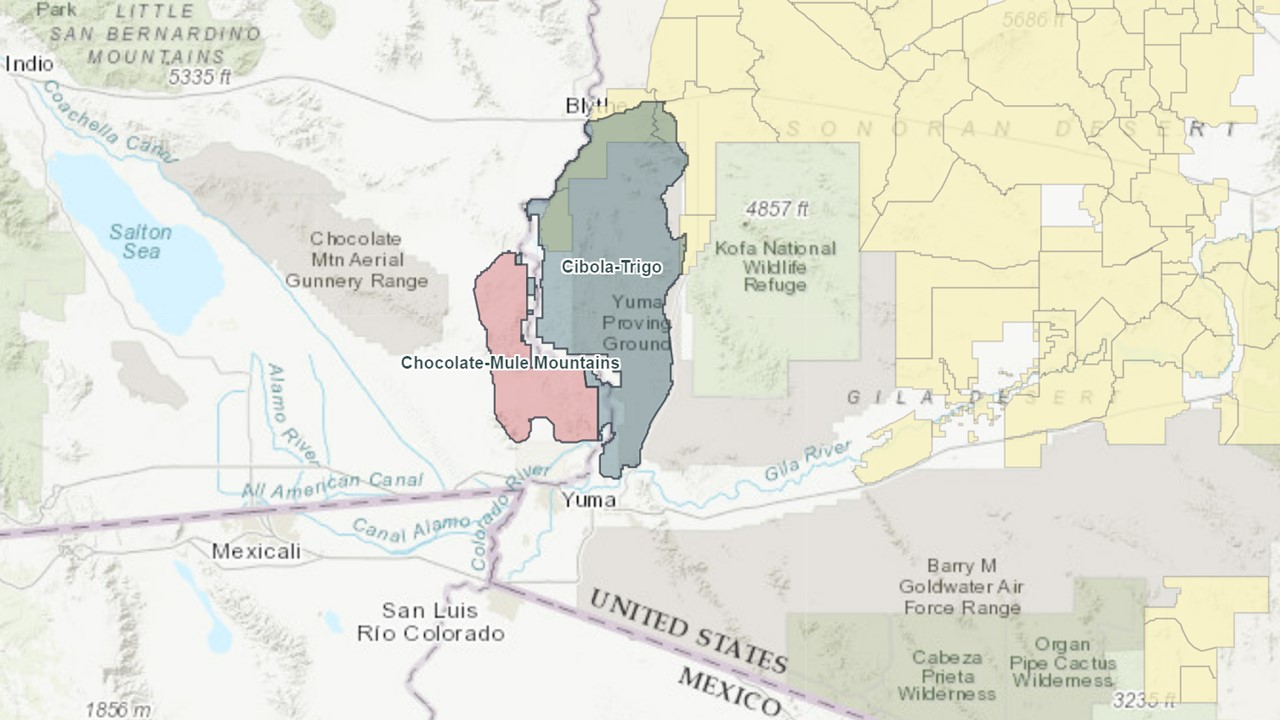
Approximately 80 animals will be removed from an area outside the Cibola-Trigo HMA but inside the Yuma Proving Ground north of Dome Valley, AZ.

The test center wraps around a wildlife refuge to the east.

The Western Watersheds map shows the arrangement.

Cibola-Trigo HMA Map 07-15-22

The incident will be carried out with bait traps and will probably not be open to public observation.

An announcement was not found at the BLM news site.

The roundup appears on the latest schedule with a start date of July 26.

The HMA is managed for horses and burros.