Vanadium Mine Coming to Fish Creek HMA?

The Draft EIS and other supporting documents have been posted for public review, according to a BLM news release dated July 22.

Under the Proposed Action, the project area would cover 6,456 public acres, on which 806 acres of surface disturbance would occur.  No state or private lands are included.

The project life consists of 1.5 years of construction, seven years of operation, four years of active reclamation and closure, and up to 30 years of post-closure monitoring.

The 85-acre open pit would not be reclaimed.

The project area straddles the eastern boundary of the Fish Creek HMA, with roads coming in from the east.

Gibellini Vanadium Mine Map 07-25-22

Impacts to wild horses are discussed in Supplemental Environmental Report 17.

Under the Proposed Action, fencing would temporarily exclude 806 acres of surface disturbance plus an additional 413 acres of undisturbed lands.

The 85 acres in the open pit would be permanently lost, a question for the comment period.  Reclaimed coal mines provide habitat for free-roaming horses in Kentucky.

The effects on wild horses from water management activities are expected to be negligible, short term and localized.

The project area lies within the Fish Creek Ranch Allotment.

Gibellini Vanadium Mine Allotment Map 07-25-22

Impacts to livestock are discussed in Supplemental Environmental Report 5.

Under the Proposed Action, 15.1 AUMs per year would be temporarily lost, with 1.4 AUMs per year permanently lost due to the open pit.

The temporary loss would equate to three cow/calf pairs on a five-month grazing season, consistent with the claim that impacts to livestock are anticipated to be minor, short term, and localized.

You could argue that resources taken from the horses were lost a long time ago, when they were assigned to the permittees.

Vanadium is used as an alloying element in steel, among other things.

Comments will be accepted through September 6.

An online public meeting will be held August 6 on Zoom from 2:00 PM to 3:00 PM Pacific Time.

The project will be pursued by Nevada Vanadium Mining Corporation.  Refer to this news release for more information.

Piceance Roundup, Part 2 Day 9

The incident began on July 15.  Gather stats through July 23:

  • Target: Horses
  • Type: Planned
  • Method: Helicopter
  • Category: Cruel and costly
  • Captured: 616, up from 494 on Day 7
  • Average daily take: 68.4
  • Capture goal: 1,050
  • Removal goal: 750
  • Returned: None, no change from Day 7
  • Deaths: 2, no change from Day 7
  • Shipped: 444, up from 364 on Day 7

The death rate is 0.3%.

The total, based on the daily reports, includes 230 stallions, 276 mares and 110 foals.

The eighteen horses taken off the range in Part 1 have been omitted.

Youngsters represented 17.9% of the animals captured.  Of the adults, 45.5% were male and 54.5% were female.

The herd can’t be growing at a rate of 20% per year with a birth rate of 18% per year.

Thirteen percent would be a better estimate based on a death rate of 5% per year.

Body condition scores were not given.

The location of the trap site was not disclosed.

The HMA and surrounding lands are subject to permitted grazing.

Piceance HMA Map 07-17-22

Day 9 ended with 170 unaccounted-for animals.

Mares treated with fertility control may be returned to the area at a later date.

Other statistics:

  • Horses allowed by plan (AML): 235
  • Forage assigned to horses: 2,820 AUMs per year
  • Pre-gather population: 1,385
  • Forage liberated to date: 7,392 AUMs per year
  • Water liberated to date: 6,160 gallons per day
  • Forage assigned to livestock: 6,840 AUMs per year (estimated)
  • Horses displaced from HMA by permitted grazing: 570
  • True AML: 805
  • Stocking rate at new AML: 4.2 horses per thousand acres
  • Horses displaced from HMA by drilling and mining: Ask the advocates

RELATED: Piceance Roundup, Part 2 Day 7.

Twin Peaks Roundup in Progress

The incident started yesterday, as scheduled, with 231 horses captured, 104 shipped and two dead.

The Day 1 report at the gather page said that 11 members of the public observed the action, including a TV production crew working on “Human Footprint, the Film,” to be aired on PBS, a reporter from KUNR public radio in Reno and a freelance filmmaker and videographer.

RELATED: Twin Peaks Roundup Explained.

Utah to Intervene in FOA v. BLM

The case was filed in 2018 by Friends of Animals and the complaint is now in its third iteration.

Last year the court denied a request by FOA to halt the Onaqui Mountain roundup.

In the latest amendment, FOA seeks an order prohibiting future Onaqui roundups and a return of the horses to the HMA.

The Utah Attorney General’s Office issued a statement last week indicating that the court had granted its motion to intervene in the case, in opposition to FOA.

Refer to Section II, Course of Proceedings, in the State’s motion for a case history.

The next step will be a hearing for summary judgment according to the announcement.

The State says it’s motivated by an interest in wildlife, not permitted grazing.

BLM to Remove Piute Mountain Burros from Fenner Spring?

A new project has been created in ePlanning but no documents have been posted.

The project map puts the job site west of the Piute Mountain HA and southwest of Fenner, CA.

The HA does not appear on the Western Watersheds map but it’s mostly inside the Lazy Daisy Allotment.

The management status is Improve according to the Allotment Master Report.

Allotments in the Improve Category exhibit vegetative and watershed conditions that don’t meet objectives and standards for rangeland health.

Piute Mountain HA Map 07-24-22

The allotment offers 3,192 active AUMs on 284,533 public acres, with forage availability coming in at a paltry 11.2 AUMs per year per thousand acres—not quite enough to support a stocking rate of two wild burros (or one wild horse) per thousand acres.

The government will collect $4,309 per year from the permittee in grazing fees while it spends $485,450 per year to care for the 266 wild horses (or 532 wild burros) that the allotment would support.

The HA has an AML of zero and is no longer managed for wild burros.

A roundup occurred in the area four years ago.

Triple B Roundup, Day 7

The incident began on July 17.  Gather stats through July 23:

  • Target: Horses
  • Type: Planned
  • Method: Helicopter
  • Category: Cruel and costly
  • Captured: 285, up from 248 on Day 5
  • Average daily take: 40.7
  • Capture goal: 1,900
  • Removal goal: 1,800
  • Returned: None, no change from Day 5
  • Deaths: 6, up from 4 on Day 5
  • Shipped: 246, up from 159 on Day 5

Helicopters did not fly on Day 7.

Two foals were put down on Day 6 due to pre-existing conditions, lifting the death rate to 2.1%.

The total includes 92 stallions, 138 mares and 55 foals.

Youngsters represented 19.3% of the animals captured.  Of the adults, 40.0% were male and 60.0% were female.

The herd can’t be growing at a rate of 20% per year with a birth rate of 19% per year.

Abnormal sex ratios are often found in herds subject to the Montana Solution but not double-digit birth rates.

Body condition scores were not given.

The location of the trap site was not disclosed.

The Complex and surrounding lands are subject to permitted grazing.

Triple B Complex Map 07-11-22

Day 7 ended with 33 unaccounted-for animals.

Mares treated with fertility control may be returned to the area at a later date.

Other statistics:

  • Horses allowed by plan (AML): 821
  • Forage assigned to horses: 9,852 AUMs per year
  • Pre-gather population: 3,475
  • Forage liberated to date: 3,420 AUMs per year
  • Water liberated to date: 2,850 gallons per day
  • Forage assigned to livestock: 49,188 AUMs per year (estimated)
  • Horses displaced from Complex by permitted grazing: 4,099
  • True AML: 4,911
  • Stocking rate at new AML: 3.0 horses per thousand acres
  • Horses displaced from Complex by drilling and mining: Ask the advocates

RELATED: Triple B Roundup, Day 5.

Congressman Tries to Defund Helicopter Roundups

The move was applauded by the Campaign Against America’s Wild Horses, according to a story posted yesterday by Fox21 News of Colorado Springs, a group that views the contractors as competitors in the wild horse removal business.

In their quest to become the industry leader, legislative action that knocks the pilots and wranglers out of contention would be most welcome.

The article did not indicate if the amendment would ban the use of helicopters and fixed-wing aircraft for catch-treat-release, which the advocates support.

RELATED: Move Over Cattoor, Advocates Want Larger Share of Market.

Advocates Issue Bizarre News Release About Water, HMAPs

They claim that wild horses in Nevada are threatened by drilling and mining, and the loss of water associated therewith, according to a bulletin picked up by AP News.

Are they suggesting that those companies are draining ponds and creeks to supply their operations?  Or maybe they’re tapping into underground sources that will somehow deplete surface water needed by wildlife and the horses?

Sounds like rape and pillage.  How did that get through the NEPA process?

Where are the environmental impact statements and findings of no significant impacts that authorized the destruction?

As for the HMAPs, they must comply with land-use plans, as noted earlier this week.

If the plans allow water to be used for drilling and mining in HMAs, then so will the HMAPs.

If the plans assign most of the authorized forage to privately owned livestock, then so will the HMAPs.

If you disagree with that, the problem is not HMAPs or the absence thereof.

The problem is in the planning and decision documents that determine how the HMAs are managed.

The advocates don’t want you thinking about them because changes would actually help the horses and they prosper under the status quo.

Drilling and mining require anywhere from a few acres to a few thousand acres while pubic-lands ranching devours entire HMAs and beyond.  There’s no comparison.

RELATED: The Three R’s of HMAPs.

ISPMB Complaint Involves ASNF ‘Jumping Mouse’ Horses

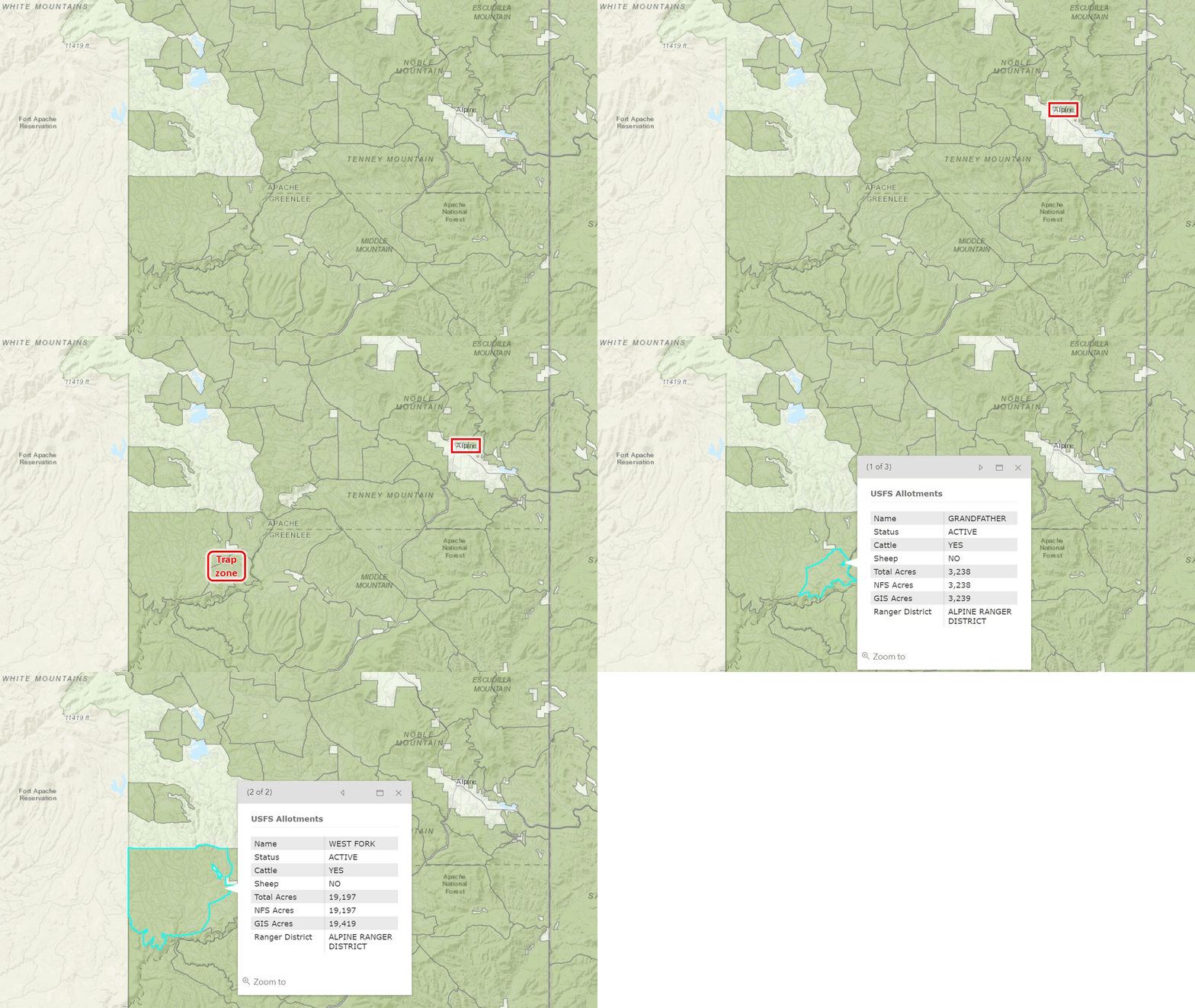
A report posted yesterday by Courthouse News Service confirms that horses removed from the Apache Sitgreaves National Forests earlier this year in a law enforcement action are the subject of the case.

The Forest Service stated they were unauthorized livestock, not unclaimed/unbranded horses entitled to protection by the WHB Act, which ISPMB disputes.

The roundup occurred in an area southwest of Alpine, AZ designated as critical habitat for the New Mexico Jumping Mouse but overlapped by grazing allotments.

ASNF Jumping Mouse Allotments 03-24-22

Curiously, in other such areas, the agency allows permitted grazing not just in close proximity to the habitats but in the habitats.

The judge said he would take the matter under advisement and rule in due course.

RELATED: ISPMB Complaint Explained.

Twin Peaks Roundup Explained

Refer to this fact sheet, posted at the gather page.

“This population management effort is required under the federal Wild Free-Roaming Horses and Burros Act because the population of wild horses and burros has exceeded the populations established in the BLM’s land use plan for the area.”  There are more horses and burros in the HMA than allowed by plan.

“The goal of the Act is to preserve and protect wild horses and burros as integral parts of a thriving ecological system in balance with other public resource values, including wildlife, livestock grazing, resource development, and recreational access.  This requires controlling populations.”  The horses and burros are consuming resources assigned to privately owned livestock.

“The BLM’s overall goal is managing healthy wild horse herds on healthy rangelands in balance with other authorized uses.”  You can have your wild horse and burro program as long as it doesn’t interfere with the grazing program.

The incident is set to begin on July 23.

RELATED: Twin Peaks Roundup Announced.

Thriving Ecological Balance-3

Black Mountain Aftermath

A writer with Outdoor Life hit the trail with one of the permittees to bring you this report about conditions on the ground now that the burros are gone.

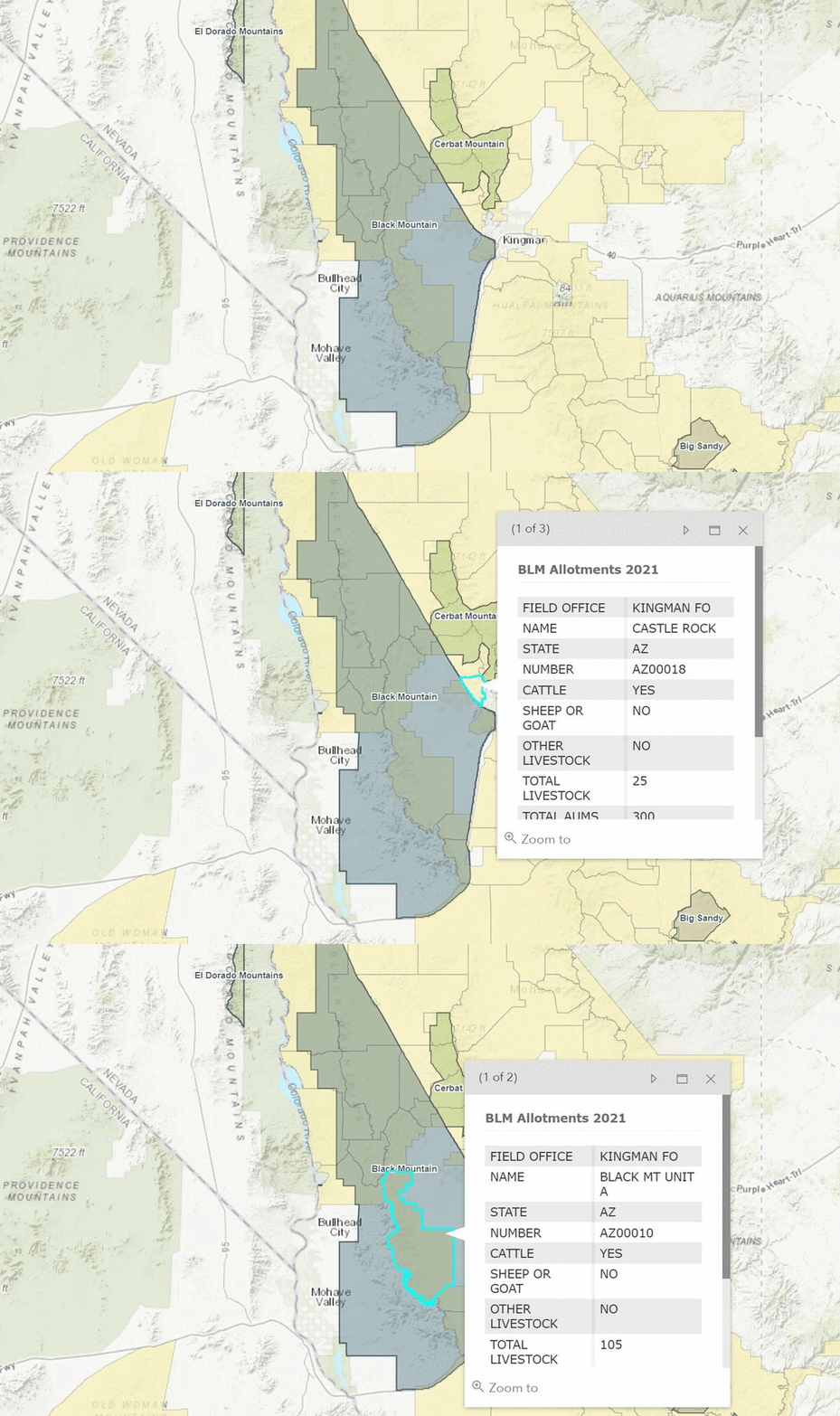
The HMA covers about 1.1 million acres in western Arizona and has an AML of 478.

A roundup in May took almost 1,100 animals off their home range.

The Operator Information Report in RAS ties the rancher to two grazing authorizations, 0202009 and 0202017.

The Allotment Information Report associates the authorizations with the Black Mt Unit A and Castle Rock allotments.

The Western Watersheds map puts Black Mt Unit A inside the HMA and Castle Rock on the eastern flank.  Click on image to open in new tab.

Black Mountain Aftermath 07-22-22

The permittee holds all of the active AUMs according to the Allotment Master Report.

The Authorization Use Report indicates he’s grazing year around, like the burros.

Black Mt Unit A is in the Maintain category while Castle Rock is in Improve.

Allotments in the Improve Category exhibit vegetative and watershed conditions that don’t meet objectives and standards for rangeland health.

Allotments in the Maintain Category comply with those standards.

Unit A likely achieved this status before the burros were removed.

The 1,247 AUMs per year sold to the permittee would support 207 wild burros.

If the rancher was confined to his base property and expected to pay the going rate to feed his animals, taxpayers would not have to pick up the tab for 207 wild burros.

As for the PZP jennies, the advocates at HSUS, signatories to the rancher-friendly “Path Forward,” will probably want the experiment to continue so most of the resources in an area set aside for wild burros can be consumed by privately owned livestock.

Good work, guys.

RELATED: Black Mountain Roundup Over.

Advocates Dispute Rationale for Piceance Roundup

The evidence does not support the BLM’s claims, according to a report posted yesterday by Aspen Public Radio.

If you’re taking wild horses off the range while leaving the cattle alone, or allowing more livestock back on the land after the horses are gone, the issue was resource enforcement, not rangeland health.

RELATED: Piceance Assessment Finds Ample Forage for Wild Horses?

Foal-Free Friday, Who Said We’re Trying to Preserve Them Edition

Mares with normal immune function respond to the Montana Solution, so the trait is not passed on to future generations.

Mares with depressed immune function do not respond to the treatments and can pass that trait to their offspring.

Thus, PZP selects for horses with low immune function, which can be destructive to the herds in the long run.

A routine infection could wipe out a population compromised by the advocates.

If the goal is preservation, the use of PZP constitutes a worst management practice.

RELATED: Foal-Free Friday, Putting Them Out of Their Misery Edition.

Triple B Roundup, Day 5

The incident began on July 17.  Gather stats through July 21:

  • Target: Horses
  • Type: Planned
  • Method: Helicopter
  • Category: Cruel and costly
  • Captured: 248, up from 138 on Day 3
  • Average daily take: 49.6
  • Capture goal: 1,900
  • Removal goal: 1,800
  • Returned: None, no change from Day 3
  • Deaths: 4, up from 3 on Day 3
  • Shipped: 159, up from 80 on Day 3

A filly died on Day 4 due to pneumonia.  The death rate is 1.6%.

The total includes 77 stallions, 124 mares and 47 foals.

Youngsters represented 19.0% of the animals captured.  Of the adults, 38.3% were male and 61.7% were female.

The herd can’t be growing at a rate of 20% per year with a birth rate of 19% per year.

If the death rate is 5% per year, 14% would be a better estimate.

The sex ratio is abnormal, a pattern seen in herds subject to the Montana Solution.

Body condition scores were not given.

The location of the trap site was not disclosed.

The Complex and surrounding lands are subject to permitted grazing.

Triple B Complex Map 07-11-22

Day 5 ended with 85 unaccounted-for animals.

Mares treated with fertility control may be returned to the area at a later date.

Other statistics:

  • Horses allowed by plan (AML): 821
  • Forage assigned to horses: 9,852 AUMs per year
  • Pre-gather population: 3,475
  • Forage liberated to date: 2,976 AUMs per year
  • Water liberated to date: 2,480 gallons per day
  • Forage assigned to livestock: 49,188 AUMs per year (estimated)
  • Horses displaced from Complex by permitted grazing: 4,099
  • True AML: 4,911
  • Stocking rate at new AML: 3.0 horses per thousand acres
  • Horses displaced from Complex by drilling and mining: Ask the advocates

RELATED: Triple B Roundup, Day 3.

Piceance Roundup, Part 2 Day 7

The incident began on July 15.  Gather stats through July 21:

  • Target: Horses
  • Type: Planned
  • Method: Helicopter
  • Category: Cruel and costly
  • Captured: 494, up from 392 on Day 5
  • Average daily take: 70.6
  • Capture goal: 1,050
  • Removal goal: 750
  • Returned: None, no change from Day 5
  • Deaths: 2, no change from Day 5
  • Shipped: 364, up from 295 on Day 5

The death rate is 0.4%.

The total, based on the daily reports, includes 184 stallions, 218 mares and 92 foals.

The 18 horses taken in Part 1 were omitted.

Youngsters represented 18.6% of the animals captured.  Of the adults, 45.8% were male and 54.2% were female.

The herd can’t be growing at a rate of 20% per year with a birth rate of 19% per year.

If the death rate is 5% per year, 14% per year would be a better estimate.

Body condition scores were not given.

The location of the trap site was not disclosed.

The HMA and surrounding lands are subject to permitted grazing.

Piceance HMA Map 07-17-22

Day 7 ended with 128 unaccounted-for animals.

Mares treated with fertility control may be returned to the area at a later date.

Other statistics:

  • Horses allowed by plan (AML): 235
  • Forage assigned to horses: 2,820 AUMs per year
  • Pre-gather population: 1,385
  • Forage liberated to date: 5,928 AUMs per year
  • Water liberated to date: 4,940 gallons per day
  • Forage assigned to livestock: 6,840 AUMs per year (estimated)
  • Horses displaced from HMA by permitted grazing: 570
  • True AML: 805
  • Stocking rate at new AML: 4.2 horses per thousand acres
  • Horses displaced from HMA by drilling and mining: Ask the advocates

RELATED: Piceance Roundup, Part 2 Day 5.

Pew Looks at New Mexico Plan to Manage Wild Horses

The wild horse alarmists get top billing in an article published yesterday by The Pew Charitable Trusts.  Rome is burning, wild horse populations are ballooning and fertility controls are needed.

Terms not found in the story:

  • Allotment
  • Cattle
  • Permit
  • Forage
  • Allocation

Lands that carried around two million wild horses a hundred years ago can only support a tiny fraction today.  What changed?

RELATED: New Mexico to Manage Wild Horses at Local Level?

HMAPs Must Comply with RMPs

From Section 2.5.2 in H-4700-1, Wild Horses and Burros Management Handbook:

HMAPs tier to and must be in conformance with the applicable LUP.  If the proposed management strategy is not consistent with the LUP, then the LUP should be amended, or the proposal should be modified or rejected.

If the land-use plan assigns 86% of the authorized forage to privately owned livestock, do you think you can write a new HMAP that allocates 98% of the resource to wild horses, with 2% to wildlife, and put it into practice?

Pay no attention to the advocates, they are full of crap.

The problem is in the planning and decision documents that determine how HMAs are managed, as well as the statutes and regulations that precede them.

RELATED: The Three R’s of HMAPs.

Draft EA for Fertility Control Research Out for Review

The scoping period began last November, sort of, with a solicitation for research proposals on fertility control and climate change involving wild horses and burros.

A driver of the research is the desire to reduce the number of animals that must be gathered and removed from the range, according to Section 1.2 of the EA, which is misleading.

The goal is to identify new ways of taking them off the range, given historical and current logistical constraints and funding levels that limit removals with traditional methods.

The Proposed Action includes an Oocyte Growth Factor vaccine study, a SpayVac study and an IUD study, as explained in Section 2.2.2.

The EA was posted with other project documents.

Comments will be accepted through August 22.

You can have your wild horse and burro program as long as it doesn’t interfere with the grazing program.

RELATED: Wild Horse and Burro Research Initiative Announced.

Pancake Gather Plan