Piceance Gather Page Found!

Maybe they just created it.

Traps were built and put in service last month.

Horses were caught on June 28 and 29 but none since.

All were shipped on June 30.

The total includes eight stallions, seven mares and three foals.

Youngsters represented 16.7% of the horses captured.  Of the adults, 53.3% were males and 46.7% were females.

Body condition scores were not given.

No deaths were reported.

The number of unaccounted-for animals is zero.

RELATED: Piceance Bait Traps Fall Short.

ISPMB Complaint Explained

Refer to this brief dated July 7 by Law Street Media.

The complaint alleges violations of the National Environmental Policy Act, Wild Free-Roaming Horses and Burros Act and Administrative Procedures Act by the Forest Service regarding horses in the Apache National Forest.

Exhibits referenced in the complaint were not provided.

Plaintiff demands trial by jury.

Defendants include Tom Vilsack, acting United States Secretary of Agriculture, and Judy Palmer, acting U.S. Forest Supervisor.

RELATED: ISPMB Claims Forest Service Removing Wild Horses Illegally.

Foal-Free Friday, Exposing the Lies of the Advocates, Part 2

The advocates will tell you that the Montana Solution is safe and reversible but experience indicates otherwise.

Trailcam images from the Virginia Range show injuries.

The herd on Assateague Island (Maryland side) is struggling to recover from the darting program, which was shut off in 2016.  Last year it grew just 7.8% and this year the Park Service refused to publish the census results, breaking a long tradition of transparency.

Wherever it’s applied, we see

  • Barren mares
  • Confused stallions
  • Injuries and infections
  • Shrinking herds
  • Abnormal sex ratios
  • Disruption of natural order
  • Subordination to livestock

Death rates are probably increasing, as explained previously.

A compilation of the effects of PZP on wild horses, assembled in 2015, appears in a report prepared by ISPMB, beginning on page 30.  The research was carried out and documented by others.  The findings predate and outrun the 2016 incident at ISPMB.

  • The vaccine does not prevent disease, it causes disease
  • PZP tricks the immune system into waging war on the ovaries
  • Treatments may lead to ovarian cysts
  • Recovery of fertility at end of treatments is slow (if at all)
  • Antibodies can be transferred to offspring via placenta and mother’s milk
  • One shot can sterilize a filly if darted before puberty
  • Risk of stillbirths may go up

The protocols call for selected mares (selected by advocates) to be taken off the treatments until they produce live foals.  Why would the procedures say “live foals?”

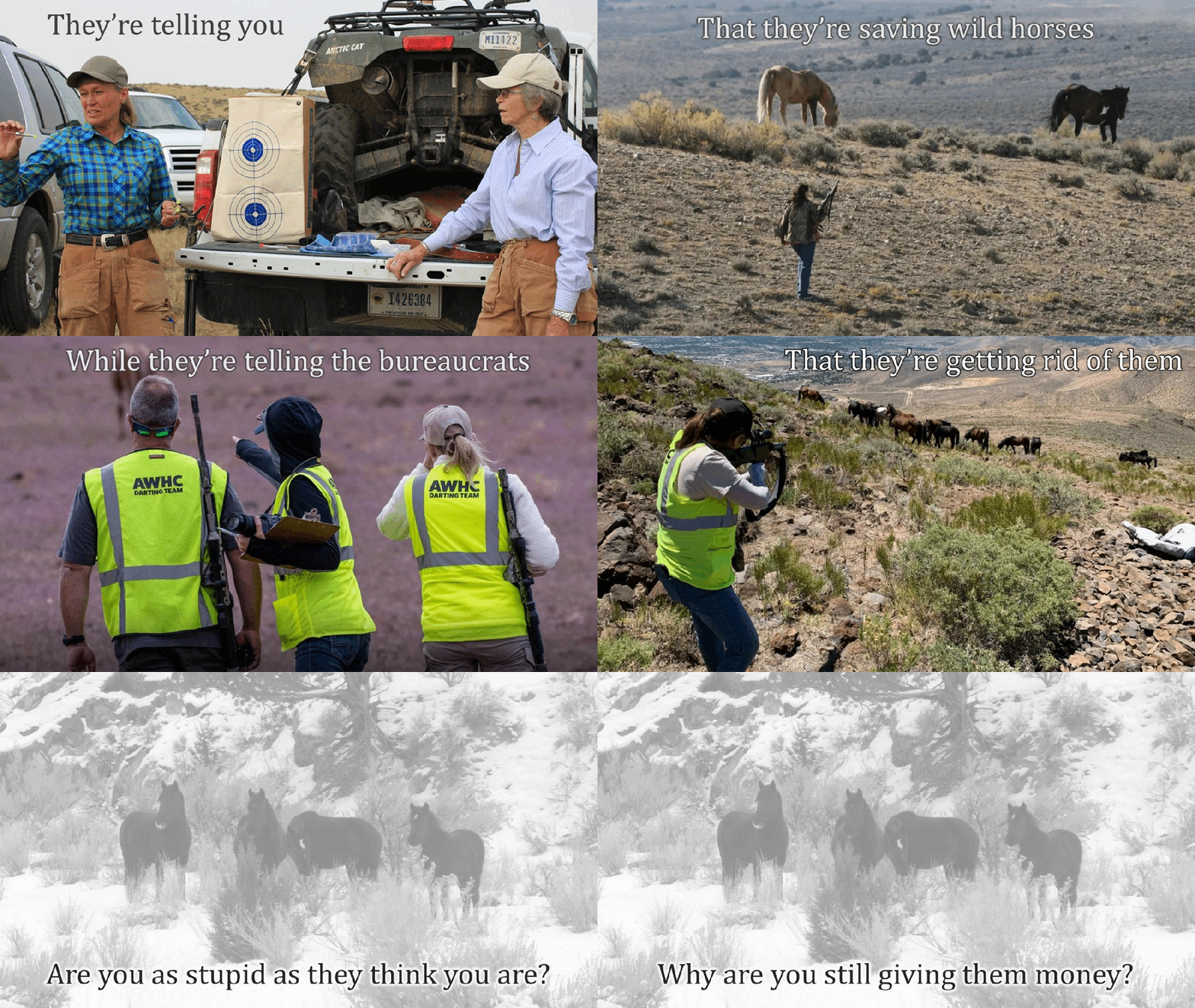
The advocates care far more about their standing with the bureaucrats and ranchers than they do about wild horses.

The following video shows their handiwork at the Salt River.  Support for the program comes from the Campaign Against America’s Wild Horses, a common denominator in many fertility control programs.

RELATED: Foal-Free Friday, Exposing the Lies of the Advocates.

Buffalo Hills Roundup Day 7

The incident began on July 1.  Gather stats through July 7:

  • Target: Horses
  • Type: Planned
  • Method: Helicopter
  • Captured: 328, up from 235 on Day 5
  • Average daily take: 46.9
  • Capture goal: 383
  • Removal goal: 353
  • Returned: 1, no change from Day 5
  • Deaths: 8, no change from Day 5
  • Shipped: 244, up from 177 on Day 5

The death rate declined from 3.4% to 2.4%.

The total, based on the daily reports, includes 118 stallions, 167 mares and 43 foals.

The total at the gather page is 318.

Youngsters represented 13.1% of the animals captured.  Of the adults, 41.4% were male and 58.6% were female.

Body condition scores were not given.

The herd can’t be growing at a rate of 20% per year with a birth rate of 13% per year.

Abnormal sex ratios are often found in herds subject to the Montana Solution.

The location of the trap site within the HMA was not disclosed.

Buffalo Hills HMA Map 06-27-22

Day 7 ended with 75 unaccounted-for animals.

Mares treated with fertility control will be returned to the area at a later date.

Operations will likely conclude by Day 9.

Other statistics:

  • AML: 314
  • Forage assigned to horses: 3,768 AUMs per year
  • Pre-gather population: 541
  • Forage liberated to date: 3,924 AUMs per year
  • Water liberated to date: 3,270 gallons per day
  • Forage assigned to livestock: 1,135 AUMs per year (estimated)
  • Horses displaced from HMA by permitted grazing: 94
  • True AML: 408
  • Stocking rate at new AML: 3.1 horses per thousand acres
  • Horses displaced from area by drilling and mining: Ask the advocates

RELATED: Buffalo Hills Roundup Day 5.

North Lander Decision Released

The Decision Record, signed on July 6, authorizes the Proposed Action, which features removal of younger animals, sex ratio skewing, sterilization of stallions and IUDs and Gonacon for mares over a ten-year period.  Refer to page 9 in the Final EA.

The DR and EA were posted with other project documents.

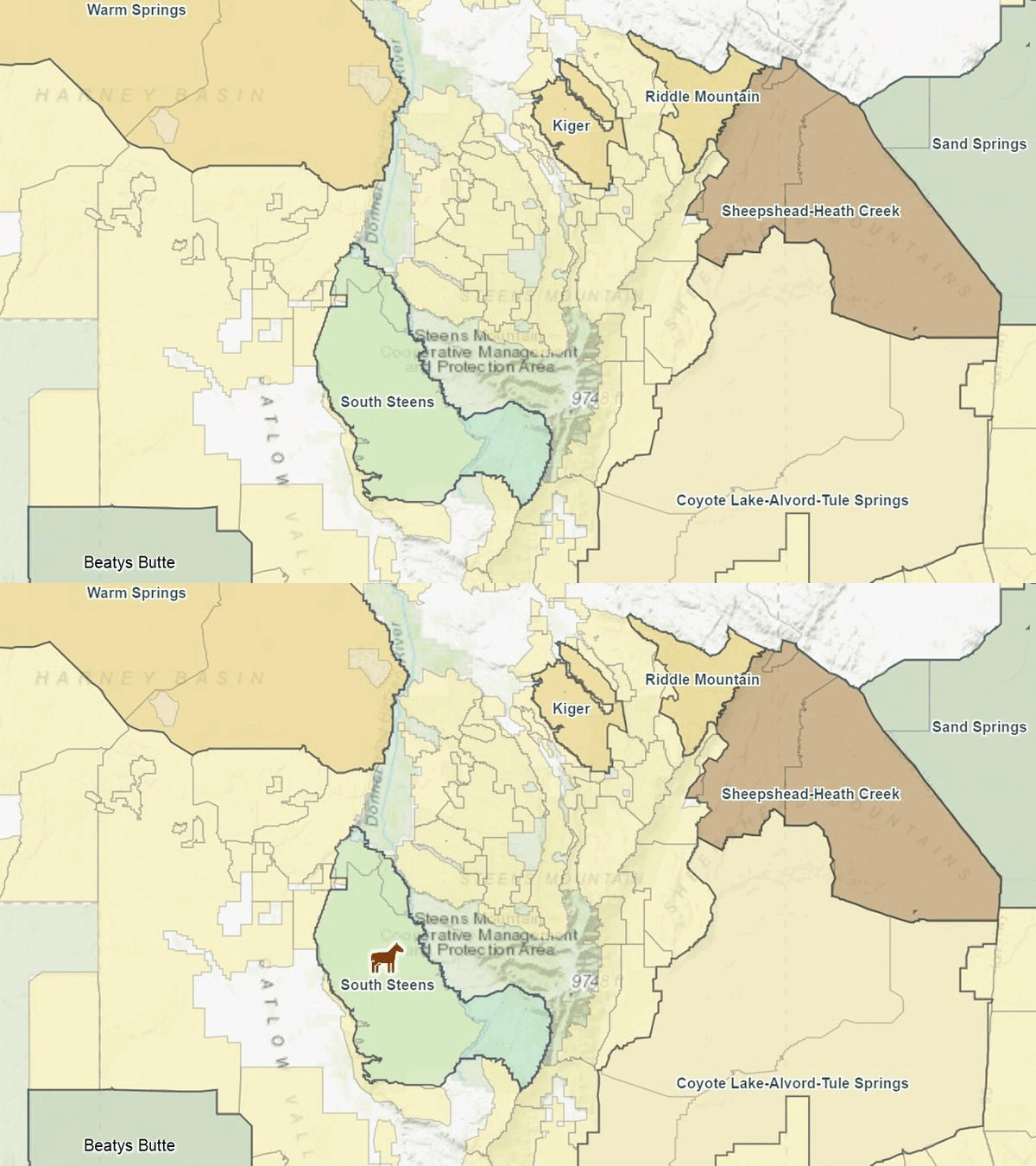
Four HMAs are affected.

North Lander Complex Map 01-21-22

The management plan assigns 7.6 times more forage to livestock than the horses and the Proposed Action will assure that the ranchers get their due.

Henceforth you may refer to it as a resource enforcement plan, pest control plan or livestock protection plan.

The BLM news release said a roundup is not on the national schedule, but one could be authorized later this year.

RELATED: Preliminary EA for North Lander Complex Out for Public Review?

Advocates Condemn Foal Abuse at Buffalo Hills Roundup

They’re outraged, according to a news release on EIN by Animal Wellness Action.

What do they prefer?  The Montana Solution.  No foals at all.

  • Injuries and infections
  • Destruction of ovaries
  • Abnormal sex ratios
  • Increased death rates
  • Shrinking herds
  • Disruption of natural order
  • Subordination to livestock

Stalking the bands with clipboards and darting rifles, injecting the mares with pesticides and shifting their food and water to the public-lands ranchers is their raison d’être.

RELATED: So Long, Helicopter Ban?

Advocates are the Predators 11-30-21

Buffalo Hills Roundup Day 5

The incident began on July 1.  Gather stats through July 5:

  • Target: Horses
  • Type: Planned
  • Method: Helicopter
  • Captured: 235, up from 156 on Day 3
  • Average daily take: 47.0
  • Capture goal: 383
  • Removal goal: 353
  • Returned: 1, up from zero on Day 3
  • Deaths: 8, up from 3 on Day 3
  • Shipped: 177, up from 72 on Day 3

Two horses were put down on Day 4 because of physical defects.  Two more were put down on Day 5 for similar reasons and one died from a fractured neck, probably from crashing into a pipe panel.

They’d be alive today if there was no roundup.

The death rate is 3.4%.

A mare was released on Day 4 but no details were given.

The cumulative total includes 87 stallions, 122 mares and 26 foals.  The cumulative total at the gather page is 225.

Youngsters represented 11.1% of the animals captured.  Of the adults, 41.6% were male and 58.4% were female.

The herd can’t be growing at a rate of 20% per year with a birth rate of 11% per year.

Abnormal sex ratios are often found in herds subject to the Montana Solution.

The location of the trap site within the HMA was not disclosed.

Buffalo Hills HMA Map 06-27-22

Day 5 ended with 49 unaccounted-for animals.

The removal goal is 66% complete.  Mares treated with fertility control will be returned to the area at a later date.

Other statistics:

  • AML: 314
  • Forage assigned to horses: 3,768 AUMs per year
  • Pre-gather population: 541
  • Forage liberated to date: 2,808 AUMs per year
  • Water liberated to date: 2,340 gallons per day
  • Forage assigned to livestock: 1,135 AUMs per year (estimated)
  • Horses displaced from HMA by permitted grazing: 94
  • True AML: 408
  • Stocking rate at new AML: 3.1 horses per thousand acres
  • Horses displaced from area by drilling and mining: Ask the advocates

RELATED: Buffalo Hills Roundup Day 3.

So Long, Helicopter Ban?

The bill was was prompted by film from the Pancake roundup showing a foal running on a broken leg and now film from the Buffalo Hills roundup showing a foal being thrown to the ground may kill it.

It was a stupid idea anyway.

The video owner said today in an interview with KLAS News of Las Vegas that imagery of a wrangler body slamming a foal will hopefully boost public support for the ban, after which the removals would be carried out by wranglers!

Are these people nuts or what?

The Advocates Have No Scruples

Consider these two scenarios for helicopter roundups of wild horses.

A. A foal was found dead on Day 1, cause unknown.  A mare was found dead on Day 2 because of a rattlesnake bite.  A stallion was put down on Day 3 due to a physical defect.

B. A foal was found dead on Day 1, cause unknown.  A mare was found dead on Day 2 because of a rattlesnake bite.  A stallion was put down on Day 3 due to a physical defect.

Which one is acceptable?

Both cases are based on the Buffalo Hills roundup.

The first one corresponds to a cruel and costly helicopter roundup that puts more horses in off-range holding.

The second one corresponds to a safe and efficient helicopter roundup that puts more horses into a catch-treat-release program.

Scenario B is better because it leads to greater use of the Montana Solution.

Next time there will be fewer horses to gather.

The Campaign Against America’s Wild Horses voiced support for catch-treat-release during the scoping period for the new Cedar Mountain pest control plan, which ran from February 4 to March 5, yet the solicitation for those services was not announced until May 10.

CAAWH Catch-Treat-Release Cedar Mountain Scoping Comments 07-05-22

Refer to comment #500236786 in Appendix G of the Draft EA.

How did they know about that?  Perhaps they were working with the bureaucrats behind the scenes to steer more business in their direction?  Equivalent to insider trading?

They seem to be more concerned about the welfare of livestock than horses.

Hard to believe, isn’t it?

RELATED: Helicopter Roundups Were Bad Before They Were Good.

Buffalo Hills Roundup Day 3

The incident began on July 1.  Gather stats through July 3:

  • Target: Horses
  • Type: Planned
  • Method: Helicopter
  • Captured: 156, up from 68 on Day 1
  • Average daily take: 52.0
  • Capture goal: 383
  • Removal goal: 353
  • Returned: None
  • Deaths: 3, up from 1 on Day 1
  • Shipped: 72, up from zero on Day 1

A foal was found dead on Day 1, cause unknown.  A mare was found dead on Day 2, rattlesnake bite.  A stallion was put down on Day 3, physical deformity.

The death rate is now 1.9%.

The cumulative total includes 51 stallions, 88 mares and 17 foals.

Youngsters represented 10.9% of the animals captured.  Of the adults, 36.7% were male and 63.3% were female.

The herd can’t be growing at a rate of 20% per year with a birth rate of 11% per year.

The abnormal sex ratio is often found in herds subject to the Montana Solution.

The location of the trap site within the HMA was not disclosed.

Buffalo Hills HMA Map 06-27-22

Day 3 ended with 81 unaccounted-for animals.

The removal goal is 44% complete.  Mares treated with fertility control will be returned to the area at a later date.

Other statistics:

  • AML: 314
  • Forage assigned to horses: 3,768 AUMs per year
  • Pre-gather population: 541
  • Forage liberated to date: 1,872 AUMs per year
  • Water liberated to date: 1,560 gallons per day
  • Forage assigned to livestock: 1,135 AUMs per year (estimated)
  • Horses displaced from HMA by permitted grazing: 94
  • True AML: 408
  • Stocking rate at new AML: 3.1 horses per thousand acres
  • Horses displaced from area by drilling and mining: Ask the advocates

RELATED: Buffalo Hills Roundup Begins.

ZD Cattle Permit Renewal Yields More Data on Forage Availability

The project, situated in the Grand Canyon-Parashant National Monument, would renew grazing permits for another ten years on the Link Spring and Last Chance allotments of northwestern Arizona.

There are no wild horses and burros on those pastures.

The Western Watersheds map shows the arrangement.

ZD Cattle Allotments 07-04-22

Table 2.1 in the Draft EA, currently out for public review, provides active AUMs and Table 3.3 provides acreage.  The Allotment Master Report provides management status.

Link Spring

  • 27,589 public acres
  • 1,094 active AUMs
  • Improve category
  • 39.7 AUMs per year per thousand acres forage production

Last Chance

  • 9,084 public acres
  • 609 active AUMs
  • Maintain category
  • 67.0 AUMs per year per thousand acre forage production

Both allotments are making progress toward meeting the Arizona BLM Standards for Rangeland Health, according to Section 1.1 of the EA, suggesting that substandard conditions exist, so how did Last Chance qualify for Maintain status?

The average forage production across both allotments is 46.4 AUMs per year per thousand acres, enough to support 3.9 wild horses per thousand acres.

The BLM has stated repeatedly, with the concurrence of the advocates, that public lands in the American west can only sustain one wild horse per thousand acres (27,000 animals on 27 million acres).

The latter figure corresponds to a shifting of resources from wild horses to privately owned livestock.

That’s what the bureaucrats, ranchers and advocates are trying to protect.

Piceance Roundup Enjoys Broad Support from Community?

As suspected, the voices in favor of the removal are those of the ranchers and advocates, as explained in a June 30 letter to the editor of the Rio Blanco Herald Times.

“The Makeover [chaired by the author, a public-lands rancher], along with the Piceance Mustangs volunteer work [the advocates], have shown the high level of community support our local White River office of the BLM have for their long awaited and much needed mustang gather.”

The writer went on camera a few weeks ago complaining about the horses and her grazing frustrations on two allotments near the HMA, identified in this map.

Piceance HMA - Macnab Allotments 06-23-22

The advocates went on record in favor of the roundup a few days later.

The letter was signed by Deirdre Macnab, Meeker Mustang Makeover, not Deirdre Macnab, 4M Ranch.

The BLM has not posted any information about the incident in the usual location, a nice example of the bureaucrats, ranchers and advocates working together for a horse-free future.

RELATED: PZP Fanatics Worried About Piceance Foals!