PZP Doesn’t Grow on Trees

A story dated January 18 by WIRED magazine explains how undercover video of gas chamber operations was obtained from a meatpacking plant in Vernon, CA.

The facility is owned by Smithfield Foods, a producer of pork controlled by the Chinese conglomerate WH Group.

The footage, showing how pigs are suffocated in an oxygen-deficient atmosphere, was copied to the interloper’s Vimeo channel.

In the following example, the animals are pushed into a cage which is lowered into the chamber where they die.  The camera was attached to the cage.

After a few minutes, the cage comes back up and they are dumped out for processing.

Is this where the folks at the Billings School of PZP Darting and Public Deception get their pig ovaries?

Who knows.

But the production process starts in plants like this.

Foal-Free Friday, Coddling the Ranchers Edition

Consider these two scenarios for wild horse removal.

A. Eliminate 150 excess horses

  • Initial population – 400
  • Final Population – 250

B. Eliminate 150 excess horses

  • Initial population – 400
  • Final Population – 250

In one case, 150 horses were removed from their lawful home and shipped to slaughter, as the Wyoming legislature desires.

In the other case, 150 horses died on the range and were not replaced because the advocates sterilized most of the mares with their safe, proven and reversible darting program.

In one case, the herd will rebound.  In the other case, the herd is toast.

Which one is which?

Which one is a win for the horses?

Both cases liberated 1,800 AUMs per year for the public-lands ranchers, enough to support 300 cow/calf pairs on a six-month grazing season.

Sadly, the premise about excess animals was false.  Both populations were well within their True AMLs.  The actions were carried out to help the ranchers.

Unabashed and undeterred, the advocates want this for all wild horse herds.

Why are you still giving them money?

RELATED: Foal-Free Friday, Getting Rid of Them Inconspicuously Edition.

Sand Wash Advocates 01-17-22

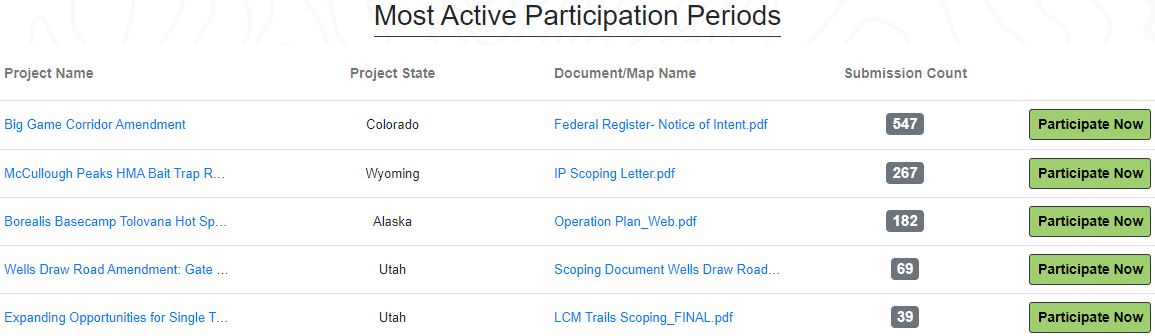
McCullough Peaks Now #2 in Top 5 (Most Active) on ePlanning

The rankings change minute by minute but here’s a screen image as of this morning.

McCullough Peaks Second Place in ePlanning 01-19-23

Comments must comply with land-use plans.  If livestock receive four times more forage than the horses and you request a reduction in grazing activity, your comment will be dismissed out of hand.

“Such changes cannot be accomplished through a wild horse gather decision.”

If you express support for the project, which will keep the pests in check so ranchers can access most of their food, the response will likely be “Thank you for your comment.”

RELATED: McCullough Peaks Takes Third Place in ePlanning Top 5.

TRNP Superintendent Says Genetic Viability Off the Table

A story by KX News indicates the herd size under Alternative A, if approved, would not be maintained at a level that supports genetic viability.

The wild horse herd under Alternatives B and C would be reduced to zero.

Refer to the scoping newsletter for a discussion of the alternatives.

Public comments on the new livestock plan will be accepted through January 31.

RELATED: Park Service Has No Rationale for Keeping Wild Horses at TRNP.

McCullough Peaks Takes Third Place in ePlanning Top 5

The rankings change minute by minute but here’s a screenshot as of this evening.

McCullough Peaks Third Place in ePlanning 01-18-23

The purpose of the project is to minimize the herd size over a ten-year period, so ranchers can access most of their food.

Suggestions that would help the horses, such as confining the ranchers to their base properties in a year-long off season, are outside the scope of the project.

Offering to provide an aggressive darting program at no cost to the government would likely receive a favorable review.

Oh wait, the advocates are already doing that.

RELATED: McCullough Peaks Makes Top 5 (Most Active) in ePlanning!

New Adjuvants to Boost Efficacy of PZP?

With the public-lands ranchers demanding more and more forage in areas identified for wild horses, the bureaucrats and advocates are always looking for new and novel ways to get rid of the horses without arousing public suspicion.

Now comes news from the University of Toledo that the safety, shelf life, effectiveness and durability of the Montana Solution can be improved by reformulating it with a different, current-generation adjuvant.

Adjuvants amplify the immune response following inoculation, making a vaccine more effective, only in this case, the vaccine causes illness instead of preventing it.

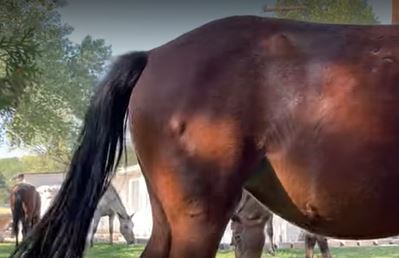
VR Darting Injury 09-15-21

The results of a study, published last month, were promising, with one new adjuvant allowing vaccine preparation days before injection and yielding a strong immune response without injection-site effects.

The research was conducted in part by Dr. John Turner, a colleague of the late Dr. Jay Kirkpatrick of Eastern Montana College.

Improving Public Perceptions of Public-Lands Ranching

Public-lands ranching is government dependency and redistribution of wealth, hallmarks of liberalism and the domain of the Democrat Party.

The practice can’t be defended from an economic viewpoint, as each AUM sold to the ranchers brings in $1.35 in grazing fees while the government spends around $150 to care for the horse displaced thereby.  (One AUM can sustain one cow/calf pair or one wild horse for one month.  The cost of off-range holding is $5 per day or more.)

Undeterred, the folks at the Berryman Institute have embarked on a plan to help the ranchers and improve their image, as explained in this presentation by director and front man Terry “Can Cougars Eat Their Way to AML” Messmer.

References to Celeste correspond to the presentation by Celeste Carlisle, Chair of the Wild Horse and Burro Advisory Board, in cahoots with the ranchers up to her eyeballs.

Most advocates will concur with his observation that you need to put the crosshairs on the mares, not the foals.

The wild horse and burro program has been a drag on the grazing program for 51 years.

RELATED: Better if They Weren’t Even Born.

Wyoming Legislature Petitions Congress to Legalize Slaughter

The sponsor of the new resolution, an outfitter and rancher, was moved by a visit to the Red Desert last year, according to a story posted this evening by WyoFile.

He was accompanied by a rangeland specialist (from the BLM?) and members of the Rock Springs Grazing Association, instigators of the Rock Springs RMP Amendments.

The bill asks Congress to enact legislation and make other necessary policy changes to allow federal land management agencies and agency partners to implement best management practices for wild horses and burros, including equine slaughter and processing for shipment to markets within or outside the United States.

Why Are We Sickened by Images of Orphaned Calves and Foals?

The story in Colorado Politics of a calf calling for its mother, who had been gunned down by Forest Service personnel or their agents, carried to the scene by helicopter, is sad and terrifying as the author suggests.

Then there was the foal put down on Day 4 of the 2021 Jackson Mountains roundup not because of a pre-existing condition, but because it was an orphan.  The BLM later edited the report to conceal the incident.

Why do these events make us sick?

Could it be they’re an affront to our innate understanding of family, and the importance thereof, written on our hearts by our creator?

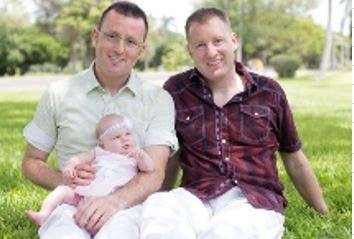
Sodomites with Pet Children 01-16-23

Not the twisted notions promoted by liberals, such as two sodomites and their pet children, or the mergers and acquisitions of divorce and remarry, but the uniting until death of husband and wife in the holy sacrament of marriage and their subsequent cooperation with God to bring forth the future inhabitants of heaven.

RELATED: Unauthorized Livestock Shot by Government Thugs?

Unauthorized Livestock Shot by Government Thugs?

The Forest Service has the authority to gather and remove estray cattle, not shoot them, according to a column posted this morning by Colorado Politics.

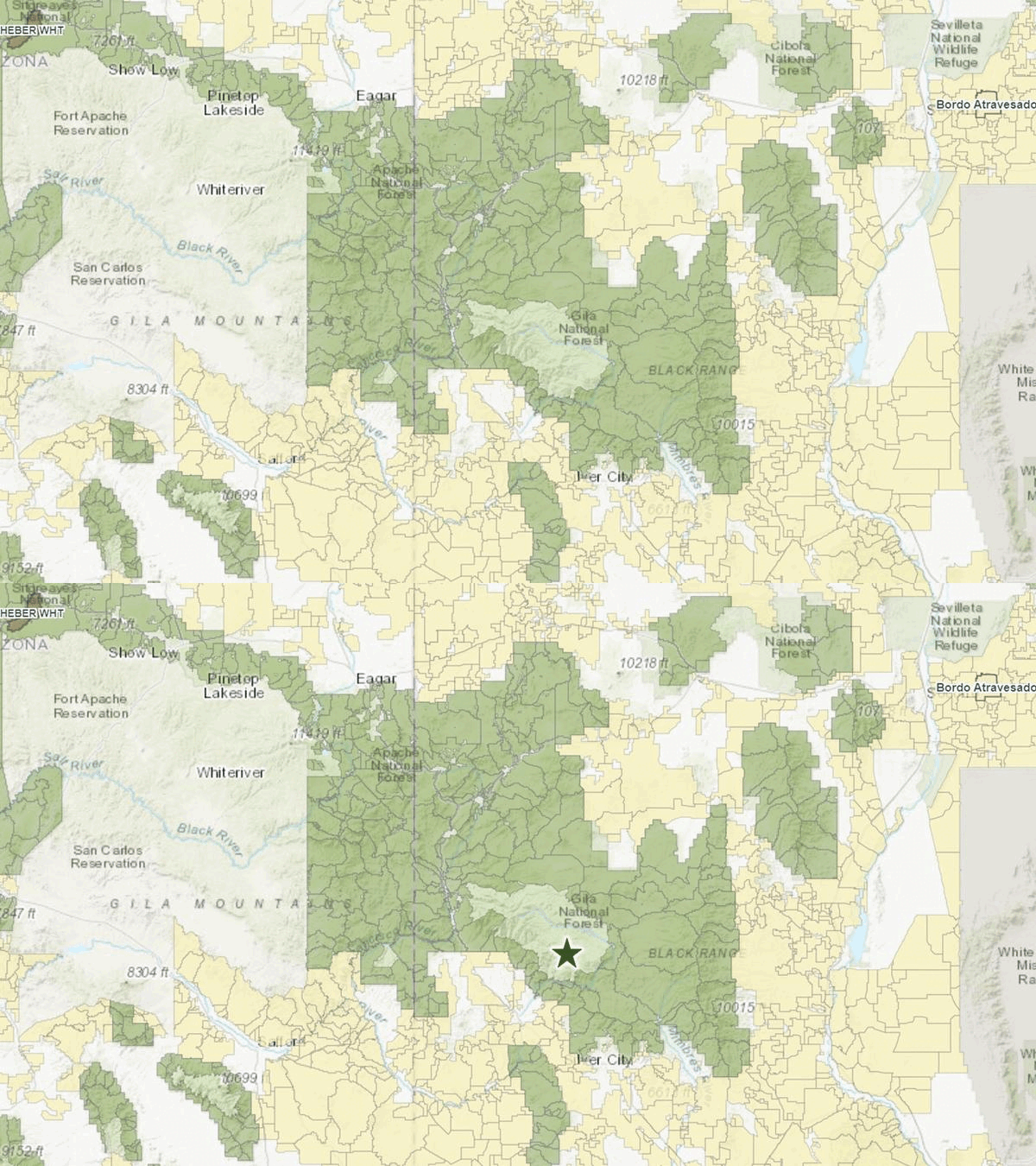
The incident occurred last spring in the Gila Wilderness of the Gila National Forest in New Mexico.

The Western Watersheds map puts it adjacent to the Apache National Forest, known for wild horse shootings, near the Arizona state line.

The Heber WHT, also known for such incidents, is to the northwest, and the Bordo Atravesado HMA is to the northeast.  Click on image to open in new tab.

Gila Wilderness Map 01-16-23

The killing of escaped livestock in New Mexico opens up a new possibility in the Arizona shootings: The feds did it, or they were involved in it, which explains why the cases will never be solved.

The 2018 Spruce-Pequop roundup in Nevada started with the shooting of eight wild horses and the BLM knows who did it, making them complicit in the incident.

Decision Posted for Three Fingers and Jackies Butte HMAs

The Decision Record, FONSI and Final EA have been copied to the project folder.

The Proposed Action, subject to appeal, features roundups and fertility control over a ten-year period.

The fertility control program will begin this year but the timing of the roundups will be determined by the BLM’s Washington D.C. office.

The decision was not announced at the agency’s news site.

RELATED: Decision Pending for Malheur County Pest Control Plan?

Resource Needed

A site is needed to help the advocates manage their decline into oblivion.

They’re wrong about almost everything in the wild horse world.

Most of their ideas help the cattlemen, not the horses.

Protect Wild Horses from Advocates 08-29-21

They’d never recommend their darting programs for privately owned livestock, only the animals they claim to protect.

Of immediate need is professional counseling, with tips and advice leading to the acknowledgment of their errors, including the solicitation of money under false pretenses and their desire to be respected by the bureaucrats and ranchers, not you.

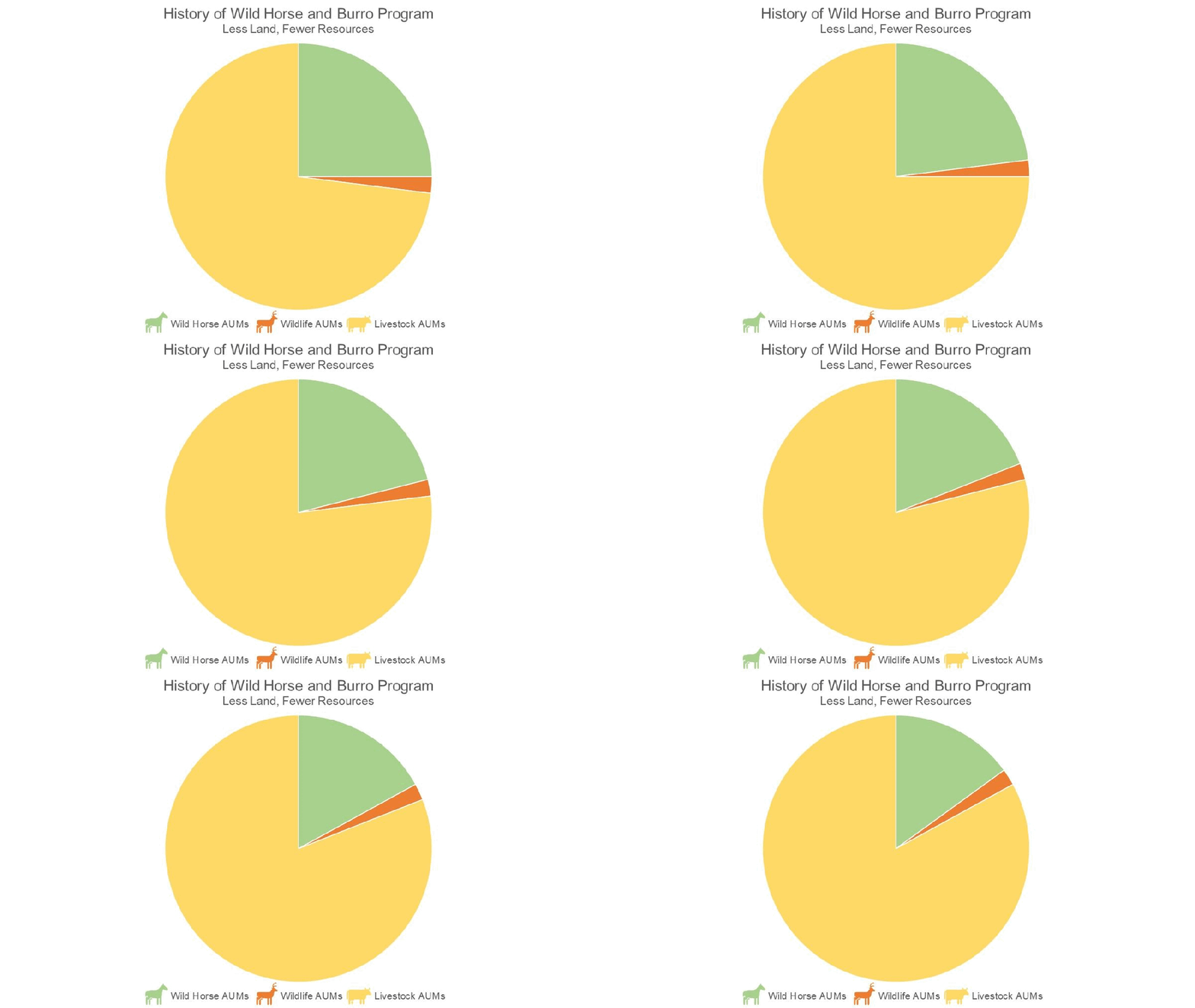
History of Wild Horse and Burro Program 12-01-22

Instead of bucking the long-term trend in resource management, indicated by the chart above, they go along with it.

One of their leaders spilled the beans last year with this remark: “You need to manage the numbers to fit what’s available for the horses.”

Are they defeatists or what?

You can have your wild horse and burro program as long as it doesn’t interfere with the grazing program.

RELATED: Fix, Sell or Close: What to Do About the Advocacy Groups?

Resource Management at McCullough Peaks HMA

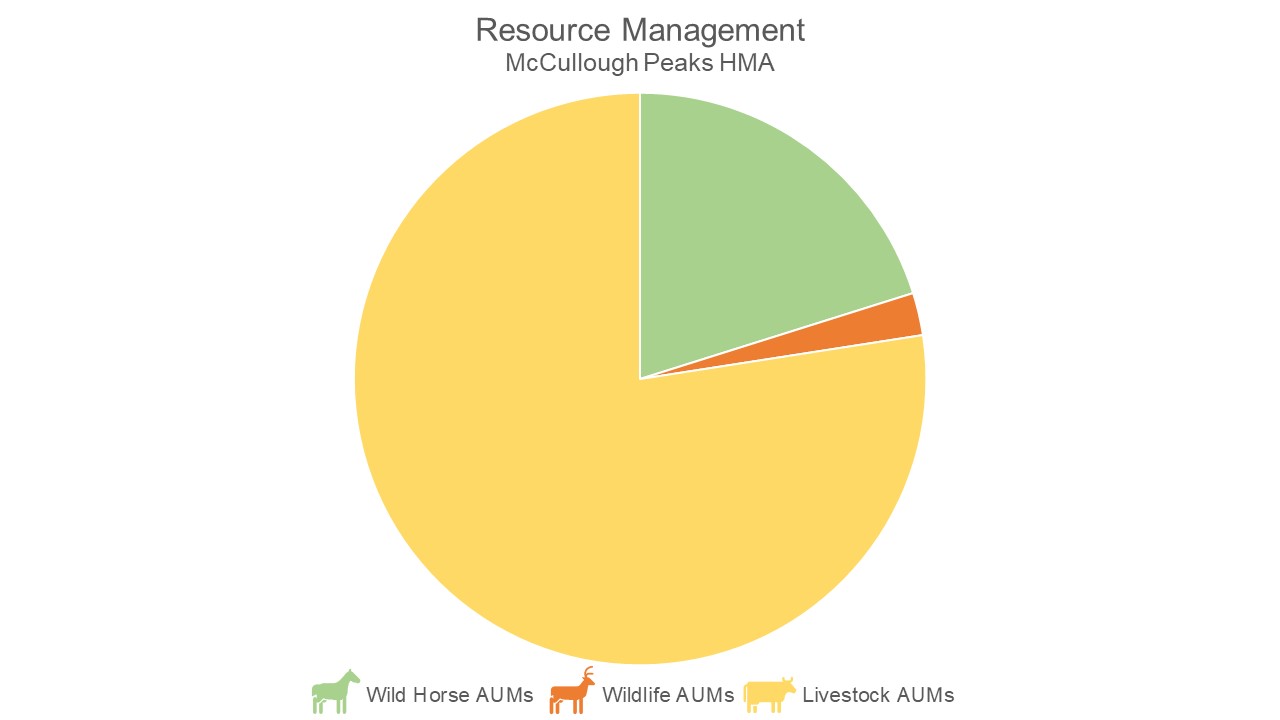
As noted yesterday, the 140 horses allowed by plan require 1,680 AUMs per year.

Livestock receive an average of 56.7 AUMs per year per thousand public acres on the six allotments that overlap the HMA.

The HMA covers 113,938 public acres so the forage assigned to livestock in the area managed for horses is 56.7 × 113,938 ÷ 1,000 = 6,460 AUMs per year.

If you allow 200 AUMs per year for wildlife, the resource management pie chart would look like this:

McCullough Peaks Resource Management 01-14-23

The AML is small relative to the available resources because the HMA is managed primarily for livestock, contrary to the original statute.

The forage allocations will be enforced over a ten-year period by thinning the herd with bait traps and stifling its growth with fertility control.

The process is just getting started.

It’s not what Velma intended but it’s what the bureaucrats, ranchers and advocates intend.

RELATED: The Carrying Capacity Puzzle.

Better if They Weren’t Even Born

Here is your chair of the Wild Horse and Burro Advisory Board, a PZP fanatic and leader of two working groups at the FREES Network, a ranching advocacy group hosted by Utah State University Extension, preaching the overpopulation narrative and fertility control gospel at The Wildlife Society’s 2022 Annual Conference in Spokane, WA.

Although the remark about “learning to love and understand people who are completely opposite of what you might be thinking” was probably a reference to the public-lands ranchers, it also applies to those of us who actually care about the horses and want them managed according to the original statute.

Return to Freedom was a signatory to the ill-advised “Path Forward” of 2019, a plan that put ranching interests far above those of wild horses—in the lawful home of wild horses.

The underlying belief, never acknowledged by the advocates, is that most of the forage in areas identified for wild horses should be consumed by privately owned livestock.

Park Service Has No Rationale for Keeping Wild Horses at TRNP

That was the message to those attending yesterday’s online meeting, according to a story by INFORUM of Fargo, ND.

The author appeared in Nokota Heart, the 2011 documentary about the original wild horses of TRNP, but he does not mention Sitting Bull, Leo Kuntz and the Nokota breed.

As for the advocates, pay no attention as they feign concern for the horses.

What they really want is a contract with the Park Service to sterilize the mares, as indicated in Alternative C of the scoping newsletter.

RELATED: Advocates Ideally Positioned to Help Park Service at TRNP.

How Many Wild Horses Can McCullough Peaks Support?

The HMA overlaps six allotments, as shown in this map from the National Data Viewer.

Although Peaks 1064 and Red Point extend beyond the HMA boundary, the forage assigned to livestock inside the HMA is easy to estimate on a per-acre basis.

The HMA covers 120,412 total acres, including 113,938 public acres, according to the BLM HMA Report, and the 140 horses allowed by plan require 1,680 AUMs per year.

The stocking rate allowed by plan is 1.2 wild horses per thousand public acres.

Click on image to open in new tab.
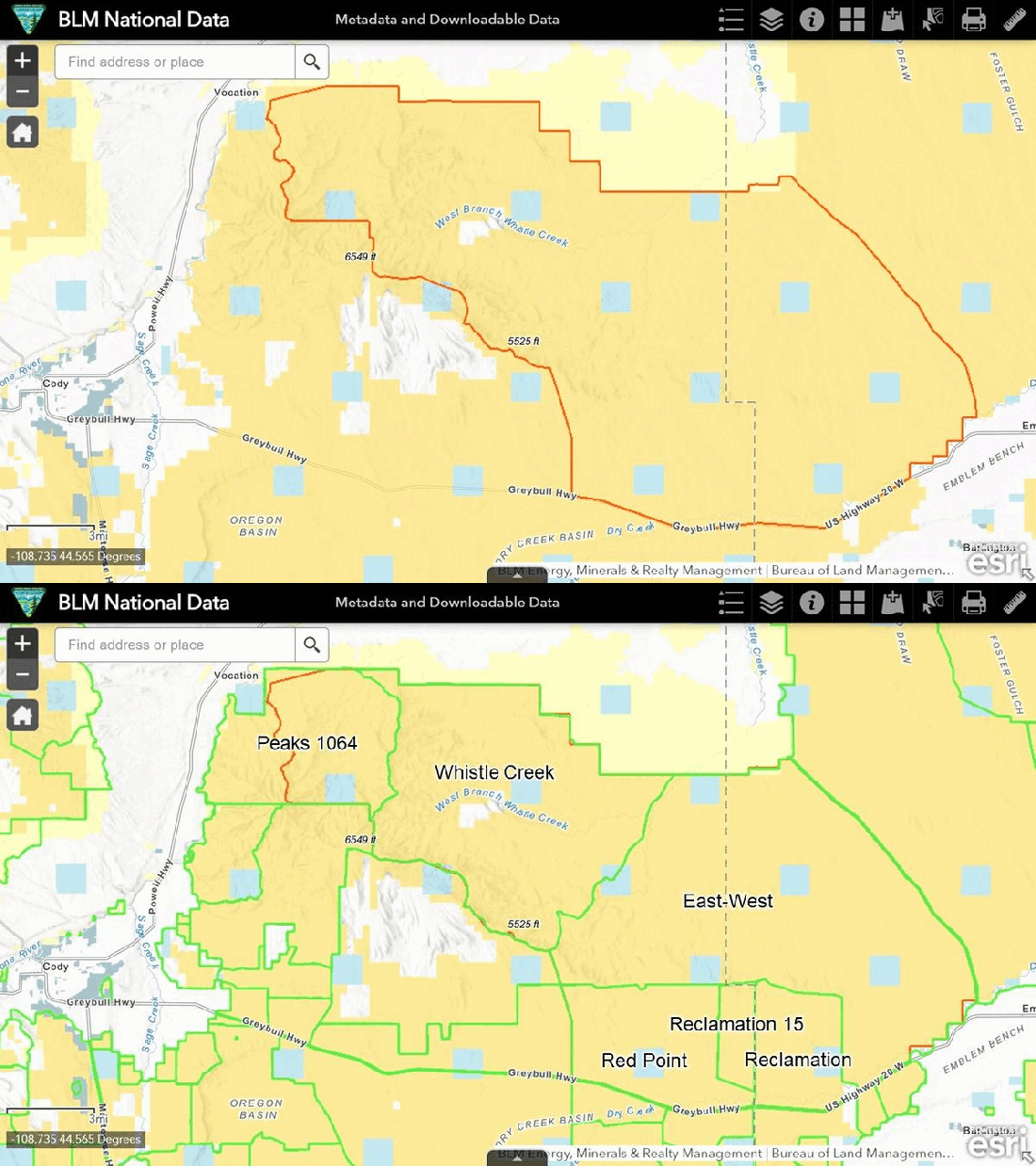
McCullough Allotment Map 01-13-23

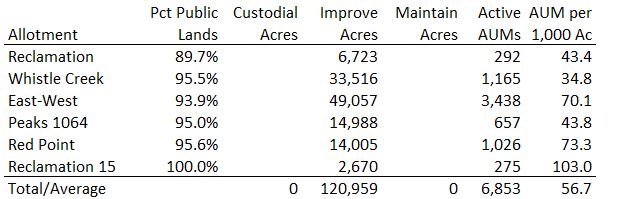
The Allotment Master Report from RAS provides management status, acreage and active AUMs.
McCullough Allotment Calcs 01-13-23

All of the allotments are in the Improve category.

The weighted average forage availability across the six parcels is 56.7 AUMs per year per thousand public acres, enough to support 4.7 wild horses per thousand public acres.

The number of wild horses displaced from their lawful home by permitted grazing is 4.7 × 113,938 ÷ 1,000 = 535, putting the True AML at 675, to be achieved by confining the ranchers to their base properties in a year-long off-season.

The BLM spends around $1 million per year to care for the 535 refugees in short-term holding, while it collects about $9,000 per year in grazing fees from ranching activity inside the HMA.

Would you say that’s a wise use of the public lands?

The current population is thought to be 179, well within the carrying capacity of the HMA.

Given that the advocates are trying to suppress the herd with their favorite pesticide, they are voices for the bureaucrats and ranchers, not the horses.

RELATED: What the McCullough Advocates Are Trying to Protect.