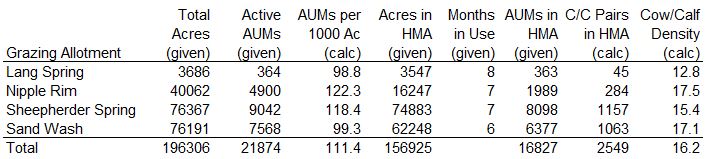
Emergency Gathers in the News

Refer to this story by AP News.  The FY 2021 removal goal is now 18,000, consisting mostly of wild horses.

Western Horse Watchers estimates that at least 200,000 horses have been displaced from their home range by privately owned livestock, on top of the 86,000 currently out there.

There is no overpopulation, only gross mismanagement by government bureaucrats.

RELATED: More Emergency Roundups in the Works.

CORRECTION: Over 200,000 on top of the 27,000 currently allowed by plan.

More Problems at RAS

The Allotment Information report may be running but it yields bad data.

For example, run the report for the allotments in the Three Rivers Field Office, home of the Stinkingwater HMA:

  • State: Oregon
  • District: Burns
  • Field Office: Three Rivers

The first allotment that comes up in the default sort order is Malheur Lake.  How many public acres does it contain?  The report gives you a variety of choices, up to 297,375 twenty pages later.  The Allotment Master report says 757.

RELATED: Problems Fixed at RAS.

More Problems at RAS 08-02-21

West Douglas Roundup Day 7

The incident began on July 26.  Gather stats through August 1:

  • Horses captured: 244, up from 186 on Day 5
  • Capture goal: 450
  • Removal goal: 450
  • Returned: 0
  • Deaths: 4, up from 3 on Day 5
  • Shipped: 135, no change from Day 5

A foal was put down on Day 6 due to pre-existing conditions, keeping the death rate at 1.6%.

Foals accounted for 19.3% of the horses gathered.  Of the adults, 42.6% were male and 57.4% were female.

Day 7 ended with 105 unaccounted-for horses.

Other statistics:

  • AML: 0
  • Forage assigned to horses: 0
  • Pre-gather population: 450
  • Forage liberated to date: 2,928 AUMs per year
  • Water liberated to date: 2,440 gallons per day
  • Forage assigned to livestock: Unknown
  • Horses displaced from HA by livestock: Unknown

RELATED: West Douglas Roundup Day 5.

Stinkingwater Roundup Starts in Two Weeks

The incident was set to begin on August 1, according to the schedule, but has been delayed two weeks, according to the gather page.  An announcement has not appeared at the BLM news site.

Horses will be pushed into the traps by helicopters and the operation will be open to public observation.

The capture goal is 420.  Approximately 30 will be returned to the range, including mares treated with contraceptives, putting the removal goal at 390.

The HMA covers 78,000 acres east of Burns, OR and has an AML of 80.

The aimed-at stocking rate is one wild horse per thousand acres, in line with the target rate across all HMAs.

The horses allowed by plan require 80 × 12 = 960 AUMs per year.

The current population is thought to be around 450, including foals.  How does that figure compare to the True AML, which must be determined by calculation?  This is where the advocates go off the rails.

Stinkingwater HMA Map 07-30-21

The authorizing project can be found in ePlanning.

  • State: Oregon/Washington
  • Program: Wild Horses and Burros
  • Clear the Show Only Active Projects checkbox
  • Hit Search

Go through the list one page at a time until you see Stinkingwater.  Two projects appear, one from 2010 and another from 2017.  Click the link for 2017, Stinkingwater HMA Population Management Plan.

Click the Documents link on the left.  The Final EA is near the bottom of the list.

A keyword search for AUM eventually brings you to Table 3-4, which shows three grazing allotments associated with the HMA.

Current data for the allotments, including active AUMs, permittees, grazing seasons and management status (Improve/Maintain/Custodial) can be found in RAS, using the Allotment Master and Authorization Use reports.  The project home page tells you they’re in the Three Rivers Field Office.

The forage allocations in Table 3-4 sum to 8,455 AUMs per year, compared to 960 AUMs per year for the horses.  An estimated 8,455 ÷ 12 = 704 wild horses have been displaced from the HMA by privately owned livestock.

Calculation of the True AML is beyond the scope of this post but here’s a first pass:

True AML = Horses allowed by plan + Horses displaced by livestock = 80 + 704 = 784

The HMA is not overpopulated, it is mismanaged.

Captured animals will be taken to the off-range corrals in Hines.

Gather stats and daily reports will appear on the gather page.

West Douglas Roundup Day 5

The incident began on July 26.  Gather stats through July 30:

  • Horses captured: 186
  • Capture goal: 450
  • Removal goal: 450
  • Returned: 0
  • Deaths: 3
  • Shipped: 135

Another foal was placed into foster care today.  The report did not say why it was separated from its mom.

Two more horses were put down on Day 4 due to pre-existing conditions, bringing the death rate to 1.6%.

Foals accounted for 17.7% of the horses gathered.  Of the adults, 45.8% were male and 54.2% were female.

Day 5 ended with 48 unaccounted-for horses.

Supplemental statistics:

  • AML: 0
  • Forage assigned to horses: 0
  • Pre-gather population: 450
  • Forage liberated to date: 2,232 AUMs per year
  • Water liberated to date: 1,860 gallons per day
  • Forage assigned to livestock: Unknown
  • Horses displaced from HA by livestock: Unknown

RELATED: West Douglas Roundup Day 3.

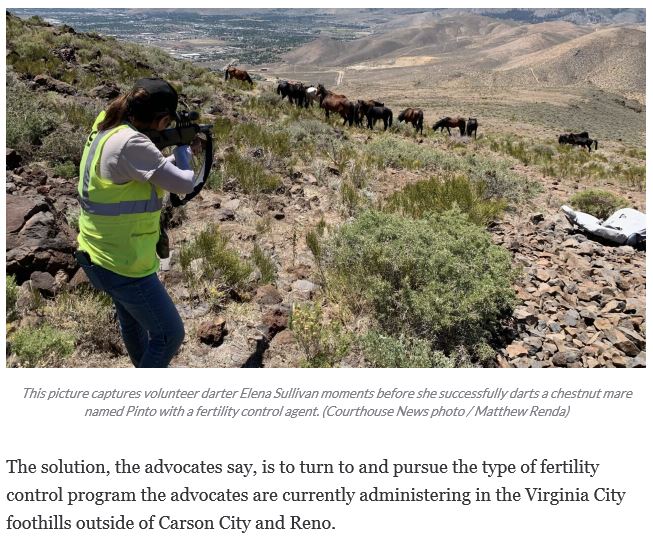
CAAWH Seeks Coordinator for Virginia Range Darting Program

Here’s your chance to save wild horses by getting rid of them.

You’ll lead a team that’s disrupting natural behaviors, driving birth rates to zero and letting the herd die off.  You’ll inflict injuries that last for weeks.  You’ll win the respect of ranchers everywhere.

The salary will be meager but the satisfaction will be great.

You need not be aborting/contracepting/sterilizing in your own life but that would definitely be a plus.

Sound interesting?  Apply here.

The Campaign Against America’s Wild Horses is an equal opportunity darter, with operations across the western U.S.  No wild horses are safe.

Click to open image in new tab.

Progression of Injuries VR 07-30-21

Antelope Complex Emergency Roundup Starts This Weekend

The BLM will remove 2,200 excess horses from four HMAs in eastern Nevada starting on or about August 1.

Helicopters will push the animals into the traps and the incident will be open to public observation, according to a news release dated July 29.

The total AML is 789 and the current population is thought to exceed 6,000.

The HMAs cover approximately 1.6 million acres, for an aimed-at stocking rate of 0.5 wild horses per thousand acres.  The average rate across all HMAs is one wild horse per thousand acres.

The pre-gather stocking rate is about four wild horses per thousand acres, equivalent to 250 acres per horse.

Antelope Complex Map 07-29-21

Horses removed from the Complex will be taken to the off-range corrals at Palomino Valley, NV or Axtel, UT.

Gather stats and daily reports will be posted to this page.

RELATED: Antelope Complex Horses Get Short End of Stick.

West Douglas Roundup Day 3

The incident began on July 26.  Gather stats through July 28:

  • Horses captured: 125
  • Capture goal: 450
  • Removal goal: 450
  • Returned: 0
  • Deaths: 1
  • Shipped: 1

One foal was placed into foster care today.

The horse put down on Day 1 would be alive if it wasn’t for the roundup.  Charge to roundup.

Foals accounted for 17.6% of the horses gathered.  Of the adults, 46.6% were male and 53.4% were female.

There were 123 unaccounted-for horses at the end of Day 3.

Supplemental statistics:

  • AML: 0
  • Forage assigned to horses: 0
  • Pre-gather population: 450
  • Forage liberated to date: 1,500 AUMs per year
  • Water liberated to date: 1,250 gallons per day
  • Forage assigned to livestock: Unknown
  • Horses displaced from HA by livestock: Unknown

RELATED: West Douglas Roundup Begins.

Calico Decision Reached

The BLM has selected the Proposed Action to enforce resource allocations in the Calico Complex over the next ten years, according to a Decision Record signed today.

The Proposed Action features removal of excess horses and burros to low AML, fertility control vaccines, intra-uterine devices, sterilization of mares and sex ratio skewing.

The Final EA was posted with other project documents.

The news release did not indicate when the plan, which is subject to a 30-day appeal period, will be implemented.  Five HMAs are affected.

RELATED: Comments Invited on Draft EA for Calico Gather Plan.