Economics of Off-Range Holding

Yesterday’s article by The New York Times noted that the BLM spends $60 million per year to keep 51,000 wild horses and burros in off-range holding.  The story did not indicate what the agency receives from the ranchers to whom their food is sold.

A report from August 2020 shows that approximately 98% of the animals in off-range holding are horses so let’s assume it’s 100% for simplicity.

The forage sold to the ranchers would be 51,000 × 12 = 612,000 AUMs per year.

Grazing fees would provide 612,000 × $1.35 = $826,200 per year, at current prices.

The government spends $60 million per year on the horses so it can collect less than $1 million per year from the ranchers.  Nobody in the private sector would do that.

Wild horses and burros are removed from their home range to make sure the ranchers receive their allocated share of the resources, not because they’re overpopulated.

Opposition to the practice has been minimal, although the method of removal has been the subject of recent debate: The advocates want to get rid of them with contraceptives, while the government and the ranchers prefer helicopters.

RELATED: Adoption Incentive Backfiring or Working Exactly as Planned?

Zoo Euthanizes Oxen Because of Global Warming?

The last two animals were put down by their caretakers last month after the state’s warming climate became too much for them, according to a report by KMSP News, the FOX affiliate in Eden Prairie, MN.

About ten years ago, zookeepers noticed that the heat and humidity were affecting the herd, so they decided not to breed them any more and not acquire any new members.

Does the climate change?  Yes.  Is it caused by man?  No.  So why did they do it?

One possibility is that the state is not suited for that type of animal and they never should have been moved there in the first place.

Another possibility, given the political leanings of the state, is that the animals were sacrificed to help you believe a lie.

A third possibility is that it was an act of terror, designed to scare you into submitting to their wicked agenda.

Have you been wearing a mask lately?  Are you terrified by an overblown virus?  Have you taken the death jabs?  If one is good, why not go for the triple crown?

Could the same thing be happening on America’s public lands?

Have the roundups, not necessary from a resource viewpoint, convinced you that wild horses are overpopulated?  How about the videos of foals being thrown to the ground by wranglers and dragged back to the traps?

What about horses stockpiled in off-range corrals (all of whom could be returned to the range if livestock grazing was discontinued on just a few dozen HMAs)?  Are you ready to support fertility control, sex-ratio skewing and sterilization?

And now, with stories emerging about the slaughter of wild horses, are you willing to accept the government’s pro-ranching agenda?

No Common Ground 05-15-21

Adoption Incentive Backfiring or Working Exactly as Planned?

Wild horses adopted with the $1,000 payout are ending up at kill pens, according to a story in today’s online edition of The New York Times.

Statements condemning the practice, by farm bureaus, stock grower’s associations and cattlemen’s groups, were not mentioned in the article.

The advocates point to it as justification for fertility control programs.

Nobody’s thinking in terms of cause and effect.  Slaughter, a result of the wild horse management process, cannot fix the problem, it can only prolong it.

You have to look upstream.

Public lands in the western U.S. can support many more horses than the government admits, but those resources have been assigned to privately owned livestock.

RELATED: Adoption Incentive Fallout?

Destroying Their Wildness

The American people may not realize the extent to which their government caters to ranching interests on public lands in the western U.S., as noted in a commentary posted yesterday by The Record-Courier of Gardnerville, NV.

Areas set aside for wild horses and burros have been zeroed out, AMLs have been reduced and habitats have been altered to suit those interests.

As land, food and water shift to privately owned livestock, the number of wild horses and burros in those areas must go down.  Resource enforcement plans, which read like pest control programs, maintain the status quo.  The Proposed Action for the Calico Complex is just one example.

Would horses and burros be better off if the statute was restored to its original form?

Probably.  Are additional protections needed?

Velma knew that they’d need protection from the ranchers but she did not realize—and could not realize—that they’d also need protection from the advocates.

Areas where wildness is at greatest risk are those where the advocates are most actively involved.

The list is too long to enumerate and one organization in particular seems to be a common cause among them, evident in yesterday’s story about the Onaqui herd.

RELATED: Hard to Call Them Wild.

Pancake Gather Plan

Truth About Wild Horses Found in the Middle?

That’s the theme of an article about wild horses in Oregon by Eugene Weekly.

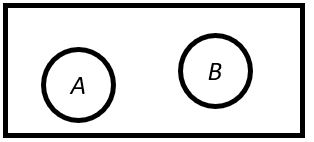
Imagine a Venn Diagram for two mutually exclusive events A and B, where A is public-lands ranching and B is wild horse preservation.  Where’s the common ground?

Mutually Exclusive Events 05-13-21

There isn’t any.  Expressed mathematically, AB = ∅.

Where’s the common ground in the Arab-Israeli conflict, given that one side wants the other side wiped off the map?  Same for the communists and the capitalists.

And so it is in the wild horse world.

As for the truth, it’s in the data, despised by the advocates but served up regularly on Western Horse Watchers.

Wild Wednesdays at Onaqui Mountain HMA

The area was set aside for wild horses.  Yet, every Wednesday, according to a story by KSL-TV of Salt Lake City, the advocates show up with their darting rifles to make sure most of the resources go to privately owned livestock.

If the ranchers understood this, they’d shut up, be patient, and let these idiots have their way.

RELATED: Running the Onaqui Numbers, Double Standard Illustrated.

Status of Sinbad Allotments

The Allotment Master report from RAS puts two of them in the Maintain category and three in the Improve category.  Approximately 68% of the grazing area does not meet standards for rangeland health.

Sinbad Allotment Data 05-12-21

The active AUMs increased on three of the allotments since the 2016 Decision Record was signed, with the largest gain in an allotment with substandard conditions.

The total allotment acreage exceeds the HMA acreage by a factor of 2.7, yet the cattle receive 35.5 times as much forage as the burros.

RELATED: Sinbad Burros Getting Short End of Stick?, Allotment Categories Explained.

Sinbad Burros Getting Short End of Stick?

The writer of a story in yesterday’s online edition of the Daily Camera asks why their numbers are so low relative to the number of cattle allowed in the area.

The management plan allows up to 70 burros in the HMA, equivalent to 35 wild horses, requiring 420 AUMs per year.

Table 2 in Section 3.3.1 of the 2016 DR / Final EA for resource enforcement actions in the area shows 10,899 AUMs per year assigned to livestock on five allotments, but does not indicate how much of that resource falls inside the HMA.  See page 26 in the pdf.

Although the management priorities in the HMA can’t be determined from the data in the EA, the author suggests that they’re not consistent with the intent of the WHB Act and he’s probably right.

Shock to Their Systems?

What would happen if you moved wild horses from an area where each one needs 100 acres or more to find enough food to an area where they can do the same on five acres, as proposed in a report dated April 30 by the Ag Information Network of the West?

Would they adjust to their new habitat without any problems?

The idea is to get them out of areas where they’re not wanted (by ranchers) and into areas not particularly suited to livestock grazing.

You could argue that it’s already happening, in effect, as horses are forced off their home range in the Great Basin and moved to grasslands in Kansas and Oklahoma.

Do they live to a ripe old age in those pastures?

The target stocking rate across all wild horse areas is currently one animal per thousand acres, compared to 200 animals per thousand acres under the proposal.

The Virginia Range was carrying about ten wild horses per thousand acres before the advocates started their herd reduction program.

RELATED: Amend WHB Act So Wild Horses Can Be Relocated?

Calico Comment Period Ends This Week

The Draft EA does not provide enough information to assess the management priorities in the Complex.

Concerns about resource allocations, probably valid, should not be submitted as they are outside the scope of the project.

The Proposed Action cannot fix the ranching problem, it can only prolong it.

The last paragraph on page 23 of the EA (page 26 in the pdf) indicates an ever-widening gap between current attitudes and beliefs and the intent of the original statute.

RELATED: Comments Invited on Draft EA for Calico Gather Plan.

Well for Fish Springs Mustangs Needs 640 Acres?

The idea of diversionary watering is not new but the purchase of one square mile to drill the well is rather novel.

The Campaign Against America’s Wild Horses wants to buy a 640 acre parcel it currently leases from the Bently Family Ranch to obtain water for seasonal ponds, according to a story posted today by The Record-Courier of Gardnerville, NV.

Presumably, the land is part of the base property that secures grazing preference to the Buckeye Allotment.

The article notes that a 2018 roundup was called off after national outcry, even though the local advocacy group is getting rid of the horses with contraceptives.

RELATED: BLM Dictates Terms of Surrender to Fish Springs Advocates.

What’s Up in Railroad Valley?

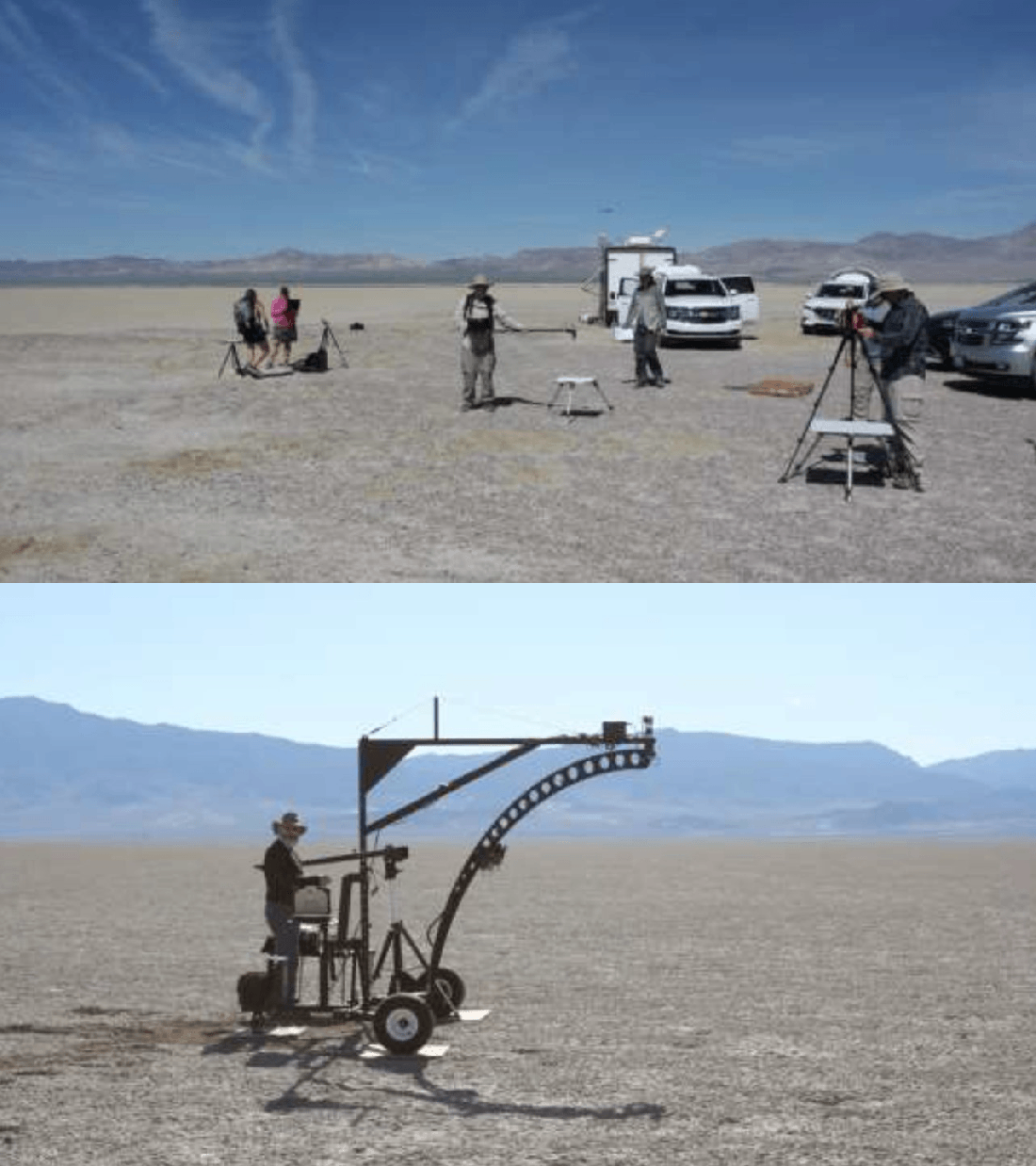
The announcement last month regarding the withdrawal of public lands near the Pancake and Sand Springs West HMAs said the area would be used for satellite calibration activities but did not give any details.

If you thought it might involve spy cameras that can read freeze marks off wild horses you might be disappointed.

And, no, the apparatus with the curved beam it not intended for use at Burning Man.

A brief from 2018 says they were evaluating the bidirectional reflectance distribution function of Railroad Valley and assessing the radiometric uncertainties thereof.

The withdrawn lands are preferred because of

  • High surface reflectance
  • Spatial uniformity
  • Spectrally flat
  • High altitude
  • Large size
  • Favorable weather

A 2002 bulletin by the Jet Propulsion Laboratory has images of irrigated fields in the valley from the Advanced Spaceborne Thermal Emission and Reflection Radiometer that can be used for monitoring crop health.

Hopefully that clears everything up.

RELATED: Satellite Calibration Activities Near Pancake HMA?

Satellite Calibration Activities RRV 05-09-21

Big Summit Management Plan Doesn’t Fix Ranching Problem

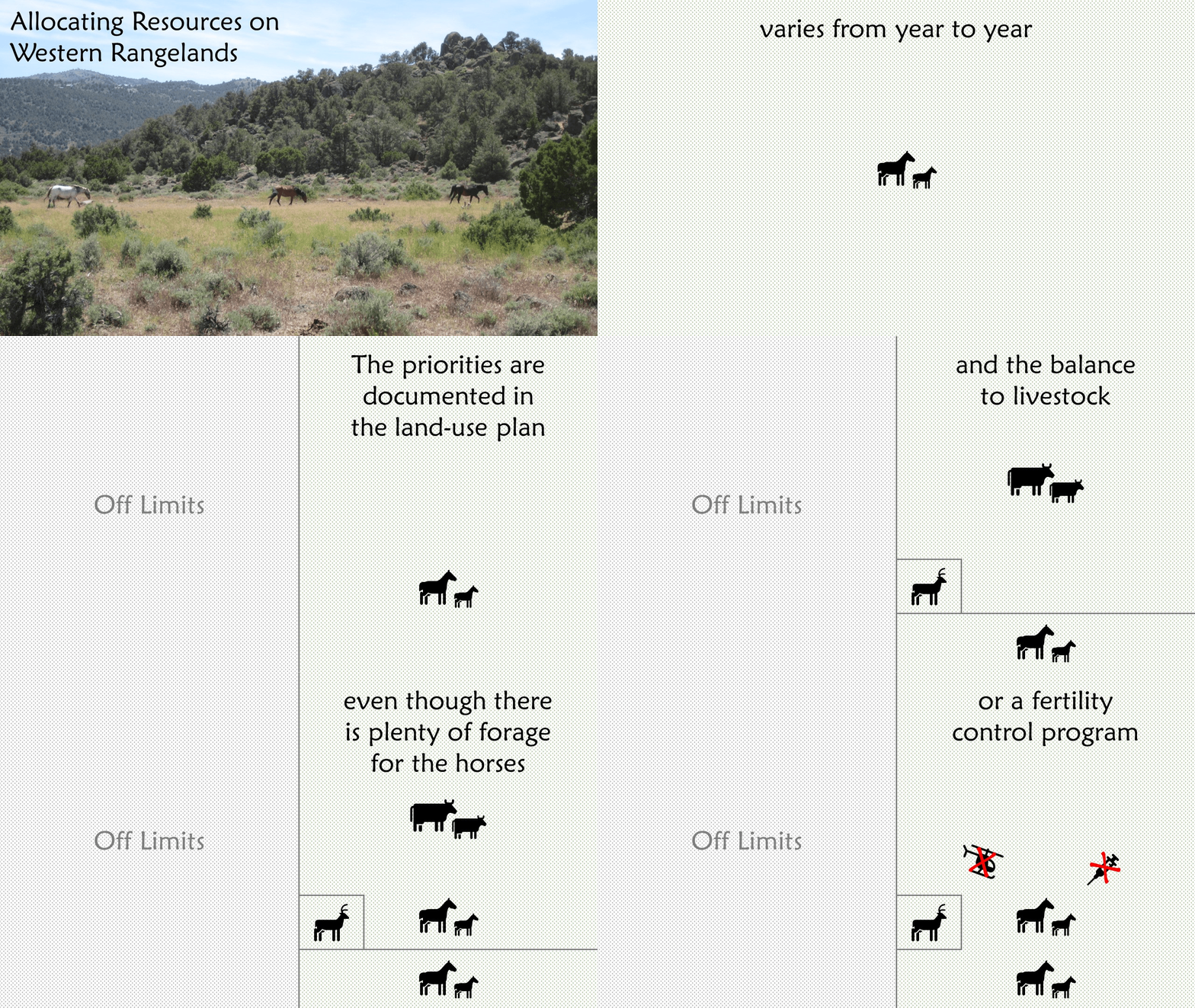
It’s not supposed to—it can only prolong it.  The plan enforces resource allocations, it does not allocate resources.

If you want to help America’s wild horses, don’t focus on the horses.

The PZP zealots focus on the horses.

Instead, look upstream in the management process, understand why they’re being forced off their home range and address those causes for a lasting solution.

RELATED: Big Summit Management Plan in the News.

Allocating Resources 05-08-21

Big Summit Management Plan in the News

The Decision Notice issued yesterday puts the plan into effect.  Here are some of the stories that have hit the wires in the past 24 hours:

The new AML of 57 means the horses receive an estimated 29% of the authorized forage, neglecting wildlife, with the balance assigned to livestock.

The Final EA was posted with other project documents in the Analysis section.

RELATED: Big Summit AML Announced.

Letter to Haaland in the News

An article posted today by Deseret News points to growing tensions between livestock operators and wild horse enthusiasts resulting from a letter sent last month to the Secretary of the Interior.

The story includes a photo of cattle on the Pearson Ranch (or public lands tied thereto) owned by Beaver County Commissioner and WHBAB member Tammy Pearson.

RELATED: Letter to Haaland Seeks Thriving Ecological Balance?