Sustainability of Currituck Wild Horses Questioned

The topic was discussed at the September 19 meeting of the county commissioners according to a report posted today by The Coastland Times.

One of the commissioners claimed that only six mares were fertile but the herd manager stated in a subsequent interview that 19 out of 53 mares (36%) were producing.

The percentages of males and females in the herd were not given.

The story indicated that a contraceptive process several years ago—sorry, a safe, proven and reversible fertility control program—ended up making several mares sterile.

The article also indicated that the filly put down by the advocates last month contracted swamp cancer.

RELATED: Currituck Filly Dies.

Report Stresses Observation of Roundups, Not Cessation

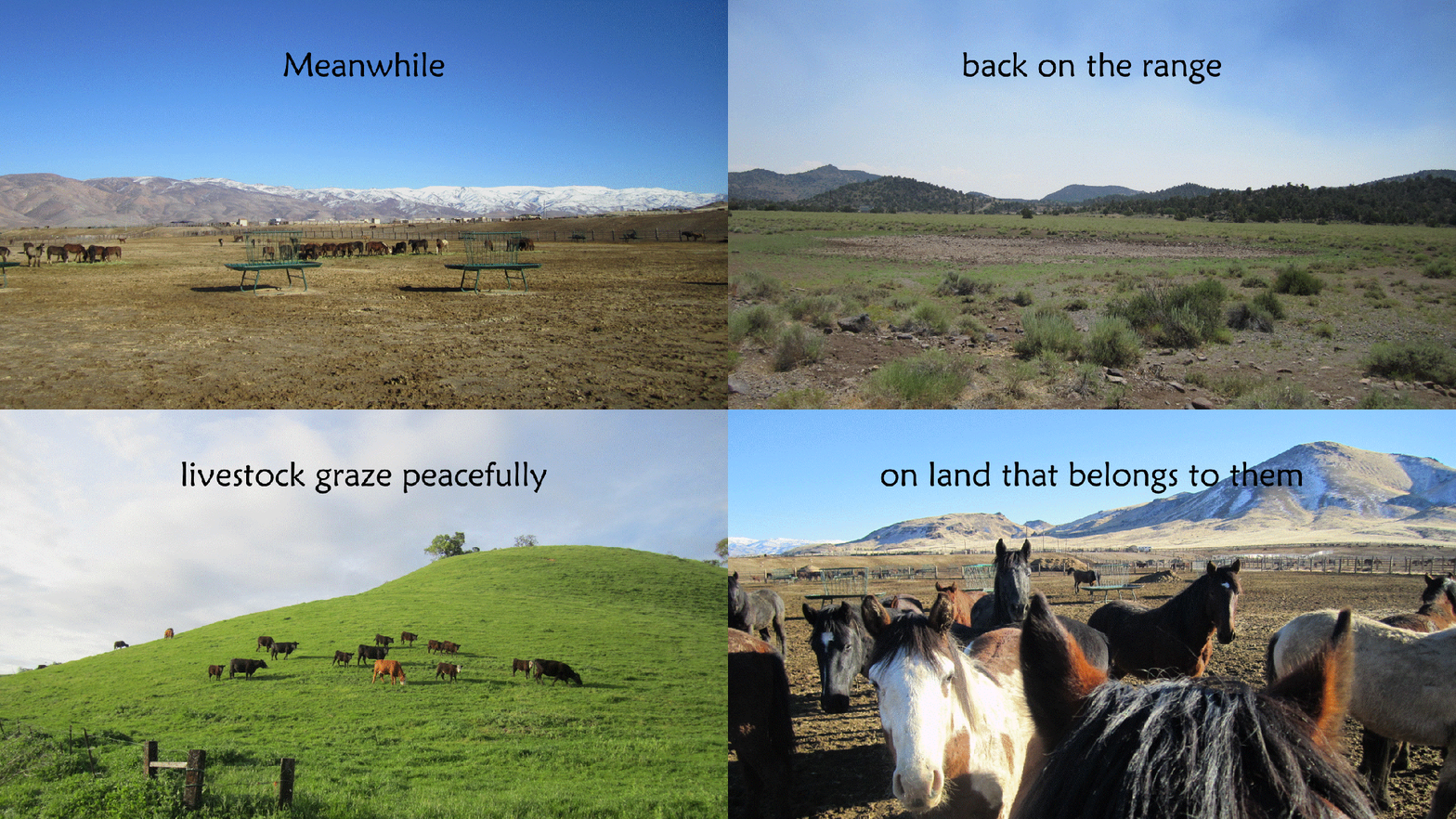
We’re not going to push back against the public-lands ranchers, and we don’t care if they receive the lion’s share of the resources, we just want the horses treated humanely as they’re forced off their lawful homes and into government feedlots.

How does that help America’s wild horses?

The news release on EIN shows that you can develop a large following, and hold your audience spellbound, teaching them everything that is wrong.

PSA 12-12-19

Alpine Shooters Knew What They Were Doing?

The advocates reported that the horses were shot in the abdomen, face and between the eyes, according to the story by KPHO News.

Shots to the abdomen may have occurred from longer range, to make the animals approachable, with kill shots applied at short distance.

Where do you find expertise in killing wild horses by gunshot?  At wild horse roundups, where it is often associated with pre-existing conditions.

The method was sanctioned by PIM 2021-007, Euthanasia of Wild Horses and Burros Related to Acts of Mercy, Health or Safety.

From paragraph VI.2 in Attachment 1:

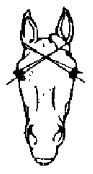
A properly placed gunshot to the brain of an animal that is calm and still, or humanely restrained, instantly produces an unconscious state followed quickly by a painless and humane death.  This method of euthanizing wild horses and burros requires only minimal handling and restraint; and when performed on the range, drug residues that may poison wildlife are not a concern.  Only qualified and experienced persons skilled in the safe handling and use of firearms and trained by a veterinarian will perform the procedure.  The optimal placement of a gunshot is from the front of the animal, perpendicular to the skull at a point one inch above the intersection of two imaginary lines drawn like an “X” from the eyes to the base of the ears.  Typically, when euthanizing a wild horse or burro in this manner with a handgun, the animal will be approached to within five-to-six feet and the gun will be held within a few inches or up to two-to-three feet from the animal.

Euthanasia by Gunshot 10-10-22This information is not limited to government contractors or the agencies that hire them.  The image above was found at thinklikeahorse.org.

RELATED: Searching for Motives in Alpine Wild Horse Shootings.

Searching for Motives in Alpine Wild Horse Shootings

The story by FOX10 News in Phoenix indicated that the dead animals were found near Forest Road 25 in the Alpine and Springerville Ranger Districts.

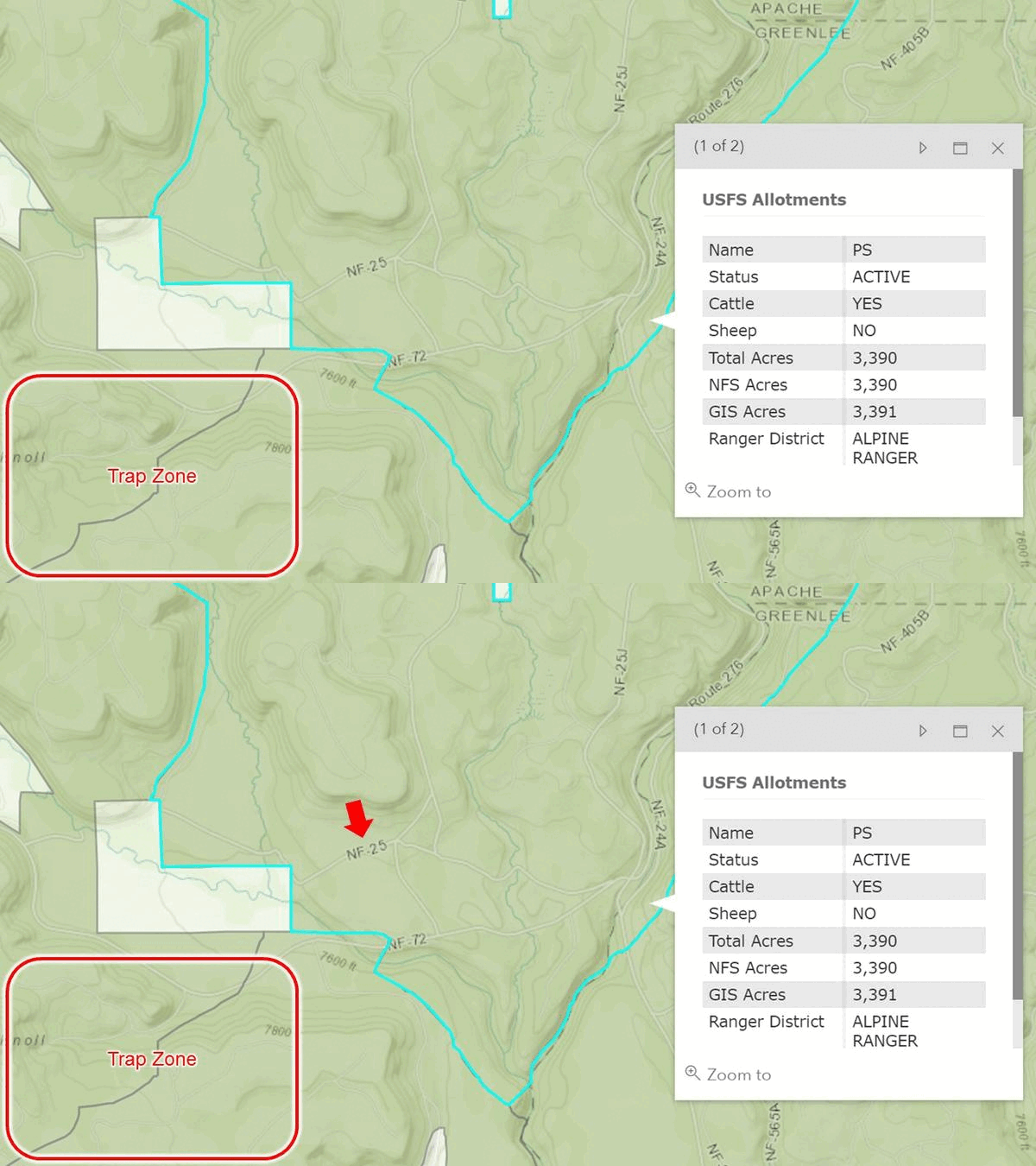
The Western Watersheds map shows Road #25 in the PS Allotment, about 15 miles southwest of Alpine and near the area where the Jumping Mouse horses were trapped earlier this year.

Forest Road 25 Map 10-09-22

The area is not just known for its grazing potential, but is home to some of the best elk and mule deer habitat in Arizona.

The Annual Operating Instructions for PS indicate two pastures, with grazing seasons ending in just a few days.

RELATED: Advocates Outraged by Alpine Wild Horse Shootings?

Pokegama Legal Action to Be Tossed Out?

The case, brought by the Vermont Law and Graduate School’s Environmental Advocacy Clinic on behalf of Wild Horse Fire Brigade, seeks to halt the removal of wild horses from private property within and adjacent to the HMA in southern Oregon, according to a news release dated October 8.

Plaintiffs allege that the BLM has violated the WHB Act and/or NEPA and have asked the Court to issue a temporary restraining order stopping the roundup.

The incident started on September 26.  To date, three horses have been captured.

If free-roaming horses or burros stray from public lands onto privately owned land, the owners of such land may inform the nearest Federal marshall or agent of the Secretary, who shall arrange to have the animals removed, per §1334 of 16 USC 30.

The BLM issued a CX and DR for the action two years ago.  The map on page 5 of the pdf shows much of the land inside the HMA is privately owned.

Is Oregon a fence-out state?

The CX was the only document posted to the project folder in ePlanning.

The aim of the Wild Horse Fire Brigade is to move wild horses from areas where they’re not wanted (by public-lands ranchers) to remote wilderness areas not particularly suited to livestock grazing.

“Horses are significantly more ecologically appropriate in wilderness areas over ruminant livestock like cattle, sheep, and goats,” according to its founder.

Achievement of that end would constitute victory for the ranchers in their long-held goal of purging wild horses from western rangelands.


McKinney Fire 08-08-22

Advocates Outraged by Alpine Wild Horse Shootings?

Fourteen horses have been found dead so far, according to a story posted this evening by KPHO News of Phoenix.

Simone Netherlands, ringleader of the Salt River Wild Horse Darting Group, told the reporter that the “atrocity shows … just how much hate there is for these horses.”

Speaking of hate, Western Horse Watchers estimates that the group, an affiliate of the Campaign Against America’s Wild Horses, gets rid of about 80 wild horses every year at the Salt River.

Their colleagues on the Virginia Range are getting rid of an estimated 400 to 600 wild horses every year with the Montana Solution.

Who’s the greater threat to America’s wild horses?  Shooters or the advocates?

RELATED: Forest Service Acknowledges Alpine Wild Horse Shooting?

Wild Horses Shot Near Alpine

The incident occurred in the Apache-Sitgreaves National Forest in eastern Arizona, according to a news release on EIN by Advocates for Wild Equines.

Western Horse Watchers has been unable to find a statement by ASNF.

ISPMB tried unsuccessfully earlier this year to stop the removal of wild horses from an area southwest of Alpine designated for the New Mexico Jumping Mouse.

Forest Service lands around Alpine, denoted by green in the Western Watersheds map, are subject to permitted grazing.

The Forest Service views the horses as trespass livestock.  The herd is not protected by the WHB Act, which no longer functions as Velma attended.

Alpine AZ Map 10-07-22

Foal-Free Friday, Safe, Proven and Reversible Edition

The Montana Solution inhibits fertilization by creating anti-zona pellucida antibodies which bind to the zona pellucida of the oocyte, alter their conformation, and block sperm attachment to the zona pellucida receptors, according to the pesticide fact sheet provided by the EPA.

If this is true, why don’t mares bear fruit when the injections are stopped, after four to five successive years of treatment?

The herd on the Maryland side of Assateague Island should have doubled in the six years since the darting program was shut off.  The population at the time was around 80, according to the chart provided by the Park Service.

As of yesterday, the population was 78.

Mares that don’t return to normal function are labeled “self-boosting” by the advocates, suggesting they produce their own antibodies, when in reality their ovaries have been destroyed, or nearly so.

This is not a defect, it is part of the plan.

The advocates treat their cherished horses and burros the way you treat your cherished ants and roaches.

Treatment for Cherished Cockroaches 07-27-22

Don’t give them a penny.

RELATED: Foal-Free Friday, We’re Not Who We Say We Are Edition.

PZP and Sterility 09-29-22

Escaped Trail Horse Captured in Cedar Mountain Roundup?

He ran off with a band of wild horses eight years ago and his owner gave up the search three years later.

But the two have been reunited according to a story by KUTV News of Salt Lake City.

The article said he was picked up “when BLM managers rounded up a herd of mustangs near military property in Tooele County in the last week of September.”

That was probably Cedar Mountain.

The gather page does not mention the capture or release of a branded/claimed horse.

Assateague Herd Struggling in Latest Census

The Assateague Island Alliance reports 78 wild horses living on the Maryland side of the island as of today, compared to 78 horses a year and a half ago.

Seven foals were born this year.

The herd could only generate a nine percent birth rate, and a zero percent growth rate, six years after the darting program was shut off.

Could this explain why the Park Service stopped publishing census results?

The advocates no longer point to the island as a paragon of wild horse management.

They are now trying to ruin the Virginia Range and Salt River herds.

RELATED: Park Service Goes Underground with Assateague Horse Census?

Devil’s Garden Roundup, Day 22, Ecological Imbalance Edition

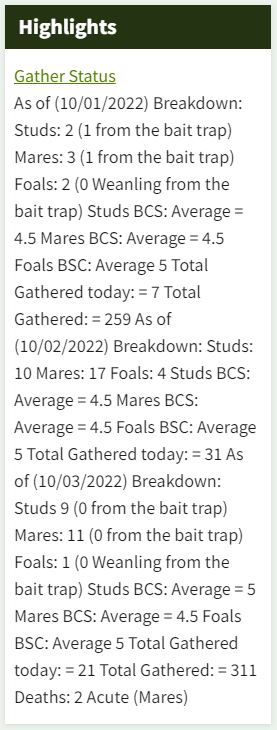
The incident began on September 12.  Results through October 3:

Devils Garden Roundup Day 22 10-03-22

Body condition scores indicate more horses than allowed by plan, not more horses than the land can support.  If the horses were starving the scores would be lower.

More information may be available in the land of make-believe on socialist media.

  • Target: Horses
  • Type: Planned
  • Method: Unknown
  • Captured: 311
  • Average daily take: 14.1
  • Capture goal: Unknown
  • Removal goal: Unknown
  • Returned: Unknown
  • Deaths: Unknown
  • Shipped: Unknown
  • Unaccounted-for: Unknown
  • Location of trap: Unknown
  • Destination of captured animals: Unknown
  • Horses allowed by plan (AML): 402
  • Forage assigned to horses: 4,824 AUMs per year
  • Pre-gather population: Unknown
  • Forage assigned to livestock inside WHT: 15,711 AUMs per year (estimated)
  • Horses displaced from WHT by permitted grazing: 1,309
  • True AML: 1,711
  • Stocking rate at new AML: 6.6 horses per thousand acres

The government collects $21,210 per year in grazing fees from ranching activity inside the WHT while it spends $2,388,925 per year to care for the horses displaced thereby.

Would you say that permitted grazing is a wise use of the public lands?

All of this could be avoided—foals, adults, all of them—with patience and an aggressive darting program.

RELATED: Devil’s Garden Roundup, Day 15, Managing for Livestock Edition.

Story of Sulphur Wild Horses?

They were stolen from Spanish colonizers and in the attempt to recover them, some were lost in the fray near today’s Nevada-Utah border, according to a report by KZMU Community Radio of Moab, UT.

The BLM thinned the herd by roughly 60% earlier this year, not to protect rangeland health as indicated in the article, but to protect the public-lands ranchers.

Not mentioned in the story:

  • Livestock receive 3.4 times more forage than the horses
  • About 850 horses have been displaced from the HMA by permitted grazing
  • No foals were captured in the roundup
  • The herd is shrinking without the aid of helicopters
  • The HMA has an HMAP

RELATED: Lots to Celebrate at Sulphur HMA, If You’re an Advocate.

Jakes Valley Reward Doubles

A pledge from the National Mustang Association increased the payout from $10,000 to $20,000.

It’s not clear from the BLM news release if it’s the group in Colorado, Utah or somewhere else.

The advocates in Colorado are helping NPS remove wild horses from Mesa Verde National Park.

Those in Utah run cattle on a BLM grazing allotment that overlaps the Tilly Creek and Bible Spring HMAs.

The IRS Form 990 suggests it’s the group in Utah.

RELATED: No Leads in Shootings of Jakes Valley Horses?

WHBAB Meeting Materials Omit Key Data

None of the reports show the forage assigned to livestock inside the HAs and HMAs.

The HA/HMA Report provides acreage, AMLs and current populations, but does not tell the American people how the resources in those areas have been allocated.

Western Horse Watchers believes those numbers would show that HAs are managed principally for livestock, while most of the HMAs, a subset of the HAs, are managed primarily for livestock.

If you neglect wildlife, the HAs—the lawful home of wild horses and burros—would be managed exclusively for livestock.

The report should include (1) the AUMs assigned to horses/burros and livestock, (2) percentages of forage assigned to horses/burros and livestock, (3) horses/burros displaced from each area by permitted grazing, (4) the costs of holding those animals in off-range corrals compared to the fees paid by ranchers occupying those areas, and (5) the True AMLs, to be achieved by confining the ranchers to their base properties.

Don’t look to the advocates for leadership in this regard.  They’re down with the ranching agenda, indicated by their near-unanimous support of the Montana Solution.

The meeting starts tomorrow.

The Board is dominated by ranchers and ranching sympathizers.

The wild horse and burro program has been a drag on the grazing program for 50 years.

RELATED: WHBAB Meeting Materials Out for Review.

Thriving Ecological Balance-3