Assateague Filly Up for Naming

The raffle ends on December 16 according to a story by the Maryland Coast Dispatch.

Tickets are $10 each, to be purchased at the Assateague Island Alliance contest page.

Western Horse Watchers would like to see her named Montana, in defiance of those who try to stop reproduction in wild horse herds.

Despite the birth of nine foals this year, the size of the herd has not changed since the 2021 census results were announced.

In fact, it has not changed very much since the darting program was shut off in 2016.

RELATED: Assateague Foal Naming Contest Yields $4,550.

Advocate Misleads Readers About HMAPs

The writer of a column in today’s edition of The Nevada Independent argues the real problem is not too many horses but loss of habitat.

The lack of Herd Management Area Plans threatens all animals on the range, while allowing for a growing presence of profit-driven industries.

This is nonsense.  The land is still there.

Nothing except Herd Management Area Plans will protect the habitats of wild horses and all the animals that live there, according to the author, who linked to a BLM Handbook that refutes her claim!

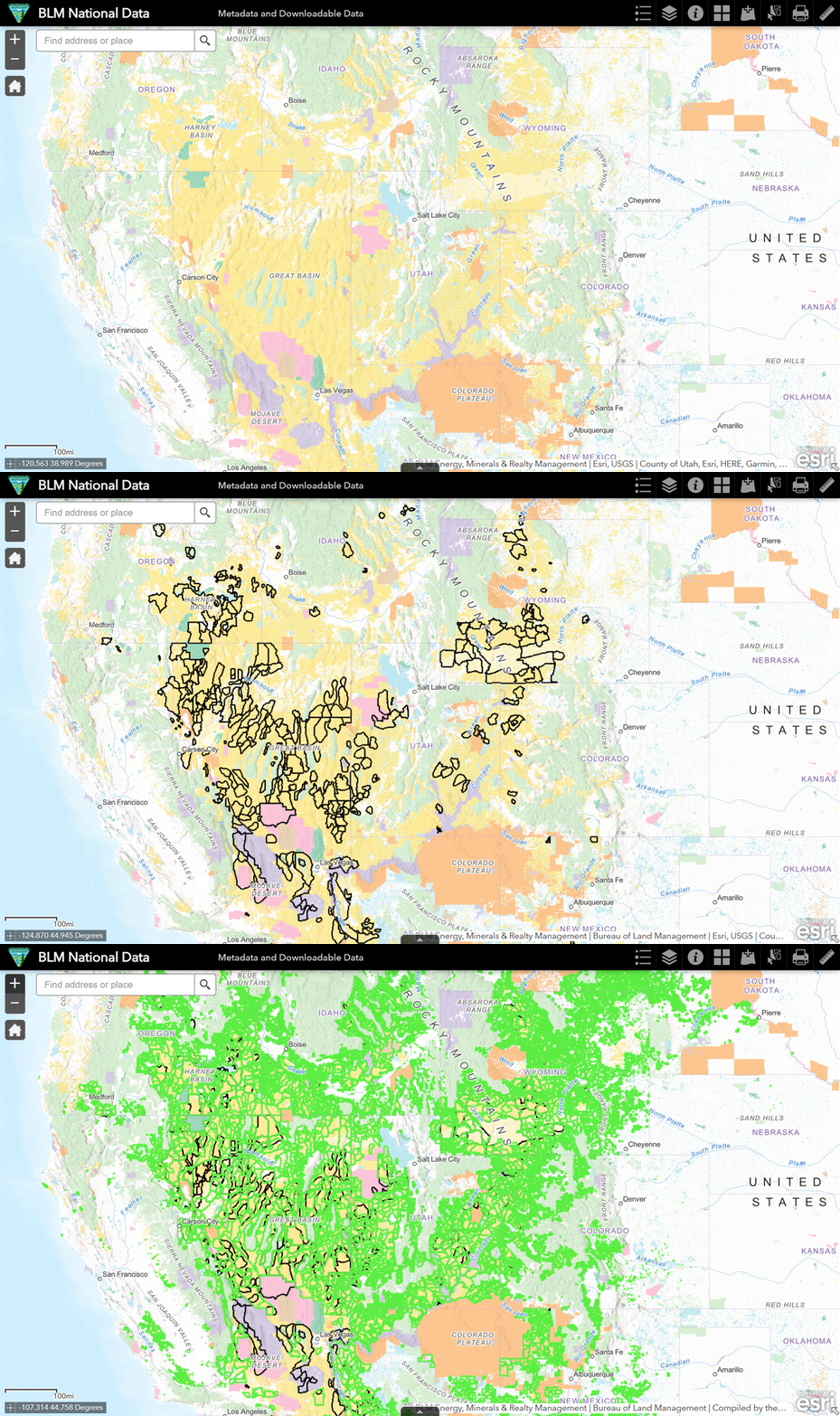
If privately owned livestock, not mentioned in the column, receive 80% of the authorized forage in an area set aside for wild horses, the driver of the roundups and downstream programs, including the stockpiling of captured animals, that specification, and the consequences thereof, will be reflected in the new HMAP.

Resource Allocations and HMAPs 12-06-22

HMAPs are useless without changes to the RMPs!

The writer also endorses HR 6635, the ridiculous helicopter ban, that won’t stop the flow of horses off the range because it doesn’t touch the RMPs and the beliefs, attitudes and priorities of those who write them.

RELATED: The Three R’s of HMAPs.

MHF Coordinator Set Right by Public-Lands Rancher

Ann Souders, Community Engagement Coordinator for the Mustang Heritage Foundation, initially was a vocal opponent of wild horse adoption. according to a story by Cowboy State Daily but changed her mind after speaking with Wyoming horse expert Ken McNabb and is now focused on raising awareness, providing education and increasing the placement of wild horses and burros into private care.

Not mentioned in the report is McNabb’s side hustle: Running cattle on Himes Group, a BLM allotment managed by the Cody Field Office.

Himes Group Allotment Map 12-05-22

The Allotment Master Report puts it in the Improve category, with McNabb receiving 73 AUMs per year.

The Authorization Use Report shows 37 head allowed on public lands from mid-April to mid-June.

It’s a small operation but that does not absolve him from conflicts of interest when handing out advice about wild horses.

The aim of MHF is to increase the number of successful adoptions and placements into private care, through programs such as EMM and TIP, not to raise awareness about the mismanagement of resources in areas set aside for wild horses.

Mismanagement of Resources in Wild Horse Areas 12-05-22

Pokegama Update

The incident started on September 26, when a stallion and mare were captured.

Another stallion was captured on September 28.

No horses were taken between September 29 and November 20.

Two stallions, a mare and a foal were trapped on November 21, bringing the total to seven.

One horse died on November 22.

Three horses were returned to the range but no details were given.

The capture and removal goals are 200 each.

RELATED: Pokegama Roundup in Progress.

Foal-Free Friday, What’s Past Is Prologue Edition

Long-term trends in resource management indicate greater need for helicopter roundups and population suppression.

History of Wild Horse and Burro Program 12-01-22

Instead of turning the clock back, the advocates have bet their futures on population suppression.

And they want you to pay for it.

Whenever you see references to cruel and costly roundups, humane management, keep them wild and free, or protect our cherished horses, you know you’re being swindled.

RELATED: Foal-Free Friday, Indoctrinating the Youngsters Edition.

New Rule to Curb Methane Releases on Public Lands?

The proposed rule will tackle methane emissions and bring federal regulations in line with technological advances, while providing a fair return to taxpayers, according to yesterday’s news release.

Private-sector activity is “wasting valuable publicly owned resources that could be put to productive use, and depriving American taxpayers, Tribes, and States of substantial royalty revenues,” as explained on page 14 of the pdf.

Worse, methane is a greenhouse gas that contributes to man-made climate change.

Sounds great.  The BLM is finally cracking down on public-lands ranching?

Nope, the focus is oil and gas production, which can only drive up the cost of domestic energy and everything derived therefrom.

Were you expecting something different from liberals?

FY 2023 Roundup Schedule Delayed by Spending Bill?

The FY 2022 schedule still appears at the BLM gather and removal page.

A Continuing Appropriations Act, signed on September 30, provided funding for the federal government through December 16.

A new schedule can’t be published until a full-year appropriations bill has been passed by Congress and signed into law?

The new fiscal year started on October 1.

RELATED: Another Beatys Butte Roundup in the Works.

This Clock Runs Backwards

The history of the wild horse and burro program is shrinkage: Less land and fewer resources.

The statute is slowly being nullified, one HMA at a time.

The next chapter in the story, the Rock Springs RMP Amendments, will rank among the greatest losses for wild horses.

Today, the advocates, not limited to the Campaign Against America’s Wild Horses, its affiliates, offshoots and supporters, offer to facilitate the removals and ruin the herds with the Montana Solution.

Keep that in mind on Giving Tuesday.

RELATED: WARNING: The Advocates Don’t Have a Better Way.

This Clock Runs Backward 11-28-22

Praising the Currituck Advocates

This fawning report by The Outer Banks Voice does not mention the darting program, concerns by Currituck County Commissioners arising therefrom or the decision earlier this year to halt the treatments.

A bit further up the coast, on the Maryland side of Assateague Island, the herd shows no growth six years after the darting program was shut off.

The same thing is happening in other areas, including the Virginia Range, Salt River and Pine Nut Mountains.

National treasures ruined by nitwits.

RELATED: Advocates Know PZP Sterilizes.

Resource Management Bias

The AML for wild horses across all HMAs is 23,866, with 2,919 burros allowed by plan, according to the HMA stats for March 1.

That’s equivalent to 25,326 wild horses, in terms of resource loading, on 26,917,766 public acres.

The stocking rate allowed by plan is 0.94 horses per thousand acres.

The BLM sells around 12 million AUMs per year to livestock operators on 155 million public acres, give or take.

That resource would support one million wild horses, for a stocking rate 6.45 horses per thousand acres.

Forage production works out to 77.4 AUMs per year per thousand acres for livestock and 11.3 AUMs per year per thousand acres for horses.

In some cases, it’s the same land.

Why the disparity?

It’s not because forage on public lands is favored by livestock and shunned by horses.

There’s considerable dietary overlap.

It’s because the bureaucrats have decided to manage the land for the benefit of the ranchers, with the full cooperation of the advocates.

RELATED: Cost of Removals.

Thriving Ecological Balance-3