In Dayton, NV with Desert Explorer 302.
Category: Range
On the range
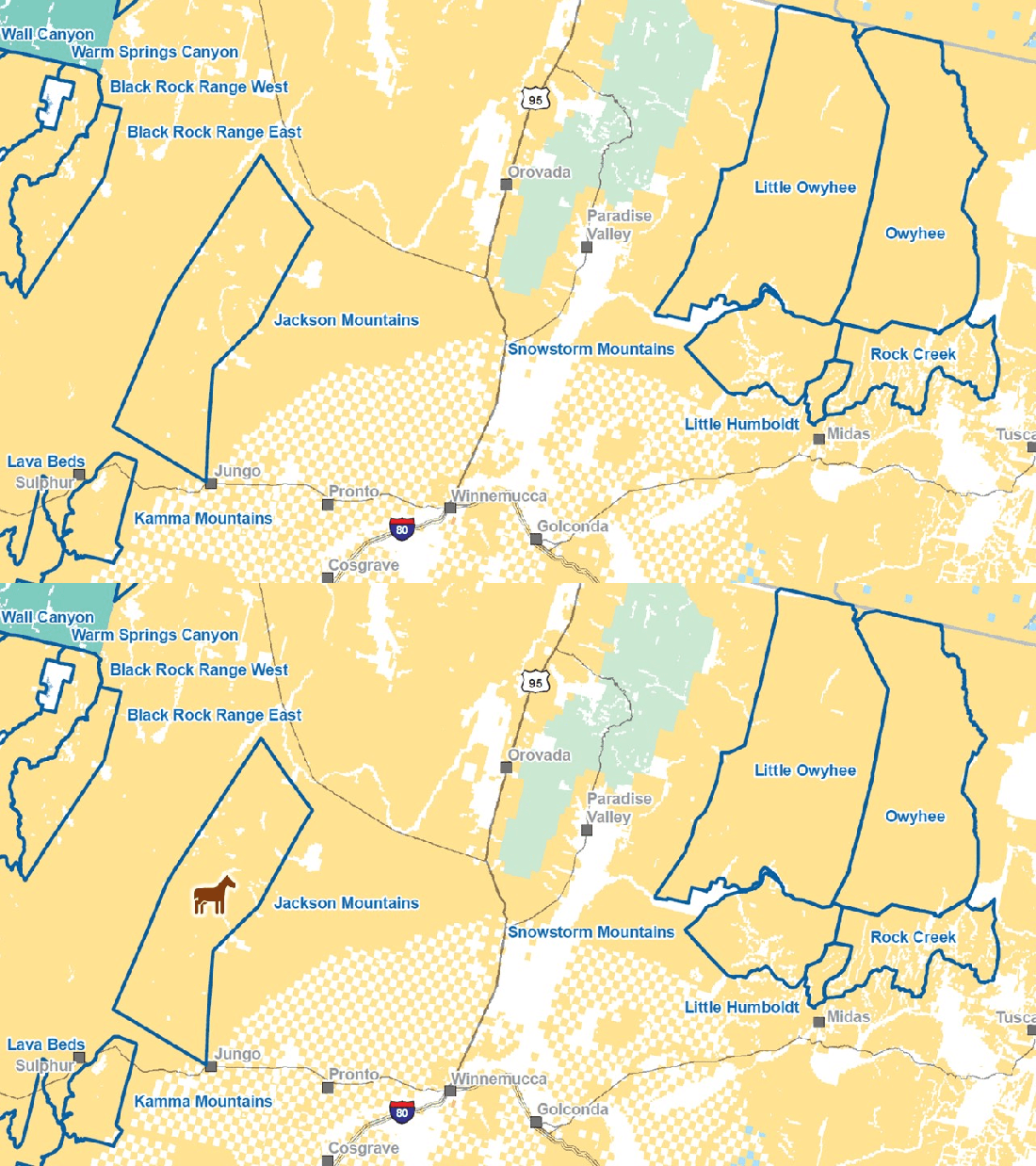
Antelope Roundup Day 20
The incident began on August 2. Gather stats through August 21:
- Horses captured: 1,491, up from 1,402 on Day 18
- Average take: 74.6 horses per day
- Capture goal: 2,200
- Removal goal: 2,200
- Returned: 0
- Deaths: 6, no change from Day 18
- Shipped: 1,467, up from 1,314 on Day 18
The death rate is 0.4%.
Foals accounted for 18.2% of the horses gathered. Of the adults, 42.7% were male and 57.3% were female.
Body condition scores were not reported.
Day 20 ended with 18 unaccounted-for animals.
The gap between males and females has increased. The observed percentages cannot be produced by a random process centered at 50% males / 50% females with n = 1,219 adults. The range of expected variation is found with basic statistical formulas.
To date, 520 stallions have been taken from the Complex, with 699 mares. The sex of the foals was not provided.
Other statistics:
- AML: 789 (four HMAs involved)
- Forage assigned to horses: 9,468 AUMs per year
- Pre-gather population: 6,032 plus foals
- Forage liberated to date: 17,892 AUMs per year
- Water liberated to date: 14,910 gallons per day
- Forage assigned to livestock: 72,946 AUMs per year (estimated)
- Horses displaced from HMAs by livestock: 6,079 (12% of off-range holding)
- Remark: Yes, Virginia, it’s that bad
- True AML: 6,868
RELATED: Antelope Roundup Day 18.
Support for ‘Path Forward’ Much Greater Than You Think
The Campaign Against America’s Wild Horses is not a signatory in fact, but a signatory in principle, along with thousands of Kool-Aid drinkers across the country.
They’re working diligently to get rid of as many wild horses as possible with PZP, which helps the public-lands ranchers.
Of interest in the following video is the remark at 6:44 that there isn’t a good way to calculate the number of wild horses an area can support.
The government has already told you what resources are available and has assigned them to multiple users.
Divide the forage assigned to livestock by twelve and add the result to the AML. That’s the True AML, the number of horses an area could support if it was managed principally for horses, as specified in the statute.
The calculation often shows that the area is not overpopulated, and has no excess horses, which undercuts their business model.
RELATED: Wild Horses Have Targets on Their Backs?
Health Officials Shun Ivermectin
This article by KXAN News of Austin, TX looks at the tablet form of the drug, although it shows a photo of the paste.
The bureaucrats want to you to wear a mask and take the clotshots.
For an alternative view, search for ‘barnhardt ivermectin’ and follow the link.
RELATED: Ivermectin Flying Off Shelves?
Conger Roundup Day 11
The incident began on August 11. Gather stats through August 21:
- Horses captured: 213, up from 188 on Day 9
- Average take: 19.4 horses per day
- Capture goal: 320
- Removal goal: 296
- Returned: 0
- Deaths: 1, no change from Day 9
- Shipped: 211, up from 138 on Day 9
The death rate is 0.5%.
Foals accounted for 23.0% of the horses gathered. Of the adults, 43.9% were male and 56.1% were female.
Body condition scores were not reported.
Day 11 ended with one unaccounted-for horse.
Other statistics:
- AML: 80
- Forage assigned to horses: 960 AUMs per year
- Pre-gather population: 355
- Forage liberated to date: 2,556 AUMs per year
- Water liberated to date: 2,130 gallons per day
- Forage assigned to livestock: Unknown
- Horses displaced from HMA by livestock: Unknown
- True AML: Unknown
RELATED: Conger Roundup Day 9.
Sand Wash Horses Get Short End of Stick
The HMA covers 156,502 acres in northwest Colorado and has an AML of 362, according to Table 1 of the Final EA for resource enforcement actions therein.
The horses allowed by plan require 4,344 AUMs per year and the aimed-at stocking rate is 2.3 wild horses per thousand acres. The average rate across all HMAs is one wild horse per thousand acres.
The HMA intersects four grazing allotments, per Table 2.1 in the EA. The status of the allotments was discussed in the post.
The paragraph above the table explains the forage allocations inside the HMA but does not give a number for the Nipple Rim allotment, stating that roughly half of the use occurs within the HMA.
Footnote 2 in Table 2 on page 206 (in the pdf) suggests that 1,989 AUMs per year are available to the Nipple Rim permittees inside the HMA so that figure was copied into the spreadsheet.
Table 1 on page 208 provides the allotment acreage inside the HMA. The total is very close to the acreage assigned to the horses so the HMA is probably 100% subject to permitted grazing.
June, July and August are the only months when livestock are not present.

The total acreage and active AUMs were sourced from the Allotment Master report.
The land, when designated for livestock grazing, can produce an average of 111.4 AUMs per year per thousand acres, but when identified for wild horses, can only produce 4,344 ÷ 156,502 × 1,000 = 27.7 AUMs per year per thousand acres.
The total forage assigned to livestock inside the HMA is 16,827 AUMs per year.
Western Horse Watchers usually converts AUMs to horses and cow/calf pairs, even if the HMA is designated for burros and/or the allotments are permitted for sheep. The resource requirements of wild horses and cow/calf pairs are said to be equivalent.
The Lang Spring permittee would have to place 363 ÷ 8 = 45 cow/calf pairs inside the HMA to graze off the allotted forage within the permitted season. Likewise for the other permittees.
The total number of cow/calf pairs inside the HMA is 2,549, for a weighted average grazing season of 16,827 ÷ 2,549 = 6.6 months per year.
The stocking rate at Nipple Rim is 284 ÷ 16,247 × 1,000 = 17.5 cow/calf pairs per thousand acres and the overall rate is 2,549 ÷ 156,925 × 1,000 = 16.2 cow/calf pairs per thousand acres.
These figures are compared in the following charts.

The HMA is managed primarily for livestock, contrary to §1332(c) of the statute, with the horses receiving just 21% of the authorized forage, neglecting wildlife.
The forage assigned to livestock would support an additional 16,827 ÷ 12 = 1,402 horses, for a True AML of 1,764.
The pre-gather population of 896 (Table 1, page 7 in EA) is well within this range, so there are no excess horses, no overpopulation and no justification for a fertility control program. The advocates are wrong again.
The 1,402 wild horses displaced from the HMA by privately owned livestock represent 2.8% of the 50,000 horses in off-range holding.
Although dry conditions have limited the availability food and water in the area, these circumstances are temporary but the removal is permanent. You can have your wild horse and burro program as long as it doesn’t interfere with the grazing program.
RELATED: Sand Wash Decision Reached.
Longmeadow BabyCam Still Up and Running
Looks like it’s set up for 12 hours of live feed on days followed by 12 hours of video at night.
RELATED: Mare Headed to Slaughter but Spared by Crash Has Foal.
Reducing Harm to Assateague Wild Ponies?
A new program urges motorists to drive carefully on the island and “Give Wild Horses a Brake,” according to a news release by the Maryland Department of Natural Resources.
Visitors feeding the horses or otherwise encouraging them to come near campgrounds and vehicles has left them unafraid of people and cars, making them more susceptible to injury on the roads.
The greatest threat to these horses, and the #1 cause of their loss, is humans that shoot them with contraceptive darts.
Although the practice was stopped five years ago, the herd was only able to generate a 7.8% birth rate this year, barely enough to keep up with the death rate.
That should scare the crap out of anyone interested in protecting these animals.
Status of Sand Wash Allotments
Table 2.1 in the Final EA for resource enforcement actions in Sand Wash Basin HMA identifies four allotments that intersect the HMA. Only one is fully inside.
The Allotment Master report in RAS provides the following information:
Lang Spring
- Public acres: 3,249
- Management status: Maintain
- Active AUMs: 364
Nipple Rim
- Public acres: 39,142
- Management status: Improve
- Active AUMs: 4,900
Sheepherder Spring
- Public acres: 74,147
- Management status: Improve
- Active AUMs: 9,042
Sand Wash
- Public acres: 69,457
- Management status: Improve
- Active AUMs: 7,568
Three out of four allotments do not meet standards for rangeland health.
Bad as that is, substandard conditions apply to 98.3% of the public acreage.
Our stewards of the public lands are not taking their responsibilities seriously.
Solution? Get rid of 85% of the wild horses.
RELATED: Sand Wash Decision Reached, Allotment Categories Explained.
Stinkingwater Roundup Day 5
The incident began on August 15. Gather stats through August 19:
- Horses captured: 364, up from 294 on Day 3
- Average take: 72.8 horses per day
- Capture goal: 420
- Removal goal: 390
- Returned: 0
- Deaths: 2
- Shipped: 362, up from 292 on Day 3
Gather operations have concluded. The death rate was 0.5%.
Foals accounted for 26.1% of the horses gathered. Of the adults, 45.4% were male and 54.6% were female.
Body condition scores were fours and fives.
Day 5 ended with no unaccounted-for animals.
Other statistics:
- AML: 80
- Forage assigned to horses: 960 AUMs per year
- Pre-gather population: 449
- Forage liberated to date: 4,368 AUMs per year
- Water liberated to date: 3,640 gallons per day
- Forage assigned to livestock: 8,455 AUMs per year (estimated)
- Horses displaced from HMA by livestock: 705
- True AML: 785
RELATED: Stinkingwater Roundup Day 3.
Wild Horses Have Targets on Their Backs?
Whatever gave you that idea?

Snippet from article by Courthouse News dated August 13.
Wild horses need protections from the advocates just like they need protections from the ranchers.
Antelope Roundup Day 18
The incident began on August 2. Gather stats through August 19:
- Horses captured: 1,402, up from 1,244 on Day 16
- Average take: 77.9 horses per day
- Capture goal: 2,200
- Removal goal: 2,200
- Returned: 0
- Deaths: 6, up from 5 on Day 16
- Shipped: 1,314, up from 1,185 on Day 16
A stallion was put down on Day 18 due to a physical defect. The death rate is 0.4%.
Foals accounted for 18.1% of the horses gathered. Of the adults, 43.8% were male and 56.2% were female.
Body condition scores were not reported.
Day 18 ended with 82 unaccounted-for animals.
The observed percentages of males and females cannot be explained by a simple random process centered at 50% males / 50% females with n = 1,148 adults. The sex of the foals was not provided.
Other statistics:
- AML: 789 (four HMAs involved)
- Forage assigned to horses: 9,468 AUMs per year
- Pre-gather population: 6,032 plus foals
- Forage liberated to date: 16,824 AUMs per year
- Water liberated to date: 14,020 gallons per day
- Forage assigned to livestock: 72,946 AUMs per year (estimated)
- Horses displaced from HMAs by livestock: 6,079 (12% of off-range holding)
- True AML: 6,868
RELATED: Antelope Roundup Day 16.
Conger Roundup Day 9
The incident began on August 11. Gather stats through August 19:
- Horses captured: 188, up from 160 on Day 7
- Average take: 20.9 horses per day
- Capture goal: 320
- Removal goal: 296
- Returned: 0
- Deaths: 1, no change from Day 7
- Shipped: 138, up from 124 on Day 7
The death rate is 0.5%.
Foals accounted for 23.9% of the horses gathered. Of the adults, 42.7% were male and 57.3% were female.
Body condition scores were not reported.
Day 9 ended with 49 unaccounted-for horses.
Other statistics:
- AML: 80
- Forage assigned to horses: 960 AUMs per year
- Pre-gather population: 355
- Forage liberated to date: 2,256 AUMs per year
- Water liberated to date: 1,880 gallons per day
- Forage assigned to livestock: Unknown
- Horses displaced from HMA by livestock: Unknown
- True AML: Unknown
RELATED: Conger Roundup Day 7.
AJR-5 Moves to State Senate
The resolution carried in the Assembly by a vote of 59 to 4 on August 16.
RELATED: AJR-5 Advances to Third Reading.
Antelope Roundup Day 16
The incident began on August 2. Gather stats through August 17:
- Horses captured: 1,244, up from 1,101 on Day 14
- Average take: 77.8 horses per day
- Capture goal: 2,200
- Removal goal: 2,200
- Returned: 0
- Deaths: 5, up from 4 on Day 14
- Shipped: 1,185, up from 958 on Day 14
A stallion was put down on Day 16 due to blindness. The death rate is 0.4%.
Foals accounted for 17.9% of the horses gathered. Of the adults, 44.6% were male and 55.4% were female.
Body condition scores were not reported.
Day 16 ended with 54 unaccounted-for animals.
The gap between males and females is larger than expected for a simple random process centered at 50% males / 50% females producing groups of n = 1,021 adults. The sex of the foals was not provided.
Other statistics:
- AML: 789 (four HMAs involved)
- Forage assigned to horses: 9,468 AUMs per year
- Pre-gather population: 6,032 plus foals
- Forage liberated to date: 14,928 AUMs per year
- Water liberated to date: 12,440 gallons per day
- Forage assigned to livestock: 72,946 AUMs per year (estimated)
- Horses displaced from HMAs by livestock: 6,079 (12% of off-range holding)
- True AML: 6,868
RELATED: Antelope Roundup Day 14.
Mare Headed to Slaughter but Spared by Crash Has Foal
The truck carrying her and 28 others to slaughter last October flipped into the median, but she survived and now has a colt, according to a story posted yesterday by KTVI News of St. Louis, MO.
Check out the babycam by Longmeadow Rescue Ranch!
RELATED: Saved by a Wreck.
Conger Roundup Day 7
The incident began on August 11. Gather stats through August 17:
- Horses captured: 160, up from 121 on Day 5
- Average take: 22.9 horses per day
- Capture goal: 320
- Removal goal: 296
- Returned: 0
- Deaths: 1, no change from Day 5
- Shipped: 124, up from 87 on Day 5
The death rate is 0.6%.
Foals accounted for 25.0% of the horses gathered. Of the adults, 40.8% were male and 59.2% were female.
Body condition scores were not reported.
Day 7 ended with 35 unaccounted-for horses.
Given the high percentages of mares and foals in the total, is the contractor targeting family bands?
Other statistics:
- AML: 80
- Forage assigned to horses: 960 AUMs per year
- Pre-gather population: 355
- Forage liberated to date: 1,920 AUMs per year
- Water liberated to date: 1,600 gallons per day
- Forage assigned to livestock: Unknown
- Horses displaced from HMA by livestock: Unknown
- True AML: Unknown
RELATED: Conger Roundup Day 5.
Senator Calls for Review of WHB Adoption Program
Refer to this story by AP News, posted today. The investigation would focus on the slaughter pipeline, not the resource allocations and land-use plans that drive the roundups and downstream programs.
RELATED: New AIP Safeguards in the News.
Stinkingwater Roundup Day 3
The incident began on August 15. Gather stats through August 17:
- Horses captured: 294
- Average take: 98.0 horses per day
- Capture goal: 420
- Removal goal: 390
- Returned: 0
- Deaths: 2
- Shipped: 292
One death occurred on Day 1 and another on Day 2, both due to pre-existing conditions.
Foals accounted for 26.9% of the horses gathered. Of the adults, 42.8% were male and 57.2% were female.
Body condition scores were fours and fives.
Day 3 ended with no unaccounted-for animals. Gather operations will likely conclude in another day or two.
Other statistics:
- AML: 80
- Forage assigned to horses: 960 AUMs per year
- Pre-gather population: 449
- Forage liberated to date: 3,528 AUMs per year
- Water liberated to date: 2,940 gallons per day
- Forage assigned to livestock: 8,455 AUMs per year (estimated)
- Horses displaced from HMA by livestock: 705
- True AML: 785
RELATED: Stinkingwater Roundup Begins.
Sand Wash Decision Reached
A Decision Record for resource enforcement actions in the Sand Wash Basin HMA over the next ten years was signed today, according to a BLM news release.
The Proposed Action, authorized thereby, features gathers and removals to low end of AML, fertility control and sex ratio skewing via selective return. Refer to page 14 in the Final EA, posted with other project documents.
A roundup is set to begin in the area on September 1 per the latest schedule.
RELATED: Comments Invited on Draft EA for Sand Wash Gather Plan.