Chincoteague Pony Auction Next Week

The herd will not be forced to swim across the channel this year but the mares and foals will be trailered to the carnival grounds after roundups and sorting on July 25 and 26, according to an announcement by the Chincoteague Volunteer Fire Company.

The foals will be auctioned and the mares returned to their home territory (Virginia side of Assateague Island).

The announcement did not say if any of the foals would rejoin the herd and provided no information on long-term trends in herd sizes, sex ratios and genetic diversity.

RELATED: Chincoteague Pony Swim Called Off Again.

Onaqui Roundup Day 4

The incident began on July 14.  Gather stats through July 17:

  • Horses captured: 344
  • Capture goal: 400
  • Removal goal: 296
  • Returned: 1
  • Deaths: 1
  • Shipped: 342

One death occurred on Day 3, related to the roundup.

Foals accounted for 10.2% of the horses gathered.  Of the adults, 48.9% were male and 51.1% were female.

There were no unaccounted-for horses.

Some of the mares will be treated with contraceptives and returned to the HMA along with some of the stallions.

Gather operations will likely conclude in another day or two.

Supplemental statistics:

  • AML: 210
  • Pre-gather population: 500
  • Forage liberated to date: 4,116 AUMs per year
  • Water liberated to date: 3,430 gallons per day
  • Horses displaced from HMA by livestock: 1,300 (estimated)
  • True AML: 1,510 (estimated)
  • Excess animals before roundup: None

RELATED: Onaqui Roundup Day 2.

How Many Cattle and Sheep Are on the Onaqui Mountain HMA?

That’s a hard question to answer, for the reason noted in this post, but the number of cattle and sheep in the Onaqui allotments is easy.

Go to the Authorization Use report in RAS.

  • State: Utah
  • Field office: Salt Lake
  • Allotments: Refer to Table 1 in the Onaqui Comment Report

Click Apply to run the report.  How do you know the field office?  Look at the news release for the roundup.

You can download the report by clicking on the gear icon in the upper right or you can view it here.

Western Horse Watchers recommends that you work with resource allocations, not the number of animals, to get the best understanding of the way our wild horses and burros are being managed.

RELATED: How Many Livestock Are on the Onaqui Mountain HMA?

Value of Forage in HMAs?

Refer to items [12], [13] and [14] of comment #1960 in the Onaqui Comment Report, starting at the bottom of page 136 in the pdf.

The 19,235 AUMs in the grazing permits provide roughly $1.9 million in benefits to local economies.  That’s about $100 per AUM per year in economic activity.

Now we can put a price tag on wild horses.

The Onaqui AML is not 210, but 210 × 12 × 100 = $252,000 per year in lost economic value.

The pre-gather population of 500 represents 500 × 12 × 100 = $600,000 per year in lost economic activity.

The answer is obvious: Remove the horses and give their food to the ranchers.

This is an area where the advocates can unite with the cattlemen in their desire to get rid of wild horses.

RELATED: Advocates Frustrated with Onaqui Roundup?

Advocates Frustrated with Onaqui Roundup?

Must be tough.  They’re watching a contractor get rid of the horses with helicopters when they could be doing the same with their darting rifles.

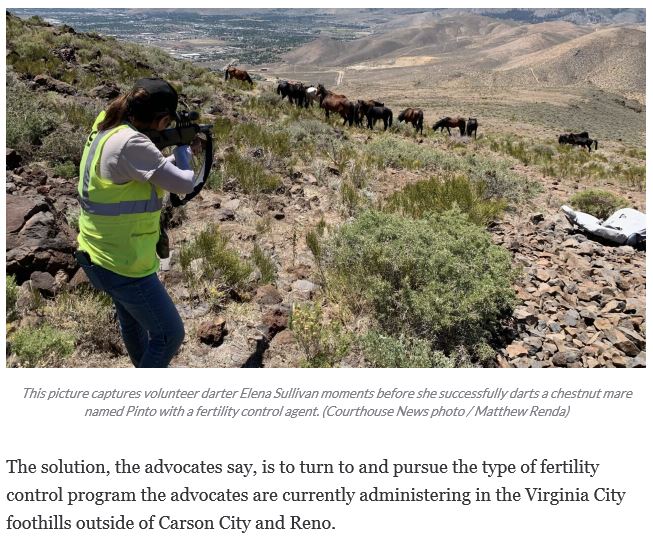
Most of them want the mares treated with PZP, a pesticide, to keep the herd in check without having to resort to sterilization or roundups, according to a report posted this morning by The Salt Lake Tribune.

Nobody’s talking about land-use plans, resource allocations and the reasons for wild horse removals.

Nobody except Western Horse Watchers.

RELATED: Status of Onaqui Allotments, Wild Wednesdays at Onaqui Mountain HMA.

Status of Onaqui Allotments

The 2018 EA for resource enforcement actions in the HMA provided little information about livestock grazing, as noted by some of the commenters.

Table 1 in the Comment Report shows ten allotments that intersect the HMA, along with size, available AUMs and grazing seasons.

Unfortunately, the percentage of grazing land (or forage) falling inside the HMA was not provided, so a ‘Short End of Stick’ report is not possible.

All of the data in following table were taken from the Allotment Master report in RAS except the 2018 AUMs, which were sourced from Table 1.

Onaqui Allotment Data 07-16-21

The AUM figures in Table 1 for West Lookout Pass appear to be for the number of animals on the permit, not the amount of forage, per the Authorization Use report for the allotment.  The grazing seasons may also be incorrect, so the 2018 allocation was assumed to be the same as 2021 and that’s why the value is marked in red.

The HMA contains about 205,000 public acres according to the EA.  The allotments contain about 267,000 public acres, so some of them must extend beyond the HMA boundaries.  The map provided with the EA does not show their boundaries.

Six of the ten allotments do not meet standards for rangeland health.

Eighty six percent of the public acres in the allotments do not meet standards for rangeland health.
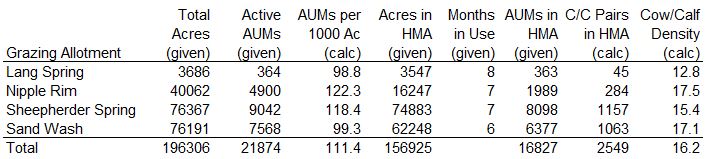
For every public acre in the Maintain category, there are six acres in the Improve category.

There is no category for blaming substandard conditions on wild horses.

Suppose that 80% of the permitted forage falls within the HMA, about 15,700 AUMs per year.

The horses allowed by plan receive about 2,500 AUMs per year, so livestock would be receiving six times more forage than the horses—on land set aside for the horses.

The HMA would be managed primarily for livestock.

The forage assigned to livestock would support an additional 1,300 wild horses, for a True AML of 1,510.

The pre-gather population was about 500, so there were no excess horses in the HMA and no justification for a roundup or fertility control program.

The 1,300 wild horses cheated out of a spot on their home range account for 2.6% of the 50,000 horses in off-range holding.  How many more HMAs would you have to look at to account for all of them?

RELATED: How Many Livestock Are on the Onaqui Mountain HMA?

Virtual Fences Coming to a Pasture Near You?

Think of it as GPS-enabled shock collars.  You enter the coordinates of the pasture into the base station, slap on the collars and the system will gently persuade your livestock to stay within the pre-defined boundaries.

There are no posts, no gates, no buried wires.

The story by KFOR News of Oklahoma City did not say what might happen if the power goes out or atmospheric conditions interfere with GPS signals.

The range of the system is not known and if it requires line-of-sight communications between the base station and the animals.

Nevertheless, the technology may be of interest to those on the political left who want to control everything, including you.

A GPS-enabled kill switch in your car would warn you when you’re approaching the limits set by your masters.  An ankle bracelet might do the same if you’re on foot.

Curiously, those who would enslave you are the ones tearing down statues because they’re associated with slavery.

BLM to Decimate Onaqui Herd, Advocates Offer to Do That

“The science is on our side,” according to a delegate of the Cloud Foundation, stating that “there are win-win solutions that can benefit the ranchers and our wild horses.”

The reference, of course, is to PZP darting of wild mares.  The term appears three times in this article by The Salt Lake Tribune.  Drive the birth rate to zero and let the herd die off.  Don’t let the horses reclaim any of their food from the cattlemen.

Any of you still wondering who the turncoats are in the wild horse world?

Undeniable Truth #2.

RELATED: Capitulation to Ranching Agenda at Onaqui Mountain HMA.