Rock Springs Wild Horse Gather Plan Approved

The Decision Record was signed today, clearing the way for a roundup in October that will gather approximately 4,400 wild horses from five HMAs, according to the news release, with 3,555 to be removed.

Mares returned to the range will be treated with fertility control.

The Final EA was posted with other project documents.

The project is not associated with the Rock Springs RMP Amendments, which will close three of the HMAs and downsize a fourth.

RELATED: Comments Invited on Draft EA for Rock Springs Gather Plan.

Tamarack Fire Enters Nevada

The fire crossed into Douglas County yesterday.  The area burned is now 43,900 acres, according to the overview at Inciweb, with no containment.

Yesterday’s 5:30 PM update said Highway 395 has been closed and the Spring Valley Subdivision is threatened.

A report by Carson Now said the flames jumped the highway but fire crews were able to stop the spread.

RELATED: Tamarack Fire Approaching Nevada State Line.

Tamarack Fire Map 07-22-21

Comments Invited on Draft EA for Sinbad Management Actions

Today, the BLM published a preliminary environmental assessment for resource enforcement actions in the Sinbad HMA.  Comments can be submitted through August 20, according to the news release.

The proposed action features periodic gathers to remove excess animals, fertility control vaccines and possible use of IUDs.  The plan would be valid for ten years.

The HMA covers 99,241 acres in central Utah and has an AML of 70 wild burros, equivalent to 35 wild horses.  The equivalent stocking rate is 0.35 wild horses per thousand acres, considerably lower than the average rate of one wild horse per thousand acres across all HMAs.

Sinbad HMA Map 07-21-21

The HMA intersects seven grazing allotments, according to Table 6 in the EA.  Burros have not been documented in two of them per the footnotes.  A map provided with the project documents shows the arrangement.

Concerns about resource allocations and management priorities, although valid, should not be submitted as they are outside the scope of the project.

The problem is upstream, in the Price RMP, cited numerous times in the EA.

An emergency roundup occurred in the area about a year ago.

RELATED: Sinbad Burros Getting Short End of Stick?

Tamarack Fire Approaching Nevada State Line

The fire started on July 4, according to the overview at InciWeb, and was monitored until July 16 when rapid growth prompted the deployment of firefighting resources.

Douglas County, home of the Pine Nut and Fish Springs horses, is now threatened but no evacuation orders have been issued.

This video from Storey County, a few miles to the north, suggests that the Virginia Range mustangs are also affected.

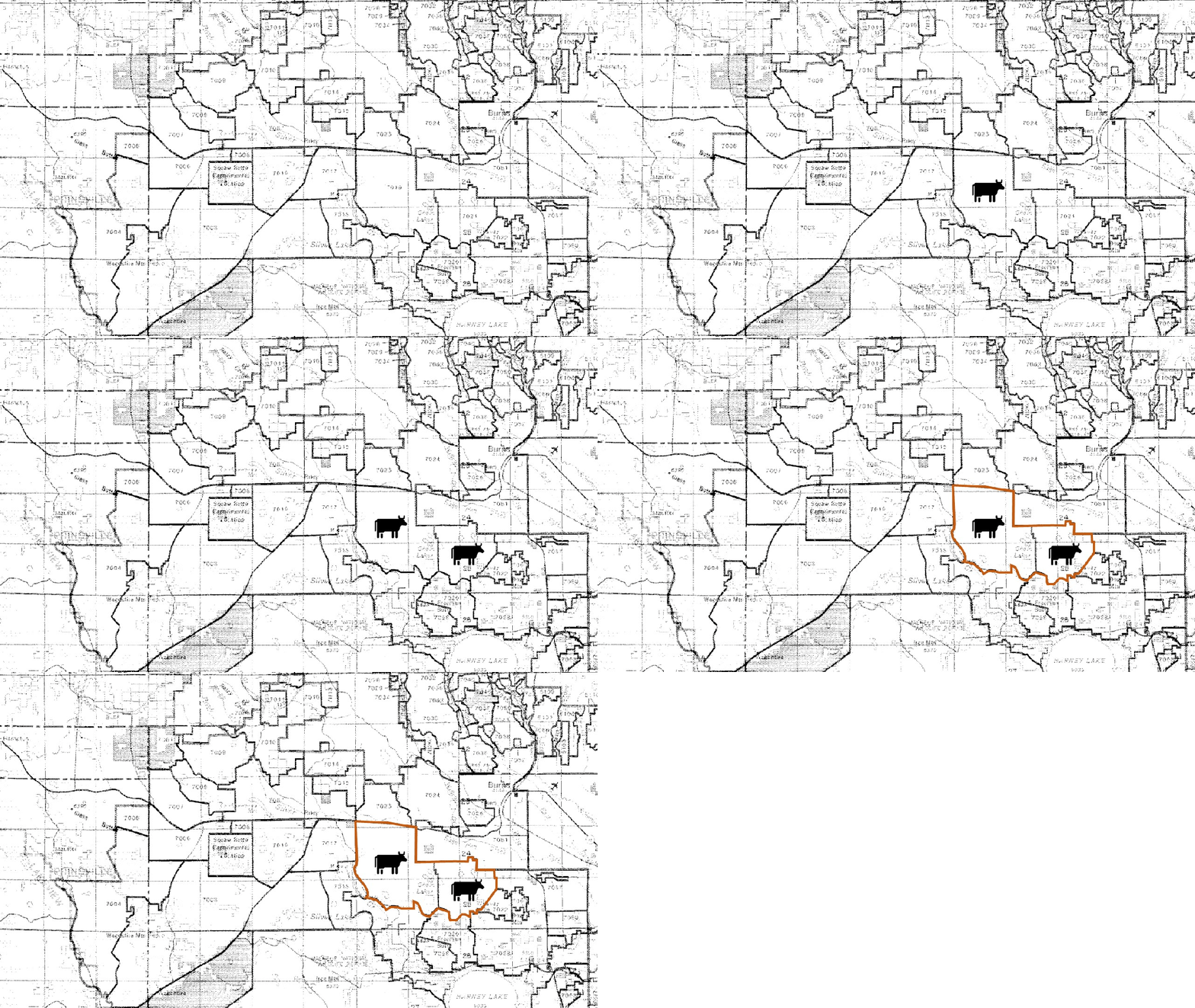
A Tale of Two Interests

Imagine a parking lot with room for 1,500 cars.

One day, when the lot contains almost 500 cars, the government says that it can only support 200.

“That’s strange,” you think to yourself, “I can see that the capacity is much larger than 200, they’re lying!”

The next day, the government announces a plan to remove the excess cars.  A towing company has been hired to do the job in five days.

When the story breaks, a parking-rights group argues that towing can be rough on cars, claiming that damage can be minimized if the cars are dismantled and carried out piece by piece.  The process will be slower but the results will be the same.

The group does not question the government’s assertion and does not oppose the removal, only the way it will be carried out.

The government is not convinced by their argument and while the tow trucks are working, opens the lot to 18-wheelers taking a break from the nearby interstate.

“That’s just wrong,” you say to yourself, “this lot was meant for cars, not big rigs.”

The parking-rights group protests the action, to no avail.

When it’s all said and done, only the truck drivers are smiling.

Tale of Two Interests-1

Onaqui Aftermath

A report by The Salt Lake Tribune says that 126 of the 433 horses shipped from the HMA will be returned, including mares treated with PZP.  The 307 remaining will be offered for adoption or placed into long-term holding.

An official acknowledged that most of the horses taken off the range exhibited fairly good body conditions, contrary to earlier reports that many were suffering from lack of water and forage due to overpopulation and drought.

RELATED: Onaqui Roundup Over.

Black Mountain Roundup, Part 2, Day 132

The operation began on March 9, a resource enforcement action that follows a wild burro removal in 2020Gather stats through July 18:

  • Burros captured: 303, up from 243 on Day 122
  • Capture goal: 500
  • Removal goal: Probably 500
  • Returned: 0
  • Deaths: 0
  • Shipped: 209, no change from Day 122

The cumulative total on the gather page is 306.

Foals represented 14.9% of the burros gathered.  Of the adults, 61.6% were male and 38.4% were female, not what you’d expect to find in a sample of n = 303 taken from a simple random process centered at 50% males / 50% females.

Do these results tell you anything useful about the herd at large?

There were 94 burros in the unaccounted-for category.

The incident is not open to public observation.

Supplemental statistics:

  • AML: 478
  • Pre-gather population: Unknown
  • Forage liberated to date: 1,818 AUMs per year
  • Water liberated to date: 1,515 gallons per day
  • Burros displaced from HMA by privately owned livestock: 1,222
  • True AML: 1,700
  • Excess animals before roundup: Unknown

RELATED: Black Mountain Roundup, Part 2, Day 122.

UPDATE: The limits of variation for males and females should be based on n = 258 adults, not n = 303.  The observed percentages are still outside the calculated limits with n = 258.  The formula for computing the limits can be found in this Wikipedia article.

Cibola-Trigo Roundup Over

Gather operations ended July 15 with 228 burros captured, 227 shipped and one death, according to figures at the gather page.

The goal was 200.

The gather page said 230 animals removed.

Foals represented 12.7% of the total.  Of the adults, 44.7% were male and 55.3% were female.  The number of unaccounted-for animals was zero.

The incident was not open to public observation.

RELATED: Cibola-Trigo Nuisance Roundup in Progress.

Onaqui Roundup Over

Gather operations ended today with 435 horses captured, one death and one returned, according to figures at the gather page.

The goal was 400.

Foals accounted for 10.8% of the total.  Of the adults, 47.9% were male and 52.1% were female.  The number of unaccounted-for animals was zero.

The incident liberated 5,208 AUMs per year for other mandated uses of public lands.

RELATED: Onaqui Roundup Day 4.

UPDATE: The AUMs liberated will be reduced by the horses returned to the HMA, including those treated with contraceptives.  The final figure may be closer to 4,000 AUMs per year, assuming 100 horses returned.

More AIP Fallout?

A rescue in West Fulton, NY has increased capacity to take in former wild horses that ended up in kill pens.  The woman running the operation pays 75 cents per pound to get them out and $1,000 or more to ship them home, according to a story posted yesterday by The Daily Gazette of Schenectady, NY.

She said that one of the mustangs brought in last year was supposed to be in long-term holding with the government paying a rancher for her care but she was handed off to kill buyers instead.

RELATED: Adoption Incentive Backfiring or Working Exactly as Planned?

Putting Price Tags on America’s Wild Horses and Burros

Comments on the 2018 EA for resource enforcement actions in the Onaqui Mountain HMA suggested that forage on public lands generates an economic benefit of about $100 per AUM per year.

If that’s true in other areas, a wild horse, who consumes 12 AUMs per year, represents an economic loss of $1,200 per year.

A wild burro, who devours six AUMs per year, represents a loss of $600 per year.

The AML for Twin Peaks HMA is 758 wild horses and 116 wild burros, for a total economic loss of $979,200 per year.

For simplicity, let’s assume the 27,000 animals allowed by plan on your public lands are horses only.  The economic loss is $32.4 million per year.

The current population of 95,000 represents a loss of $114 million per year.

As Archie D. Ryan of the DOI stated many years ago, “The wild horse consumes forage needed by domestic livestock.  They bring in no return and serve no useful purpose.”

RELATED: Value of Forage in HMAs?