American Prairie Acquires Another Base Property

This report by the Billings Gazette parallels a news release from American Prairie.

The property covers 4,960 total acres southwest of Malta, MT, including 3,075 deeded acres, 1,245 BLM acres and 640 state acres, according to the listing on Land & Farm.

The BLM land lies within the North Wild Horse Allotment, adjacent to the Fort Belknap Indian Reservation.

The Allotment Master Report puts it in the Custodial category, with 1,142 public acres and 143 active AUMs per year, enough to support twelve wild horses.

The Authorization Use Report shows a year-round grazing season.

American Prairie did not indicate if it would petition the BLM for a change in livestock type, to allow bison on the allotment instead of cattle.

RELATED: American Prairie Using Leverage to Achieve Conservation Goals.

North Wild Horse Allotment Map 03-31-23

Specialized Approach Dropped from Pryor Management Plan?

The preliminary plan noted that management of the WHR can be more specialized than that of most HMAs, but the concept has vanished from the preliminary EA now out for public review, according to a report dated March 30 by The Sheridan Press.

Strict adherence to BLM guidance has changed the document from specialized to standardized, similar to plans for wild horse areas across the country.

A woman interviewed for the story explained that all BLM lands are managed in accordance with RMPs, which establish how they will be used, a concept that eludes most advocates, especially those selling HMAPs as a solution to wild horse problems.

Comments on the EA will be accepted through April 14.

All documents have been posted to the project folder in ePlanning.

RELATED: Draft EA Released for Pryor Mountain RMP Update.

New Reg Would Treat All Public Lands Like Grazing Allotments?

The proposed rule would apply standards for rangeland health to all BLM-managed public lands and uses, including watershed function, ecological processes, water quality, and wildlife habitat.

According to the definitions, land enhancement means any infrastructure or other use related to the public lands that is designed to improve production of forage, improve vegetative composition, direct patterns of use to improve ecological condition, provide water, stabilize soil and water conditions, promote effective wild horse and burro management, or restore, protect, and improve the condition of land health or fish and wildlife habitat.

The term includes, but is not limited to, structures, treatment projects, and the use of mechanical devices or landscape modifications achieved through mechanical means.

Wild horse and burro management was not defined, but generally equates to population reduction, to be achieved by helicopters, baited traps, wranglers and/or pesticides, so the regulation could provide the authority to reduce AMLs and zero-out more HMAs.

The rule would direct land managers to identify and prioritize lands and waters through the land management process that require habitat restoration work, such as removing invasive species or restoring streambanks, according to today’s news release.

Publication in the Federal Register will initiate a 75-day public comment period, accompanied by five information forums to discuss the details of the rule.

What the Onaqui Advocates Are Trying to Protect

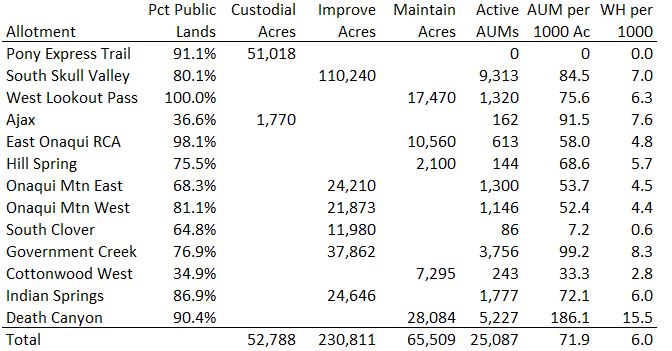
There are three layers of forage demand within the HMA: Horses, wildlife and livestock.

The 210 horses allowed by plan require 2,520 AUMs per year.

The HMA covers 507,681 total acres, including 375,915 public acres, according to the March 2022 HA/HMA Report.

The stocking rate allowed by plan is 0.6 wild horses per thousand public acres.

Recall that low stocking rates may indicate large amounts of forage assigned to privately owned livestock.

The land must be able to produce at least 6.7 AUMs per year per thousand public acres to support the horses.

The forage assigned to wildlife inside the HMA is unknown, but is probably small, maybe 200 to 300 AUMs per year.

The HMA intersects twelve grazing allotments, as noted previously.

The National Data Viewer shows thirteen, but one, the Pony Express Trail, has no active AUMs.  It appears as a gray strip across the HMA in the map below.

The Allotment Master Report at RAS provides acreage, management status and active AUMs (Salt Lake City Field Office | Fillmore Field Office).

Onaqui Allotment Calcs 03-29-23

About two-thirds of the land is in the Improve category.

The allotments provide 71.9 AUMs per year per thousand public acres, on average, 10.7 times more forage than the land can produce for the horses.  For the most part, it’s the same land!

As the advocates get rid of the horses, the ranchers can get enjoy more of what their allotments have to offer.

RELATED: Onaqui Herd Struggling?

Onaqui Allotments 09-29-21

Currituck Herd Grows by One?

Between four and six foals are born each year and the herd now numbers less than 100, according to a story dated March 27 by The Virginian-Pilot.

This is frightening.

The on-range population was 106 a year ago.

A herd of that size should produce 15 to 20 foals per year.

“We cannot afford to lose horses due to human-caused problems,” wrote herd manager Meg Puckett in a post on socialist media.  “They face so many challenges to their survival that are beyond our control…”

Nonsense!  She is the greatest threat to the herd, and her ruinous darting program, which was suspended in 2022 due to concerns about the long-term effects of PZP, a restricted-use pesticide that destroys the ovaries of mares in four to five years.

You only need to look at the herd on the Maryland side of Assateague Island to see where this is going.

RELATED: Advocates, Not Climate Change, to Destroy Currituck Herd.

BLM Expands Wild Horse and Burro Outplacement Program

The agency has awarded two grants totaling more than $4.7 million to accelerate the placement of excess animals into private care, according to today’s news release.

The Mustang Heritage Foundation received approximately $4 million and Mustang Champions received $750,000.

Use of the term “excess” reinforces the overpopulation narrative.

If ranchers operating in areas identified for wild horses and burros were confined to their base properties, all of the off-range corrals and long-term pastures could be emptied, several times over.

Huge savings can be realized by ending public-lands ranching, not by removing these animals from their lawful homes.

RELATED: New Grants Available for Wild Horse and Burro Management.

‘Path Forward’ Was Brainchild of Chris Stewart?

So says the writer of a column in today’s edition of The Intercept.

The ill-advised plan for achieving and maintaining AMLs, which are small relative to the available resources, was a bonanza for the public-lands ranchers.

Contrary to what you read in the article, the BLM knows how much food and water are available on the acreage it manages, and most of these have been assigned to privately owned livestock through the planning process, even in areas designated for wild horses.

Although many advocacy groups opposed the idea, today they are fierce supporters of tenet #3: Apply proven, safe and humane population growth suppression strategies to every herd that can be reached utilizing trained volunteers, Agency staff, and animal health professionals, as individual HMAs dictate to prevent repeated gathers.

RELATED: Chris Stewart: The ‘Horse Guy.’

UPDATE: Link to Path Forward fixed.

Beatys Butte Roundup Delayed

A gather page has been created but no activity has been reported.

The HMA covers 438,140 total acres in southern Oregon, according to the March 2022 HA/HMA Report, including 399,725 public acres.

The AML is 250, which is small relative to the available resources.

Livestock receive six times more forage than the horses.

The incident was set to begin in December according to the latest schedule.

RELATED: Another Beatys Butte Roundup in the Works.

Onaqui Herd Struggling?

The Onaqui Catalogue Foundation reported earlier this year that the herd consisted of 144 males, 127 females, ten undetermined and 24 foals, for a total of 305, compared to an AML of 210.

The 2021 roundup took 435 wild horses into custody and returned 123 to the HMA, for a net removal of 312.

The BLM said the pre-gather population was over 475, plus that year’s foals.

Today, foals represent just 7.9% of the population, which is unnatural, a product of the darting program administered by the Wild Horses of America Foundation, not climate change or drought.

This amount is probably only two or three percentage points above the death rate, which was not given.

Why is it important to achieve and maintain AMLs?  So ranchers can access most of the resources in the lawful homes of wild horses.

WITHOUT DARTING PROGRAMS

  • Livestock receive most of the authorized forage, in theory
  • Herds bounce back after roundups

WITH DARTING PROGRAMS

  • Livestock receive most of the authorized forage, in practice
  • Herds don’t bounce back after roundups
  • Massive human involvement
  • Disruption of natural order
  • Injuries and infections
  • Increasing death rates
  • Abnormal sex ratios
  • Sterility

These programs are safe, proven and reversible according to their adherents.
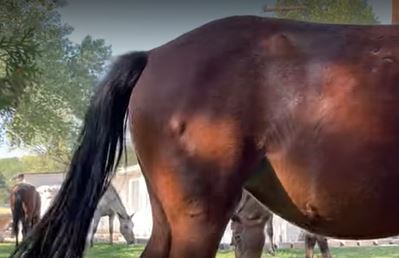
VR Darting Injury 09-15-21

Those who disagree with permitted grazing, and don’t want the mares’ ovaries destroyed with a restricted-use pesticide, are derided by the charlatans at WHAF, who claim to be “in the know” and describe the concern as a “juvenile argument.”

Against PZP 03-26-23

A keyword search of their page about PZP yielded these results:

  • Sterilization – 0 occurrences
  • Sterility – 0
  • Injuries – 0
  • Infections – 0
  • Sex ratios – 0
  • Death rates – 0

As for the wild horse shootings, two stallions were lost.

A herd composed of 281 adults should see around 50 new foals in a given year, a 17.8% birth rate, but only 22 were born in 2022.

That means the advocates got rid of 28 federally protected animals, 14 times more than the shooters.

Why hasn’t a warrant been issued for their arrest?

RELATED: Onaqui Reward Climbs.

More on the Onaqui Poseurs

The hypocrisy of the Campaign Against America’s Wild Horses and the National Mustang Association, contributors to the $22,500 reward for information about the shootings, are well known and have been documented previously.

Of two other groups pledging financial support, the Onaqui Catalogue Foundation does not appear to be a 501(c)(3) non-profit while the Red Birds Trust is.

Both groups endorse the Montana Solution.

Bios of the Onaqui team begin with suggested pronouns, a big red flag.

Theresa Orison, treasurer, is “married” to Sue Robbins.

The Board at Red Birds includes Alisa Graham, treasurer, also “married” to a woman.

The groups know much about wild horses but little about permitted grazing, apparently.

Has their access to the herd and inside information from the BLM been purchased at the price of silence?

A coalition was formed and a reward was established before the agency went public with news of the incident.

RELATED: Reward Offered as Two Onaqui Stallions Found Dead.

Foal-Free Friday, All Roads Lead to Billings Edition

Overpopulation.

Mistreatment during roundups.

Illness and death in off-range holding.

Adoptions resulting in abuse and slaughter.

Why do the advocates harp about these things?

Because they have a better way.

These problems could be avoided if there were no wild horses.

Crime in the Wild Horse World 05-26-22

This of course means the Montana Solution.

There are no other options.

Deniz Bolbol TCF Darter 03-11-23

Sterility is the goal.

Ranching interests must prevail.

All roads lead to the Billings School of PZP Darting if you’re a wild horse advocate.

RELATED: Foal-Free Friday, Noticing Their Hypocrisy Edition.

Reward Offered as Two Onaqui Stallions Found Dead

The remains were discovered on March 19, according to a BLM news release.

Several poseurs joined the BLM in posting the $22,500 reward, including Suzanne Roy of the Campaign Against America’s Wild Horses, who said shooting these protected animals is a serious federal crime but did not acknowledge her role in the shooting of thousands of wild mares with a restricted-use pesticide.

Roy, of course, is trying to establish her bona fides with the bureaucrats and ranchers, hoping to become the dominant player in the wild horse removal industry.

The National Mustang Association runs cattle on a Utah allotment, consuming forage in areas set aside for wild horses.  Rock solid advocates, those guys, just like CAAWH and dozens of other charlatans.

Most of the wild horses were taken off the Onaqui Mountain HMA in a 2021 roundup and the advocates are now working diligently to make sure the herd never comes back.

Advocate Leads Readers Astray about HMAPs

A well-defined problem is half solved.  That may be true in some cases, but the other 50% comes from identification of causes, a concept that eludes the wild horse advocates.

For example, a column in today’s edition of The Nevada Independent indicates that tens of thousands of privately owned livestock graze on allotments overlapping the Pancake Complex in Nevada, an area identified for wild horses, yet only 638 such animals are allowed to live there.

This pattern occurs throughout the western U.S. not because the BLM failed to create HMAPs, as suggested by the author, but because it’s specified in the land-use plans.

HMAPs must comply with LUPs.  If the LUP assigns 84% of the authorized forage to privately owned livestock in an area set aside for wild horses, so will the HMAP.

Drilling and mining affect anywhere from a few acres to a few thousand acres, not mentioned by the writer, while public-lands ranching devours entire HMAs and beyond.  There’s no comparison.

As for the advocates, articles like this keep their base fired up and the donations rolling in, while accomplishing nothing useful for America’s wild horses.

RELATED: The Truth About HMAPs.