Studs on the Virginia Range can’t understand why their mares aren’t bearing any fruit.
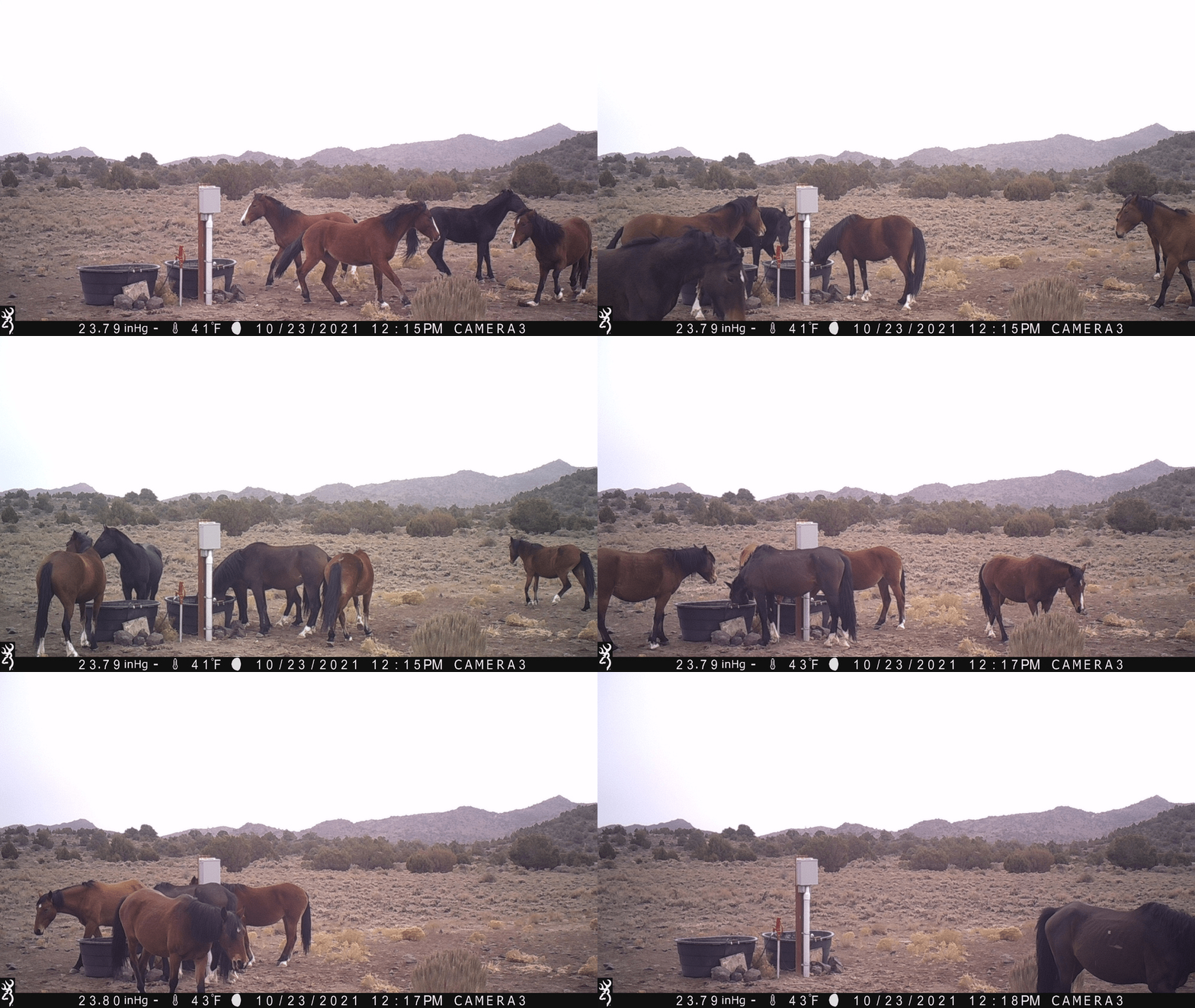
Last horse picked up by this camera was on December 6. None seen since.

Western Horse Watchers Association
Exposing the Hypocrisy, Lies and Incompetence of the Wild Horse Advocates
Studs on the Virginia Range can’t understand why their mares aren’t bearing any fruit.
Last horse picked up by this camera was on December 6. None seen since.
The BLM says roundups are necessary and humane, but more and more members of Congress aren’t buying it, according to the communications director of the Campaign Against America’s Wild Horses in a column posted this evening by the Las Vegas Review-Journal.
Western Horse Watchers hopes that more and more Americans aren’t buying their anti-horse agenda, aimed at replacing helicopter roundups with fertility control programs.
They don’t oppose the removals, only the way they are carried out. They, and their army of volunteers, are stooges for the public-lands ranchers.
RELATED: Group Uses Pancake Deaths to Sell Montana Solution.
The forage assigned to livestock inside the allotments is known but the forage assigned to livestock inside the HMA is not known.
The preliminary EA is still months away, as noted yesterday, so how do you answer the question?
The management plan assigns 26,337 AUMs per year to livestock across four allotments covering 398,222 public acres, as computed in the post, or 66.1 AUMs per thousand acres per year.
That resource would support 66.1 ÷ 12 = 5.5 wild horses per thousand acres, on top of the 0.9 wild horses per thousand acres allowed by plan.
The total authorized forage inside the HMA, neglecting wildlife, should be able to support 0.9 + 5.5 = 6.4 wild horses per thousand acres, assuming the resource is evenly distributed across the parcels.
The HMA covers 411,636 acres, which may include some non-BLM lands, but a quick estimate of the True AML, the number of animals the HMA could support if it was managed principally for wild horses, is 6.4 × 411,636 ÷ 1,000 = 2,634.
The number horses displaced from the HMA by privately owned livestock is 5.5 × 411,636 ÷ 1,000 = 2,264, about 4.5% of those in off-range holding.
The difference between the two figures, 2,634 – 2,264 = 370 is slightly less than the current AML of 390 due to rounding errors.
In general,
True AML = Current AML + Horses displaced by permitted grazing
RELATED: Cedar Mountain Allotments.
Western Horse Watchers agrees: The numbers show that many areas set aside for wild horses are managed primarily, if not principally, for livestock. That’s why the animals are being forced off their home range at a record pace.
Data from the Pancake roundup, discussed in a BLM blog post, indicate five horses lost (0.24%) due to injuries sustained in the incident. Not mentioned are the 21 horses put down (shot dead?) due to physical defects.
The number of horses that would be lost if the roundup didn’t occur? Zero.
Ten horses were lost in the Rock Springs roundup due to injuries sustained in the incident (0.24%), plus 27 put down due to physical defects, compared to zero if the incident didn’t occur.
The number of horses shipped from the Rock Springs HMAs was not provided, so the results cannot be checked for balance and the number of unaccounted-for animals cannot be determined.
Thus, it is true, the figures don’t lie—if you can get them.
On Day 4 of the Jackson Mountains roundup, not considered in the post, a foal was put down because it was an orphan. That was its only shortcoming. The government has since tried to cover it up.
Links to roundups in 2021 have been removed from the Nevada gather page, but the daily reports for Jackson Mountains can be found here. The final death rate was 5.9%!
The writer(s) of the blog post indicated that the Pancake herd boomed as food and water dwindled, suggesting that other factors may be more important for the support of life on western rangelands.
That’s what a Rock Springs resident told Wyoming Public Media in a story posted yesterday. They won’t be starving to death in the winter.
The government, media and advocates have done a fine job covering for the public-lands ranchers, brainwashing the American people about the situation out west.
The Rock Springs HMAs could not be overpopulated with 5,105 wild horses (before the roundup), when the BLM authorizes privately owned livestock equivalent to 15,982 horses in the same area, on top of the 2,145 horses allowed by plan.
The horses displaced from the HMAs by permitted grazing represent almost one third of those in off-range holding.
The advocates won’t tell you the truth about wild horses because the rationale for their darting programs would fall to the ground. They are far more concerned about their standing with the bureaucrats and ranchers.
The original inhabitants, thought to be descendants of Sitting Bull’s horses, were removed from the park over 20 years ago.
The current inhabitants are now test subjects for a drug that may act as a sterilant, according to a story by KX News of Bismarck, ND.
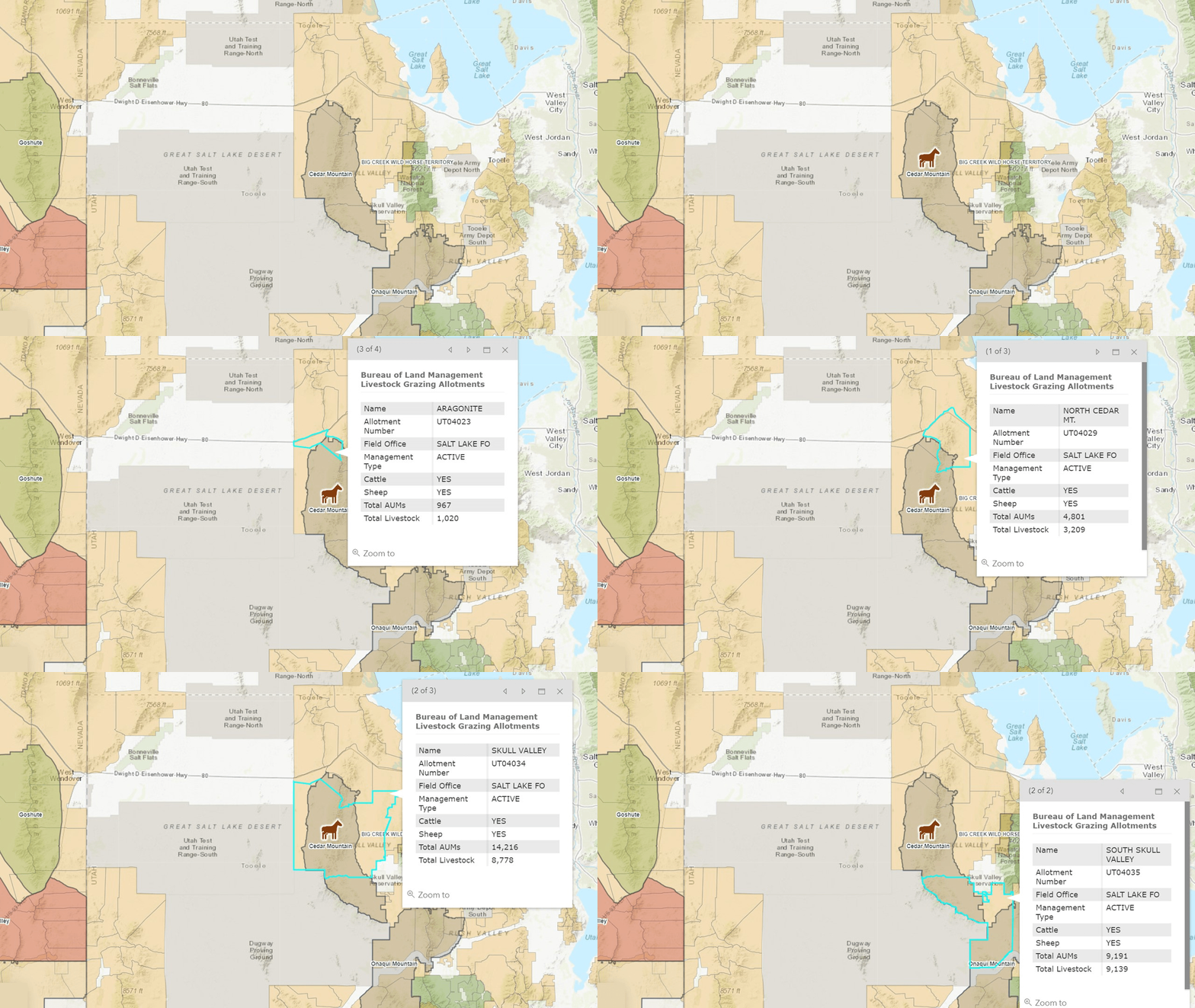
The new pest control plan is still in the scoping phase and a preliminary EA is still months away, but the Western Watersheds map indicates the HMA intersects four grazing allotments. Click on image to open in new tab.
The Allotment Master report puts all of the BLM/public acres in the Improve category.
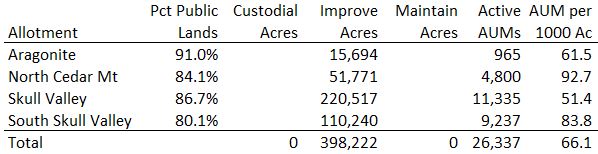
The forage densities (AUMs per thousand acres) provide a basis for estimating the carrying capacities of the allotments.
For example, Aragonite should be able to support 61.5 ÷ 12 = 5.1 wild horses per thousand acres. North Cedar Mountain should be able to support 7.7 wild horses per thousand acres.
This would be in addition to the horses already allowed by plan.
The aimed-at stocking rate for Cedar Mountain is 0.9 wild horses per thousand acres, in line with the target rate across all HMAs of one wild horse per thousand acres.
Why are those numbers so low? Because most of the resources have been assigned to privately owned livestock.
RELATED: Scoping Begins for Cedar Mountain Pest Control Plan.
The incident concluded yesterday, according to a statement at the gather page, with 383 horses captured, 352 shipped, 11 dead and 20 returned.
There were no unaccounted-for animals.
The death rate was 2.9%.
The number of horses removed from the HMA was 363.
The capture goal was 376 and the removal goal was 326.
The cumulative total includes 184 stallions, 199 mares and no foals.
Of the adults, 48% were stallions and 52% were mares.
With no youngsters, the herd will shrink without the aid of helicopters.
Body condition scores were not reported.
The BLM claimed the HMA was overpopulated with 600 wild horses, when it authorizes privately owned livestock equivalent to 854 horses in the same area, on top of the 250 horses allowed by plan.
The advocates will likely point to the HMA as a model of wild horse management.
It might even replace Assateague Island as their favorite.
RELATED: Sulphur Roundup Announced.
Unlike cattle and sheep, horses do appear in the North American fossil record and their story will be told in the next episode of the long-running ‘Nature’ series, set to air on February 23, according to an announcement posted earlier this week by Arizona PBS.
The extent to which the wild vs. feral debate will be considered is not known.
The remark about horses racing across the Pony Express trail may be a reference to the Onaqui Mountain herd, most of them removed from their Congressionally designated habitat last summer, in favor of privately owned livestock.
Refer to local listings for dates and times in your area.
Refer to the audio segment posted today by KNPR Radio of Las Vegas.
The herds must still be managed (for the benefit of the public-lands ranchers).
There will be fewer injuries (but there will still be roundups).
Management plans (that favor the ranchers) won’t change.
Just use a more humane approach (but keep the gravy train going).
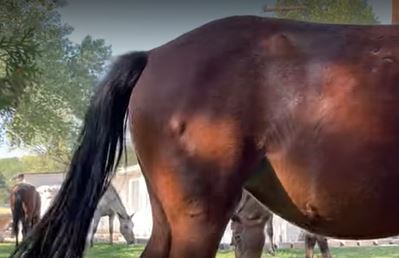
Resource enforcement goal before the ban: 22,000 captured and 19,000 removed.
Resource enforcement goal after the ban: 22,000 captured and 19,000 removed.
RELATED: Anti-Helicopter Chatter Too Far Downstream to Help Wild Horses.
The executive director of the Campaign Against America’s Wild Horses told Nevada Current in a story posted today that the herd is probably at a point of population reduction, “because there is a high mortality rate of foals out on the Virginia range, in large measure because of mountain lions.”
If that’s true, why are they darting the mares? Let the predators keep the herd in check.
On the contrary, the mountain lions are probably going hungry, thanks to her and her army of volunteers.
RELATED: Lower Speed, More Fencing for Virginia Range Mustangs?
The BLM has opted for the Proposed Action, minus the use of IUDs, according to the Decision Record signed on February 15.
The news release said a wild burro roundup will occur later this year, although it does not appear on the latest schedule.
Section 3.2.1 of the Final EA notes that “Wild burros, wildlife, and livestock compete directly for the same space, water, and forage resources,” but the DR, which ties substandard conditions and lack of forage to heavy utilization by the burros, indicates that the animals “are also competing heavily with native wildlife” for food and water.
A burro consumes about half as much forage as a horse or cow/calf pair.
The Proposed Action, valid for ten years, is discussed in Section 2.1 of the EA.
The DR and EA have been posted to ePlanning with other project documents.
The HMA is in eastern Utah.
RELATED: Comments Invited on Draft EA for Sinbad Management Actions.
As if right on cue, the executive director of the Campaign Against America’s Wild Horses told FOX 5 News of Las Vegas in a report posted yesterday that her group supports the ill-advised plan to end helicopter roundups and the use of fertility control vaccines to eradicate wild horses.
Ranchers in the Pancake Complex receive over five times more forage than the horses, yet this woman, and other like her, want to target the horses.
RELATED: Anti-Helicopter Chatter Too Far Downstream to Help Wild Horses.
No youngsters have been captured eight days into the roundup.
Apparently, the Pancake herd didn’t get the memo. Twelve percent of the captured animals were foals, in a roundup that ended yesterday.
If you’re an advocate, there is much to cheer about at the HMA, as noted previously.
The incident began on February 8. Gather stats through February 15:
The capture goal has been achieved.
A stallion was euthanized on Day 6, followed by two more on Day 8. A stallion died on Day 8 of a broken neck. The death rate increased to 2.9%.
The cumulative total includes 180 stallions, 197 mares and no foals.
The absence of youngsters implies a negative growth rate. The herd is getting smaller, without the aid of helicopters, which is what the advocates are trying to accomplish in other areas with the Montana Solution. A growth rate of 20% per year is often used by land managers to predict herd sizes.
Of the adults, 47.7% were stallions and 52.3% were mares.
Body condition scores were not reported.
The location of the trap site within the HMA was not provided.
Twenty stallions were released on Day 8 to an undisclosed location.

Day 8 ended with 38 unaccounted-for animals.
The number of horses removed to date is 357.
Mares returned to the HMA, which may correspond to the unaccounted-for animals, will be treated with PZP or GonaCon Equine.
Other statistics:
RELATED: Sulphur Roundup Day 5.
Two traps have been partially constructed and will be completed after the horses get accustomed to them, according to a BLM representative.
A request for comment on the wild horse shooting was not immediately answered.
RELATED: Challis Roundup Announced.
The group, which represents the interests of farmers and ranchers in the state, said in news release posted today by the Elko Daily Free Press that HR 6635, legislation that would ban the use of helicopters in wild horse and burro roundups, would seriously thwart the efforts of the BLM to achieve AMLs as well as restore the condition of rangelands that provide habitat for wildlife and multiple-use stakeholders.
Helicopter roundups are the only cost-effective method available for gathering the necessary number of animals over vast and difficult terrain, according to the writers, who did not explain that AMLs are usually small relative to the available resources.
Western Horse Watchers has not seen any critiques of the proposal by groups representing drilling and mining interests.
RELATED: Anti-Helicopter Chatter Too Far Downstream to Help Wild Horses.
Law enforcement agents with the Forest Service have maintained a visible presence on the roads where one or more individuals shot dozens of wild horses over the past four years, according to a story posted yesterday by CBS5 News of Phoenix, but no arrests have been made in the case.
RELATED: Heber Wild Horse Shootings in the News.
The incident concluded today, according to a statement at the gather page, with 2,054 horses captured, 2,004 shipped, 26 dead and 24 returned.
There were no unaccounted-for animals.
The number of horses removed from the Complex was 2,030.
The capture goal was 2,060 and the removal goal was 2,030.
The cumulative total includes 853 stallions, 954 mares and 247 foals.
Youngsters represented 12.0% of the horses captured, consistent with a growth rate of seven percent per year, assuming a five percent death rate.
Of the adults, 47.2% were stallions and 52.8% were mares.
Body condition scores were not reported.
A coalition of advocacy groups tried unsuccessfully to block the roundup.
The loss of a colt on Day 1 sparked outrage among some advocates and prompted calls for an end to helicopter roundups.
The BLM claimed that the Complex was overpopulated with 3,244 wild horses, when it authorizes privately owned livestock equivalent to 3,612 horses in the same area, on top of the 638 horses allowed by plan.
RELATED: Pancake Roundup Announced.
UPDATE: BLM news release dated February 15 omits deaths.
 Western Horse Watchers Association