The Untold Story of Alma, Abandoned Currituck Mare?

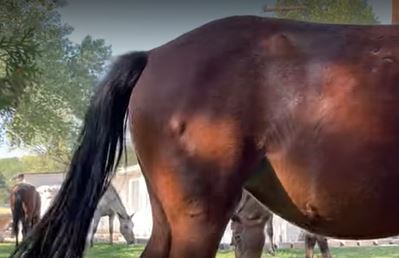
She’s been wandering the Currituck Outer Banks in search for companionship and has finally been accepted by another band, according to a story dated July 28 by The News & Observer of Raleigh, NC.

Alma joined up with Cowboy, a stallion, mares Daisy and Shala, and Shala’s 3-year-old son Renzi.

Apparently, the band does not include any foals.

Alma and Renzi may eventually split from the group and create their own family, a statement attributed to the Corolla Wild Horse Fund, like others in the article.

Western Horse Watchers decided to check it out.

An email sent to the herd manager asked if Alma had been treated with fertility control and what was the plan going forward.

As of this evening, no answer has been received.

Birth rates and breeding patterns are determined by the advocates, not the horses.

If Alma has been darted, the statement about starting a family was a lie.

A commenter on socialist media said “It’s hard to sit back sometimes and let nature take its course,” which is just about impossible wherever the advocates are involved.
Blue Wing Legal Action Centers Around HMAPs

The term does not appear in the news release issued earlier this week but that’s what it’s all about, according to a brief by Law Street Media.

A copy of the complaint was posted to Docket Alarm.

The Interior Board of Land Appeals has held that an HMAP is not a prerequisite to a wild horse roundup as long as the record indicates compliance with the WHB Act, as noted, for example, in Section 1.1 of the Final EA for livestock protection actions in the Bible Springs Complex.

If the BLM can show that the major components of an HMAP have been addressed, including the establishment of HMAs, AMLs and objectives for managing them, with ongoing monitoring and evaluation of whether those objectives are being met, the case will likely go down in flames and the advocates will not win the relief they seek.

A waste of time and money.  Exactly what you’d expect from the advocates.

RELATED: Advocates Take Legal Action to Stop Blue Wing Roundup.

Congressman Tries to Defund Helicopter Roundups

The move was applauded by the Campaign Against America’s Wild Horses, according to a story posted yesterday by Fox21 News of Colorado Springs, a group that views the contractors as competitors in the wild horse removal business.

In their quest to become the industry leader, legislative action that knocks the pilots and wranglers out of contention would be most welcome.

The article did not indicate if the amendment would ban the use of helicopters and fixed-wing aircraft for catch-treat-release, which the advocates support.

RELATED: Move Over Cattoor, Advocates Want Larger Share of Market.

Advocates Issue Bizarre News Release About Water, HMAPs

They claim that wild horses in Nevada are threatened by drilling and mining, and the loss of water associated therewith, according to a bulletin picked up by AP News.

Are they suggesting that those companies are draining ponds and creeks to supply their operations?  Or maybe they’re tapping into underground sources that will somehow deplete surface water needed by wildlife and the horses?

Sounds like rape and pillage.  How did that get through the NEPA process?

Where are the environmental impact statements and findings of no significant impacts that authorized the destruction?

As for the HMAPs, they must comply with land-use plans, as noted earlier this week.

If the plans allow water to be used for drilling and mining in HMAs, then so will the HMAPs.

If the plans assign most of the authorized forage to privately owned livestock, then so will the HMAPs.

If you disagree with that, the problem is not HMAPs or the absence thereof.

The problem is in the planning and decision documents that determine how the HMAs are managed.

The advocates don’t want you thinking about them because changes would actually help the horses and they prosper under the status quo.

Drilling and mining require anywhere from a few acres to a few thousand acres while pubic-lands ranching devours entire HMAs and beyond.  There’s no comparison.

RELATED: The Three R’s of HMAPs.

HMAPs Must Comply with RMPs

From Section 2.5.2 in H-4700-1, Wild Horses and Burros Management Handbook:

HMAPs tier to and must be in conformance with the applicable LUP.  If the proposed management strategy is not consistent with the LUP, then the LUP should be amended, or the proposal should be modified or rejected.

If the land-use plan assigns 86% of the authorized forage to privately owned livestock, do you think you can write a new HMAP that allocates 98% of the resource to wild horses, with 2% to wildlife, and put it into practice?

Pay no attention to the advocates, they are full of crap.

The problem is in the planning and decision documents that determine how HMAs are managed, as well as the statutes and regulations that precede them.

RELATED: The Three R’s of HMAPs.

The Three R’s of HMAPs

1. Review the planning and decision documents that determine how the HMA is managed.

2. Ratify those provisions by copying them into the HMAP.  If the RMP assigns 86% of the authorized forage to privately owned livestock, then so shall the HMAP.  Describe how the horse population will be controlled to achieve the resource allocations on a continuing basis.

3. Reinforce the mismanagement of the HMA by putting the new HMAP out for public review, followed by minor revisions and approval.

RELATED: HMAPs Are Not the Answer.

Thriving Ecological Balance-3

RTF Science Advisor Leads FREES Working Groups

Celeste Carlisle and Eric Thacker lead the Population Management Working Group.

Carlisle serves as Biologist and Science Program Manager for Return to Freedom.

Thacker, Rangeland Extension Specialist for Utah State University, explained his role in a lecture last December that was covered in this post.

Carlisle also leads the Outreach and Communication Working Group.

Collaboration with the FREES Network, a ranching advocacy group hosted by Utah State University Extension, further undermines the credibility of Return to Freedom, signatory to the ill-advised “Path Forward.”

RELATED: FREES Conference Announced.

House to Consider Spending Bills This Week?

Refer to this news release dated July 11.

They’d have to cure themselves of Trump derangement syndrome and put their January 6 show trial on the back burner.

The Wild Horse and Burro program would receive $156 million in FY 2023, according to the summary for Interior, Environment and Related Agencies, including $11 million for research on reversible immunocontraceptive fertility control and its administration.

VR Darting Injury 09-15-21

How much of the funding will actually go to research, including the long-term effects of the Montana Solution?

Local People Working with the BLM (to Get Rid of Wild Horses)

The Pine Nut advocates did some unplanned bait trapping to remove a small tire caught on a mare’s leg, as explained in the July edition of Horse Tales by the real estate agent and PZP darter in the Minden/Gardnerville area.

The account begins on on page 16 and continues on page 19.

The listings are on page 24.

The incident could have been avoided by a more aggressive darting program that would take more horses off the range, leaving more food and water for the permittees (who are never mentioned in these stories).

APN 1322-00-002-041, a 161.8 acre parcel, has been marketed with an image of the animals she’s trying to eradicate.

Same for APN 1322-00-002-050, 80 acres.  No youngsters allowed.

APN 1322-00-002-050 07-17-22

As stated previously, the advocates have no scruples.

Support for the Pine Nut darting program comes in part from the Campaign Against America’s Wild Horses.

RELATED: Foal-Free Friday, No Major Side Effects Edition.

WHB Refresher

As the second half of the FY 2022 gather season ramps up, here are two provisions from the current statute to keep in mind as the action unfolds.

§1331. Wild free-roaming horses and burros shall be protected from capture, branding, harassment, or death; and to accomplish this they are to be considered in the area where presently found, as an integral part of the natural system of the public lands

§1332. “Range” means the amount of land necessary to sustain an existing herd or herds of wild free-roaming horses and burros, which does not exceed their known territorial limits, and which is devoted principally but not necessarily exclusively to their welfare in keeping with the multiple-use management concept for the public lands

The undefined concept of Appropriate Management Levels was not in the original statute, nor were there any provisions for privately owned livestock, yet today the land that remains is managed primarily for livestock and AMLs correspond to a tiny fraction of the available resources.

BLM3

What you are seeing on the range could be described as lawlessness, yet the advocates are consumed with HMAPs, drilling and mining, and the Montana Solution.

Foals and Pregnant Mares Should Not Be Chased by Helicopters?

So says Scott Wilson, who sits on the Board of the Campaign Against America’s Wild Horses, in a story about the Piceance roundup by The Colorado Sun.

What he didn’t say is that his group, a purveyor of the Montana Solution and a leader in the wild horse removal business, believes there shouldn’t be any foals or pregnant mares for helicopters to chase.

He’s in good company.  Most of the advocacy groups feel the same way.

RELATED: Piceance Roundup in the News.

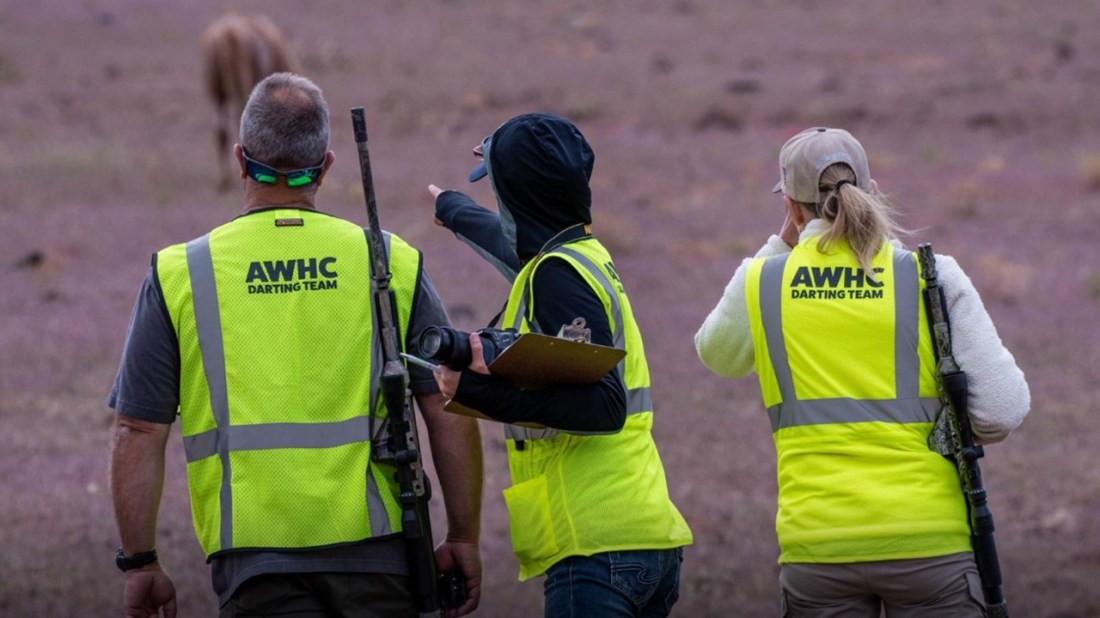
CAAWH Field Darters 07-16-22

Chincoteague Ponies Hit the Water in Two Weeks

The action begins on July 23 with the southern herd roundup, as explained in the official guide, followed by the northern herd roundup on July 24.

The annual swim occurs on July 27.

The herd includes 150 adults and 60 to 70 foals according to the guide, putting the birth rate above 40%!

The growth rate probably exceeds 35% per year, assuming a 5% death rate.

Most of the foals will be auctioned.  A few will be returned.

When the incident is over the island will resemble the Salt River and Virginia Range, where the advocates are ruining the herds with the Montana Solution:

  • Barren mares
  • Confused stallions
  • Disruption of natural order
  • Breeding patterns determined by humans

The incident would qualify for an episode of Foal-Free Friday.

Inflation Gauges Don’t Consider Price of Hay?

Here are the headlines on Drudge.  The first link pointed to a story by CNBC.

Inflation Report at Drudge 07-13-22

The price of alfalfa-grass hay in this area went from $19 per bale last July to $36 per bale this July, an 89% increase.

Democrat supporters didn’t get a return on their investments in 2016 so now the party is under great pressure from our enemies, foreign and domestic, to destroy the country and its standard of living.

RELATED: Price of Hay Hits New Record.

Bible Springs Complex Added to Roundup Schedule

The incident, set to begin on August 7, increased the FY 2022 capture goal from 22,541 in the previous schedule to 22,991 in the latest schedule.

The EA for the new resource enforcement plan went through the planning process like red clover through a bull.

The project was created in ePlanning on February 24, no documents posted.

An announcement for the scoping phase does not appear in the project documents and cannot be found at the BLM news site.  That step was skipped?

The Draft EA was released for public review on May 18, comments accepted through June 17.

The Decision Record was signed on July 7.

Maybe the permittees and their cheerleaders were big donors to the Biden Campaign?

RELATED: Bible Springs Decision Released.

Advocates Far Greater Threat to Wild Horses Than ISPMB

The 2016 incident, prompted by an exposé that turned public support away from the group, led to the removal of approximately 900 horses from the sanctuary, in harsh conditions during the winter.

ISPMB released a statement in 2018 in response to the actions.

The advocates eliminate that many horses every year with the Montana Solution, to the delight of the bureaucrats and ranchers, and will get rid of more if given the chance.

Some may be negotiating with roundup contractors right now to submit proposals for catch-treat-release.

If successful, the case brought by ISPMB against the Forest Service might actually help the horses.

The advocates should try that sometime.

RELATED: The Advocates Have No Scruples.

Standing Up for Wild Horses on Virginia Range 06-18-22