Bold Prediction for Veterans Against Mustangs Act

None of the big-name advocacy groups will claim responsibility for it.

They may have been upstaged.

The news release by Animal Wellness Action, a lobbying group for the PZP fanatics and presenter at the SOWH Conference, indicates that the legislation is endorsed by

  • Veterans for Mustangs
  • Animal Wellness Action
  • Animal Wellness Foundation
  • Center for a Humane Economy (another presenter)
  • Wild Beauty Foundation (ditto)
  • American Horse Protection Society
  • American Legion
  • Monty Roberts
  • Flag Is Up Farm
  • Horse Sense and Healing
  • War Horse Creek
  • Devil Dog Depot Equine Sanctuary and Rescue
  • Wish for Our Heroes

The advocates’ plan to take market share from Cattoor and Sun J may now have a serious challenger.

RELATED: Veterans Against Mustangs Act Now in Committee.

Critics of Cañon City Incident Have Hidden Agenda

A board member for the Campaign Against America’s Wild Horses told The Colorado Sun in an article posted this morning that “We cannot continue to round up wild horses from their native habitats, cram them into holding pens and expect a good outcome for the wild horses or the taxpayers who are funding this broken system.”

Sounds great.  Is he suggesting the animals would be better off on the range?

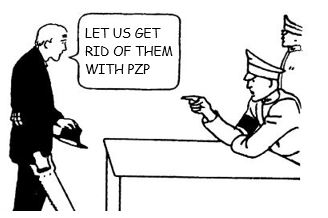
No!  He’s suggesting that the BLM should be getting rid of them with PZP.

The advocates are always looking for new ways to sell old ideas.

RELATED: AWI Pushes Montana Solution in Wake of Cañon City Incident.

Sinbad Roundup Day 3

The incident began on April 30.  Gather stats through May 2:

  • Target: Burros
  • Type: Planned
  • Method: Helicopter
  • Captured: 123, up from 53 on Day 1
  • Average daily take: 41.0
  • Capture goal: 300
  • Removal goal: 260
  • Returned: None
  • Deaths: None
  • Shipped: 123, up from 53 on Day 1

The cumulative total includes 56 jacks, 58 jennies and 9 foals.

Youngsters represented 7.3% of the animals captured.  Of the adults, 49.1% were male and 50.9% were female.

The herd can’t be growing at a rate of 20% per year with a birth rate of 7% per year.

The location of the trap site within the HMA was not disclosed.

Sinbad HMA Map 04-27-22

Day 3 ended with no unaccounted-for animals.

The number of burros removed to date is 123.

Other statistics:

  • AML: 70
  • Forage assigned to burros: 420 AUMs per year
  • Pre-gather population: 328
  • Forage liberated to date: 738 AUMs per year
  • Water liberated to date: 615 gallons per day
  • Forage assigned to livestock: 5,547 AUMs per year (estimated)
  • Burros displaced from HMA by permitted grazing: 922
  • True AML: 992
  • Stocking rate at new AML: 10 burros per thousand acres
  • Burros displaced from area by drilling and mining: Ask the advocates

RELATED: Sinbad Roundup in Progress.

Death Valley Auxiliary Roundup Day 7

The incident began on April 25.  Gather stats through May 1:

  • Target: Burros
  • Type: Planned
  • Method: Helicopter
  • Captured: 137, up from 78 on Day 5
  • Average daily take: 19.6
  • Capture goal: 490
  • Removal goal: 490
  • Returned: None
  • Deaths: 1
  • Shipped: 137, up from 78 on Day 5

A jenny died on Day 7 due to a head injury.  The number of animals shipped is usually less than the number of animals captured when deaths are reported.

The cumulative total includes 55 jacks, 64 jennies and 18 foals.  The breakdown for Day 6 is not correct.  The number of foals is probably zero. 

Youngsters represented 13.1% of the animals captured.  Of the adults, 46.2% were male and 53.8% were female.

The herd can’t be growing at a rate of 20% per year with a birth rate of 13% per year.

The trap site was moved on Day 6 to an undisclosed location.

The maps in Appendix B of the project documents show the location of gather activity relative to the park.  The Western Watersheds map does not show Herd Areas.

Death Valley Auxiliary Roundup Map 04-29-22

Day 7 ended with -1 unaccounted-for animals, more animals disbursed than captured.

The number of burros removed to date is 137.

Other statistics:

  • AML: Zero
  • Forage assigned to burros: None
  • Pre-gather population: Unknown
  • Forage liberated to date: 822 AUMs per year
  • Water liberated to date: 685 gallons per day
  • Forage assigned to livestock: Unknown
  • Burros displaced from area by permitted grazing: Unknown
  • True AML: Unknown
  • Stocking rate at new AML: Unknown
  • Burros displaced from area by drilling and mining: Ask the advocates

RELATED: Death Valley Auxiliary Roundup Day 5.

Assateague Stallion Removed from Island

He was sent to a wildlife sanctuary in Texas according to a report by WBOC News of Salisbury, MD because he had become aggressive toward park visitors and staff.

Stallions are in the minority on the Maryland side of the island, or at least they were a year ago.  Western Horse Watchers has not seen a census report for 2022.

The island has been a test bed for the Montana Solution since 1995.

The advocates point to it as a model of wild horse management.

Salt River Advocates Match First Week of Cañon City Incident

The number of horses lost at the off-range corrals between April 23 and April 29 was 102, roughly equal to the number of lives denied every year on the Salt River by the darting program.

Protect Wild Horses from Advocates 08-29-21

These are horses that should have joined the herd to replace those who died, but didn’t because of the Montana Solution.

RELATED: Virginia Range Darting Program Dwarfs Losses at Cañon City.

Little Bookcliffs Really Managed Principally for Wild Horses?

In most wild horse areas, AMLs are small relative to the available resources because most of them have been assigned to privately owned livestock.

Permitted grazing does not occur at Little Bookcliffs WHR in Colorado, one of four such areas managed by the BLM.

Does the AML reflect full utilization of the available forage?

The 150 horses allowed by plan require 1,800 AUMs per year.  The WHR covers 36,113 acres and the stocking rate allowed by plan is 4.2 wild horses per thousand acres.

The average rate across all HMAs is one wild horse per thousand acres.

The land must be able to produce at least 49.8 AUMs per year per thousand acres to support the Little Bookcliffs horses.

The Western Watersheds map shows six allotments adjacent to the WHR.

Little Bookcliffs Allotments 05-01-22

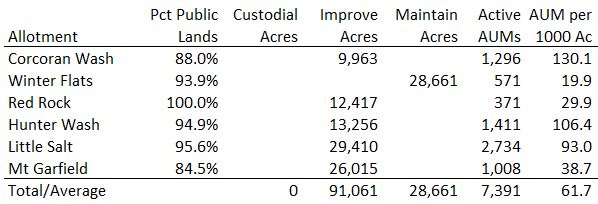
The Allotment Master Report at RAS provides acreage, management status and active AUMs for the allotments.  Roughly 76% of the public acres are in the Improve category.
Little Bookcliffs Allotment Calcs 05-01-22

Forage production across the six allotments averages 61.7 AUMs per year per thousand acres, enough to support five wild horses per thousand acres.

The target rate at Little Bookcliffs is close, so the AML probably represents most of the forage in the WHR, with a small amount reserved for wildlife.

Two years ago the Pine Gulch Fire came within a mile of the north end of the WHR.

Almost certainly much of forage in Corcoran Wash was lost, yet it ranks #1 in terms of forage density.  That resource would support ten wild horses per thousand acres.

Legislation Would Train Veterans to Dart Wild Horses

A bill known as the Veterans for Mustangs Act, sponsored by three U.S. representatives, was unveiled on April 28 according to a story by Fox21 News of Colorado Springs, CO.

The measure would increase the use of PZP in areas set aside for wild horses, reducing the need for roundups and potentially saving taxpayers billions of dollars over the next ten years, while offering a unique form of healing for veterans.

Contrary to statements in the article, PZP is a pesticide, not a medicine.  It protects the public-lands ranchers, not the horses, and PTSD is not alleviated by engaging in the same type of activity that created it, especially when the targets are symbols of the freedoms you fought for.

Supporters of the idea include Marty Irby of Animal Wellness Action, Scott Beckstead of the Center for a Humane Economy and Cameron Ring of Veterans for Mustangs, according to a news release dated April 29 on EIN.

Curiously, Irby and Beckstead spoke at the SOWH conference just concluded.

Our servicemen and horses deserve something better.

Price of Hay Jumps Eight Percent in Eight Weeks

A bale of alfalfa-grass mix was $28 today, 20 bales minimum, compared to $26 on March 5.

That works out to $140 per AUM for the average horse.

The single-bale price was $29.

The price last July was $19 per bale, 20 bales minimum, so the increase over ten months is 47%.

The public-lands ranchers currently pay $1.35 per AUM, the same as they did last year.

With the rising cost of feed and illnesses at the off-range corrals, wild horse adoptions may be heading for a downturn.

RELATED: Price of Hay Jumps Again.

Death Valley Auxiliary Roundup Day 5

The incident began on April 25.  Gather stats through April 29:

  • Target: Burros
  • Type: Planned
  • Method: Helicopter
  • Captured: 78, up from 55 on Day 3
  • Average daily take: 15.6
  • Capture goal: 490
  • Removal goal: 490
  • Returned: None
  • Deaths: None
  • Shipped: 78, up from 55 on Day 3

Helicopters were grounded on Day 4 due to high winds.

The cumulative total includes 34 jacks, 37 jennies and seven foals.

Youngsters represented 9% of the animals captured.  Of the adults, 48% were jacks and 52% were jennies.

The herd can’t be growing at a rate of 20% per year with a birth rate of 9%.  If the death rate is 5%, the growth rate would be around 4% per year.  The BLM did not indicate if the jennies had been treated with the Montana Solution.

The location of the trap site was not provided.

The maps in Appendix B of the project documents show the location of gather activity relative to the park.  The Western Watersheds map does not show Herd Areas.

Death Valley Auxiliary Roundup Map 04-29-22

Day 5 ended with no unaccounted-for animals.

The number of burros removed to date is 78.

Other statistics:

  • AML: Zero
  • Forage assigned to burros: None
  • Pre-gather population: Unknown
  • Forage liberated to date: 468 AUMs per year
  • Water liberated to date: 390 gallons per day
  • Forage assigned to livestock: Unknown
  • Burros displaced from area by permitted grazing: Unknown
  • True AML: Unknown
  • Stocking rate at new AML: Unknown
  • Burros displaced from area by drilling and mining: Ask the advocates

RELATED: Death Valley Auxiliary Roundup Day 3.

Soft Bigotry of Low Expectations Applies to Public-Lands Ranchers

The nation is rigged against the downtrodden and underserved.  They can’t succeed without the help of government.  Self-reliance is overrated.

The whinefest produced by Golden Productions for the Nevada Rangeland Resources Commission sends the same message.

You can’t expect the ranchers to operate their business on their own land while paying the going rate to feed their animals.  Nobody in this country does that and nobody should be held to that standard.

RELATED: Rising Price of Hay Explained.