Cañon City Deaths in the News

Misleading reports about the loss of 145 wild horses are still rolling out, including this one by KVVU News in Las Vegas.

Why weren’t the horses on their home range?

Off-range corrals are not the problem, they are a symptom of the problem.

Curiously, the charlatans interviewed for these stories use the case to advance their own anti-horse agenda.

RELATED: Advocates Seek End of Roundups in Wake of Cañon City Incident.

PSA 12-07-19

Bible Springs Complex Has No HMAP!

Is that why livestock receive 3.5 times more forage than the horses?

An HMAP could only ratify and reinforce current management practices.

The AML, which is small relative to the available forage, would carry over into the new plan, the HMAs would be managed primarily for livestock, as they are now, and the enforcement actions of Section 2.2.1 in the Draft EA would be implemented to ensure the herds can’t consume more than their fair share of the food and water.

The opportunity for public participation in the process, limited to comments on an EA for a new pest control program, can never lead to meaningful changes for the horses.

The planning and decision documents that put ranching interests far above those of the horses, along with the statutes and regulations the precede them, need to be dragged into the open for scrutiny by the American people.

RELATED: Draft EA for Bible Springs Complex Out for Review.

Thriving Ecological Balance-3

Axtell Burros Not Doing Their Job in Colorado?

The rancher lost three more calves this spring, the latest on Memorial Day, according to a report posted this morning by The Colorado Sun.

Wild burros, forced off their home range to accommodate privately owned livestock, are now expected to protect them.

The story did not indicate if any of the burros had been attacked by wolves.

RELATED: Axtell Burros Guarding Cattle for Public-Lands Rancher!

Fun with Forage Allocations

A 1980 study showed that 8,165 cattle AUMs, 2,353 sheep AUMs, 322 wildlife AUMs and 3,116 horse AUMs were available for use in the HMAs of the Bible Springs Complex, according to Section 3.3.2 of the Draft EA for resource enforcement actions therein.

What can you conclude from these data if (a) you’re a sensible person and (b) you’re a wild horse advocate?

(a) Let’s simplify the dataset:

  • Forage to livestock – 10,518 AUMs per year
  • Forage to horses – 3,116 AUMs per year
  • Forage to wildlife – 322 AUMs per year

1. The AML was 260.  It was small relative to the available forage.  Today it is 170.

2. Livestock received 3.4 times more forage than the horses.

3. The HMA was managed primarily for livestock.

4. Horses received 23% of the authorized forage, neglecting wildlife.

5. The number of horses displaced from the HMAs by livestock was 876.

6. The True AML was 1,136.

7. If the herd was at 4X AML, the number of excess horses was zero.

8. The HMA was not overpopulated.

9. There was no justification for a roundup or fertility control program.

10. There is considerable dietary overlap among horses, cattle and sheep.

(b) The BLM should be managing the herd with safe and reversible birth control, not cruel and inhumane helicopter roundups.

RELATED: Fun with Resource Allocations.

Bible Springs Allotment Status

Section 3.3.2 in the Draft EA for resource enforcement actions in the Complex indicates 16 allotments with acreage inside the HMAs, although Table 3.1 shows 17.

The Allotment Master Report provides size, management status and active AUMs.

Bible Springs Allotment Calcs 06-05-22

Approximately 69% of the public acres are in the Improve category.

Of the six allotments in the Maintain category, only Pine Valley has most its acreage outside the HMAs, according to the Western Watersheds map.  If wild horses are damaging public lands, all of those allotments should be outside the HMAs.

Forage production averages 46 AUMs per thousand acres, enough to support 3.8 wild horses per thousand acres.

The 170 horses allowed by plan roam on approximately 215,000 acres, so the land should be able to support 170 + 215 × 3.8 = 987 wild horses.

The current population is thought to be 831 per Section 1.1 of the EA.

If there was no dietary overlap between horses and livestock, there’d be no grazing inside the Complex and the horses probably wouldn’t survive beyond it.

RELATED: Draft EA for Bible Springs Complex Out for Review.

Hay Available But Unaffordable

The price of alfalfa-grass mix was $30 today, twenty bales minimum.  The single-bale price was $31.  No shortages or waiting lines observed.

The price last July was $19 per bale, twenty bales minimum, putting the increase at 58% in eleven months.

The average horse would need five bales per month, which works out to $150 per AUM.

The price of forage to the public-lands ranchers over the same period was unchanged, $1.35 per AUM.

The grazing program insulates them from the realities of the market, at least on the cost side, another reason to take more wild horses off the range.

RELATED: Price of Hay Jumps Eight Percent in Eight Weeks.

National Mustang Association Runs Cattle on Utah Allotment?

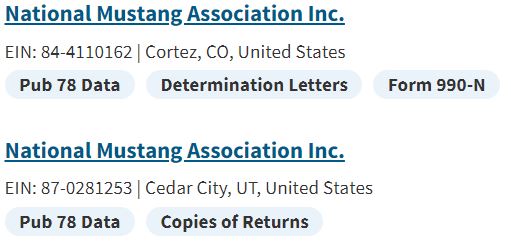
A search of the IRS records for tax-exempt organizations yielded two results.

NMA Search Results 06-04-22

The first group is helping the Park Service take wild horses off Mesa Verde National Park.

Their mission is to preserve and protect horses in the wild and to promote conscious and humane herd management.

One of their board members is a trained PZP darter.

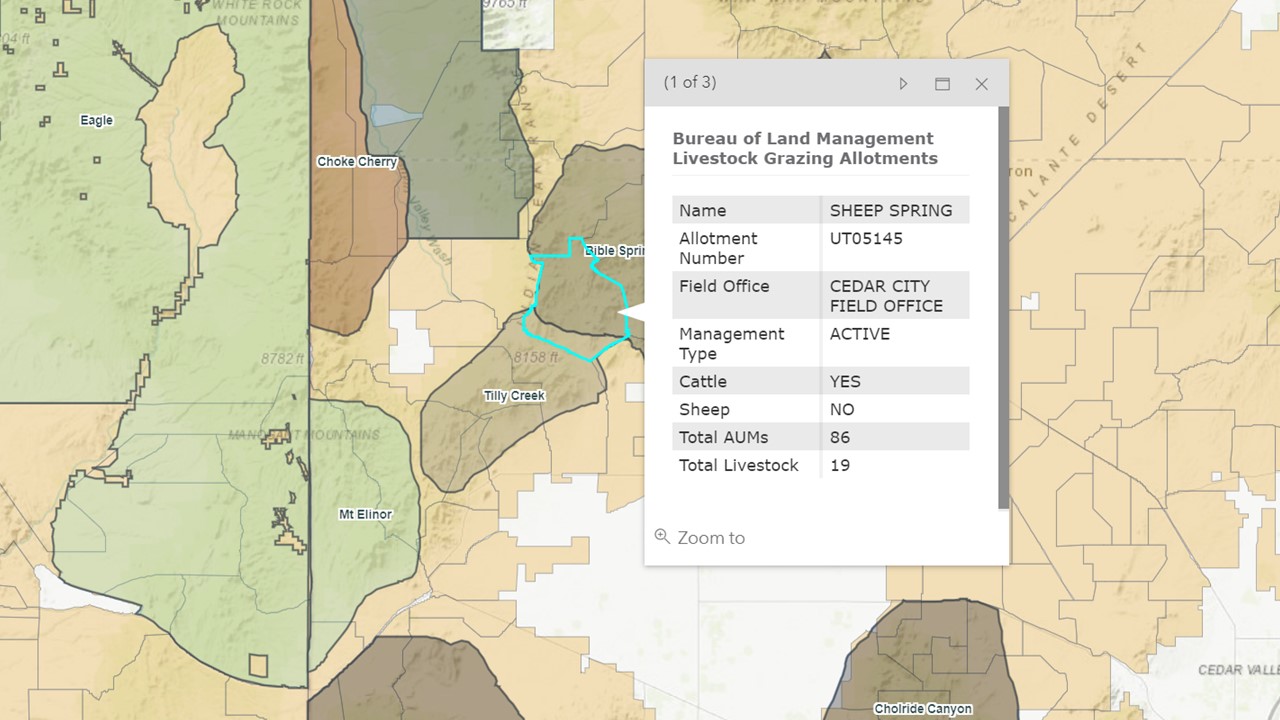
The other group, whose mission is to protect wild mustangs, according to their 2019 Form 990, the most recent available, has a permit to graze cattle on the Sheep Spring Allotment in southwestern Utah.

The address on the 990 matches the address in the Operator Information Report at RAS, PO Box 1367, Cedar City, Utah.

NMA Address 06-04-22

Western Horse Watchers is unable to determine if the groups are related.

The Allotment Master Report shows 86 active AUMs on 15,373 public acres.

The Authorization Use Report indicates 19 head on a 4.5 month grazing season.

Curiously, the allotment is in the Improve category.

It overlaps the Tilly Creek and Bible Spring HMAs, which means seven wild horses have been displaced from their home range by a group claiming to protect them.

Sheep Spring Allotment Map 06-03-22

The two HMAs belong to the Bible Springs Complex, target of a new pest control plan, so the group would benefit from roundups and fertility control programs.

Maybe the allotment has been repurposed for adopted or rescued horses and the BLM records haven’t been updated.  The tiny forage allocation would make sense if true.

Or maybe they’re just frauds like most advocacy groups.  Who knows.

Western Horse Watchers was unable to find a web site for the group but they may have a presence on socialist media.

RELATED: Mesa Verde Roundup Continues, Private Placement Begins.

Advocates Seek End of Roundups in Wake of Cañon City Incident

Two sentences from a story by the Las Vegas Review-Journal will suffice.

“An advocacy group for wild horses is seeking an emergency halt of roundups on public lands following recent assessments of understaffing and animal welfare risks at federal corrals and holding centers in Nevada and other Western states.”

“The American Wild Horse Campaign, as well as lawmakers led by Titus and Cohen, want federal agencies to implement birth control measures to reduce the need for the helicopter roundups.”

There’s nothing to see here, folks.

The Campaign Against America’s Wild Horses wants roundups replaced with darting programs.  They want the horses off the range as much as the bureaucrats and ranchers.

They’d be agitating for that even if there were no deaths at the off-range corrals.

Their long-term goal is to be the leader in the wild horse removal business.

So long, Cattoor and Sun J.

RELATED: Bold Prediction for Incident at Cañon City.

Cañon City Incident, Day 42

No horses were lost to the virus this week according to the sitrep.

A West Douglas mare was found dead on May 30 but the loss was attributed to colic.

The total number dead remains at 145.

All fatalities have occurred in pens occupied by the West Douglas horses, displaced from their home range by privately owned livestock.

Approximately 17% were foals.

Updates are now provided on a weekly basis.  Previous reports can be found at the Colorado HMA page.

RELATED: Cañon City Incident, Day 35.

Idaho Wild Horses Leaving Maine for Oregon

They were rescued and rehabilitated by the Maine State Society for the Protection of Animals but couldn’t be gentled, according to a report posted today by Bangor Daily News, so they’re headed to Skydog in two weeks.

The story said they were captured about two years ago, which may link them to the Saylor Creek or Challis roundups.

They were offered for sale by the BLM, suggesting they were “three strikers,” with a risk of entering the slaughter pipeline, but the buyer tried to give them a second chance.

RELATED: Giving Foals a Chance at Life.

Resource Enforcement Actions Coming to Canyonlands HMA?

A new project was created in ePlanning but only a map was posted for public review.

The HMA covers about 90,000 acres in southeastern Utah and the 100 burros allowed by plan require 600 AUMs per year.

Canyonlands HMA Map 06-01-22

The HMA intersects two allotments according to the Western Watersheds map, a small portion of Saucer Basin to the north and a larger portion of Robbers Roost in the south.

The Proposed Action would likely keep the pests in check so the ranchers could enjoy more of what their allotments have to offer.

The arrangement suggests an appreciable amount of dietary overlap between livestock and burros.  If that was not true, there’d be little if any grazing inside the HMA and the burros would probably not survive outside the HMA.

The same could be said for areas identified for wild horses.

Jackson Mountains HMA Has No HMAP!

Is that why livestock receive almost three times more forage than the horses?

The BLM has determined that excess horses are present, removal is necessary and growth rates must be suppressed to achieve a thriving ecological balance in the HMA.

An HMAP would reiterate, ratify and reinforce existing management practices that put ranching interests far above those of the horses.

The AML, which is small relative to the available forage, would carry over into the new plan, the HMA would be managed primarily for livestock, as it is now, and enforcement actions, such as those mentioned above, would be implemented to ensure the herd can’t consume more than its fair share of the food and water.

Refer to the final paragraph in Section 1.4 of the Final EA.

RELATED: How Many Horses Can Jackson Mountains HMA Support?

Thriving Ecological Balance-3

How Many Horses Can Jackson Mountains HMA Support?

The HMA lies in a area occupied by six allotments, described in Section 3.3.3 of the Final EA for resource enforcement actions therein.

The Western Watersheds map shows the arrangement.

The easterly border of the HMA no longer crosses the Desert Valley Allotment, as indicated on page 18 of the Nevada HMA maps.

Jackson Mountains HMA Allotments 06-01-22

The 217 horses allowed by plan require 2,604 AUMs per year.

As noted previously, livestock receive an estimated 7,394 AUMs per year inside the HMA, enough to support 616 wild horses.

The True AML, the number of animals the HMA could sustain if it was managed principally for horses—as specified in the original statute—would be 217 + 616 = 833.

The current population, thought to be 451 according to Table 1 in the EA, is well within this range, so there are no excess animals, the HMA is not overpopulated and there is no basis for a roundup or fertility control program.  The problem is public-lands ranching.

The 616 horses displaced from the HMA by permitted grazing account for roughly one percent of the animals in off-range holding.

An emergency roundup last year took 526 horses off the range with a death rate of 5.9%, including a foal that was put down because it was an orphan.

The HMA does not appear in the latest roundup schedule.

RELATED: Decision Announced for Jackson Mountains Enforcement Plan.