
Unadoptable horses are also returned, according to the writer of a letter to the Lassen County Times published today.
Month: January 2022
Assateague Island Loses Two Senior Mares
The Park Service is working on another wild horse census, according to a story posted today by the Maryland Coast Dispatch.
An advocacy group associated with the effort reported that two mares were confirmed dead by Assateague Island National Seashore staff.
As for the other findings, the agency probably won’t post them to their news site.
That stopped over two years ago.
The fertility control program was shut off in 2016, contrary to remarks in the article, and the herd declined in size for the next four years, until it rebounded slightly in 2021.
In 2020, females outnumbered males 51 to 21.
The advocates point to the island as a paragon of wild horse management.
How Many Wild Horses Can the North Lander Complex Support?
Reports for the four HMAs are listed here for reference:
Data were sourced from the Draft EA for resource enforcement actions in the Complex.
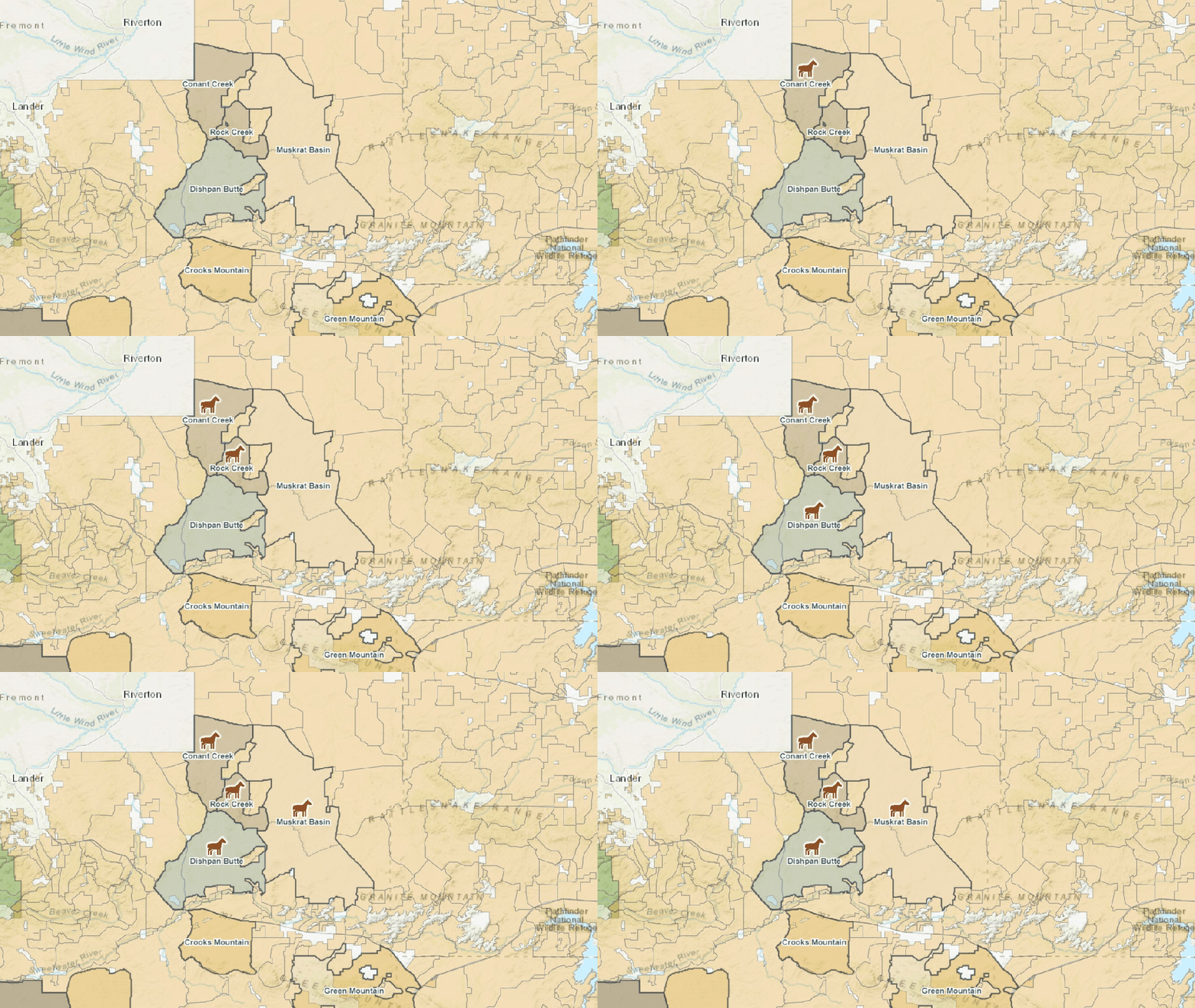
Figures from the reports are summarized as follows:
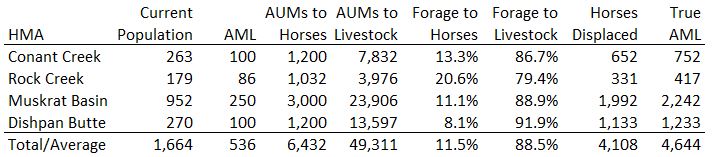
An estimated 4,108 wild horses have been denied a place on their home range by permitted grazing. The True AML, the number of animals the Complex could support if it was managed principally for wild horses, is 4,644.
The current population is well within this range.
The combined AML represents 11.5% of the authorized forage, neglecting wildlife.
The 4,108 horses displaced from the Complex account for 8.2% of the 50,000 animals in off-range holding.
How do you convince the American people that the Complex is overpopulated with 1,664 wild horses, and that the herd must be drastically reduced, when you authorize privately owned livestock equivalent to 4,108 horses in the same area, on top of the 536 allowed by plan?
The same way you sell umbrellas in the desert.
RELATED: Preliminary EA for North Lander Complex Out for Public Review?
Thriving Ecological Imbalance at Dishpan Butte HMA
At the upper end of the AML, the 100 horses allowed plan receive 8% of the authorized forage, neglecting wildlife, as noted earlier today.
At the low end of the AML, the 50 horses allowed by plan receive 4% of the authorized forage, sometimes referred to as ‘their food.’ The remainder goes to privately owned livestock. This is the goal of the North Lander resource enforcement plan.
The BLM says the HMA is overpopulated with 270 wild horses, while it authorizes privately owned livestock equivalent to 1,133 wild horses in the same area, on top of the 100 horses allowed by plan.
Without changes to the resource management plan(s), a herd management area plan (HMAP) could only ratify and reinforce the lopsided forage allocations that benefit ranching interests at the expense of our wild horses.

Desatoya Roundup Day 10
The incident began on January 16. Gather stats through January 25:
- Target: Horses
- Type: Planned
- Method: Helicopter
- Captured: 188, up from 147 on Day 6
- Average daily take: 18.8
- Capture goal: 233
- Removal goal: 150
- Returned: 2, no change from Day 6
- Deaths: 3, up from 2 on Day 6
- Shipped: 115, up from 83 on Day 6
A stallion was euthanized on Day 9, boosting the death rate to 1.6%.
The cumulative total includes 82 stallions, 80 mares and 26 foals.
Youngsters represented 13.8% of the horses captured, consistent with a herd growth rate of 9% per year, assuming a 5% death rate.
Of the adults, 50.6% were stallions and 49.4% were mares.
Body condition scores were not reported.
The location of the trap site within the HMA was not provided.

Day 10 ended with 68 unaccounted-for animals.
The number of horses removed to date is 186. Mares returned to the HMA will be treated with GonaCon Equine.
Other statistics:
- AML: 180
- Forage assigned to horses: 2,160 AUMs per year
- Pre-gather population: 277
- Forage liberated to date: 2,232 AUMs per year
- Water liberated to date: 1,860 gallons per day
- Forage assigned to livestock: 9,608 AUMs per year (estimated)
- Horses displaced from HMA by permitted grazing: 801
- True AML: 981
- Stocking rate at new AML: 6.1 wild horses per thousand acres
- Horses displaced from HMA by drilling and mining: Ask the advocates
RELATED: Desatoya Roundup Day 6.
New Rules for AIP Announced
The incentive payment will now be made no later than 60 days after title, rather than half at the time of adoption and half at the title date, according to today’s news release.
Title applications will have to be signed by a veterinarian or BLM-authorized officer for the adopter to receive payment.
RELATED: New Safeguards for AIP?
How Many Wild Horses Can the Dishpan Butte HMA Support?
For a quick estimate, convert the livestock AUMs to wild horses and add the result to the AML.
The HMA intersects two grazing allotments according to Table 2 of the Draft EA for resource enforcement actions in the North Lander Complex.
The HMA boundary coincides roughly with the boundaries of the Dishpan Butte and Big Pasture allotments, as shown in the Western Watersheds map. Long Creek Pasture is not included.

The 100 horses allowed by plan require 1,200 AUMs per year. The HMA covers 99,736 total acres, including 92,373 BLM (public) acres.
The eight permittees receive a total of 13,597 AUMs per year according to Table 2.
The Allotment Master Report indicates a forage allocation of 13,892 AUMs per year across the two allotments. Both are in the Improve category and contain a total of 92,371 public acres.
The forage assigned to livestock, based on data in the EA, would support an additional 13,597 ÷ 12 = 1,133 wild horses, for a True AML of 100 + 1,133 = 1,233. This is the number of animals the HMA could support if it was managed principally for wild horses, as specified in the original statute.
The current population of 270 is well within this range, so there are no excess horses in the HMA and there is no need for a roundup or fertility control program.
The 1,133 horses displaced from the HMA by permitted grazing represent 2.3% of the 50,000 animals in off-range holding.
The current AML corresponds to about 8% of the total authorized forage, neglecting wildlife, meaning the HMA is managed principally for livestock.
Forage availability in this area is very high, about 160 AUMs per year per thousand acres, which would support a stocking rate of 13 wild horses per thousand acres!
The target rate across all HMAs is one wild horse per thousand acres.
AMLs and stocking rates are low relative to the available resources because the bureaucrats put ranching interests far above those of the horses.
The advocates would have you believe that Herd Management Area Plans (HMAPs) are the answer to wild horse mismanagement, but until the Resource Management Plans are changed, they can only prolong it.
Confine the ranchers to their base properties, including those who secure grazing preference with water rights, and let them pay market rates to feed their animals.
RELATED: Preliminary EA for North Lander Complex Out for Public Review?
Excess Horses in Sulphur HMA?
How can the government argue that the HMA is overpopulated with 497 wild horses, when it authorizes privately owned livestock equivalent to 854 wild horses in the same area, on top of the 250 horses allowed by plan?
RELATED: Sulphur Resource Enforcement Plan Approved, First Awareness.
FY 2022 Resource Enforcement Goals in the News
This report by AP News has already been picked up by some news outlets and will likely spread to others in the next few hours.
How can the BLM say, for example, that the Muskrat Basin HMA is overpopulated with 952 wild horses, when it authorizes privately owned livestock equivalent to 1,992 wild horses in the same area, on top of the 250 horses allowed by plan?
Pancake Roundup Day 14
The incident began on January 11. Gather stats through January 24:
- Target: Horses
- Type: Planned
- Method: Helicopter
- Captured: 982, up from 852 on Day 10
- Average daily take: 70.1
- Capture goal: 2,060
- Removal goal: 2,030
- Returned: 4, no change from Day 10
- Deaths: 11, up from 10 on Day 10
- Shipped: 917, up from 797 on Day 10
Helicopters did not fly on Day 11 due to poor weather.
One horse was put down on Day 12. The death rate is 1.1%.
The cumulative total includes 409 stallions, 444 mares and 129 foals.
Youngsters represented 13.1% of the horses captured, consistent with a herd growth rate of 8% per year, assuming a 5% death rate.
Of the adults, 47.9% were stallions and 52.1% were mares.
Body condition scores were not reported.
The location of the trap site within the Complex was not provided.

Day 14 ended with 50 unaccounted-for animals.
The number of horses removed to date is 978. Mares returned to the Complex will be treated with fertility control of unspecified type.
Other statistics:
- AML: 638 (across two HMAs, one WHT and one HA)
- Forage assigned to horses: 7,656 AUMs per year
- Pre-gather population: 3,244
- Forage liberated to date: 11,736 AUMs per year
- Water liberated to date: 9,780 gallons per day
- Forage assigned to livestock: 43,344 AUMs per year (estimated)
- Horses displaced from Complex by permitted grazing: 3,612
- True AML: 4,250
- Stocking rate at new AML: 3.5 wild horses per thousand acres
- Horses displaced from Complex by drilling and mining: Ask the advocates
RELATED: Pancake Roundup Day 10.
Film About Nokotas Premiers This Weekend
Three showings are set for January 28, 29 and 30 in Bismarck, according to a story posted this evening by The Dickinson Press of Dickinson, ND.
The film can be rented or purchased on Vimeo.
Sulphur Resource Enforcement Plan Approved, First Awareness
The decision was announced yesterday. The Decision Record, Final EA and other supporting documents can be accessed at the project page in ePlanning.
Western Horse Watchers was unable to find any notifications at the BLM news site and does not know how and when public involvement was solicited for the scoping phase of the project or the release of the draft EA.
A notice appeared at ePlanning on May 6, 2020 according to the Decision Record.
The Proposed Action, discussed in Section 2.2 of the EA, targets wild horses over a ten-year period and features the removal of excess animals to the low end of the AML as quickly as possible through one or more roundups, population suppression using PZP-22 and equipping the remnant with GPS tracking devices for research purposes.
The HMA covers 265,675 acres in western Utah and the 250 horses allowed by plan consume 3,000 AUMs per year. The stocking rate allowed by plan is 0.9 wild horses per thousand acres, in line with the target rate across all HMAs of one wild horse per thousand acres.

The HMA intersects nine grazing allotments, according to Table 3.1 of the EA, and livestock receive an estimated 10,256 AUMs per year therein, assuming the resource is evenly distributed across the allotments.
The forage assigned to livestock would support an additional 854 wild horses, for a True AML of 1,104, the number of animals the HMA could support if it was managed principally for wild horses as specified in the original statute.
The current population of 497 is well within that range.
The 854 horses displaced from the HMA by permitted grazing represent about 1.7% of the 50,000 animals in off-range holding.
The stocking rate at the new AML would be 4.2 horses per thousand acres, or 238 acres per horse.
Although livestock receive 3.4 times more forage than the horses, and the AML corresponds to just 22.6% of the authorized AUMs (neglecting wildlife), the HMA does have a Herd Management Area Plan (HMAP), according to Section 1.3 of the EA.
The new resource enforcement plan, which will help the ranchers access all of the AUMs on their permits, is subject to a 30-day appeal period.
Curiously, a roundup appears on the latest schedule with a start date of February 8.
RELATED: HMAPs Are Not the Answer.
Comment Period Extended for Stewart Creek Darting Project?
The news release said comments would be accepted until January 17 but the project page at ePlanning says the participation period runs from January 10 to February 9.
The proposal will likely receive overwhelming support from the advocates.
RELATED: Will Advocates Oppose Stewart Creek Darting Program?
Advocacy Coalition Tries to Stop Pancake Roundup
Animal Wellness Action, CANA Foundation and Wild Horse Education filed suit in federal court on Friday, alleging that the BLM failed to develop a Herd Management Area Plan (HMAP) as required by law before the roundup, according to a story posted today by Nevada Current.
RELATED: Group Calls for End of Pancake Roundup, Demands Investigation.
How Many Wild Horses Can the Muskrat Basin HMA Support?
For a quick estimate, convert the livestock AUMs to wild horses and add the result to the AML.
The HMA intersects two grazing allotments according to Table 2 of the Draft EA for resource enforcement actions in the North Lander Complex.
The HMA boundary coincides roughly with the boundaries of the Muskrat Open and Granite Mountain Open allotments, as shown in the Western Watersheds map.
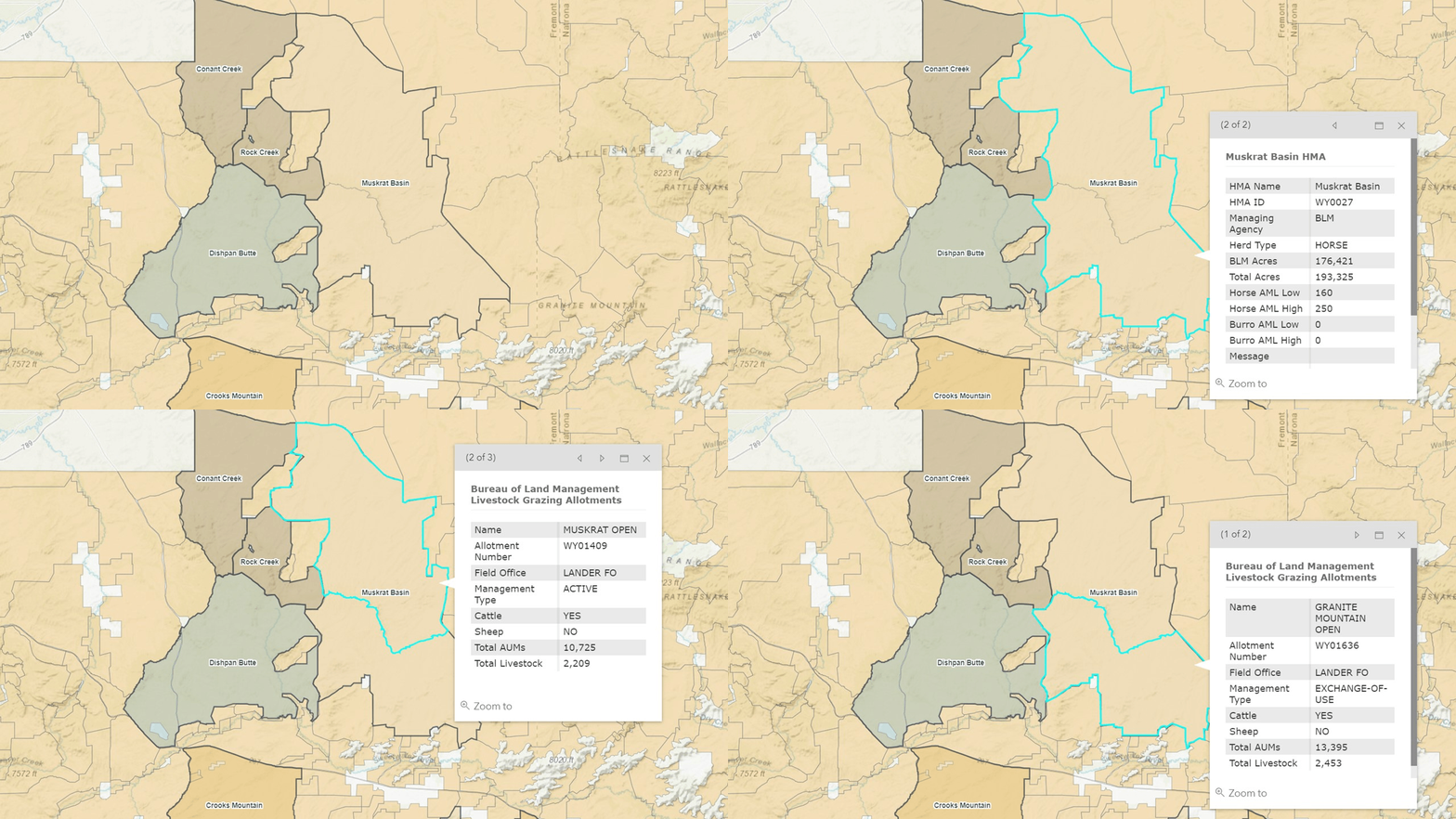
The 250 horses allowed by plan consume 3,000 AUMs per year. The HMA covers 193,255 total acres, including 176,227 BLM (public) acres.
The eight permittees receive a total of 23,906 AUMs per year according to Table 2.
The Allotment Master Report indicates a forage allocation of 23,103 AUMs per year across the two allotments. Both are in the Improve category and contain a total of 176,988 public acres.
The forage assigned to livestock, based on data in the EA, would support an additional 23,906 ÷ 12 = 1,992 wild horses, for a True AML of 250 + 1,992 = 2,242. This is the number of animals the HMA could support if it was managed principally for wild horses, as specified in the original statute.
The current population of 952 is well within this range, so there are no excess horses in the HMA and there is no need for a roundup or a fertility control program.
The 1,992 horses displaced from the HMA by permitted grazing represent 4.0% of the 50,000 animals in off-range holding.
The current AML corresponds to about 11% of the total authorized forage, neglecting wildlife, meaning the HMA is managed primarily for livestock.
Forage availability in this area is very high, about 152 AUMs per year per thousand acres, which would support a stocking rate of almost 13 wild horses per thousand acres!
For reference, the Virginia Range was carrying ten wild horses per thousand acres before the advocates got involved.
The target rate across all HMAs is one wild horse per thousand acres.
AMLs and stocking rates are small relative to the available resources because the bureaucrats put ranching interests far above those of the horses.
RELATED: Preliminary EA for North Lander Complex Out for Public Review?
Mustang Monday
At or near the Gila River Indian Reservation with InMaricopa.
How Many Wild Horses Can the Rock Creek HMA Support?
For a quick estimate, convert the forage assigned to livestock (AUMs) to wild horses and add the result to the AML.
Table 2 of the Draft EA for resource enforcement in the North Lander Complex indicates the HMA intersects one grazing allotment.
The HMA boundary coincides roughly with the boundary of the Rim Pasture Allotment, as shown in the Western Watersheds map. (Click on image to open in new tab.)

The 86 horses allowed by plan consume 1,032 AUMs per year. The HMA covers 24,584 total acres, including 19,085 BLM (public) acres.
The five permittees receive 3,976 AUMs per year according to Table 2.
The Allotment Master Report is not working today but the Allotment Information Report, also at RAS, indicates a forage allocation of 3,982 AUMs per year at Rim Pasture. The allotment is in the Improve category according to the AIR and contains 19,100 public acres.
The forage assigned to livestock, based on data in the EA, would support an additional 3,976 ÷ 12 = 331 wild horses, for a True AML of 86 + 331 = 417. This is the number of animals the HMA could support if it was managed principally for wild horses, as specified in the original statute.
The current population of 179 is well within this range, so there are no excess horses in the HMA and there is no need for a roundup or fertility control program.
The 331 horses displaced from the HMA by permitted grazing represent about 0.7% of the 50,000 animals in off-range holding.
The current AML corresponds to about 21% of the total authorized forage, neglecting wildlife, meaning the HMA is managed primarily for livestock.
Forage availability in this area is very high, 262 AUMs per year per thousand acres, which would support a stocking rate of almost 22 wild horses per thousand acres!
The target rate across all HMAs is one wild horse per thousand acres.
AMLs and stocking rates are low relative to the available resources because the bureaucrats put ranching interests far above those of the horses.
Would an HMAP fix that? Nope.
RELATED: Preliminary EA for North Lander Complex Out for Public Review?
UPDATE: AMR has been fixed, report for Rim Pasture posted.
Writer Overlooks Key Beneficiary of Wild Horse Roundups
They rob forage from native wildlife, according to the writer of a letter in today’s edition of the Casper Star-Tribune, but impacts to non-native animals, such as privately owned cattle and sheep, were omitted from the remarks.
How Many Wild Horses Can the Conant Creek HMA Support?
The advocates will never ask that question. The rationale for their darting programs would fall to the ground. They don’t want you asking either.
Table 2 of the Draft EA for resource enforcement actions in the North Lander Complex indicates the HMA intersects one grazing allotment.
The HMA boundary coincides roughly with the boundary of the Conant Creek Common Allotment, as shown in the Western Watersheds map.

For a quick estimate, convert the forage assigned to livestock (AUMs) to wild horses and add the result to the AML, which is currently 100.
The three permittees receive 7,832 AUMs per year according to Table 2 and 7,987 AUMs per year according to the Allotment Master Report. Let’s use the figure in the EA.
The forage assigned to livestock would support an additional 7,832 ÷ 12 = 652 wild horses, for a True AML of 752.
The current population of 263 is well within this range, so there are no excess horses in the HMA and there is no need for a roundup or fertility control program.
The stocking rate at the new AML would be about 15 wild horses per thousand acres.
The 652 horses displaced from the HMA by privately owned livestock represent about 1.3% of the 50,000 animals in off-range holding.
The current AML corresponds to about 13% of the total authorized forage, neglecting wildlife, meaning the HMA is managed primarily for livestock.
RELATED: Preliminary EA for North Lander Complex Out for Public Review?
Desatoya Roundup Day 6
The incident began on January 16. Gather stats through January 21:
- Target: Horses
- Type: Planned
- Method: Helicopter
- Captured: 147, up from 93 on Day 3
- Average daily take: 24.5
- Capture goal: 233
- Removal goal: 150
- Returned: 2, up from zero on Day 3
- Deaths: 2, up from 1 on Day 3
- Shipped: 83, up from 9 on Day 3
A stallion was euthanized on Day 5, lifting the death rate to 1.4%.
The cumulative total includes 67 stallions, 61 mares and 19 foals.
Youngsters represented 12.9% of the horses captured, consistent with a herd growth rate of 8% per year, assuming a 5% death rate.
Of the adults, 52.3% were stallions and 47.7% were mares.
Body condition scores were not reported.
The location of the trap site within the HMA was not provided.
Two stallions, each blind in one eye, were returned to the HMA on Day 4. Blindness is usually a fatal flaw for captured horses.
The number of animals shipped includes nine privately owned horses returned to their owner on Day 3.
Day 6 ended with 60 unaccounted-for animals.
Other statistics:
- AML: 180
- Forage assigned to horses: 2,160 AUMs per year
- Pre-gather population: 277
- Forage liberated to date: 1,740 AUMs per year
- Water liberated to date: 1,450 gallons per day
- Forage assigned to livestock: 9,608 AUMs per year (estimated)
- Horses displaced from HMA by permitted grazing: 801
- True AML: 981
- Stocking rate at new AML: 6.1 wild horses per thousand acres
- Horses displaced from HMA by drilling and mining: Ask the advocates
RELATED: Desatoya Roundup Day 3.
 Western Horse Watchers Association