WHB Advisory Board Tours Onaqui Mountain HMA

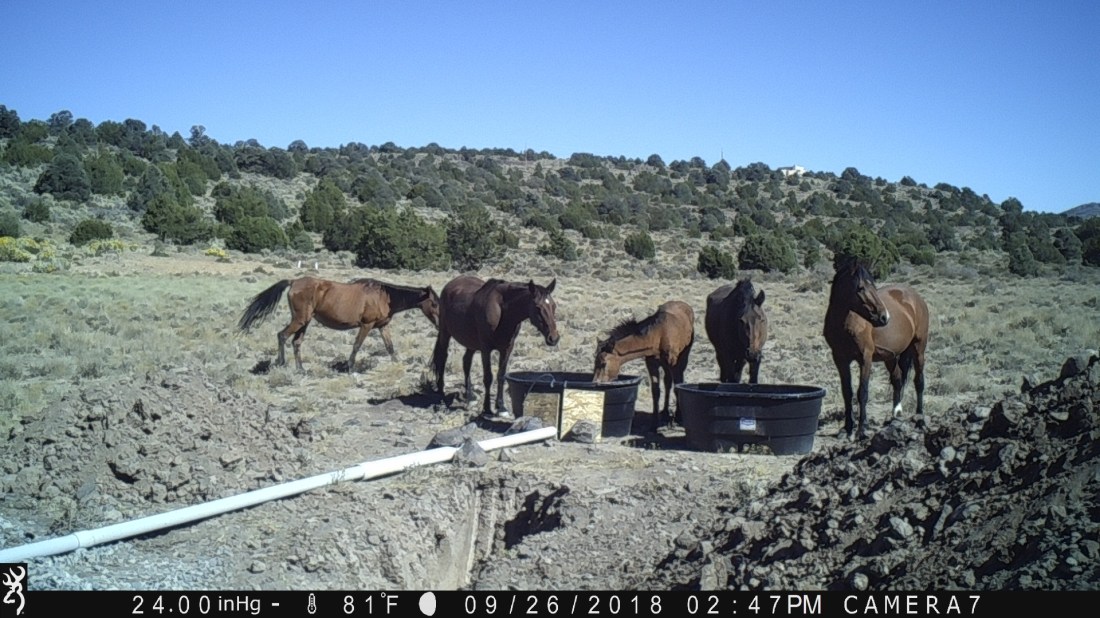
The WHB Advisory Board meeting in Salt Lake City kicked off yesterday with a field trip to the Onaqui Mountain HMA.  BLM staff hosted the tour, eager to associate any and all conditions with the horses.  Refer to this report by Deseret News.

It’s like climate change.  Whatever the perceived malady, blame it on the horses.  Mud or no mud, vegetation or no vegetation, wildlife or no wildlife, ascribe it to the horses.

Don’t mention livestock, don’t mention multiple use.

Recite the wild horse narrative as often as possible.

Cover for the public-lands ranchers.

Polls show that 80% of Americans want these animals protected and preserved.

Do think that will have any effect on the anti-horse juggernaut that has rolled across western rangelands since Trump was elected?
RELATED: WHB Advisory Board Meeting Starts Tomorrow.

Antelope / Goshute Roundups Make the Headlines

A syndicated report has been picked up by major news outlets regarding the second wild horse gather at the Antelope Valley and Goshute HMAs in eastern Nevada.  Refer to this article in the Beaumont Enterprise for example.  Here’s what they have in common:

  • Unquestioned acceptance of statements regarding wild horse populations
  • Erroneous reporting of the number of horses removed
  • Animal deaths not mentioned

Although the stories hint at the role of livestock in the debacle, they fail to acknowledge that all of this is happening on lands set aside for the horses.

RELATED: BLM Ends Antelope Valley and Goshute Gathers.

CA-1

BLM Ends Antelope Valley and Goshute Gathers

Bait trapping ended 10/02/18, with 902 wild horses removed from the two HMAs, according to a news release issued today.  Fifteen deaths were reported, leaving 887 animals to be shipped to the Indian Lakes Off-Range WHB Corrals in Fallon, NV, where they will be offered for adoption or transferred to segregated long-term holding.

Two horses were put down due to blindness.

Ten were put down due to emaciation and weakness.

Three horses died after hitting panels (walls of the traps) and breaking their necks, sometimes referred to affectionately as ‘capture shock’ by those in the field.

All euthanized animals had been given a hopeless prognosis for recovery.

The announcement did not indicate if livestock were present on the HMAs and if they were also affected by inadequate food and water.

RELATED: BLM Wants Another Bite of the Apple at Goshute and Antelope Valley HMAs.

Multiple Use on Lands Set Aside for Horses and Burros

Suppose an area can support ten or more wild horses per thousand acres.  The stated carrying capacity is one horse per thousand acres.  The current population density is three horses per thousand acres.

  • Claims will be made that the area is overpopulated
  • Arguments will be made that excess horses must be removed
  • Meetings will be held to draft a management plan
  • Helicopters will be deployed
  • Horses will be gathered

Given that the area is now underpopulated, what do you suppose will fill the gap?

WHB Advisory Board Meeting Starts Tomorrow

The meeting on Day 2 and Day 3 will be livestreamed according to a report posted yesterday by KSL in Salt Lake City.

The theme of the meeting will be wild horse and burro overpopulation.  Not that it’s true, but an excuse is needed for removing more of these animals from lands set aside for them.

Who’s pushing that?  The National Horse and Burro Rangeland Management Coalition, a livestock advocacy group.  See this position statement in Ag Daily, posted 10/05/18.

“Overpopulation of horses and burros continues to threaten the health of our rangelands and negatively impacts the multiple-use of these public lands.”

Translation: Wild horses are burros are robbing us of forage that could be consumed by cattle and sheep.  They have to go.

RELATED: BLM Posts Agenda for WHB Advisory Board Meeting.

BLM Posts Agenda for WHB Advisory Board Meeting

Meeting will occur October 9 – 11 in Salt Lake City, agenda posted here.

Topics include:

  • Telling the truth about the carrying capacity of the land
  • Restoring zeroed-out lands to wild horses and burros
  • Allocating more land to the WHB program
  • Increasing AMLs
  • Introducing new ideas for keeping WHB on the range
  • Ending ‘humane management practices’ (contraception and sterilization)
  • Investigating misleading statements about WHB overpopulation
  • Raising grazing fees for livestock on public lands
  • Requiring labels on beef that indicate if it was produced on public lands
  • Educating the public about treatment of WHB on western rangelands
  • Publishing charts that show how forage is allocated on public lands
  • Reviewing upcoming AUM curtailments
  • Reviewing plans for restoring horses to areas impacted by fire and drought
  • Waiving property taxes on lands obtained for private sanctuaries
  • Omitting sales taxes on equipment and supplies purchased for sanctuaries
  • Investigating ties between the BLM, USFS and livestock industry
  • Exposing the media blackout regarding livestock on lands set aside for WHB
  • Discussing the constitutionality of FLPMA (federal ownership of land)
  • Nullifying the WHB Act

Not!  None of these items are on the agenda.

RELATED: National WHB Advisory Board to Meet Next Month.

BLM Ends Owyhee Gather

Helicopter operations ended 10/04/18, with 1178 wild horses gathered from the Owyhee Complex.  Of these, 129 mares and 151 studs were returned to the range, with 127 of the mares treated with contraceptives (PZP).  Refer to the news release posted today.

The emergency roundup was a consequence of the Martin Fire.  The announcement did not indicate if any horses would be returned to the area when conditions improve.

Twenty five deaths were reported.  Nine horses were euthanized due to blindness.  A twenty year old mare was euthanized because she kicked through a panel after being treated with PZP, fracturing her left hind leg below the hock.

Horses not returned to the range were taken to the WHB Center at Palomino Valley, north of Reno, NV, where they will be readied for adoption, sale or long-term holding.

No livestock were affected by the roundup.

RELATED: Emergency Gather at Owyhee Complex Begins This Week.

Devil’s Garden Roundup In the Headlines

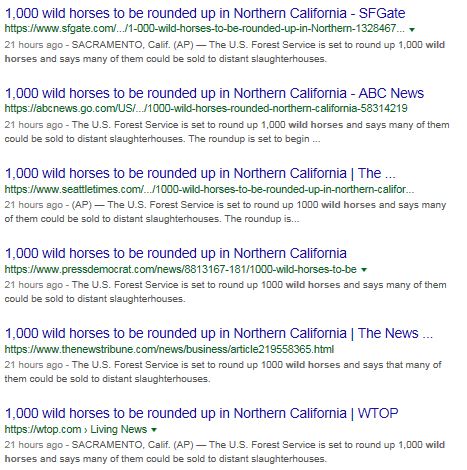
The Sac Bee report about the Devil’s Garden roundup (which starts next week) is all over the news, minus one teeny weeny detail, namely, that the horses have been robbing public-lands ranchers of their birthright: forage for cattle and sheep—on lands set aside for the horses.

Devils_Garden_News-1

BLM won’t talk about it.  USFS won’t acknowledge it.  Left-wing media outlets won’t cover it.  If conservatives were involved, they’d be attacking from all sides.

Public-lands ranchers get their sustenance from government.  They graze their livestock for pennies per day (the fee in 2018 is $1.41 per cow-calf pair per month).  Government spends tens of millions of dollars every year to remove other species that might interfere with the enterprise.

Their cheerleaders think you have a right to eat meat.

Their leading political ally received a grade of ‘D’ from Conservative Review.

The entire affair looks like one big welfare racket, propagated by liberals for the benefit of liberals.  So much for hard-working cowboys and rugged individualism.

RELATED: Not One Word About Livestock at Devil’s Garden WHT.

Not One Word About Livestock at Devil’s Garden WHT

An article posted yesterday by The Sacramento Bee about the upcoming removal of 1000 wild horses from the from the Devil’s Garden Plateau WHT does not mention that the entire territory falls within permitted grazing allotments.

This story was linked on Drudge so how many readers came away with the wrong impression?

The Forest Service argues the roundup is necessary to “allow range and riparian ecological conditions to recover, while also supporting wild horse herd health by reducing competition for limited food, water and habitat.”

Competition with whom?  The oil and gas industry?  Mining companies?  Can’t possibly be livestock and public-lands ranchers.  They are blameless, as always.

RELATED: Gather In Devil’s Garden WHT Starts Next Month.

County Seeks Input on Placitas Wild Horses

Residents of Sandoval County, NM have been asked to participate in an online survey about free-roaming horses near the town of Placitas.  Responses from individuals in that area will carry the most weight.

County staff have been working with the Bureau of Land Management and New Mexico Livestock Board to develop a management plan.  The goal is to “…truly and sustainably resolve the situation with the free roaming horses in Placitas.”  That the horses might be competing with cattle and sheep for food and water was not mentioned in the narrative.

What might the plan include and what would be the results?

  • Helicopter roundups – fewer horses on the range, breeding patterns altered
  • Bait traps – fewer horses on the range, breeding patterns altered
  • Fertility control – fewer horses on the range, breeding patterns altered
  • Sterilization – fewer horses on the range, breeding patterns altered
  • Euthanasia – fewer horses on the range, breeding patterns altered

The first three options don’t provide a lasting solution and are therefore eschewed by public-lands ranchers, their overlords, cheerleaders and political allies.

Hopefully, someone will come forward with a proposal that works to the benefit of the horses, not their enemies.

RELATED: Case Against Man Who Rescued Foal Dismissed, Mostly Pintos.