LRTC Seeks Volunteers for Large Animal Rescue Team

The 2023 spring training and certification cycle is starting now, according to a report by The Fernley Reporter.

The non-profit serves most of the Virginia Range and surrounding counties.

The article did not indicate if interventions have increased over the last five years as the horses scatter in fear of the advocates.

RELATED: Press Briefing for Virginia Range Horse Program?

Standing Up for Wild Horses on Virginia Range 06-18-22

Winnemucca Base Property Hits Market for $11.2 Million

The ranch covers 3,621 deeded acres along the Humboldt River, according to the agent’s listing, with grazing preference on the Sonoma Allotment.

The Allotment Master Report puts it in the Improve category, with 1,485 active AUMs.

The Authorization Use Report indicates a four-month grazing season.

Where do you suppose the cattle go during the off season?

Most of the public land, representing about 50% of the total, is in the Sonoma Range HA, as shown in the following map from the National Data Viewer.  Click on image to open in new tab.

The new owner need not run cattle on Sonoma.

He could petition the BLM for a change in livestock type and season of use, as American Prairie did in Montana, allowing horses to return to a small part of their lawful home.

Sonoma Allotment Map 02-21-23

On the Nevada Checkerboard

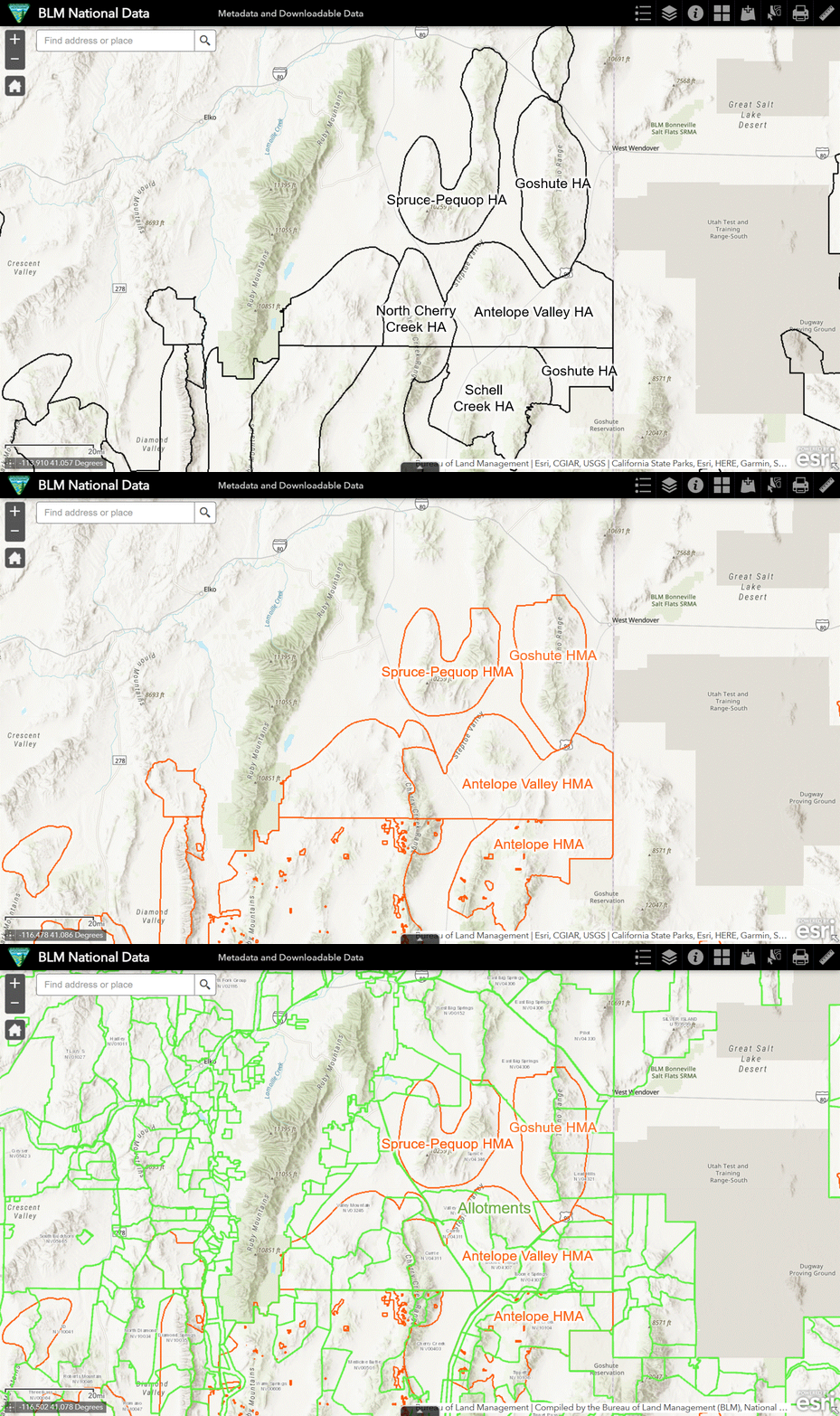
The following maps from the National Data Viewer show land designations along the I-80 corridor from Lovelock to Elko.  Click on image to open in new tab.

BLM land is tan, private property is white.

First, areas of critical environmental concern, in gray.

Next, herd areas, in black, where wild horses were found in 1971.

In orange, herd management areas, with non-zero AMLs, a subset of the herd areas.

Finally, in green, the grazing allotments.

What’s the predominant use of public lands in this area?

On the Nevada Checkerboard 02-21-23

New Grazing Fee Untouched by Inflation

The price for 2023 is $1.35 per AUM, same as last year, according to a BLM news release dated January 31.

Western Horse Watchers believes it was posted more recently but was backdated to bury it in the archives.

The announcement means the fee has been at rock bottom for three years in a row.

The price of hay in this area has gone from around $95 per AUM in 2021 to $180 per AUM in 2023.

The new fee goes into effect on March 1.

Senate Committee Tries to Alter Colorado Anti-Slaughter Bill

Two amendments were proposed yesterday in the Agriculture and Natural Resources Committee, L.007 and L.008.

They will not be incorporated into the bill unless adopted by the full Senate.

The changes would turn the measure into a livestock transportation bill, according to a report posted this morning by The Colorado Sun.

Slaughtering horses and burros for human consumption would become a crime under the original bill but with the amendments it would only establish tighter regulations when transporting twenty or more horses for slaughter.

Dan Waldvogle, director of the Rocky Mountain Farmers Union, which represents 17,000 farmers and ranchers in the state, said “Numerous cultures embrace horse consumption and we support their access to culturally relevant products and increasing their food sovereignty.”

You can monitor the status of SB23-038 at this page.

RELATED: Colorado Legislature Considers Bill to Prohibit Slaughter.

SB 301 Advances to New Mexico Judiciary Committee

The bill cleared the Senate Conservation Committee yesterday, according to a story by KRQE News.

A representative of Animal Protection Voters spoke in favor of the measure.

An APV fact sheet says the bill allows population suppression (PZP for mares, castration for stallions), relocation to other areas, transfer to rescues and preserves for sanctuary or adoption and euthanasia of horses with untreatable medical conditions.

Curiously, the Campaign Against America’s Wild Horses opposed the bill, claiming that it could undermine efforts to control free-roaming herds with contraceptives.

The status of the bill can be monitored at this page.

RELATED: New Mexico Lawmakers Tackle Wild Horse Problem?

Foal-Free Friday, Spending Your Money Wisely Edition

Would you attend a conference organized by those who say PZP is not a pesticide?

Should you support an organization that

What about groups that

  • Care far more about their standing with the bureaucrats and ranchers than they do about the horses?
  • Want to be leaders in the wild horse removal industry?
  • Won’t provide data for their darting programs, including herd sizes, demographics and changes year over year?

What about individuals that

  • Refer to sterilized mares as self-boosting?
  • Describe abnormal sex ratios as mares living longer?
  • Say preservation when they mean eradication?
  • Tell you the herds are aging out, not dying off?
  • Want the ranchers to succeed, not the horses?
  • Treat their cherished/beloved/innocent wild horses as pests.

What should you believe?  Their words or their deeds?

RELATED: Foal-Free Friday, Fooling You with Euphemisms Edition.

For Your Innocent Ants and Roaches 10-23-22

Advocates Upset as BLM Traps More Pine Nut Horses

Thirteen more have been captured, according to a report by The Record-Courier of Minden, NV, bringing the total to 18.

All of the mares had been treated with the Montana Solution.

Although a nuisance gather appears at the bottom of the FY 2023 roundup schedule, with a removal goal of 22, there are no gather stats and daily reports at the Nevada roundup page.

The Pine Nut Mountains HMA, shown in orange on the following map, is roughly half the size of the HA, shown in black.

Operations may be on private lands west of the HA.

RELATED: Advocates Fuming After BLM Nabs Pine Nut Horses.

Resource Management in Pine Nut Mountains 01-24-23

Writer Doubts BLM’s Investment in Sand Wash Basin

Commenting on a February 6 story about the agency’s plan to install fixed trap stations and increase the use of fertility control, he stated in a February 15 letter that the purpose of roundups is to destroy wild horse herds at the behest of sheep and cattle ranchers.

Although he referred to them as cruel and unnecessary, he did not point to the Montana Solution as an alternative.

RELATED: Management Paradigm Shifting at Sand Wash Basin?

Fire Department Rescues Wild Horse from Cattle Guard

The incident occurred on February 9 at the entrance to the Ten-X Campground of the Kaibab National Forest, according to a report posted today by Williams News of Williams, AZ.

The facility is located two miles south of Tusayan, AZ on the east side of Highway 64.

The article did not indicate if the guard had been installed by our stewards of the public lands.

The Western Watersheds map indicates that the campground is surrounded by the Anita Allotment of the Tusayan Ranger District.

The mishap follows two other calls in the past year involving horses in cattle guards.

UPDATE: More information about the allotment can be found in the 2022 Annual Operating Instructions.

Ten-X Campground Map 02-14-23

AMLs and Carrying Capacities

The statement last week by the BLM that the AML for Sand Wash Basin represents the carrying capacity of the land was false.

If an HMA is subject to permitted grazing, the carrying capacity will be higher.

Same for WHTs.

Sand Wash Basin covers 156,502 total acres, according to the 2022 HA/HMA Report, including 151,435 public acres.

The AML is 362.

The 362 horses allowed by plan, the correct interpretation of the term, require 4,344 AUMs per year, or 28.7 AUMs per year per thousand public acres.

The stocking rate allowed by plan is 362 ÷ 151,435 × 1,000 = 2.4 wild horses per thousand public acres.

The National Data Viewer shows four allotments that overlap the HMA: Lang Spring, Nipple Rim, Sheepherder Spring and Sand Wash.

The allotment boundaries deviate slightly from the HMA boundary and roughly half of Nipple Rim extends beyond the HMA, but the forage assigned to livestock inside the HMA—the reason why AMLs are not synonymous with carrying capacities—can be estimated on a per-acre basis.

Sand Wash Allotments 02-04-23

The Allotment Master Report provides acreage, management status and active AUMs.

Sand Wash Basin Allotment Calcs 02-12-23

Approximately 98% of the public acreage is in the Improve category.

The forage assigned to livestock would support 117.6 ÷ 12 = 9.8 horses per thousand public acres, on top of the 2.4 allowed by plan, despite claims by the BLM that public lands in the western U.S. can only support one wild horse per thousand acres (27,000 animals on 27 million acres).

There are three layers of forage demand across the HMA: Horses, livestock and wildlife.

Livestock receive 117.6 × 151,435 ÷ 1,000 = 17,809 AUMs per year per year inside the HMA, enough to support 17,809 ÷ 12 = 1,484 wild horses.

The horses receive 4,344 AUMs per year as noted above.

The forage assigned to wildlife is not known but is probably around 200 AUMs per year.

These figures are presented in the pie charts below.

The estimated carrying capacity is 362 + 1,484 = 1,846, the True AML, to be achieved by confining the ranchers to their base properties in a rear-round off season.

The Sand Wash Advocates beat the horse population down with their favorite pesticide so livestock can access most of their food.

The Wild Horse Fire Brigade would ship them to a remote wilderness area, never to be seen again, so livestock can access all of their food.

The 2021 roundup took over 600 horses off the range.  The pre-gather population was 896, well within the carrying capacity of the HMA.

RELATED: Management Paradigm Shifting at Sand Wash Basin?

Sand Wash Resource Management 02-14-23

Assateague Pony Census, February 2023

The Assateague Island Alliance counted 78 horses on the Maryland side of the island as of February 8, no change from January.

No births were indicated.

The number of males and females was not given.

The Park Service no longer provides census results.

The herd, barely able to keep up with deaths, shows little if any growth since the safe, proven and reversible darting program was shut off in 2016.

The sex ratio is likely skewed in favor of females, a side-effect of the Montana Solution.

RELATED: Assateague Census, January 2023.