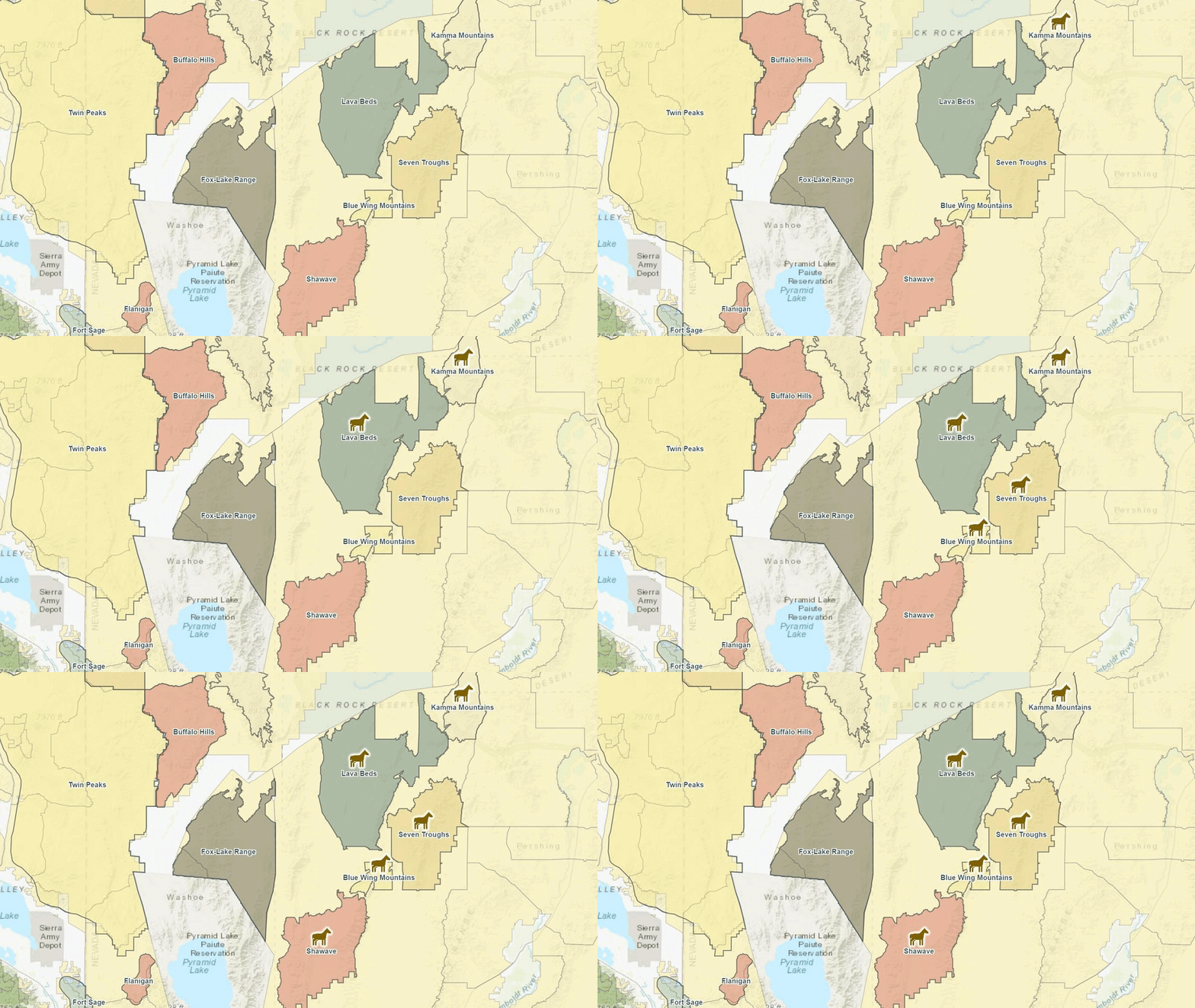
Triple B Roundup, Day 7

The incident began on July 17.  Gather stats through July 23:

  • Target: Horses
  • Type: Planned
  • Method: Helicopter
  • Category: Cruel and costly
  • Captured: 285, up from 248 on Day 5
  • Average daily take: 40.7
  • Capture goal: 1,900
  • Removal goal: 1,800
  • Returned: None, no change from Day 5
  • Deaths: 6, up from 4 on Day 5
  • Shipped: 246, up from 159 on Day 5

Helicopters did not fly on Day 7.

Two foals were put down on Day 6 due to pre-existing conditions, lifting the death rate to 2.1%.

The total includes 92 stallions, 138 mares and 55 foals.

Youngsters represented 19.3% of the animals captured.  Of the adults, 40.0% were male and 60.0% were female.

The herd can’t be growing at a rate of 20% per year with a birth rate of 19% per year.

Abnormal sex ratios are often found in herds subject to the Montana Solution but not double-digit birth rates.

Body condition scores were not given.

The location of the trap site was not disclosed.

The Complex and surrounding lands are subject to permitted grazing.

Triple B Complex Map 07-11-22

Day 7 ended with 33 unaccounted-for animals.

Mares treated with fertility control may be returned to the area at a later date.

Other statistics:

  • Horses allowed by plan (AML): 821
  • Forage assigned to horses: 9,852 AUMs per year
  • Pre-gather population: 3,475
  • Forage liberated to date: 3,420 AUMs per year
  • Water liberated to date: 2,850 gallons per day
  • Forage assigned to livestock: 49,188 AUMs per year (estimated)
  • Horses displaced from Complex by permitted grazing: 4,099
  • True AML: 4,911
  • Stocking rate at new AML: 3.0 horses per thousand acres
  • Horses displaced from Complex by drilling and mining: Ask the advocates

RELATED: Triple B Roundup, Day 5.

ISPMB Complaint Involves ASNF ‘Jumping Mouse’ Horses

A report posted yesterday by Courthouse News Service confirms that horses removed from the Apache Sitgreaves National Forests earlier this year in a law enforcement action are the subject of the case.

The Forest Service stated they were unauthorized livestock, not unclaimed/unbranded horses entitled to protection by the WHB Act, which ISPMB disputes.

The roundup occurred in an area southwest of Alpine, AZ designated as critical habitat for the New Mexico Jumping Mouse but overlapped by grazing allotments.

ASNF Jumping Mouse Allotments 03-24-22

Curiously, in other such areas, the agency allows permitted grazing not just in close proximity to the habitats but in the habitats.

The judge said he would take the matter under advisement and rule in due course.

RELATED: ISPMB Complaint Explained.

Twin Peaks Roundup Explained

Refer to this fact sheet, posted at the gather page.

“This population management effort is required under the federal Wild Free-Roaming Horses and Burros Act because the population of wild horses and burros has exceeded the populations established in the BLM’s land use plan for the area.”  There are more horses and burros in the HMA than allowed by plan.

“The goal of the Act is to preserve and protect wild horses and burros as integral parts of a thriving ecological system in balance with other public resource values, including wildlife, livestock grazing, resource development, and recreational access.  This requires controlling populations.”  The horses and burros are consuming resources assigned to privately owned livestock.

“The BLM’s overall goal is managing healthy wild horse herds on healthy rangelands in balance with other authorized uses.”  You can have your wild horse and burro program as long as it doesn’t interfere with the grazing program.

The incident is set to begin on July 23.

RELATED: Twin Peaks Roundup Announced.

Thriving Ecological Balance-3

Black Mountain Aftermath

A writer with Outdoor Life hit the trail with one of the permittees to bring you this report about conditions on the ground now that the burros are gone.

The HMA covers about 1.1 million acres in western Arizona and has an AML of 478.

A roundup in May took almost 1,100 animals off their home range.

The Operator Information Report in RAS ties the rancher to two grazing authorizations, 0202009 and 0202017.

The Allotment Information Report associates the authorizations with the Black Mt Unit A and Castle Rock allotments.

The Western Watersheds map puts Black Mt Unit A inside the HMA and Castle Rock on the eastern flank.  Click on image to open in new tab.

Black Mountain Aftermath 07-22-22

The permittee holds all of the active AUMs according to the Allotment Master Report.

The Authorization Use Report indicates he’s grazing year around, like the burros.

Black Mt Unit A is in the Maintain category while Castle Rock is in Improve.

Allotments in the Improve Category exhibit vegetative and watershed conditions that don’t meet objectives and standards for rangeland health.

Allotments in the Maintain Category comply with those standards.

Unit A likely achieved this status before the burros were removed.

The 1,247 AUMs per year sold to the permittee would support 207 wild burros.

If the rancher was confined to his base property and expected to pay the going rate to feed his animals, taxpayers would not have to pick up the tab for 207 wild burros.

As for the PZP jennies, the advocates at HSUS, signatories to the rancher-friendly “Path Forward,” will probably want the experiment to continue so most of the resources in an area set aside for wild burros can be consumed by privately owned livestock.

Good work, guys.

RELATED: Black Mountain Roundup Over.

Advocates Dispute Rationale for Piceance Roundup

The evidence does not support the BLM’s claims, according to a report posted yesterday by Aspen Public Radio.

If you’re taking wild horses off the range while leaving the cattle alone, or allowing more livestock back on the land after the horses are gone, the issue was resource enforcement, not rangeland health.

RELATED: Piceance Assessment Finds Ample Forage for Wild Horses?

Foal-Free Friday, Who Said We’re Trying to Preserve Them Edition

Mares with normal immune function respond to the Montana Solution, so the trait is not passed on to future generations.

Mares with depressed immune function do not respond to the treatments and can pass that trait to their offspring.

Thus, PZP selects for horses with low immune function, which can be destructive to the herds in the long run.

A routine infection could wipe out a population compromised by the advocates.

If the goal is preservation, the use of PZP constitutes a worst management practice.

RELATED: Foal-Free Friday, Putting Them Out of Their Misery Edition.

Triple B Roundup, Day 5

The incident began on July 17.  Gather stats through July 21:

  • Target: Horses
  • Type: Planned
  • Method: Helicopter
  • Category: Cruel and costly
  • Captured: 248, up from 138 on Day 3
  • Average daily take: 49.6
  • Capture goal: 1,900
  • Removal goal: 1,800
  • Returned: None, no change from Day 3
  • Deaths: 4, up from 3 on Day 3
  • Shipped: 159, up from 80 on Day 3

A filly died on Day 4 due to pneumonia.  The death rate is 1.6%.

The total includes 77 stallions, 124 mares and 47 foals.

Youngsters represented 19.0% of the animals captured.  Of the adults, 38.3% were male and 61.7% were female.

The herd can’t be growing at a rate of 20% per year with a birth rate of 19% per year.

If the death rate is 5% per year, 14% would be a better estimate.

The sex ratio is abnormal, a pattern seen in herds subject to the Montana Solution.

Body condition scores were not given.

The location of the trap site was not disclosed.

The Complex and surrounding lands are subject to permitted grazing.

Triple B Complex Map 07-11-22

Day 5 ended with 85 unaccounted-for animals.

Mares treated with fertility control may be returned to the area at a later date.

Other statistics:

  • Horses allowed by plan (AML): 821
  • Forage assigned to horses: 9,852 AUMs per year
  • Pre-gather population: 3,475
  • Forage liberated to date: 2,976 AUMs per year
  • Water liberated to date: 2,480 gallons per day
  • Forage assigned to livestock: 49,188 AUMs per year (estimated)
  • Horses displaced from Complex by permitted grazing: 4,099
  • True AML: 4,911
  • Stocking rate at new AML: 3.0 horses per thousand acres
  • Horses displaced from Complex by drilling and mining: Ask the advocates

RELATED: Triple B Roundup, Day 3.

Piceance Roundup, Part 2 Day 7

The incident began on July 15.  Gather stats through July 21:

  • Target: Horses
  • Type: Planned
  • Method: Helicopter
  • Category: Cruel and costly
  • Captured: 494, up from 392 on Day 5
  • Average daily take: 70.6
  • Capture goal: 1,050
  • Removal goal: 750
  • Returned: None, no change from Day 5
  • Deaths: 2, no change from Day 5
  • Shipped: 364, up from 295 on Day 5

The death rate is 0.4%.

The total, based on the daily reports, includes 184 stallions, 218 mares and 92 foals.

The 18 horses taken in Part 1 were omitted.

Youngsters represented 18.6% of the animals captured.  Of the adults, 45.8% were male and 54.2% were female.

The herd can’t be growing at a rate of 20% per year with a birth rate of 19% per year.

If the death rate is 5% per year, 14% per year would be a better estimate.

Body condition scores were not given.

The location of the trap site was not disclosed.

The HMA and surrounding lands are subject to permitted grazing.

Piceance HMA Map 07-17-22

Day 7 ended with 128 unaccounted-for animals.

Mares treated with fertility control may be returned to the area at a later date.

Other statistics:

  • Horses allowed by plan (AML): 235
  • Forage assigned to horses: 2,820 AUMs per year
  • Pre-gather population: 1,385
  • Forage liberated to date: 5,928 AUMs per year
  • Water liberated to date: 4,940 gallons per day
  • Forage assigned to livestock: 6,840 AUMs per year (estimated)
  • Horses displaced from HMA by permitted grazing: 570
  • True AML: 805
  • Stocking rate at new AML: 4.2 horses per thousand acres
  • Horses displaced from HMA by drilling and mining: Ask the advocates

RELATED: Piceance Roundup, Part 2 Day 5.

Pew Looks at New Mexico Plan to Manage Wild Horses

The wild horse alarmists get top billing in an article published yesterday by The Pew Charitable Trusts.  Rome is burning, wild horse populations are ballooning and fertility controls are needed.

Terms not found in the story:

  • Allotment
  • Cattle
  • Permit
  • Forage
  • Allocation

Lands that carried around two million wild horses a hundred years ago can only support a tiny fraction today.  What changed?

RELATED: New Mexico to Manage Wild Horses at Local Level?

Draft EA for Fertility Control Research Out for Review

The scoping period began last November, sort of, with a solicitation for research proposals on fertility control and climate change involving wild horses and burros.

A driver of the research is the desire to reduce the number of animals that must be gathered and removed from the range, according to Section 1.2 of the EA, which is misleading.

The goal is to identify new ways of taking them off the range, given historical and current logistical constraints and funding levels that limit removals with traditional methods.

The Proposed Action includes an Oocyte Growth Factor vaccine study, a SpayVac study and an IUD study, as explained in Section 2.2.2.

The EA was posted with other project documents.

Comments will be accepted through August 22.

You can have your wild horse and burro program as long as it doesn’t interfere with the grazing program.

RELATED: Wild Horse and Burro Research Initiative Announced.

Pancake Gather Plan

Triple B Roundup, Day 3

The incident began on July 17.  Gather stats through July 19:

  • Target: Horses
  • Type: Planned
  • Method: Helicopter
  • Category: Cruel and costly
  • Captured: 138, up from 43 on Day 1
  • Average daily take: 46.0
  • Capture goal: 1,900
  • Removal goal: 1,800
  • Returned: None, no change from Day 1
  • Deaths: 3, up from zero on Day 1
  • Shipped: 80, up from zero on Day 1

Three horses were put down on Day 3 due to pre-existing conditions, lifting the death rate to 2.2%.  They would be alive if there was no roundup.

The total includes 45 stallions, 63 mares and 30 foals.

Youngsters represented 21.7% of the animals captured.  Of the adults, 41.7% were male and 58.3% were female.

Body condition scores were not given.

The location of the trap site was not disclosed.

The Complex and surrounding lands are subject to permitted grazing.

Triple B Complex Map 07-11-22

Day 3 ended with 55 unaccounted-for animals.

Mares treated with fertility control may be returned to the area at a later date.

Other statistics:

  • Horses allowed by plan (AML): 821
  • Forage assigned to horses: 9,852 AUMs per year
  • Pre-gather population: 3,475
  • Forage liberated to date: 1,656 AUMs per year
  • Water liberated to date: 1,380 gallons per day
  • Forage assigned to livestock: 49,188 AUMs per year (estimated)
  • Horses displaced from Complex by permitted grazing: 4,099
  • True AML: 4,911
  • Stocking rate at new AML: 3.0 horses per thousand acres
  • Horses displaced from Complex by drilling and mining: Ask the advocates

RELATED: Triple B Roundup in Progress.

Piceance Roundup, Part 2 Day 5

The incident began on July 15.  Gather stats through July 19:

  • Target: Horses
  • Type: Planned
  • Method: Helicopter
  • Category: Cruel and costly
  • Captured: 392, up from 292 on Day 3
  • Average daily take: 78.4
  • Capture goal: 1,050
  • Removal goal: 750
  • Returned: None, no change from Day 3
  • Deaths: 2, no change from Day 3
  • Shipped: 295, up from 172 on Day 3

The death rate declined from 0.7% on Day 3 to 0.5% on Day 5.

The total, based on the daily reports, includes 143 stallions, 176 mares and 73 foals.

Youngsters represented 18.6% of the animals captured.  Of the adults, 44.8% were male and 55.2% were female.

Body condition scores were not given.

The location of the trap site was not disclosed.

The HMA and surrounding lands are subject to permitted grazing.

Piceance HMA Map 07-17-22

Day 5 ended with 95 unaccounted-for animals.

Mares treated with fertility control may be returned to the area at a later date.

Other statistics:

  • Horses allowed by plan (AML): 235
  • Forage assigned to horses: 2,820 AUMs per year
  • Pre-gather population: 1,385
  • Forage liberated to date: 4,704 AUMs per year
  • Water liberated to date: 3,920 gallons per day
  • Forage assigned to livestock: 6,840 AUMs per year (estimated)
  • Horses displaced from HMA by permitted grazing: 570
  • True AML: 805
  • Stocking rate at new AML: 4.2 horses per thousand acres
  • Horses displaced from HMA by drilling and mining: Ask the advocates

RELATED: Piceance Roundup, Part 2 Day 3.

Twin Peaks Roundup Announced

The incident will begin on July 23, according to the BLM news release, with a capture goal of 2,000 wild horses and 339 wild burros.  The removal goal is 1,800 and 339.

Up to 110 mares with be treated with fertility control and returned to the HMA.

Helicopters will push the animals into the traps and operations will be open to public observation.

The HMA covers 758,128 acres on the California-Nevada border and is managed for horses and burros.  The AMLs are 758 and 116, respectively.

The combined AML expressed in horses only would be 817 and the stocking rate allowed by plan would be 1.1 wild horses per thousand acres.

The current population, thought to be approximately 3,300 horses and 400 burros, is equivalent to 3,500 horses.Twin Peaks HMA Map 07-19-22

The HMA is subject to permitted grazing and livestock receive and estimated 27,178 AUMs per year, 2.8 times more than the horses and burros.

Captured animals will be taken to the off-range corrals in Litchfield, CA, Palomino Valley, NV and Bruneau, ID.

A link to gather stats and daily reports was not provided.

The roundup appears on the latest schedule.

Location of Cherry Spring WHT?

It’s in the Triple B Complex according to Table 2 of the 2017 Final EA for resource enforcement actions therein, but it’s not included in the 2022 Triple B roundup.

The Western Watersheds map puts it at the northwest corner of the Triple B HMA.

Cherry Spring WHT Map 07-18-22

The WHT has an AML of 58 according to the Forest Service but Table 2 says 68.

The map indicates that it’s overlapped by three allotments and is probably subject to permitted grazing.

The EA was posted with other project documents in ePlanning.

RELATED: Triple B Roundup in Progress.

Piceance Roundup, Part 2 Day 3

The incident began on July 15.  Gather stats through July 17:

  • Target: Horses
  • Type: Planned
  • Method: Helicopter
  • Category: Cruel and costly
  • Captured: 292, up from 159 on Day 1
  • Average daily take: 97.3
  • Capture goal: 1,050
  • Removal goal: 750
  • Returned: None, no change from Day 1
  • Deaths: 2, up from zero on Day 1
  • Shipped: 172, up from zero on Day 1

Horses were put down on Days 2 and 3, presumably, due to pre-existing conditions but no details were given.  The death rate is 0.7%.

The total includes 106 stallions, 132 mares and 54 foals.

Youngsters represented 18.5% of the animals captured.  Of the adults, 44.5% were male and 55.5% were female.

Body condition scores were not given.

The location of the trap site was not disclosed.

The HMA and surrounding lands are subject to permitted grazing.

Piceance HMA Map 07-17-22

Day 3 ended with 118 unaccounted-for animals.

Mares treated with fertility control may be returned to the area at a later date.

Other statistics:

  • AML: 235
  • Forage assigned to horses: 2,820 AUMs per year
  • Pre-gather population: 1,385
  • Forage liberated to date: 3,504 AUMs per year
  • Water liberated to date: 2,920 gallons per day
  • Forage assigned to livestock: 6,840 AUMs per year (estimated)
  • Horses displaced from HMA by permitted grazing: 570
  • True AML: 805
  • Stocking rate at new AML: 4.2 horses per thousand acres
  • Horses displaced from HMA by drilling and mining: Ask the advocates

RELATED: Helicopters Take to the Skies at Piceance HMA.