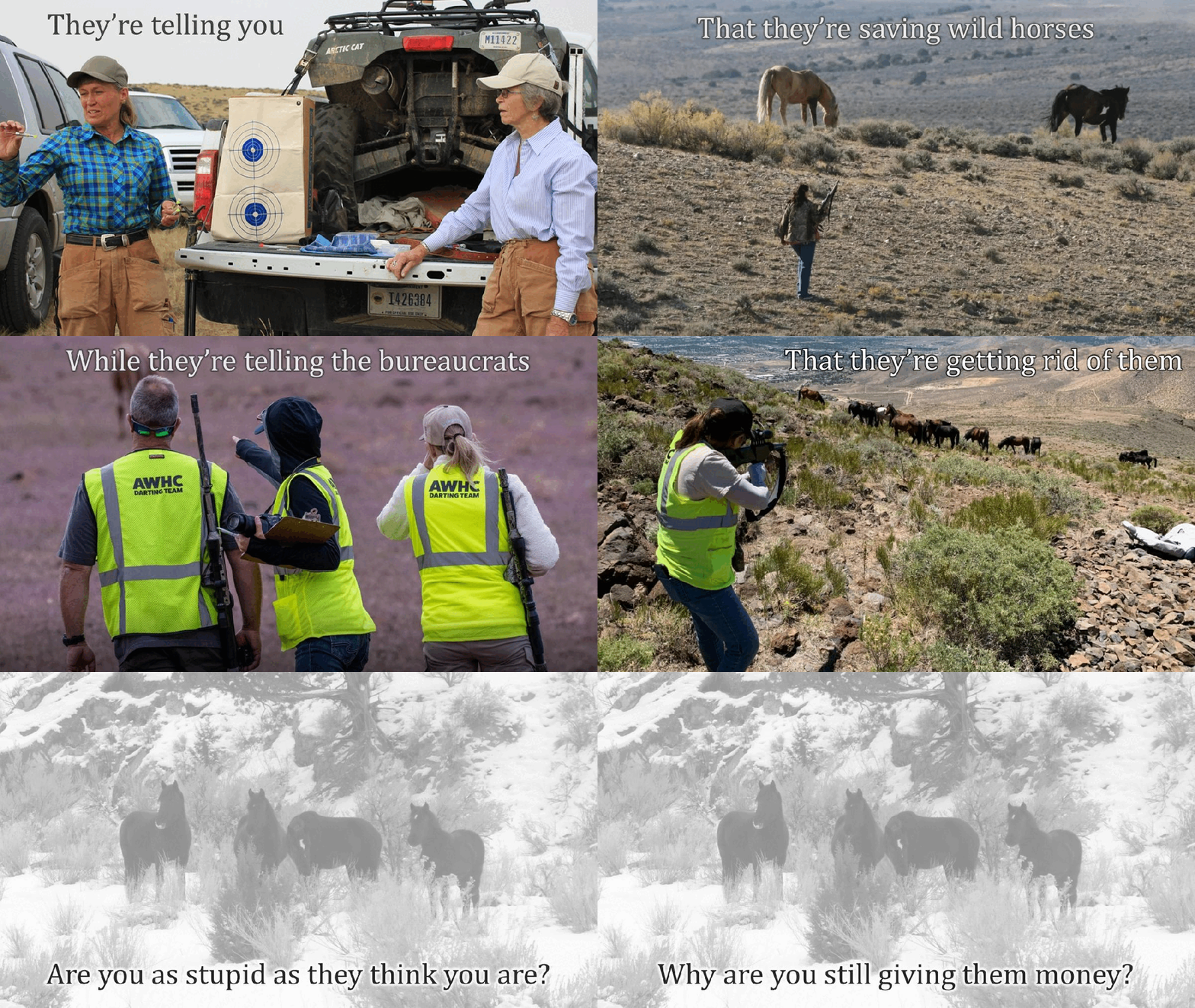
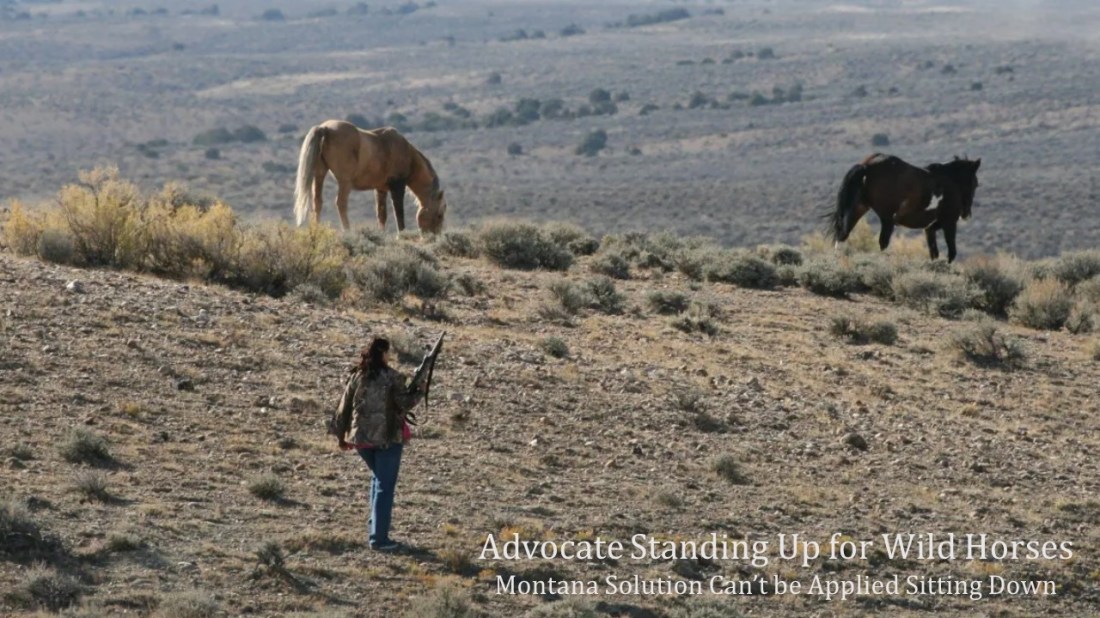
Refer to this post on HuntTalk, a message board for outdoorsmen.
The original piece was probably written by the real estate agent and PZP darter in the Minden/Gardnerville area.
“You MUST want to protect wild horses and be a team player.”
Stories by the Pine Nut advocates are occasionally featured these pages, along with the appropriate commentary, such as the June 24 edition of Foal-Free Friday.
The Decision Record, dated July 28, authorizes a mix of Alternatives B and C across seven BLM allotments, as described in Sections 2.3 and 2.4 of the Final EA.
Alternative B applies to Telegraph Creek, Box Elder, Flat Creek and Whiterock Coulee.
Alternative C applies to French Coulee, East Dry Fork and Garey Coulee.
American Prairie Reserve obtained grazing privileges on these allotments by acquiring private lands serving as base properties then petitioned the BLM to change the livestock type to bison.
The decision may establish a precedent for others who acquire private property tied to grazing allotments then request the BLM to change the livestock type to horses.
Catch-treat-release could become adopt-haul-release.
The figures above are based on the daily reports. The number of horses shipped doesn’t match the total at the gather page.
Two horses were put down on Day 4 due to pre-existing conditions. A mare jumped out of a pen on Day 5, ran through fencing and was later found dead.
The horse death rate is 1.1%.
The horse total includes 308 stallions, 352 mares and 127 foals.
Youngsters represented 16.1% of the horses captured. Of the adults, 46.7% were male and 53.3% were female.
The herd can’t be growing at a rate of 20% per year with a birth rate of 16%. A better estimate would be 11% per year, assuming a death rate of 5% per year.
The plaintiffs allege that the planned removal of 1,000 wild horses and burros will occur without the benefit of current data and environmental assessments related to rangeland conditions, according to a news release dated July 26.
A link to the complaint was not provided.
Helicopters are the fastest way to bring resource consumption in line with the specifications of the land-use plans but they don’t do much for rangeland health.
The Campaign Against America’s Wild Horses said yesterday in a news release that at least 840 wild horses and burros have been sold at slaughter auctions since 2019 as a result of the Adoption Incentive Program.
Adopters pocket the cash then dump the animals at livestock auctions, where they are sold to kill buyers for slaughter in Canada and Mexico, according to the announcement.
Western Horse Watchers estimates that during the same period, CAAWH and its army of nitwits got rid of at least 2,000 wild horses with the Montana Solution.
Who’s the greater threat to these animals?
When you spray your home for bugs, do you refer to them as cherished cockroaches while you apply the pesticide, as CAAWH does to wild horses?
The incident will begin on or about August 1, according to a BLM news release, with five HMAs and four HAs affected.
Helicopters will push the animals into the traps and operations will be open to public observation.
The capture and removal goals are 200 wild horses and 800 wild burros. No animals will be treated with fertility control and returned to the range.
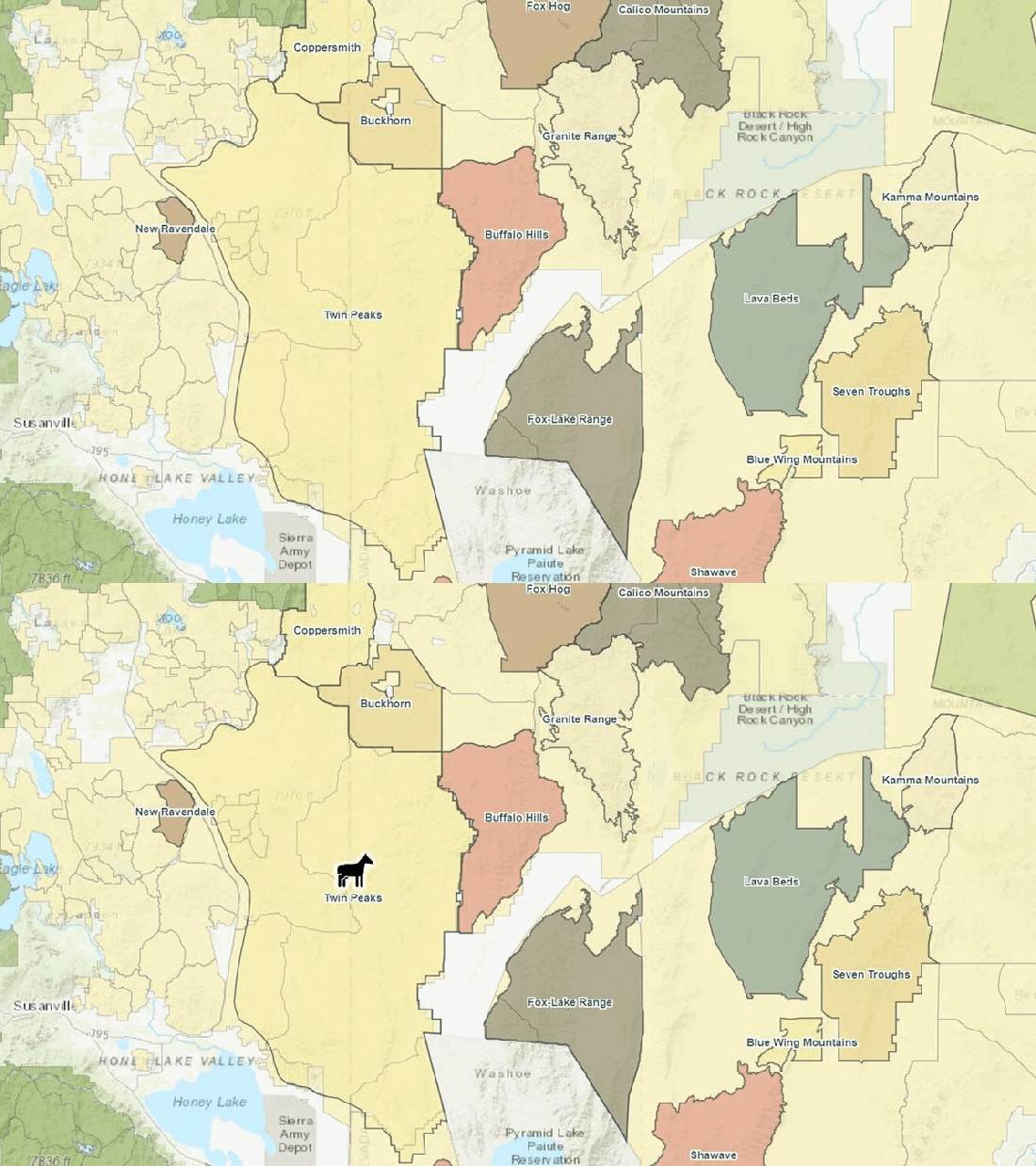
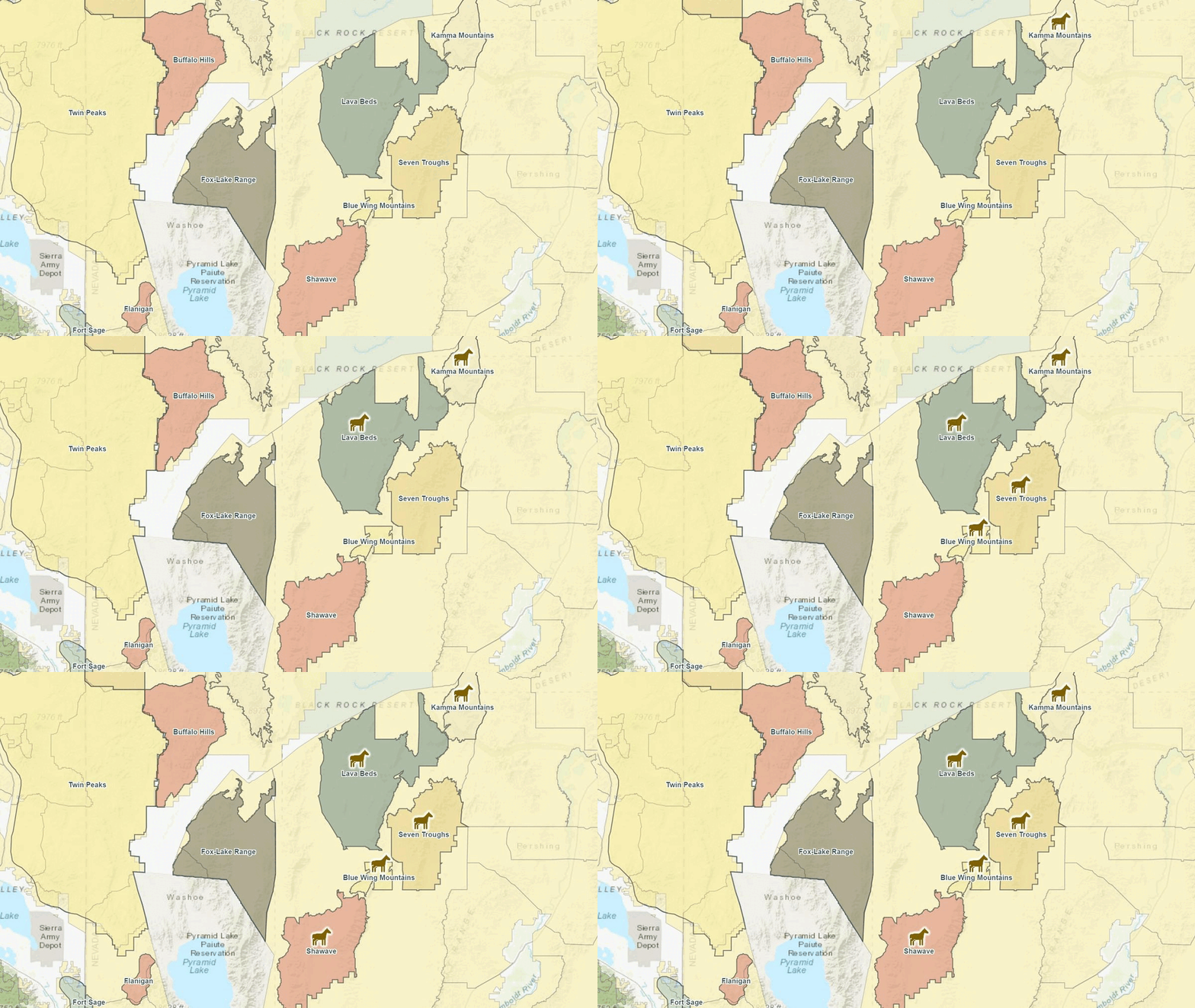
The Complex covers about 1.2 million total acres northeast Pyramid Lake, NV and has a combined AML of 553 horses and 90 burros, equivalent to 598 horses. Refer to Table 1 in the Final EA for resource enforcement actions therein.
The HAs are no longer managed for horses and burros and have an AML of zero.
The Western Watersheds map shows the arrangement. The HAs are not included.’
The current population is thought to be 1,695 horses and 1,327 burros.
A foal died on Day 2 after collapsing in the pen due to pneumonia. Three horses were put down on Day 3. An incident in the trap resulted in the escape of ten horses.
The horse death rate is 1.0%.
The horse total includes 228 stallions, 266 mares and 94 foals.
Youngsters represented 16.0% of the horses captured. Of the adults, 46.2% were male and 53.8% were female.
The herd can’t be growing at a rate of 20% per year, a figure used by land managers to predict herd sizes, with a birth rate of 16%.
They’re safer in the wild [but not from the advocates] according to a spokesman for CAAWH in this not-ready-for-prime-time report by KREX News in Grand Junction.
If the Campaign Against America’s Wild Horses had its way, they’re wouldn’t be any foals or pregnant mares for helicopters to chase.
Indeed, there wouldn’t be any horses to capture at all, because its army of nitwits would have taken most of them off the range with the Montana Solution, leaving their food and water to the public-lands ranchers, as specified in the land-use plans.
Nevada Vanadium has reached an agreement with Fish Creek Ranch to lease water rights to meet the water supply requirements of the project for a period of ten years, according to Section 3.19.2.2 of the Draft EIS.
As specified in the agreement, Fish Creek Ranch would remove 818 acres of alfalfa from production during the term of the lease to compensate for water that would otherwise be used for irrigation.
Water would pumped from a take-off near Fish Creek Springs to the project site.
A Rangeland Management Specialist with the Battle Mountain District confirmed that Fish Creek Ranch qualifies as a base property and has grazing preference on the Fish Creek Allotment, which overlaps the project area.
The advocates issued a bizarre statement last week claiming that “BLM NV is preparing to dig in and use millions more gallons of precious water for mining operations while ousting federally protected wild horses from their homes, and continue the destruction of our lands and wildlife.”
The SER and EIS were posted to the Gibellini project folder in ePlanning.
The Draft EIS and other supporting documents have been posted for public review, according to a BLM news release dated July 22.
Under the Proposed Action, the project area would cover 6,456 public acres, on which 806 acres of surface disturbance would occur. No state or private lands are included.
The project life consists of 1.5 years of construction, seven years of operation, four years of active reclamation and closure, and up to 30 years of post-closure monitoring.
The 85-acre open pit would not be reclaimed.
The project area straddles the eastern boundary of the Fish Creek HMA, with roads coming in from the east.
Under the Proposed Action, 15.1 AUMs per year would be temporarily lost, with 1.4 AUMs per year permanently lost due to the open pit.
The temporary loss would equate to three cow/calf pairs on a five-month grazing season, consistent with the claim that impacts to livestock are anticipated to be minor, short term, and localized.
You could argue that resources taken from the horses were lost a long time ago, when they were assigned to the permittees.
Vanadium is used as an alloying element in steel, among other things.
Comments will be accepted through September 6.
An online public meeting will be held August 6 on Zoom from 2:00 PM to 3:00 PM Pacific Time.
The project will be pursued by Nevada Vanadium Mining Corporation. Refer to this news release for more information.
The incident started yesterday, as scheduled, with 231 horses captured, 104 shipped and two dead.
The Day 1 report at the gather page said that 11 members of the public observed the action, including a TV production crew working on “Human Footprint, the Film,” to be aired on PBS, a reporter from KUNR public radio in Reno and a freelance filmmaker and videographer.
In the latest amendment, FOA seeks an order prohibiting future Onaqui roundups and a return of the horses to the HMA.
The Utah Attorney General’s Office issued a statement last week indicating that the court had granted its motion to intervene in the case, in opposition to FOA.
Refer to Section II, Course of Proceedings, in the State’s motion for a case history.
The next step will be a hearing for summary judgment according to the announcement.
The State says it’s motivated by an interest in wildlife, not permitted grazing.
Allotments in the Improve Category exhibit vegetative and watershed conditions that don’t meet objectives and standards for rangeland health.
The allotment offers 3,192 active AUMs on 284,533 public acres, with forage availability coming in at a paltry 11.2 AUMs per year per thousand acres—not quite enough to support a stocking rate of two wild burros (or one wild horse) per thousand acres.
The government will collect $4,309 per year from the permittee in grazing fees while it spends $485,450 per year to care for the 266 wild horses (or 532 wild burros) that the allotment would support.
The HA has an AML of zero and is no longer managed for wild burros.