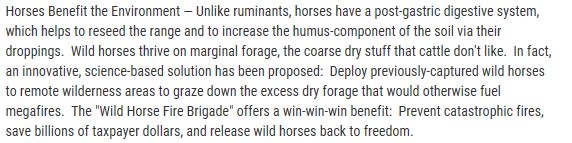
Devil’s Garden Roundup In the Headlines

The Sac Bee report about the Devil’s Garden roundup (which starts next week) is all over the news, minus one teeny weeny detail, namely, that the horses have been robbing public-lands ranchers of their birthright: forage for cattle and sheep—on lands set aside for the horses.
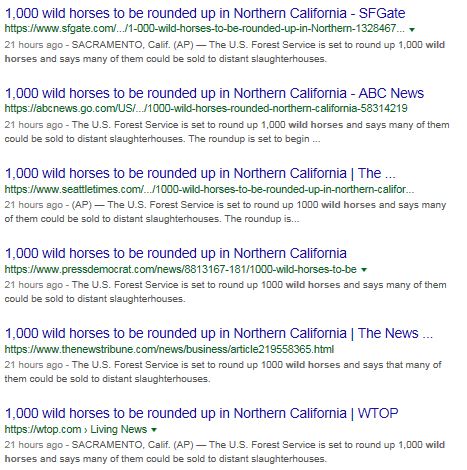
Devils_Garden_News-1

BLM won’t talk about it.  USFS won’t acknowledge it.  Left-wing media outlets won’t cover it.  If conservatives were involved, they’d be attacking from all sides.

Public-lands ranchers get their sustenance from government.  They graze their livestock for pennies per day (the fee in 2018 is $1.41 per cow-calf pair per month).  Government spends tens of millions of dollars every year to remove other species that might interfere with the enterprise.

Their cheerleaders think you have a right to eat meat.

Their leading political ally received a grade of ‘D’ from Conservative Review.

The entire affair looks like one big welfare racket, propagated by liberals for the benefit of liberals.  So much for hard-working cowboys and rugged individualism.

RELATED: Not One Word About Livestock at Devil’s Garden WHT.

Columnist Opposed to Delays in Spay Research

The writer of an opinion piece that appeared yesterday in the Elko Daily Free Press argues that it’s impossible to say what’s best for wild horses until sterilization experiments are performed.

You can’t make assumptions about what’s best for them.  Theory and experience have no value.  Knowledge and facts are useless.  You have to pass the bill to find out what’s in it.

Better to cut the ovaries out of mares than to have foals born into a world of degraded ecosystems and endangered wildlife.  Spontaneous abortions, permanent injuries, infections and deaths are a just cost of doing business.

Let’s get the roundup back on track and ship those mares to Hines.

Anything for the public-lands ranchers.

RELATED: Consortium Files Lawsuit to Stop BLM Spay Research, BLM Hauls Water to Warm Springs Horses?

WHB Cash and Carry Event Coming to Belton, TX

BLM announced yesterday that 50 wild horses and burros would be offered for direct purchase to good homes at the Bell County Expo Center October 12 – 13.  Gentling demonstrations will occur both days.  Refer to this news release for details.

The event was made possible by a BLM rule change on 05/24/18.  If you could find it in your heart to buy 10, 15, or maybe 25 horses, you would be doing the BLM—and the public-lands ranchers—a huge favor.

The more captured horses they can unload, the more wild horses they can remove from the range, to be replaced with cattle and sheep—on lands set aside for the horses.

And don’t forget, the Mexican border is only 300 miles away.

Carbon Capitalists Greatest Threat to WHB?

An opinion piece posted today in the left-wing blog Down to Earth states that wild horses and burros in the western U.S. are ‘…under siege by oil, gas, mining and other special interests.’  They are not.  The greatest threat to WHB is public-lands ranching.

The writer mentions livestock grazing in the essay but most of the blame is placed on the oil and gas companies, which she refers to as ‘Carbon Capitalists.’

Thus it is possible she takes this position not because she cares about the horses but because she’s a liberal.

How many frac tanks and drilling rigs do you see at this post?  How many excavators and dump trucks do you see in this post?

How many oil companies have written Zinke demanding that wild horse populations be reduced to AMLs immediately?  How many mining companies have been outspoken cheerleaders for the ovary cutters at the BLM?

Wake up, people.  These companies do not require tens of thousands of acres to go about their business.  Public-lands ranchers do.  That’s why the space available to WHB has been going down, along with the AMLs attached thereto.

Acceptance of this trend as axiomatic, a given, is at the root of the ‘humane management’ paradigm, which can only result in total defeat for the horses (and great satisfaction for their enemies).

CANA Foundation Sponsors Panel on Wild Horse Protection

This was in the news a few weeks ago but was avoided due to skepticism about the organization and disdain for the venue—the show circuit—which is bad for horses.

Besides, liberals aren’t known for conserving anything that’s right and good.  But the idea of returning wild horses to wilderness areas to help prevent wildfires, by grazing down excess forage, is worth considering.

RELATED: Benefits of Wild Horses.

Advocacy in North Carolina

Personnel with the Cajun Navy help flood victims in New Bern.  No, they’re not administering birth control to all the women.

Shouldn’t the government be rescuing those people?

What an individual can do, society should not take over, and what small societies can do, larger societies should not take over.  That is the principle of subsidiarity.

Nowadays too many people have given up control of their lives, instead, receiving their sustenance from government.  Can you think of an example on western rangelands?

When is a Wild Horse ‘Excess?’

Answer: When he competes with privately owned livestock for food and water—on lands set aside for him.  The term is often used to justify roundups.

“The BLM plans to gather and remove approximately 300 excess wild horses.”

An article published yesterday by the left-leaning digital news service Circa, offers a lengthy discussion of the issues on western rangelands.  As usual, the debate revolves around the horses for most of the story (overpopulation, mismanagement, excessive costs and what to do about them).

The issue of public-lands ranching is not reached until the end of the report.

“Grazing on public land costs cattle farmers a tiny fraction of what they’d pay on private farms.”

The amount of land available to the horses has been going down.  The number of cattle and sheep has been going up.  What could possibly go wrong?

The ranchers—along with their overlords, cheerleaders and political allies—are not going to let some pesky advocates interfere with this gravy train.

Volunteers Determine Breeding Patterns for Corolla Horses

Refer to the story posted today by the Charlotte Observer.  The contraceptive of choice is PZP and it’s applied to mares aged five or less and fifteen and older.

A few miles to the south, at Shackleford Banks, fertility control was stopped in 2009.

What’s the difference?

There is a rule in the unwritten code of wild horse advocacy that says you don’t participate in anything that results in fewer horses on the range.  Fertility control, however, seems to be an exception.  The code word is ‘humane management.’

National WHB Advisory Board to Meet Next Month

A news release issued today states that the National Advisory Board will meet in Salt Lake City October 9 – 11 to provide recommendations to the BLM on the WHB program.

The subject of the conference will be wild horses and burros.  The stated reason for the meeting is the adverse effects of WHB overpopulation on western rangelands.  The real reason for the meeting is the adverse effects of WHB on public-lands ranching.

The Board will visit a nearby HMA on the first day, presumably one that hasn’t been gathered this year (will be hard to find in Utah).

The last two days will probably be devoted to freeing up more forage for livestock, on lands set aside for horses and burros.

It’s not about saving money.  It’s not about saving an endangered species.  It’s about an unelected bureaucracy catering to a special interest against the wishes of the American people.

RELATED: Zinke: Treat Wild Horses Like Cats and Dogs.

Gather In Devil’s Garden WHT Starts Next Month

The USFS will remove approximately 1000 wild horses from the Devil’s Garden Plateau WHT, beginning in early October, according to an undated statement at the Modoc National Forest web site.

The roundup will be conducted by Cattoor Livestock Roundup Inc.  The announcement did not indicate if gather operations would be open to public observation.

Presumably, horses removed from the range will be taken to BLM holding facilities where they will be checked by veterinarians and offered for adoption.

The WHT covers 308,000 acres and has an AML of 402, for an aimed-at population density of 1.3 animals per thousand acres.  It’s located in northeast California.

Devils_Garden_WHT_Map-1

The announcement did not indicate if livestock were present in the area.  A video was included to document current conditions on the WHT (embedded below).

Livestock do not appear in the video and the term is not mentioned in the narrative.

Therefore, it must be those darn oil companies—or mining companies—demanding that the wild horse population be reduced.  After all, T-post fencing is a sure sign that drilling and digging are going on just out of frame.  Almost certainly there are derricks behind those trees the Forest Service doesn’t want you to see.

Devils_Garden_Livestock-1

The muddy area at 4:07 was caused by the fence not by the horses.  Who put that fence there?  Not exactly what you’d expect to find in a wilderness area.

Apparently, media coverage of livestock on HMAs and WHTs is taboo, especially during roundup season.

Zinke: Treat Wild Horses Like Cats and Dogs

He’s right.  Those darn horses have been breeding in back alleys, running through neighborhoods, driving down property values.  They should be spayed and neutered, just like cats and dogs.  Government takes thousands of them off the streets every year, why shouldn’t they do that for horses?

See the report posted yesterday by CBS-4 News in Denver.

As always, the debate revolves around the horses, never around the livestock that have been allowed to invade their territory.  The BLM has been an ally of public-lands ranchers and their overlords since Moby Dick was a minnow.  It’s a Good Ol’ Boy network if ever there was one.  And it needs to be broken up.

That would be your responsibility, Mr. Zinke.

RELATED: Mustang Meg Goes Drone.

It’s ‘Go Along to Get Along’ at Little Bookcliffs WH Range

A report posted today at The Daily Sentinel, titled ‘Volunteers understand why horses have to go,’ explains how the so-called advocates at Friends of the Mustangs are working with the BLM to remove 60 of the 190 horses in the Little Bookcliffs Wild Horse Range.

“Gathers involving the Little Book Cliffs herd have tended to be less controversial…

[BLM’s Jim] Dollerschell said he thinks one of the reasons there is less contention in the case of Little Book Cliffs gathers is because of the longtime partnership the BLM has had with the Friends of the Mustangs in managing the herd.”

Maybe those ‘Friends’ are drunk on PZP fumes.

At the Pryor Mountains, advocates took legal action to stop a planned roundup.

At Sand Wash Basin, advocates brought in water to help the horses cope with drought.

But at Little Bookcliffs, advocates help set the traps.

What the hell is wrong with these people?  Couldn’t they figure out a way to keep the horses on the range by bringing in food and water?  Drought is a temporary condition, why are they making permanent changes?

The author of the report, possibly aligned with ranching interests, couldn’t resist taking a shot at the horses:

“The pressure the horses are currently putting on their habitat is made evident as travelers leave it and cross into a livestock grazing area that’s still replete with grass.”

Yeah, we should get rid of the horses and replace them with cattle.  Go pound sand, dude.

RELATED: BLM Plans Roundup at Little Bookcliffs Wild Horse Range.

WHB Population Explosion?

The BLM’s Wild Horse and Burro program is at a crossroads, according to an article posted today by the American Veterinary Medical Association.  The author claims that HMAs are overpopulated by 100 percent to 1,500 percent.

“There were 81,951 animals on 26.9 [million] acres of public rangelands and 44,730 animals in corrals or pastures as of mid-2018…

To give some perspective, the BLM says ideally 27,000 of these animals can live in balance with livestock and wildlife on public lands.”

This is another example of misuse of figures.  The aimed-at population of 27,000 animals and available land of 26.9 million acres pertain to HMAs only.  The observed population of 81,951 animals corresponds to all lands, including HMAs.  You can’t compare 81,951 to 27,000 and conclude wild horses and burros are overpopulated because they don’t have the same land-basis.

Note that the combined AML of 27,000 animals (horses and burros) and available land of 26.9 million acres yield a population density of one animal per thousand acres, just one twelfth (8.3%) of the density typically allowed for livestock.

AML_vs_Population-1

There are real problems and stated problems.  The stated problem is that wild horses are overpopulated on western rangelands.  The real problem is that they compete with livestock for forage, depriving public-lands ranchers and their overlords of benefits owed to them in exchange for their campaign contributions and political support.

What you see on the range is not private-sector capitalism.  The helicopters, the bait traps, the zeroing-out of HMAs and reductions of AMLs, the video propaganda and bogus news reports, all are the result of a special interest using the media and instrumentalities of government to achieve its agenda.  It needs to be broken up.

Benefits of Wild Horses

If you’re a numbers guy, this article in NorCal Fishing News, dated 08/26/18, will make you smile.  (Not sure how it got into a fishing report, might be a reprint of figures published elsewhere.)

The video below shows some vegetation on the side of a road in the Virginia Range near sunset on 08/24/18.

You might think somebody took a sickle to that brush but the work was done by wild horses.  Remaining stalks are about six inches tall, no trimmings to clean up.  It’s nature’s fire control regimen.

Benefits_of_Wild_Horses-1

See also this story in Markets Insider dated 08/23/18.

The article also stated that the BLM typically allows eight cow/calf pairs per square mile, equivalent to eight wild horses per square mile.  That yields a stocking rate for livestock of 12.5 animals per thousand acres, compared to an aimed-at population density of one animal per thousand acres for horses on BLM lands.

Who benefits from this arrangement?  Is this what Congress intended on lands set aside for wild horses and burros or is it a twisting and stretching of ‘multiple use’ by the BLM, on behalf of the livestock industry?  Is this the meaning of ‘thriving ecological balance?’

The figures at the end of the article hint at the idea of replacing AMLs with pie charts that show how resources are allocated among consumers on HMAs.

PTH Laments CSU Decision

A news release issued yesterday by Protect the Harvest blamed an unnamed ‘extremist’ group for persuading the folks at Colorado State University to withdraw from sterilization research on wild mares, calling the decision ‘disappointing.’

And rightfully so, because cutting ovaries out of wild horses is as mainstream as cutting unborn kids out of pregnant women.  Everybody does it.

Although many wild horse advocates filled out the computer-generated letter and sent it in, the driving force in the university changing its mind may have been just a few right-minded and highly influential people.

Can you spell e-n-d-o-w-m-e-n-t?

The folks at PTH, like the Clinton supporters on election night, can’t understand why some people—most people—don’t agree with the idea of ovariectomy via colpotomy.

Could it be the flow of mutilated ponies to the demonic futurity might be reduced?

Or is much more at stake?

Look at the list of the organizations in favor of sterilization.  Many are aligned with the livestock industry, cheerleaders for ranchers who fatten their cattle on public lands at fire-sale prices.

Gotta keep the gravy train rolling, reward the donors and political supporters, let more cattlemen suck on the sugar teat.  That means WHB populations must be reduced to AML, immediately, by sterilization or euthanasia.  Slaughter is another option.

A better approach would be to raise the grazing fee on public lands to $25 per AUM and require labels on beef that show where it was produced.  Educate the public on threats to our wild ones by public-lands ranchers and their allies at the BLM.  Admit the carrying capacity of the land is higher than publicly acknowledged and allow the horses to return to Herd Areas and beyond.

Put more land in private hands, waive property taxes on acreage purchased for sanctuaries and rescues, omit sales taxes on equipment and supplies procured therefor.

RELATED: CSU Withdraws from Wild Horse Sterilization Research.