
In keeping with ‘other mandated uses’ of this blog, here is a video of wildlife impacted by (former) wild horses, in particular, their poop. Filmed 12/30/18.
Category: Commentary
Opinion
On the Anniversary of Roe
Politics follows morality. Contraception is the root of abortion. Can’t get rid of one without getting rid of the other.
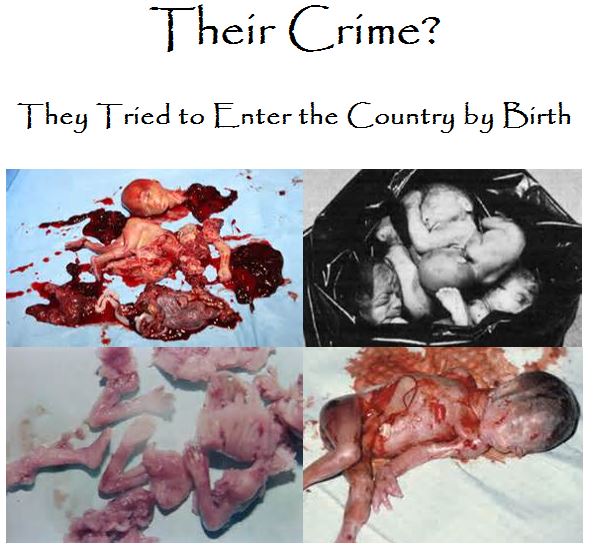 RELATED: Humanae Vitae at 50.
If This Blog Was Managed Like Western Rangelands…
There would be ten to twenty posts about cattle and sheep for every post about horses and burros, even though it’s dedicated to horses and burros.
Reports about wild horses and burros would be removed from time to time, because there are too many of them, and stories about privately owned livestock would be allowed on these pages for just pennies per day.
It’s Not Their Land, It’s Their Birthright
If you think AMLs represent the carrying capacity of the land, or are somehow related to it, read this press release about livestock grazing that appeared in Wyoming Livestock Roundup in 2011. Here’s the money quote:

Appropriate Management Levels should be renamed Acceptable Forage Losses, the number of wild horses (or burros) the ranchers are willing to tolerate.
After all, the land was set aside for cattle and sheep, right?

RELATED: Livestock Grazing in Wyoming.
Additional Remarks About the Devil’s Garden Wild Horse Sale
The syndicated report cited in this post earlier today, which has been picked up by news outlets across the country, suggests that the Forest Service built a short-term holding facility (known as the Double Devil Wild Horse Corrals), to circumvent protections afforded by the WHB Act of 1971.
The article, carried by AP News, said “The U.S. Forest Service has built a new corral for wild horses in Northern California, which could allow it to bypass federal restrictions and sell the animals for slaughter.”
It is the belief of this writer that
- The Devil’s Garden horses enjoy all protections of the WHB Act
- The Forest Service has no intent of bypassing the law
The problem is the WHB Act has been amended several times by ranching interests and no longer works to the benefit of the horses. The sale of these animals without limitation was established in 2004 by the Burns Amendment.
The case is an indication of the amount of work that lies ahead in pushing back against the ranchers, along with their allies in government and media.
Gillette Bows to the Marxists
The Wild Horse Debate
You can’t discuss wild horses and burros without discussing livestock and public-lands ranching. That did not happen in an opinion piece posted yesterday by Carson Now.
Omission of the topic, common in articles about wild horses, is a sure sign of bias. This one by Northern Ag of Billings, MT is typical. No ties to the ranching industry there.

Back to the original piece in Carson Now.
1. They’re a non-native species. The fossil record shows that horses existed in North America until they, and other large mammals, were wiped out 10,000 years ago. They were reintroduced by Spanish explorers 500 years ago, as stated in the article.
2. Humans were here a lot longer before any horses. The fossil record shows that horses pre-date the appearance of humans by tens of millions of years.
3. Free-roaming horses are feral, not wild. Horses that have been gelded or wear shoes are occasionally noted in BLM gather reports. They are the exceptions. Most of the domesticated horses died off decades ago. Their offspring have never known anything other than wild. The anti-horse crowd will often apply the feral and estray labels to diminish the importance of these animals and cast doubt on their protected status.
4. Don’t feed them. Carrots, apples and bits of hay may seem like innocent treats, but giving them to wild horses can make them pushy and disrespectful, jeopardizing their free-roaming status. Besides, it’s illegal in Nevada. Providing water is not illegal, but should be done away from populated areas, a practice known as diversionary watering.
5. Horses rob forage from deer, elk, antelope and bighorn sheep. You forgot livestock.
6. Horses reduce the risk of wildfires by consuming excess vegetation. Good point.
7. There are not enough predators to keep the horses numbers in check. That’s because of the livestock grazing in the next valley.
8. Fertility control has not been very effective, allow hunting of wild horses. The idea is sickening. And you can’t eat meat that’s been tainted with contraceptives (and dewormers in the case of freed or escaped ranch horses).
Why not start by retiring the grazing permits and giving back the territory that’s been allocated primarily to the public-lands ranchers?
RELATED: Livestock Grazing in Nevada.
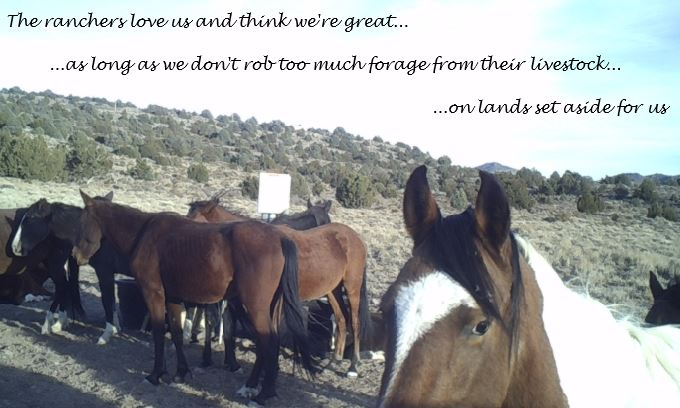
Do We Really Need $5 Billion for a Wall?
Getting rid of wild horses and burros apparently is a top priority of our precious government, but rounding up the criminal invaders—and keeping them out—is not.
Are there other options for protecting the American people? Consider these data:
- 2,000 miles of border to defend
- $10,000 for a gas operated, belt fed, automatic rifle
Five billion dollars would buy 500,000 rifles (5,000,000,000 divided by 10,000), enough to put one every 21 feet on the border (2,000 times 5,280 divided by 500,000).
That’s way too many. One every 300 feet would be adequate, which means 35,200 rifles should be ordered immediately (2,000 times 5,280 divided by 300). Cost would be $352 million (35,200 times 10,000).
Liberals have offered $1.3 billion for border security so this is well within their budget.
Roughly one billion dollars would remain after they cut the PO.
The fence would be six to eight feet high, just enough to slow down the undocumented Democrats and increase the hit probability of the flying lead. Chain link would be ideal.
Assuming a cost of $50 per foot, the price for the ‘wall’ would be $528 million (2,000 times 5,280 times 50). Approximately $500 million remaining in the leftist budget.
Ammo consumption would be minimal, a few hundred rounds, enough to convince the murderers, rapists, drug runners, terrorists and socialist voters they’re not welcome here. Cost impact would be insignificant, not even the magnitude of a rounding error.
The final $500 million could be allocated to technology, just as the Progressives have insisted (for automation and surveillance). If a soldier sitting in a bunker on U.S. soil can take out an enemy in a foreign nation, these rifles can operated by remote control.
The inflow of Marxist supporters, some unwitting, some not, has to be stopped. Pay no attention to the national news coverage and imagery of poor, oppressed women and children confronted by racists at the border. It’s all theater.
Don’t worry, though, these measures will never be put into practice. The individuals charged with the safety of America are in favor of its fundamental transformation.
They become bolder as more illegals enter the country, and the veil is slowly coming off their plan.
The task for normal, God-fearing Americans is not to save the planet, but to save the republic, and its constitutionally limited government.
To learn more about the instruments of self defense referenced above, which are illegal in many states, watch this video by Iraqveteran8888.
The Most Pressing Medical Issue of Our Time
What goes wrong with a person’s brain to turn him into a liberal?
Wild Horses Are Safe Tonight
Because of the federal government shutdown.
Malheur Wild Horse Transfer Still in the News
Oil companies aren’t complaining, mining companies aren’t protesting, the timber companies have been silent.

The PZP zealots never target livestock.
A darted mare still eats.
Wake up people!
RELATED: Ranchers Protest Malheur Horse Transfer.
Illinois Sanctuary Finds Homes for ‘Excess’ Wild Horses
Refer to this story, published today by St. Louis Public Radio, an NPR affiliate (and probable conduit of Marxist propaganda). Includes audio.
While the efforts of the owners are commendable, they are too late, too far downstream in the process. They guarantee more horses will be removed from western rangelands, because they focus on symptoms, not on causes.
This is also true for the PZP zealots, who think shooting wild mares in the ass with contraceptives is the answer. It is not. It is capitulation to the anti-horse agenda, assent to the wild horse narrative.
Advocacy must be aimed at keeping these animals on the range.
That means pushing back against the public-lands ranchers and those at the BLM and Forest Service who coddle them. Same for land managers at the state level.
‘Lunatic Farmer’ Longs for Horsemeat Dinner
Refer to his blog post dated 12/26/18 about the wild horse ‘problem’ on western rangelands. Opposing comments are not allowed so they are presented here:
Sir, the symptoms you describe are the result of a strong connection to agriculture and the rural lifestyle.
Many of the wild horses and burros now wasting away in long-term holding got there because of livestock and public-lands ranching.
The agency charged with the care of those animals has steadily given more and more of their land (set aside for them by the WHB Act of 1971) to the ranchers and other commercial interests, while gradually reducing the number of horses and burros allowed to live in the remaining areas.
The figures you cited are correct. BLM says the land, 27 million acres in ten western states, can only support 27,000 wild horses and burros. That works out to one animal per thousand acres, almost nothing.
The same agency allows ten to twenty times as many cow/calf pairs on western rangelands, depending on the area. In some cases it’s the same territory set aside for the horses!
You may wish to view this aerial footage from SE Oregon: https://youtu.be/zFofShEuZJk. What do you see at 3:06? At 3:36? Which species is in the majority?
Twenty seven thousand has nothing to do with the carrying capacity of the land. It only represents the forage loss the ranchers, and their allies at the BLM, are willing to tolerate.
By the way, the fossil record shows that horses are a native species in North America. They died off around 12,000 years ago and were reintroduced by Spanish explorers, as you noted.
Keep in mind that many of the horses and burros roam on the harsh landscape of the Great Basin. They have not destroyed their habitat, that’s what the high desert looks like. Here’s an example: https://www.youtube.com/watch?v=HOzB6ltmZ20.
O Come, O Come Emmanuel
Octave of Christmas, day eight. Solemnity of Mary Mother of God. H/T Megan Smith.
Joy to the World
Octave of Christmas, day six. Feast of The Holy Family. H/T Megan Smith.
O Come All Ye Faithful
Day four of the Octave of Christmas. H/T Megan Smith for the video.
What Child Is This?
Day two of the Octave of Christmas. H/T Megan Smith.
Two-State Solution on Western Rangelands: Ain’t Gonna Happen
Not when the other party, and many of your so-called supporters, want you wiped off the map.

No goodwill, no peace.
RELATED: Arab-Israeli Conflict Plays Out on Western Rangelands.
No Room at the Inn
The stars in the sky looked down where He lay, the little Lord Jesus asleep on the hay.
Message of Christmas
Hell is real and people go there but it need not be you. Video produced in 2010 by Real Catholic TV, forerunner of Church Militant.
 Western Horse Watchers Association