This is Not What Americans Mean by ‘Wild Horse Protection’

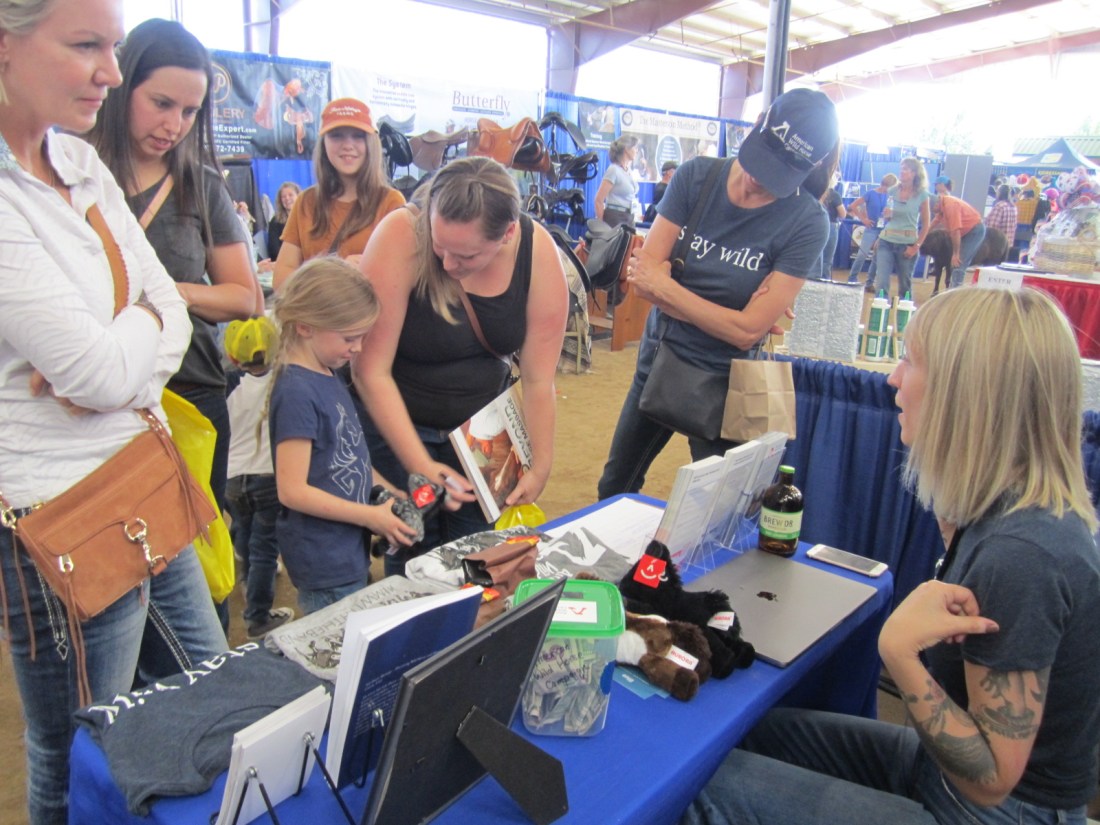
Video from the Onaqui Rally on 04/05/19.  Note the poster at 0:19 and the remarks beginning at 0:50.  These so-called advocates have bought into the overpopulation narrative and now seek to “manage horses to a lower population.”

They’re not friends of the Onaqui horses, they are enemies.  They do the bidding of the public-lands ranchers.  Don’t give them a penny.

Wild Horses and Burros Facing a Bleak Future?

So say the writers of a guest column published last week by Deseret News of Salt Lake City.  The original piece was commissioned by the Property and Environment Research Center of Bozeman, MT.

There are too many wild horses and burros struggling to scrape out an existence on limited rangeland, according to the writers, the premise of the article.  (‘Axiomatic basis’ might be a better term—as if the idea was already established, accepted as true, self-evident.)

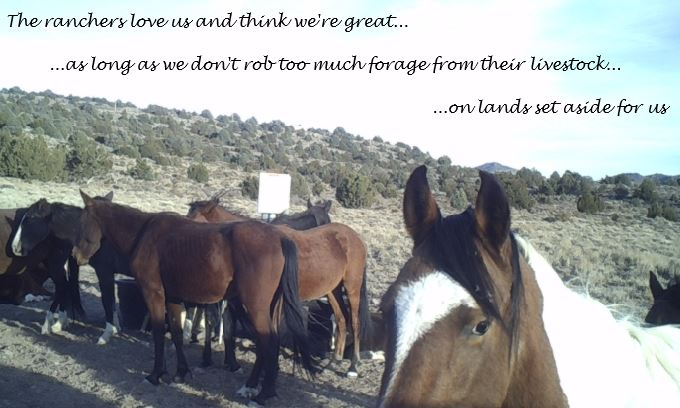
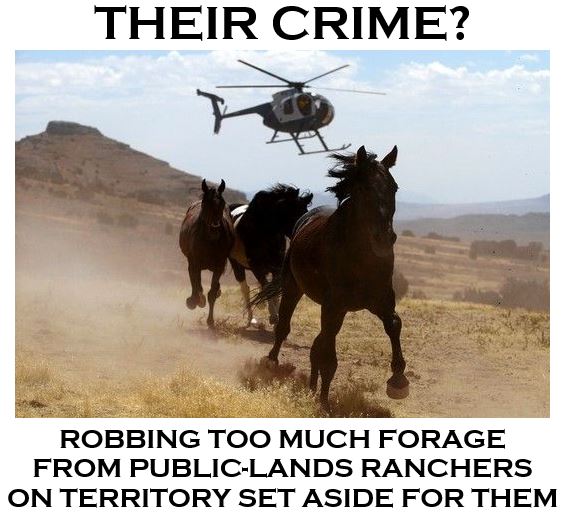
That these animals have lost over 40% of the public lands originally set aside for them seems to have been overlooked by the writers.  That they are being forced off the remaining land to accommodate privately owned livestock was not mentioned.

The words ‘cattle’ and ‘sheep’ appear nowhere in the article, as though it’s possible to discuss the ‘problem’ of wild horses and burros independently of public-lands ranching.

Consider these points made by the authors:

1. The new $1,000 incentive will benefit wild horses and burros.  It may stimulate adoptions, at least in the short term, but how many of these animals will end up at auctions because the owner’s motivation was a cash reward (extrinsic), not a concern for the horses (intrinsic).

2. Wild horses and burros have no natural predators.  Yeah, they’re the same predators that take down privately owned cattle and sheep.

Cattle Grazing on Hill-1

3. Wild horse and burro populations are three times higher than their Appropriate Management Level.  So what?  AMLs have nothing to do with the carrying capacity of the land.  Rather, they represent the forage loss the ranchers are willing to tolerate.  How can you say there are too many horses and burros on public lands when they are far outnumbered by cattle and sheep?

Wild Horse Overpopulation Current-1

4. Wild horses and burros have consumed so much forage on public lands that they’re literally on the brink of starvation.  These are free-roaming animals, they do not stand around on dry lots and starve to death.  Why can’t they move to greener pastures?  Because of fences installed by the ranchers?

5. The government spends $50 million annually to care for horses and burros in long-term holding.  Yep, the BLM spends two dollars per day to feed a horse on private land so it can collect 4.5 cents per day from the public-lands rancher to whom the forage is sold.  If it was really about the money, the government would leave the horses on the range and tell the ranchers to go pound sand.

Cash Flow Roundups-1

6. Finding ‘good homes’ for wild horses and burros is clearly a better outcome than starving on the range.  The best home for these animals is the territory set aside for them by the WHB Act of 1971.  True, there are some areas where livestock grazing is not allowed but they are the exception not the rule (three for horses and one for burros).  What’s so good about being locked in a stall and having a big pain bit shoved in your mouth?

Multiple_Use_Rev-1

Folks, there is no wild horse problem, only greed and deceit on the part of the ranchers, their overlords, cheerleaders and political allies.  If they achieve their goals, this is what the charts will look like:

Wild Horse Overpopulation Planned-1

The nine million AUMs per year currently allocated to privately owned cattle and sheep on public lands in the western U.S. would support 750,000 wild horses and burros, enough to empty all of the off-range corrals and long-term pastures fifteen times over.

RELATED: Wild Horse Overpopulation?, Economics of Wild Horse Gathers.

The Voice of Dependency

What is the Public Lands Council?  The description for the following video says the organization represents 22,000 public lands ranchers in the Western United States.

Given its location in Washington DC, most of its resources are probably devoted to public relations and political influence.

One thing is clear: Its anti-horse agenda.

Public Lands Council Anti Horse Agenda-1

Curiously, the first goal has been accepted by most of the so-called advocacy groups, with some of them involved in the second item as well.

The fourth item is perhaps the most troubling—elimination of HMAs and WHTs so forage consumed by wild horses and burros can be allocated to privately owned cattle and sheep.

Consider this definition regarding public lands from Section 103 of FLPMA:

Principal Uses FLPMA-1

Go ahead and find a trade group representing oil companies, mining companies, timber companies or outdoor recreation companies that’s as hostile to WHB as these guys.

Satellite Adoptions

Video posted in 2016 by the Michigan Farm Bureau about wild horse and burro adoptions at non-BLM facilities.  A list of these events for 2019 can be found here.

Roundups drive the adoptions and ‘multiple use’ drives the roundups.

Which of these ‘other mandated uses,’ mentioned at 2:26, interferes most directly with the health and welfare of wild horses and burros?

a. Recreation

b. Oil and gas development

c. Livestock grazing

d. Wildlife

How many reports have you read about

  • Wild horses being attacked by hikers and campers?
  • Wild horses being slaughtered by oil companies?
  • Wild horse herds being wiped out by wildlife?

The great destroyer is public-lands ranching, which explains the remark at 2:20 about no natural predators.

Economics of Wild Horse Gathers

Refer to the data and remarks in this post and this post.

  • Cost to remove a horse from his home range, $400
  • Cost to place him in long-term holding, $2 per day
  • Revenue from selling his food to a public-lands rancher, $16 per year

Assumptions:

  • Costs of transport and short-term holding ($5 per day) can be neglected
  • Most horses removed from public lands won’t be adopted
  • Fee for livestock grazing is $1.35 per AUM

The adoption assumption is based on a removal rate of 12,000 or more wild horses per year, which floods the program, as in 2018 (lands managed by BLM and USFS).

A wild horse consumes 12 AUMs annually, yielding payments to the government of $16 per year from the rancher to whom the unused forage is sold (12 times 1.35).

The annual cost of holding him in off-range pastures is $730 per year (2 times 365).

Note that $2 per day equals $60 per AUM.  Are you seeing a problem here?

You’re spending $730 per year so you can collect $16 per year.  This is how the mortgage deduction works on federal income taxes.  Ditto for property taxes.

This is what the situation looks like on a cash flow diagram.  There is no payout, no rate of return.

Cash Flow Roundups-1

The BLM removed 846 wild horses last fall from the Warm Springs HMA.  The diagram for that would look the same but the figures would be different.

The initial outlay would be -$338,000 (846 times 400), the annual expenditure for long-term holding would be -$617,000 per year (846 times 730) and the revenue from grazing would be +$13,000 per year (846 times 16).

The grazing fee would have to be raised to at least $65 per AUM to make the program economically viable (internal rate of return greater than zero), a 4,700 percent increase from the current amount.

Corolla Stallions Spar for Mares

Good grief, people are shocked when horses act like horses.  An incident described as a ‘vicious brawl’ was captured on film and reported yesterday in The News & Observer of Raleigh, NC.  The story was also picked up by other news outlets.

“It’s completely natural and a behavior that we like to see,” said one person interviewed for the story, suggesting that the fertility control program hasn’t totally screwed up the herd, at least not yet.

Last month, the same individual blamed the occurrence of ‘swamp cancer’ at the OBX on climate change.

Wild Horse Overpopulation?

Congress tells the BLM to fix the wild horse ‘problem.’  Let’s look at the numbers.

Data from this post and this post, rounded, lands managed by the BLM:

  • 9 million AUMs per year currently used by livestock
  • 12 million AUMs per year available to livestock
  • 155 million acres of public lands available to livestock
  • 71,000 wild horses and burros currently on public lands
  • 27,000 wild horses and burros allowed on public lands
  • 27 million acres of public lands available to wild horses and burros

Assumptions:

  • Livestock graze 6 months per year
  • Horses and burros graze 12 months per year

AUM consumption, current conditions:

  • 9 million AUMs per year allocated to livestock
  • 0.85 million AUMs per year allocated to wild horses and burros

Animal population, current conditions:

  • 1.5 million cow/calf pairs
  • 0.071 million horses and burros

Population density, current conditions:

  • 9.7 cow/calf pairs per thousand acres
  • 2.6 horses and burros per thousand acres

Graphical summary:

Wild Horse Overpopulation Current-1

AUM consumption, planned:

  • 12 million AUMs per year allocated to livestock
  • 0.32 million AUMs per year allocated to wild horses and burros

Animal population, planned:

  • 2 million cow/calf pairs
  • 0.027 million horses and burros

Population density, planned:

  • 12.9 cow/calf pairs per thousand acres
  • 1 horse or burro per thousand acres

Graphical summary:

Wild Horse Overpopulation Planned-1

There is no wild horse problem, only a livestock problem.  Thanks to the public-lands ranchers, the contractors, the trade groups, their cheerleaders and political allies—all working together to eradicate wild horses and burros—on land that belongs to you.

Letter to Editor Reveals Truth About Colville Roundup

Tribal leaders have great plans for the future, so they rewrite the law to suit their agenda and the horses are gone.  Sound familiar?

Where are they getting the money to pay the contractor?  Did they receive a ‘donation’ from the federal government?

Refer to the letter titled ‘Amendment to horse capture law: Horses being slaughtered for damage caused by cattle, logging, pollution’ in yesterday’s edition of The Safety Valve in The Wenatchee World.

RELATED: Colville Gather Underway.

Partnership Benefits McCullough Peaks Ranchers

BLM reported today that its alliance with Friends of a Legacy provided ‘healthy wild horses and healthy rangeland in 2018.’  As suggested last week, those terms are euphemisms for ‘getting rid of the horses and giving their food and water to livestock.’

The volunteers, who convinced the state legislature to rename a highway east of Cody, are also known for their use of contraceptives to keep the size of the herd in check.

Birth rates have been reduced 70% according to the announcement.

Fertility_Control_Puzzle_Solved-1

This is not wild horse advocacy and certainly not wild horse preservation.

It is assent to the overpopulation narrative and capitulation to the anti-horse agenda.

RELATED: Livestock Grazing in Wyoming.

Grazing Fee for 2019 Pending

The government shutdown filled the public-lands ranchers with anxiety, according to a report by Tri-State Livestock News, causing undue stress about turnout dates and grazing fees.  One thing they won’t have to worry about is the price escalating into a range that brings it in line with the cost of private-sector ranching.

The current fee, which expires at the end of the month, is 4.7¢ per cow/calf pair per day, or $1.41 per AUM.

Try feeding your horse for that.  Or your parakeet.

Wild horse critics like to point at the expense of animals in long-term holding, for which the government spends around $50 million per year.  The cost of feed is about $2 per day, or $60 per AUM.

Given nine million AUMs allocated to livestock annually, with room for three million more, the government receives about $13 million each year from the ranchers.

Add the costs of roundups, adoptions, transport and the like and you have the government spending around $60 million each year so it can collect $13 million from the ranchers.

If you restrict the revenue to lands subject to the roundups, you’d have the government spending at least ten times as much as it hopes to collect in grazing fees.

Those nine million AUMs would support 750,000 wild horses and burros, enough to empty all the off-range corrals and long-term pastures fifteen times over.

Their position is untenable and they know it.  That’s why they spew all the BS about wild horse overpopulation and damage to western rangelands.

If it was really about the money, the government would leave the horses on the range and tell the ranchers to go pound sand.

RELATED: Dire Condition of Wild Horses and Burros in Western U.S.

IMG_8139

Dire Condition of Wild Horses and Burros in Western U.S.

True or false?

___ a. Wild horses and burros are starving to death.

___ b. The land can no longer sustain the basic needs of these animals.

___ c. They are displacing cattle, sheep, elk, mule deer and sage grouse.

___ d. They graze vegetation close to the surface, stunting regrowth.

___ e. If livestock were removed, they would still die.

All are true, according to this opinion piece posted today in HJ News of Logan, UT.

No evidence, no citations, no supporting documentation.  Never let the facts get in the way of a good story.

Given that roughly nine million AUMs are allocated to livestock each year on public lands in the western U.S., 750,000 wild horses and burros could be returned to the range if the cattle and sheep were removed.

That’s fifteen times the number of animals currently in long-term holding!

RELATED: Infamous Fence Experiment, Vegetation Control on the Virginia Range, Wild Horses on the Edge (of the Road), Population Densities on Western Rangelands.

Zinke Orders Reinstatement of Hammond Grazing Permit

It’s tough being a government dependent.

You’re convicted of arson in 2012 (to hide the deer you killed, probably because they were robbing forage from your livestock), and when you tried to renew your grazing permit in 2014, the government said no.

In 2016, you returned to prison (because the original sentence was too light), sparking the Malheur Incident that ended with the death of another public-lands rancher.

In 2018, your hero (and wild horse hater) pulled some strings in the Trump Administration to get your sentence commuted.

Then, in early 2019, your grazing permit is restored, at the direction of outgoing DOI Secretary Ryan Zinke, according to a report that appeared Friday in Tri-State Livestock News.

Your cattle can once again enjoy the hills near South Steens HMA.  The next wild horse roundup can’t come soon enough.

“The people that are losing their permits from the wild horses, I feel terrible about that.  We’ve regained our ground.  I don’t see that they are going to get the horse deal understood before those people are totally out of business.  What in the world is America thinking about?”

There is nothing admirable in the story.  It’s not about rugged individualism and self reliance, it’s about victimhood and dependency.  Long-term access to cheap feed and periodic removal of other animals that get in your way.  Courtesy of the federal government and the American taxpayer.

The occupation of Malheur was in protest to the Obama administration, nothing more.

The ringleaders were public-lands ranchers from Bunkerville, NV.

Meanwhile, a few miles to the north in Elko County, NV, Madeleine Pickens waits patiently for the BLM to fulfill its end of the deal reached ten years ago to graze former wild horses on 600,000 acres of public land, access to which she obtained legally and with their blessing.

Moreover, the individual(s) who shot several wild horses there last August still haven’t been brought to justice.

Bill Aims to ‘Protect’ Corolla Wild Horses

Draft legislation, introduced in the U.S. Senate, would require the Fish and Wildlife Service, along with other stakeholders, to create a new plan for ‘managing’ the Corolla wild horses, according to a report posted yesterday in Coastal Review Online.

The move was endorsed by the Humane Society and ASPCA, groups that favor the use of contraceptives on wild horses.

You only have to look at western rangelands to see how this will turn out.

There will be claims of overpopulation, lack of predators and destruction of habitat.

Managers will be forced to achieve a ‘thriving ecological balance’ with ‘other mandated uses’ of the land.  This will come through amendments to the original statute, at the behest of one or more special interests.

Finally, actions will be taken to reduce the number horses, or better yet, replace them with other ‘ventures’ that are more ‘productive.’

Keep the feds out of it.

Comment on the Brumbies

The loss of dozens of wild horses in Australia has been in the news for several days, but was passed over by this writer because the circumstances were not understood and the location was beyond the scope of this blog.

But when liberals use the incident to push their Marxist agenda, well, that’s fair game.

The kook who wrote the piece said the horses “died a horrific, cruel death,” blaming them on “people who drive gas-guzzling trucks, luxury cars, SUVs, and so on.”

Omitted from his worldly concerns are the cruel and horrific deaths experienced by pre-born kids as they are hacked to pieces in their mother’s wombs and sucked out by vacuum cleaners in women’s ‘health clinics.’  (Also missing are the acts committed by the sodomites—so vile they cannot be put into words.)

Nope, he’s worried about carbon emissions and global warming.

Worst of all, he’s not getting the help he needs.

An example of those ‘immoral’ vehicles, which should be outlawed, can be found on the masthead of the WHW YouTube channel.

RELATED: The Most Pressing Medical Issue of Our Time.

CANA Foundation: Don’t Give Them a Penny

Manda Kalimian, founder of the non-profit organization that aims to ‘re-wild’ horses removed from western rangelands, made the following statement in an article posted 01/22/19 by the Navajo-Hopi Observer:

“I think we need to be looking at horse slaughter in the U.S. because we’re still exporting these horses (to Canada and Mexico), but we’re not saving them from being slaughtered.  Humane horse slaughter is an option that needs to be revisited and seriously revisited.”

Enough said.  The mask has come off.

RELATED: CANA Foundation Sponsors Panel on Wild Horse Protection.