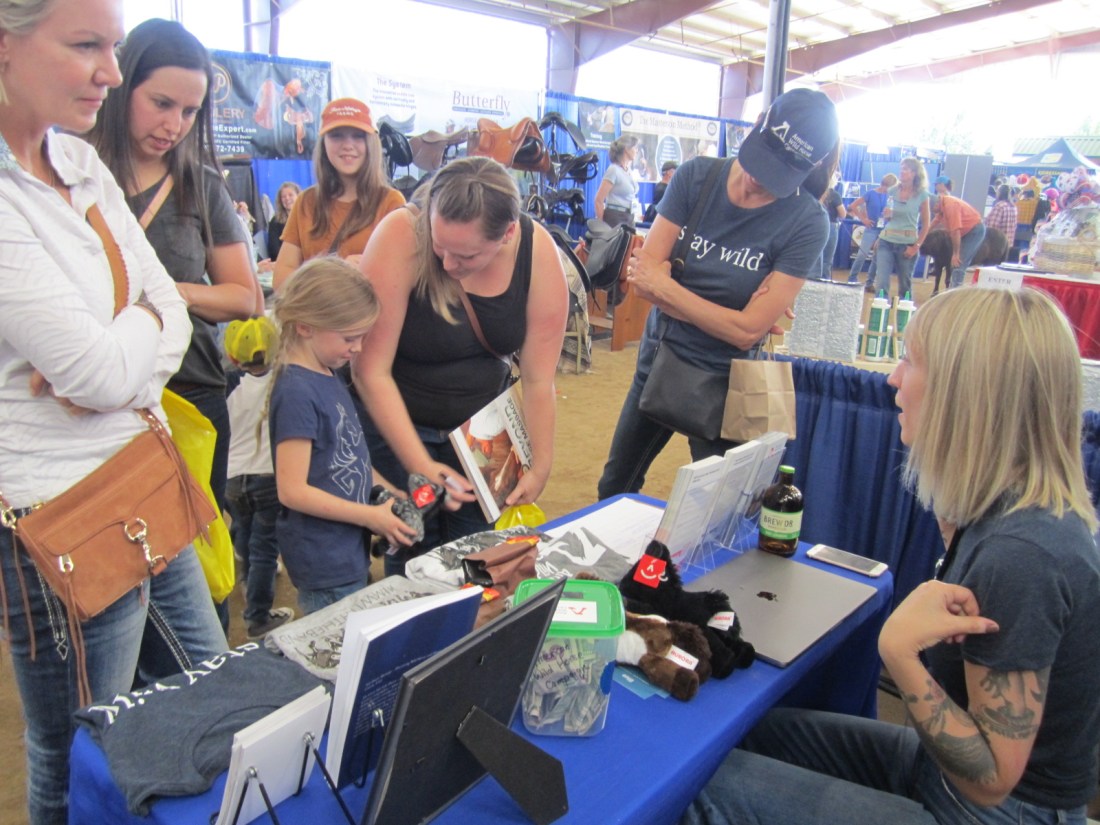
At the AWHC booth on Day 2 of the Western States Horse Expo, 05/10/19.

Western Horse Watchers Association
Exposing the Hypocrisy, Lies and Incompetence of the Wild Horse Advocates
Opinion
At the AWHC booth on Day 2 of the Western States Horse Expo, 05/10/19.
Animal protection groups urged a federal judge yesterday to block the sale (without limitation) of wild horses removed last year from the Devil’s Garden Plateau WHT, which was set to begin on May 13.
Plaintiffs believe the animals could be sold for human consumption. That they might end up in pet food or other products apparently was not a concern.
A public-lands rancher attending the hearing said the horses drain resources that cattle and other wild animals need to survive.
The report did not say if any oil or mining companies had intervened in the case.
RELATED: Horses at Double Devil Corrals Now ‘Three Strikers’, Devil’s Garden Horses Get Short End of Stick.
A guest column dated 05/02/19 in Drovers, a publication for the beef industry, says the plan should be rejected for several reasons, and any path going forward should have contraception as its centerpiece.
How exactly does that qualify as opposition? It doesn’t. It’s resignation to the ranching agenda, acceptance of the overpopulation narrative.

The proposal will reduce wild horse and burro numbers by 70% on lands set aside for the horses and burros, so they can be replaced by privately owned cattle and sheep.
It’s absurd, but nobody wants to talk about it. What are they afraid of?
RELATED: Private Sanctuaries: End-Game of Wild Horse Management Plan.
Much has been written in recent days about the proposal, how it will reduce wild horse populations by 70% in the next three to five years and how population growth in the remaining herds will be suppressed by contraceptives and sterilization.
But what the plan’s supporters really want to see—most of them beef producers operating on public lands—is the transfer of all wild horses to private sanctuaries.
And now, an editorial by an Arizona rancher (and brother of a former supreme court justice), is making the rounds in some news outlets, pitching the idea to the public.
“Without a doubt, private wild horse sanctuaries can be a win-win for wild horses and horse lovers. With more sanctuaries in place, perhaps the BLM can concentrate on ways to keep the free-roaming wild horses from overpopulating the open range.”
Recall that the Public Lands Council, a cheerleader group for the ranchers, wants HMAs and WHTs abolished (fourth bullet item below).

With the BLM largely divested of the wild horse ‘business,’ it can dedicate more resources to their for-profit enterprise.
Thus, the proposed management plan will put a smile on the faces of public-lands ranchers, not wild horse advocates.
Privately owned cattle and sheep should be raised on private lands, not wild horses and burros. The proposal must be defeated.
RELATED: New Wild Horse Management Plan: Reinforcing the Narrative.
In an editorial published today by the Mesquite Local News, the writer, commenting on a proposal announced last week for managing wild horses and burros on public lands in the western U.S., states
“Currently the animals in many herd management areas are so overpopulated that they are starving and damaging water resources. Grazing land needed by cattle and other wild animals is depleted.”
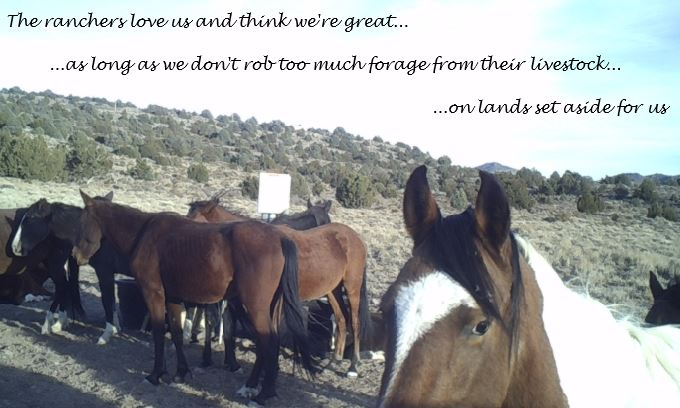
TRANSLATION: Wild horses are robbing too much forage from the poor ranchers, on land set aside for the horses. The horses need to go.
Can’t get much more absurd than that.
Truth is, these people have never accepted the WHB Act and have worked steadily towards its nullification.
Backers of proposal, which will reduce wild horse populations by 70% on western rangelands, were mostly beef producers and a few animal protection groups.
There were no supporters from the oil and gas industry. Nobody from the timber industry stepped forward. Mining companies were silent.
RELATED: New Wild Horse Management Plan: Reinforcing the Narrative.
Reposting this video for the form-follows-function crowd, such as the public-lands ranchers, who believe that wild horses, unlike livestock, should be removed from western rangelands because they serve no useful purpose and bring in no economic return. Pay attention to the remarks from 14:44 to 15:45.
“People need useless things.”
The announcement last week by the American Farm Bureau Federation said no but an article posted yesterday by Wild Horse Education says it will, not by legislation, but through the appropriations process, similar to the Burns Amendment.
RELATED: New Wild Horse Management Plan: Reinforcing the Narrative.
You know the drill: They’re overpopulated, have no natural predators, serve no useful purpose and bring in no economic return. Keep pounding those words into the psyche.
Tell your elected representative that you want to see free-roaming horses and burros on public lands in the western U.S., not privately owned cattle and sheep.
RELATED: Cheerleader Groups Endorse New WHB Management Plan.
In case you don’t have two brain cells to rub together:
1. Get the horses off the range.
2. Sell their food to public-lands ranchers.
3. WHB Act nullified.
Return to Freedom, one of the signatories to the proposal, operates a sanctuary in central California. What will happen to those horses if their funding dries up?

Today is not a Friday of Lent, but it’s still a good day to abstain from range-fed beef.
In fact, any day is a good day to abstain from range-fed beef.
Of course they are. They can’t condemn it without condemning themselves.
They oppose the government’s ‘systematic and cruel elimination’ of free-roaming horses and burros. Instead, they want to do it themselves, ‘humanely,’ by firing contraceptive darts into the herds, with the long-term goal of sterilization.
RELATED: Opposition to New Management Plan Begins.
Refer to this opinion piece in the Pagosa Daily Post of Pagosa Springs, CO.
Apparently the writer has subscribed to the overpopulation narrative, in that he agrees with the use of contraceptives not to slow wild horse population growth but to reverse it, yet somehow he arrives at the right conclusion:
“The reality is, there are far more cattle and sheep on our public lands than wild horses and burros. This is an attempt to further imbalance the ratio by liquidating populations of wild horses and burros, so that beef can may graze on more federal lands.”
The nine million AUMs allocated each year to privately owned livestock on public lands managed by the BLM in the western U.S. would support at least 750,000 wild horses and burros, enough to empty all of the off-range corrals and long-term pastures fifteen times over. The current wild horse population is about ten percent of that.
There is no wild horse population crisis.
The proposed wild horse management plan is not about saving money or protecting western rangelands. It’s about deceit and greed on the part of the public-lands ranchers, their overlords, cheerleaders and political allies.
RELATED: Wild Horse Overpopulation?
It’s not true but it’s an indication of what the headlines might look like if a proposed wild horse management plan, announced yesterday, can be defeated in the court of public opinion. Details of the plan can be found in this policy statement by the ASPCA.
The proposal was endorsed by organizations that represent public-lands ranchers, so you know it’s bad for the horses. The Public Lands Council, one of its supporters, makes its anti-horse agenda clear:
Note how well it aligns with the ASPCA recommendations, almost as if it was copied and pasted into their proposal.

The goal of this cabal, this newly formed alliance between ranching interests and animal protection groups, is to reduce wild horse and burro populations on public lands in the western U.S. by 70%.
Are you going to join them or will you push back?
Range-fed beef is not good for you and it’s not good for the environment if it’s produced at the expense of America’s wild horses and burros.
If the ranchers won’t back down, don’t buy their product.
RELATED: Financial Incentive Will Reduce Wild Horse Population?
The National Cattlemen’s Beef Association, Public Lands Council and Society for Range Management expressed their support today for a proposal to reduce wild horse and burro populations on public lands in the western U.S, according to a news release from the American Farm Bureau Federation.
A report by YubaNet of Nevada City, CA said the management plan was drafted by the American Society for the Prevention of Cruelty to Animals, Return to Freedom Wild Horse Conservation, the Humane Society of the United States, and the Humane Society Legislative Fund, with input from other rangeland management stakeholders.
It employs four management techniques, all currently in use:
A link to the plan document was not provided.
As usual, the proposal puts the crosshairs on horses and burros, while privately owned livestock are omitted from the analysis.
It is capitulation to the ranching agenda, assent to the overpopulation narrative and a failure in wild horse preservation.
The problem is not free-roaming horses and burros, it is public-lands ranching.
He is not here, but is risen.

You jackals! How many of them did you reject because they wouldn’t comply with your thirty day timeframe?
The only thing these horses did ‘wrong’ was to rob too much forage from your livestock.
Note the reference at 0:12 to the ‘Beaty Butte Allotment,’ not the Beatys Butte HMA.
These people have never accepted the WHB Act and never will.
RELATED: Rangelands in Southeast Oregon, Solving Problems That Don’t Exist.
Thought for the day: Lands set aside for wild horses and burros must accommodate privately owned cattle and sheep, but lands set aside for privately owned cattle and sheep need not accept wild horses and burros.

Lest you get the impression that this blog is managed principally but not necessarily exclusively for wild horses and burros.
Today we share in our Lord’s suffering through fasting and abstinence from meat.
Known by many as ‘Wild Horse Monument,’ it sits on a ridge above the Columbia River near Vantage, WA. Fifteen life-sized horses made from steel were installed before the money ran out in 1990. Fundraising has resumed and the designer visited the job site recently with the goal of completing the project as originally intended.
RELATED: Grandfather Cuts Loose the Ponies.
 Western Horse Watchers Association