New Wild Horse Management Plan: Reinforcing the Narrative

You know the drill: They’re overpopulated, have no natural predators, serve no useful purpose and bring in no economic return.  Keep pounding those words into the psyche.

Tell your elected representative that you want to see free-roaming horses and burros on public lands in the western U.S., not privately owned cattle and sheep.

RELATED: Cheerleader Groups Endorse New WHB Management Plan.

PZP Zealots Silent on Proposed Wild Horse Management Plan?

Of course they are.  They can’t condemn it without condemning themselves.

Fertility_Control_Puzzle_Solved-1

They oppose the government’s ‘systematic and cruel elimination’ of free-roaming horses and burros.  Instead, they want to do it themselves, ‘humanely,’ by firing contraceptive darts into the herds, with the long-term goal of sterilization.

RELATED: Opposition to New Management Plan Begins.

Opposition to New Management Plan Begins

Refer to this opinion piece in the Pagosa Daily Post of Pagosa Springs, CO.

Apparently the writer has subscribed to the overpopulation narrative, in that he agrees with the use of contraceptives not to slow wild horse population growth but to reverse it, yet somehow he arrives at the right conclusion:

“The reality is, there are far more cattle and sheep on our public lands than wild horses and burros.  This is an attempt to further imbalance the ratio by liquidating populations of wild horses and burros, so that beef can may graze on more federal lands.”

The nine million AUMs allocated each year to privately owned livestock on public lands managed by the BLM in the western U.S. would support at least 750,000 wild horses and burros, enough to empty all of the off-range corrals and long-term pastures fifteen times over.  The current wild horse population is about ten percent of that.

There is no wild horse population crisis.

The proposed wild horse management plan is not about saving money or protecting western rangelands.  It’s about deceit and greed on the part of the public-lands ranchers, their overlords, cheerleaders and political allies.

RELATED: Wild Horse Overpopulation?

BLM Gives More Land to Wild Horses, Cuts Forage to Ranchers

It’s not true but it’s an indication of what the headlines might look like if a proposed wild horse management plan, announced yesterday, can be defeated in the court of public opinion.  Details of the plan can be found in this policy statement by the ASPCA.

The proposal was endorsed by organizations that represent public-lands ranchers, so you know it’s bad for the horses.  The Public Lands Council, one of its supporters, makes its anti-horse agenda clear:

Public Lands Council Anti Horse Agenda-1

Note how well it aligns with the ASPCA recommendations, almost as if it was copied and pasted into their proposal.

ASPCA Proposal-1

The goal of this cabal, this newly formed alliance between ranching interests and animal protection groups, is to reduce wild horse and burro populations on public lands in the western U.S. by 70%.

Are you going to join them or will you push back?

Range-fed beef is not good for you and it’s not good for the environment if it’s produced at the expense of America’s wild horses and burros.

If the ranchers won’t back down, don’t buy their product.

RELATED: Financial Incentive Will Reduce Wild Horse Population?

Cheerleader Groups Endorse New WHB Management Plan

The National Cattlemen’s Beef Association, Public Lands Council and Society for Range Management expressed their support today for a proposal to reduce wild horse and burro populations on public lands in the western U.S, according to a news release from the American Farm Bureau Federation.

A report by YubaNet of Nevada City, CA said the management plan was drafted by the American Society for the Prevention of Cruelty to Animals, Return to Freedom Wild Horse Conservation, the Humane Society of the United States, and the Humane Society Legislative Fund, with input from other rangeland management stakeholders.

It employs four management techniques, all currently in use:

  • Contraceptives
  • Roundups
  • Rehoming
  • Adoptions

A link to the plan document was not provided.

As usual, the proposal puts the crosshairs on horses and burros, while privately owned livestock are omitted from the analysis.

It is capitulation to the ranching agenda, assent to the overpopulation narrative and a failure in wild horse preservation.

The problem is not free-roaming horses and burros, it is public-lands ranching.

A Place for Excess Horses Off the Beaty Butte Allotment

You jackals!  How many of them did you reject because they wouldn’t comply with your thirty day timeframe?

The only thing these horses did ‘wrong’ was to rob too much forage from your livestock.

Note the reference at 0:12 to the ‘Beaty Butte Allotment,’ not the Beatys Butte HMA.

These people have never accepted the WHB Act and never will.

RELATED: Rangelands in Southeast Oregon, Solving Problems That Don’t Exist.

Artist Returns to Unfinished Sculpture Thirty Years Later

Known by many as ‘Wild Horse Monument,’ it sits on a ridge above the Columbia River near Vantage, WA.  Fifteen life-sized horses made from steel were installed before the money ran out in 1990.  Fundraising has resumed and the designer visited the job site recently with the goal of completing the project as originally intended.

RELATED: Grandfather Cuts Loose the Ponies.

This is Not What Americans Mean by ‘Wild Horse Protection’

Video from the Onaqui Rally on 04/05/19.  Note the poster at 0:19 and the remarks beginning at 0:50.  These so-called advocates have bought into the overpopulation narrative and now seek to “manage horses to a lower population.”

They’re not friends of the Onaqui horses, they are enemies.  They do the bidding of the public-lands ranchers.  Don’t give them a penny.

Wild Horses and Burros Facing a Bleak Future?

So say the writers of a guest column published last week by Deseret News of Salt Lake City.  The original piece was commissioned by the Property and Environment Research Center of Bozeman, MT.

There are too many wild horses and burros struggling to scrape out an existence on limited rangeland, according to the writers, the premise of the article.  (‘Axiomatic basis’ might be a better term—as if the idea was already established, accepted as true, self-evident.)

That these animals have lost over 40% of the public lands originally set aside for them seems to have been overlooked by the writers.  That they are being forced off the remaining land to accommodate privately owned livestock was not mentioned.

The words ‘cattle’ and ‘sheep’ appear nowhere in the article, as though it’s possible to discuss the ‘problem’ of wild horses and burros independently of public-lands ranching.

Consider these points made by the authors:

1. The new $1,000 incentive will benefit wild horses and burros.  It may stimulate adoptions, at least in the short term, but how many of these animals will end up at auctions because the owner’s motivation was a cash reward (extrinsic), not a concern for the horses (intrinsic).

2. Wild horses and burros have no natural predators.  Yeah, they’re the same predators that take down privately owned cattle and sheep.

Cattle Grazing on Hill-1

3. Wild horse and burro populations are three times higher than their Appropriate Management Level.  So what?  AMLs have nothing to do with the carrying capacity of the land.  Rather, they represent the forage loss the ranchers are willing to tolerate.  How can you say there are too many horses and burros on public lands when they are far outnumbered by cattle and sheep?

Wild Horse Overpopulation Current-1

4. Wild horses and burros have consumed so much forage on public lands that they’re literally on the brink of starvation.  These are free-roaming animals, they do not stand around on dry lots and starve to death.  Why can’t they move to greener pastures?  Because of fences installed by the ranchers?

5. The government spends $50 million annually to care for horses and burros in long-term holding.  Yep, the BLM spends two dollars per day to feed a horse on private land so it can collect 4.5 cents per day from the public-lands rancher to whom the forage is sold.  If it was really about the money, the government would leave the horses on the range and tell the ranchers to go pound sand.

Cash Flow Roundups-1

6. Finding ‘good homes’ for wild horses and burros is clearly a better outcome than starving on the range.  The best home for these animals is the territory set aside for them by the WHB Act of 1971.  True, there are some areas where livestock grazing is not allowed but they are the exception not the rule (three for horses and one for burros).  What’s so good about being locked in a stall and having a big pain bit shoved in your mouth?

Multiple_Use_Rev-1

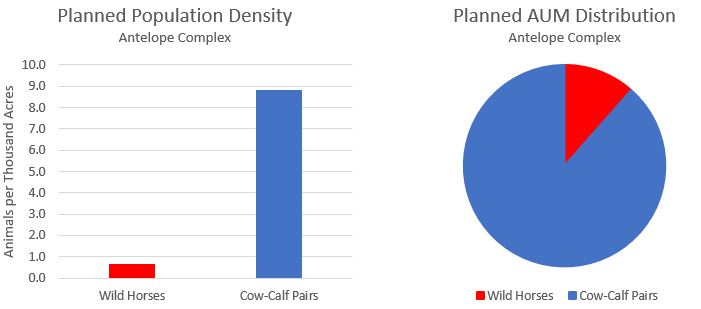
Folks, there is no wild horse problem, only greed and deceit on the part of the ranchers, their overlords, cheerleaders and political allies.  If they achieve their goals, this is what the charts will look like:

Wild Horse Overpopulation Planned-1

The nine million AUMs per year currently allocated to privately owned cattle and sheep on public lands in the western U.S. would support 750,000 wild horses and burros, enough to empty all of the off-range corrals and long-term pastures fifteen times over.

RELATED: Wild Horse Overpopulation?, Economics of Wild Horse Gathers.

The Voice of Dependency

What is the Public Lands Council?  The description for the following video says the organization represents 22,000 public lands ranchers in the Western United States.

Given its location in Washington DC, most of its resources are probably devoted to public relations and political influence.

One thing is clear: Its anti-horse agenda.

Public Lands Council Anti Horse Agenda-1

Curiously, the first goal has been accepted by most of the so-called advocacy groups, with some of them involved in the second item as well.

The fourth item is perhaps the most troubling—elimination of HMAs and WHTs so forage consumed by wild horses and burros can be allocated to privately owned cattle and sheep.

Consider this definition regarding public lands from Section 103 of FLPMA:

Principal Uses FLPMA-1

Go ahead and find a trade group representing oil companies, mining companies, timber companies or outdoor recreation companies that’s as hostile to WHB as these guys.

Satellite Adoptions

Video posted in 2016 by the Michigan Farm Bureau about wild horse and burro adoptions at non-BLM facilities.  A list of these events for 2019 can be found here.

Roundups drive the adoptions and ‘multiple use’ drives the roundups.

Which of these ‘other mandated uses,’ mentioned at 2:26, interferes most directly with the health and welfare of wild horses and burros?

a. Recreation

b. Oil and gas development

c. Livestock grazing

d. Wildlife

How many reports have you read about

  • Wild horses being attacked by hikers and campers?
  • Wild horses being slaughtered by oil companies?
  • Wild horse herds being wiped out by wildlife?

The great destroyer is public-lands ranching, which explains the remark at 2:20 about no natural predators.