Almost certainly it was somebody with ties to oil or mining companies.
Let’s take a look at the developer’s bios.
Oh crap, it was invented by a rancher.

Western Horse Watchers Association
Exposing the Hypocrisy, Lies and Incompetence of the Wild Horse Advocates
Opinion
Almost certainly it was somebody with ties to oil or mining companies.
Let’s take a look at the developer’s bios.
Oh crap, it was invented by a rancher.
Public-lands ranchers don’t hide their disdain for wild horses. The Public Lands Council, a cheerleader group attached to the National Cattlemen’s Beef Association, makes their position known on this page.
The American Petroleum Institute, a trade group for the energy industry, must have a similar page on its site. After all, oil and gas companies are major threats to wild horses according to some advocacy groups.
See if you can find it.
After that, please indicate
What’s that? Still haven’t found that policy statement on the API web site?
RELATED: Where Are Your Figures?
A colt separated from his mom was surrounded by onlookers on Friday, causing him to panic, according to a report posted today by The News & Observer of Raleigh, NC.
Remember, you should never approach wild horses—unless you’re stalking them with darting rifles, which the local ‘advocacy’ group does on a routine basis.
Operation of the machine can’t be all that bad, as the video shows a horse coming back to eat after ‘treatment.’ Most of them probably did the same thing, so it was hard to choose the right clip for the video.
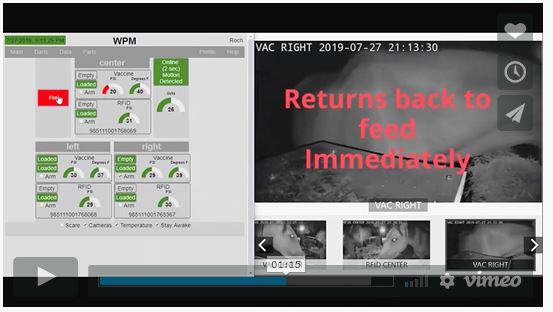
Do you think the user of this equipment will want darted mares eating more of the bait, when there is so much need out in the pasture? Do you think said user will be willing to feed the studs when they come in for a bite?
Hell no!
There must be another feature in the machine that drives the animals out after they’ve been treated or deemed unnecessary, such as an electric shock.
POW! Hit ’em with a dart. Then ZAP! So long sucka!
The following video, posted in 2017, shows a prototype of a machine that automatically darts wild horses in the field. The company now seeks investors to commercialize the technology.
The device targets the forequarters of the animals, contrary to the conventional wisdom in the darting world. It is not clear how the PZP zealots, whose purpose in life is now at risk, will respond.
Oil and mining companies, the greatest threat to wild horses and burros according to some ‘advocacy’ groups, have shown little interest in the contraption.
RELATED: New Machine Darts Wild Horses Automatically.
You can’t have a conversation about wild horses without having a conversation about public-lands ranching, but a story published yesterday by KSL News of Salt Lake City does exactly that.
Why don’t the horses have any natural predators? Public-lands ranching.
Why can’t the land support more than 27,000 wild horses? Public-lands ranching.
Why do they leave their HMAs in search of food and water? Public-lands ranching.
Nature determines resource availability but resource allocations—and the problems arising therefrom—are man made.
When you carve out 80% or more of the forage for privately owned livestock, wild horse numbers must go down. The programs are not independent, but intertwined.
The PZP zealots want to see the horses wild and free on their home range, they just don’t want them conceived and born on their home range. Makes perfect sense.
RELATED: Lies of Omission in New WHB Management Strategy.

They’re not, but if you’re a shill for the public-lands ranchers, anything that gets wild horses and burros off the range is good.
Being a wild horse on western rangelands is like moving into a five bedroom home and then being told that you can only use one bedroom. The four remaining bedrooms are reserved for other authorized users, which you’re not allowed to talk about, just like the writer of this opinion piece appearing today in The Salt Lake Tribune.
The introductory material in the new WHB management plan, beginning on page 2, is not complete. You might get the impression that wild horses are the problem.
Mustangers were not ordered to harvest them for commercial purposes, such as the production of dog food. That’s how they got rid of the carcasses. They were hired by ranchers to clear the range of anything that robbed forage from their livestock.
Yes, the WHB Act has been amended by Congress on four different occasions—at the behest of ranching interests. That part was not stated. The original Act protected the horses from ranchers, not drillers, loggers and miners.
Velma understood the issues. Today, most wild horse ‘advocates’ do not. In their zeal for contraceptives, they’ve sided with the ranchers.
Yes, the number of wild horses on western rangelands has grown, while the amount of land reserved for them has gone down. That part was carefully omitted. When the Rock Springs RMP amendments are implemented, the loss will be roughly 50% (of the land inhabited by these animals in 1971).
Lands no longer managed for wild horses and burros don’t have enough resources to support them, but somehow, privately owned livestock seem to do just fine.
If nothing is done to reduce growth rates, the on-range population of wild horses and burros could reach 2.8 million by 2040. OK, why is that a problem? Because it will lead to catastrophic harm to the land and to other species—meaning it will put the livestock operators out of business.
This plan is nothing but a shameless defense of the public-lands ranchers, who hide in the shadows while the government does their dirty work. It’s one of the best examples of crony capitalism you’d ever want to investigate.
RELATED: WHB Strategy in the News.
A syndicated report by AP News is making its way across major news outlets.
The plan calls for the removal of 20,000 wild horses and burros per year from western rangelands until the population target of 27,000—known as ‘AML’—is achieved.
The current population is 88,000 animals, with herd sizes doubling every five years.
The plan also requires more contraceptives and sterilizations, more adoptions and more off-range warehousing.
All of this to prop up an industry that’s outlived its usefulness.
The 33-page strategy is not necessary, just two sentences:
RELATED: Strategy for Implementing ‘Path Forward’ Sent to Congress.

The $21 million authorized in December for the disastrous management plan is another step closer to obligation, according to a news release by Animal Wellness Action, a lobbying group in Washington, DC.
Congress withheld funding until the BLM developed a comprehensive and detailed plan for controlling wild horse and burro populations on public lands in the western U.S.
The plan was issued last week and Congress has 60 days to review it.
The news release did not indicate if it was a draft, subject to revision, or if it would be posted for public comments.
A simple way to assess the validity of the plan is to search it for terms such as ‘AUM,’ ‘livestock,’ ‘forage allocation,’ ‘permit’ and ‘grazing season.’
They’re not in there, as if the grazing program was independent of the WHB program, not intertwined. Everybody knows that AMLs must go down if permitted AUMs go up!
The plan puts the crosshairs on America’s wild horses and burros while shielding the ranchers from public scrutiny.
HMAs were supposed to be safe havens for wild horses and burros but the government has turned them into breeding grounds for privately owned livestock.
Meanwhile, the BLM is ‘modernizing’ the grazing program, to streamline the permitting process, provide greater flexibility for managing resources and further enrich the public-lands ranchers.
The closure of three HMAs in the Wyoming checkerboard, and downsizing of a fourth, represent theft of economic resources, according to an opinion piece posted today by WyoFile, a member-supported public-interest news service.
These changes, prompted by a court order, will benefit public-lands ranchers, as stated in the column.
But they’re really just a formality. Under the current management plans, the HMAs are already managed primarily for livestock.

In the revised management plans, crumbs allocated to the horses will likely be assigned to the ranchers—on land set aside for the horses.
But look at the bright side. Losses from declining tourism may be offset, at least partially, by a high-density horse feeding operation on the other side of the state.
Instead of spending the afternoon and half a tank of gas driving the Pilot Butte Wild Horse Scenic Loop, you can go straight to Burns and see as many as 5,000 wild horses crammed onto 80 acres.
RELATED: New Twist in Rock Springs RMP Amendments?

It should be obvious to even the casual reader of these pages that the problem on western rangelands is not too many wild horses and burros but too many cattle and sheep, privately owned, of course.
Advocacy groups that push for contraceptives are allies of the ranchers. Get away from them as fast as you can. The ranchers already receive eighty percent of the forage on lands set aside for the horses and these people want to drive the ratio higher!
You don’t need an eleven-point plan, such as this PZP Manifesto from 2018, to save America’s wild horses and burros.
Only two actions are required:
It’s a problem of public awareness and support. That’s how Velma did it.
Two of the five HMAs located within the county are below their AMLs, according to an opinion piece posted yesterday by the Elko Daily Free Press, but three are way above their government-mandated limits.
The overpopulated HMAs belong to the Antelope Complex, reviewed on these pages back in August, where the management plan assigns 89% of the forage to livestock.
That tells you that the available resources are far greater than those required by the AMLs. In other words, AMLs represent the number of wild horses the land can support after most of the resources have been diverted to privately owned cattle and sheep.
That’s what makes the writer grumpy: He can’t stand the thought of horses roaming freely on lands designated for them, enjoying resources that were set aside for them.
Such a waste!
The Spruce-Pequop HMA, one of the offending areas, was the scene of a wild horse shooting at the beginning of a gather in 2018. Multiple rounds to the abdomens.
BLM knows who did it but to my knowledge there have been no arrests in the case.
The HMA intersects the massive Spruce Allotment, to which Madeleine Pickens has grazing preference. Not for cattle but for wild horses. Initially the BLM agreed with the plan but has since blocked every attempt to effect it. Because of the crybaby ranchers.
The AML for Spruce-Pequop yields a stocking rate of 0.3 wild horses per thousand acres, almost nothing, which is what you’d expect for an area where most of the food has been allocated to public-lands ranchers.
Horses on the Goshute HMA, which is 1,184% over AML (not 1,284% as stated in the article) must be skin and bone.
Same for the Antelope Valley horses, which are 272% over the limit (not 372%).
Except they’re not. Resources are more than adequate. They’re just not being distributed in a manner that satisfies the ranchers.
An editorial posted this morning by the Rocket Miner of Rock Springs, WY says “It’s time for a roundup.” Wild horses are robbing the poor ranchers of their birthright.
These animals have been set up to fail, by the government agencies entrusted with their care. Yes, Virginia, it’s sabotage.
The management plan for the affected HMAs allocates 86% of the forage to privately owned livestock—on lands set aside for the horses. This is now—before the plan is amended to satisfy a rancher-friendly court order!
Would that explain the movement of horses off their HMAs? Would it account for complaints about wild horses on private property and safety issues attributed to the animals near roads and highways?
The ranchers, who believe they have a right to place their property on land they don’t own, cluttering it with various ‘improvements’ that allow them to strip away a sizeable portion of the resources, are the problem. Never mind that the fees they pay have been stuck in time capsule since the 1960s.
Nobody’s trying to force them off their own land. But they do need to be confined to it.
Many of the wild horse ‘advocates’ buckle at the idea, because they have ranching backgrounds or ties to the ranching industry. They’d rather give aid and comfort to the government serfs through application of contraceptives.
The 50,000 wild horses in long-term holding can be explained by the misappropriation of forage on just a few dozen HMAs.
Payments by the ranchers ($1.35 per AUM) don’t even come close to the cost of feeding those animals ($60 per AUM). There is no payout and no rate of return for removing wild horses from their home range. Like other government programs, it’s negative cash flow all the way, with the shortfall covered by taxpayers.
Meanwhile, the ranchers and contractors get rich.
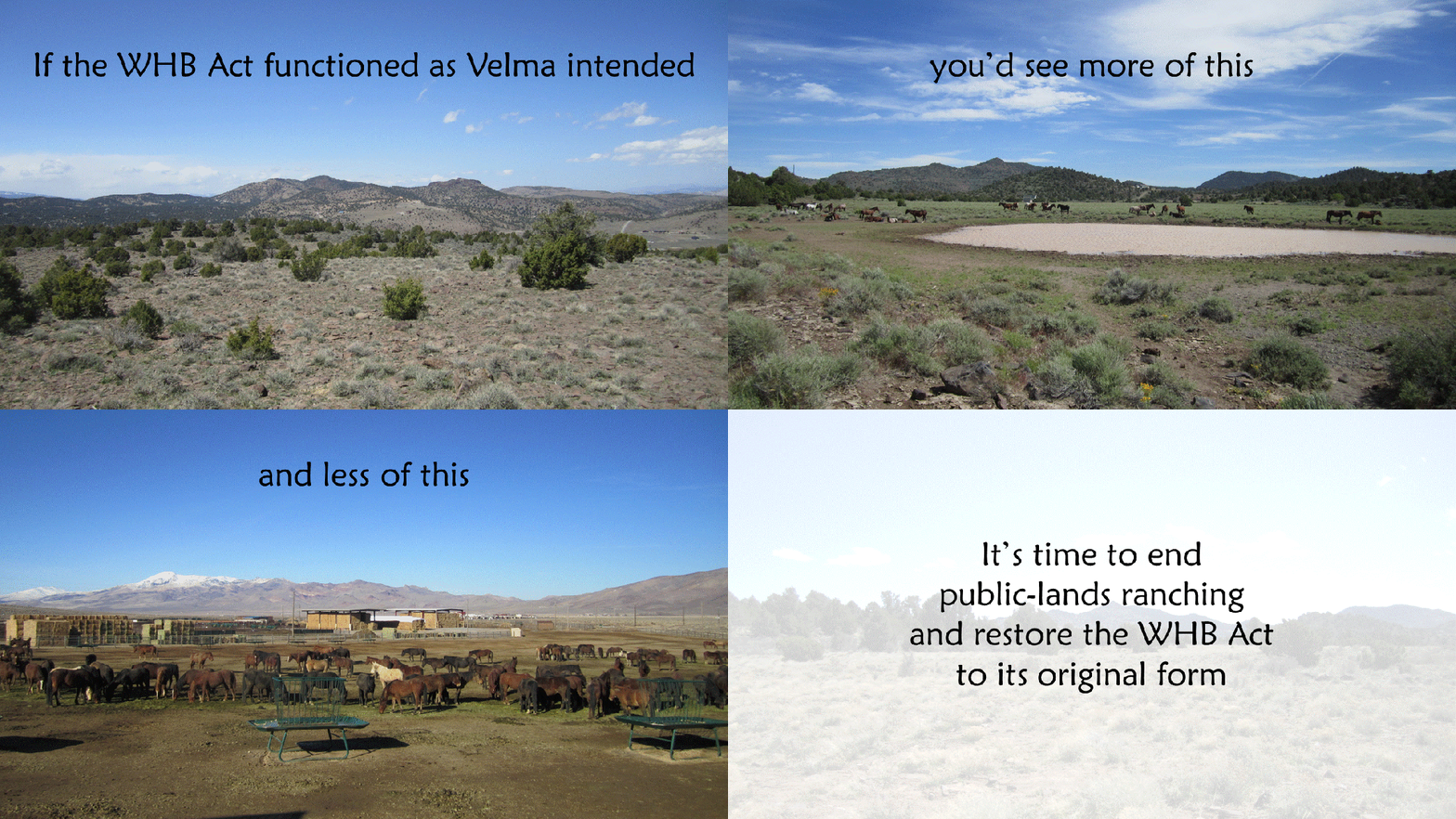
The wild horse outplacement program, with its adoption events, financial incentives and training programs is necessary because the WHB Act—altered at the behest of ranching interests—no longer functions as Velma intended.
It’s not time for a roundup. It’s time to end public-lands ranching and restore the Act to its original form.
RELATED: Rock Springs AML Amendments, Defending the Ranchers.
So says the writer of an opinion piece appearing today in the Reno Gazette-Journal.
He’s talking about a Virginia Range darting program that started a year ago. To date, his ‘volunteers’ have ‘treated’ over 950 mares with PZP.
At least he didn’t refer to them as ‘advocates,’ because they aren’t, and neither is he.
The Virginia Range, with a stocking rate of approximately ten wild horses per thousand acres, refutes the claim by the BLM that western rangelands can only support one wild horse per thousand acres.
And these idiots are destroying it. Whose side are they on?
The author says “PZP doesn’t hurt horses.” Apparently, he hasn’t looked at the data for the Assateague herd, where it has been applied for many years.
The EPA was recently ordered to review new evidence of the detrimental effects of the pesticide, that may lead to the withdrawal of its registration.
But he describes the affair as a model for humane management of wild horse herds.
The organization backing the venture is the American Wild Horse Campaign.
So says the writer of an opinion piece that appeared last week in the East Oregonian.
The solution “will require the removal of at least 60,000 horses, most of them through killing, and a commitment to remove by one means or another 5,000 per year to maintain an appropriate level.”
That’s about 70% of the horses currently on public lands in the western U.S., in line with the rancher-friendly ‘Path Forward.’
After all, the government just killed hundreds of bison in Yellowstone National Park to protect cattle, so why not horses?
The population limit set by the government, approximately 27,000 wild horses and burros on 27 million acres (which works out to one animal per thousand acres), is not a function of available resources. Rather, it is the number of animals the land can support after diverting most of the food and water to privately owned cattle and sheep—on lands set aside for the horses and burros.
If you don’t think that’s true, just look at this example. If you do believe it, you’re just seeing a “nefarious motive,” according to the author. Leave the poor ranchers alone.
The fences that hold livestock in also keep horses out. That may not be a problem on allotments with grazing seasons of two or three months per year, but what about areas that are in use for eight to twelve months per year, with stocking rates five to ten times higher than the horses?
Would that explain the movement of horses off their HMAs?
Would it account for conditions that don’t meet standards for rangeland health?
Have the most productive areas been given to the public-lands ranchers?
Stop imagining things!!! There is no nefarious motive (even though it looks like sabotage). If anything, it’s just an ‘unintended consequence’ of the grazing program.
On the Little Bookcliffs WHR in western Colorado, one of four areas set aside for wild horses and burros (out of roughly 200) that’s managed principally for wild horses and burros, per the statute.
The denominator doesn’t include areas where WHB were found in 1971 that have been commandeered for other mandated uses of public lands.
What about the other 196 areas set aside for WHB? Most of the resources have been diverted to the other mandated users, a truly sad state of affairs for these animals.
The roundups, adoption incentives, training programs, off-range warehousing, darting programs, sterilization research, sanctuaries and preserves reflect that reality.
RELATED: Suggestion for the Big-Name Advocacy Groups, Hypothesis Revisited.
A U.S. District Court Judge ruled yesterday in favor of Friends of Animals regarding the detrimental effects of PZP, a pesticide applied to wild horses and burros to reduce herd sizes. Long-term use can result in sterilization.
Many of the so-called advocacy groups accept and promote wild horse fertility control, with some of them actually providing it, to the delight of the public-lands ranchers.
A news release by FOA said that the EPA will now be required to review the “evidence of unintended—and previously undisclosed—side effects on both targeted mares and wild horses in general.”
Stallions on the Maryland side of Assateague Island. where contraceptives have been applied for many years, have a high mortality rate, the sex ratio of the herd is far from normal and genetic diversity may be compromised. But the PZP zealots point to it as a model of wild horse management.
RELATED: Assateague Herd Declines in Latest Census.
Many of the areas currently set aside for wild horses and burros are managed primarily for cattle and sheep, privately owned of course.
Other areas, where horses and burros were found in 1971, don’t have enough food and water to support them, although other users of public lands seem to do quite well.
Paragraph 1332(c) of the WHB Act says the land will be devoted principally for horses and burros.
CFR 4710.3-2 says “We’ll do that if we feel like it.”
Which viewpoint prevails?
Only four of the areas currently designated for wild horses and burros are managed primarily for them, out of roughly 200 areas so designated (HMAs and WHTs).
Here is the issue in a nutshell:
Can a federal regulation supersede a duly enacted statute?
Can the unelected bureaucracy override the legislative process?
That is for the court to decide.
A ruling in favor of the advocacy groups wouldn’t improve anything: It would only put things back where they should have been in the first place.
After that, the hard work begins.
Herds of wild horses, reindeer, bison and other large herbivores could pack down the earth and any snow on top of it, keeping the permafrost cold and reducing the risk of carbon emmissions, according to an article in Scientific American.
After all, they roamed the area thousands of years ago.
What a bunch of garbage. Scientific American used to be a respectable publication but now it’s a left-wing propaganda organ.
Why not open it up to public-lands ranching? Cut the grazing fee to 29¢ per AUM.
Cattle, being sedentary animals, will do a better job of packing down the soil and snow.
Remove them from western rangelands, ship them all up north and return warehoused horses to their home range.
 Western Horse Watchers Association