R.I.P. Assateague Horse Census?

The Park Service counts the horses six times per year, in February, March, May, July, September, and November, according to a news release published in November, 2019.

Western Horse Watchers has been unable to find any data since March, 2020.

Did they stop doing it?  Probably not.

Why did they go underground?  Perhaps they don’t want you to see the long-term effects of the darting program.

What about other such programs?  There’s no accountability to the public.

Every group that administers a darting program, whether on public or private lands, should be required to produce a census count with demographics, at least once a year, so the American people can see what’s being done to their wild horses.

They already have the data.

Remember, there’s no such thing as birth control for horses, only safe and effective birth control for horses, and interfering with nature is a good alternative to roundups.

And above all, never talk about resource allocations, management priorities and privately owned livestock.


RELATED: Assateague Wild Horse Census Temporarily Halted?

Confusion at Confusion HMA About Cause and Effect?

Roundups, sterilization and long-term holding are effects.  They are outcomes of a process.  If you want to change the outcomes, you have to look upstream in the process.

Why are these effects occurring?

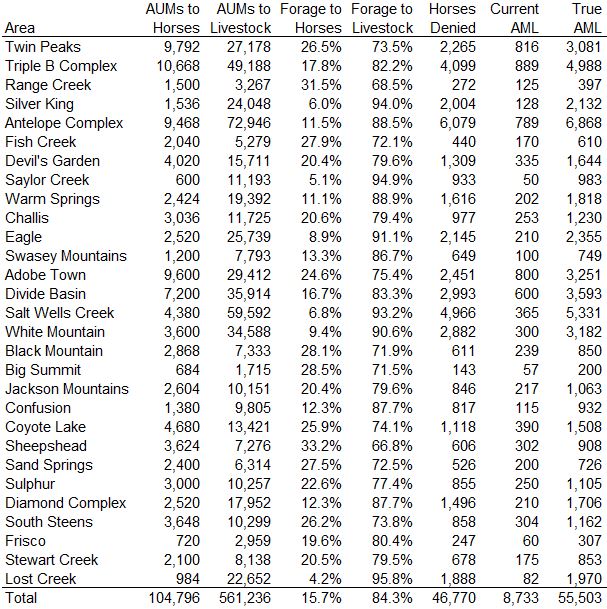
How much forage has been allocated to public-lands ranchers?  How many horses would it support?  What is the true AML?  How does the current herd size compare to that?  Would the roundup be necessary if the HMA was managed principally for wild horses?

Why is it managed primarily for livestock?  How are resource allocations determined?

Why are the horses treated like pests on land set aside for them?

RELATED: Confusion Wild Horses Get Short End of Stick.

Thriving Ecological Balance-3

Definition of Rangeland Health

It’s when the poor ranchers can enjoy the full benefit of their permitted AUMs.

Consider this example from Appendix VII of the Final EA for wild horse management actions in the Caliente Complex:

To reestablish the health to the rangeland in the Areas we currently run Cattle the population of Wild Horses must be managed properly.  Current numbers indicate a gross overpopulation of Wild Horses on our allotments as well as many others.  We currently have an allotment that is supposed to allow us up to 327 Cattle (1312 AUMS) on our Sheep Flat permit.  The damage because of overpopulation of Wild Horses has made it to where we can barely run 100 head on this Allotment and not for the full grazing season.  We have to gather cattle and move them to rented pasture in Barclay to finish out the summer season.

Can you imagine that?  Having to pay market rates to feed your cattle?  You wouldn’t wish that on your worst enemy.

Cattle and Horses

WHBAB Member Identifies Cause of Wild Horse ‘Problem’

In a story posted yesterday by the Paulick Report, a news service devoted to the horseracing industry, Dr. Tom Lenz, WHBAB member representing veterinary medicine, said “I think the problem we have today is that the public, through Congress, is managing the horses, rather than the BLM managing them through scientists.”

OK, people, it’s time to ‘fess up.

Who among you have been writing and approving the RMPs that allocate eighty percent or more of the forage in HMAs to privately owned livestock?

How many of you have been demanding the roundups and other population controls that enforce those resource allocations?

Which one of you secured funding for the ‘Path Forward,’ which will ultimately remove seventy percent of America’s wild horses and burros from their home range and place them into off-range pastures and private sanctuaries?

Who benefits as HMAs are zeroed out, predators are decimated and invasive species, such as pinyon pines and juniper trees, are eradicated?

Who pushed for changes to the WHB Act, rendering it ineffective?

Avoid the consequences.  Identify yourselves in the comments.  Do it now!

Propping Up a Failed Industry

“Nevada’s livestock industry would not exist without ranchers’ ability to graze on public land,” according to the Nevada Rangelands Resources Commission, because most of the land is owned by the federal government.

Nevada is also home to half of America’s wild horses.

Western Horse Watchers is unable to determine if NRRC is a government entity or a trade group masquerading as a government entity.  The state seal appears on their home page.  An email seeking clarification in November 2019 was never answered.

Federal ownership of land in other western states is considerably less, but we see the same pattern of roundups and biased RMPs.

Do you think the rancher-friendly ‘Path Forward‘ applies only to Nevada?

“Healthy horses on healthy rangelands” is a lie.

Roundups enforce resource allocations of RMPs, which assign eighty percent or more of the forage to privately owned livestock, not because the ranchers are on the verge of bankruptcy but because they have co-opted a federal agency to suit their agenda.

The wild horse and burro program has been turned into a grazing program ancillary.

Cut them off.  The west is settled.  They are destroying an irreplaceable natural resource.

How many tears were shed when manufacturers of vacuum tubes went out of business with the advent of the transistor?

Who cried for makers of carburetors when fuel injectors hit the market?

Can you imagine the federal government spending hundreds of millions of dollars to marginalize Henry Ford so it can protect the jobs of those who make buggy whips?

It’s time to end public-lands ranching and restore the WHB Act to its original form.

Thriving Ecological Balance-3

What Happened to the Moriah HMA?

It was chartered in 1983 with an AML of 29, according to Section 4.1.2 of the Final EA for wild horse management actions therein.

To quality as an HMA, an area must supply forage, water, cover, space, and reproductive viability, according to Section 1.1.  In 2007, Moriah was evaluated for wild horse suitability and “failed to meet one or more of the five required habitat components resulting in the decision, under the land-use plan, to drop its HMA status.”

But the EA does not say which requirements were not met and does not explain the 714 wild horses currently living there.

There must be another reason.  The allotments that overlap the HA were not zeroed out so perhaps it had resources coveted by the public-lands ranchers.

The initial comments in Appendix V of the EA support that theory.

RELATED: Moriah Roundup Pending.

Oregon Fact Sheet: It’s All About the Missing Numbers

Earlier this week, BLM released a fact sheet for public lands in Oregon and Washington during FY 2019.

Key management indicators can be computed for the wild horse and burro program in Oregon, using data on page 29 of the pdf.  (There are no HMAs in Washington.)

Animals allowed by plan = 2,697 (some burros present but assumed to be 100% horses)

Authorized land = 2,698,902 acres

Current population = 5,878 (assumed to be 100% horses)

Required forage allocation = 2,697 × 12 = 32,364 AUMs per year

Current herd size  = 5,878 ÷ 2,697 = 2.2X AML

Stocking rate allowed by plan = 2,697 ÷ 2,698,902 × 1,000 = 1 horse per thousand acres

What about livestock?  Unfortunately, the data provided on page 30 don’t include the acreage designated for grazing and the average grazing season.

The number of cow/calf pairs can be estimated if you guess the grazing season but the stocking rate can’t be determined.

Authorized forage = 659,201 + 69,141 = 728,342 AUMs per year

Grazing season = 6 months (assumed)

Authorized herd size = 728,342 ÷ 6 = 121,390 cow/calf pairs

Stocking rate allowed by plan = ?

Livestock receive 22 times more forage than horses.  But a more detailed comparison of management practices in Oregon is not possible, thanks to the missing numbers.

Rangeland Stewardship Awards Go to Public-Lands Ranchers

We know that cattle and sheep are intelligent, hard working and dedicated to the improvement of western rangelands, so they should be recognized for their efforts.

Unlike wild horses and burros, who are destroying their habitat.

What’s the difference?  Human involvement.

Are local advocacy groups allowed to participate?

No!  You only need to look at the Sinbad roundup to see what happens when volunteers try to help wild horses and burros.

Every year, 50% of grazing receipts or $10 million, whichever is greater, goes back into the program for rangeland improvements.  Wells, tanks and water lines, road, fence and gate repairs, etc.  Other funds go to predator management and vegetation control.

In exchange, the ranchers pay the government almost nothing.

What’s invested in the WHB program?

The news release sounds like a mutual admiration society.  The president of the Public Lands Council, a cheerleader group for the public-lands ranchers, said “Grazing on federal lands is a critical part of our country’s food supply…,” which it isn’t.

You could end the program tomorrow and nobody would notice.

Horse Takes Barrel Racer on Hell Ride

Only a few seconds earlier she had been digging it into his gums, spurring him on to victory.  Then the bit broke—allowing him to give her some feedback on her riding style.

He bolted from the arena, with her on top, down the driveway and over to a busy highway, according to a story posted this morning by the Nashville Tennessean.

He ran wild for 15 minutes but does not appear to be a wild horse.  The incident stopped with the help of a firefighter and nobody was hurt.

But what will happen to the horse?

Back to the Fast-Disappearing Days

The following remarks were delivered at the October 2019 WHBAB meeting by a representative of the Society for Range Management, an organization that believes rangelands should be used for livestock grazing and not much else.

Although the group accepts wild horses and burros on those lands, they insist that their numbers be limited to those that existed when the WHB Act became law (0:23 to 0:36).

This is where they’re going with the ‘Path Forward.’

We know from President Nixon’s remarks that only 9,500 wild horses and 11,000 wild burros remained on western rangelands in 1971.  That’s equivalent to 15,000 wild horses today on 27 million acres, for a stocking rate of 0.6 horses per thousand acres.

A number that low means only one thing: Large amounts of forage diverted to privately owned livestock.

No new laws are required.  Just enforce the plans that are already on the books.

RELATED: ‘Path Forward’ Extinction Target.

Future of Wild Horses in Hands of U.S. Senate?

So says the writer of an opinion piece published this morning by the Las Vegas Sun.

Written by the director of field operations for AWHC, it’s just another attempt to push the PZP Amendment through Congress, an idea so good that even the Rolling Stones would support it.

This is the same guy who’s coordinating the Virginia Range darting program.  A former BLM employee, he’s 100% on board with the overpopulation narrative.

Never let the facts get in the way of a good story, especially if you’re a big-name ‘advocacy’ group with a hidden agenda.

Truth is, the helicopters are flying because most of the resources in wild horse areas have been diverted to privately owned livestock.  And, apparently, AWHC doesn’t give a damn about that.  Just keep the PZP supply chain moving.

Short End of Stick Recap 10-14-20-1Would you be surprised if they take money from ranching interests?  The organization needs a thorough house cleaning, starting at the top.
Handiwork of PZP Zealots

On the Red Desert Roundup

As the photos roll out, remember that you are watching an enforcement action.

Media coverage—if there is any—will focus on casualties and the treatment of the horses but the real injustice was done years ago, by those who wrote and approved the resource management plans.

On the Lost Creek HMA, for example, the horses receive an estimated four percent of the authorized forage, excluding wildlife.  They have been consuming more than their fair share, around 16%, so the herd needs to be cut down to size.

The same is true for the ‘Path Forward,’ a plan with the same goal but much broader scope: Enforce the resource allocations across all HMAs, manage them principally for cattle and sheep.

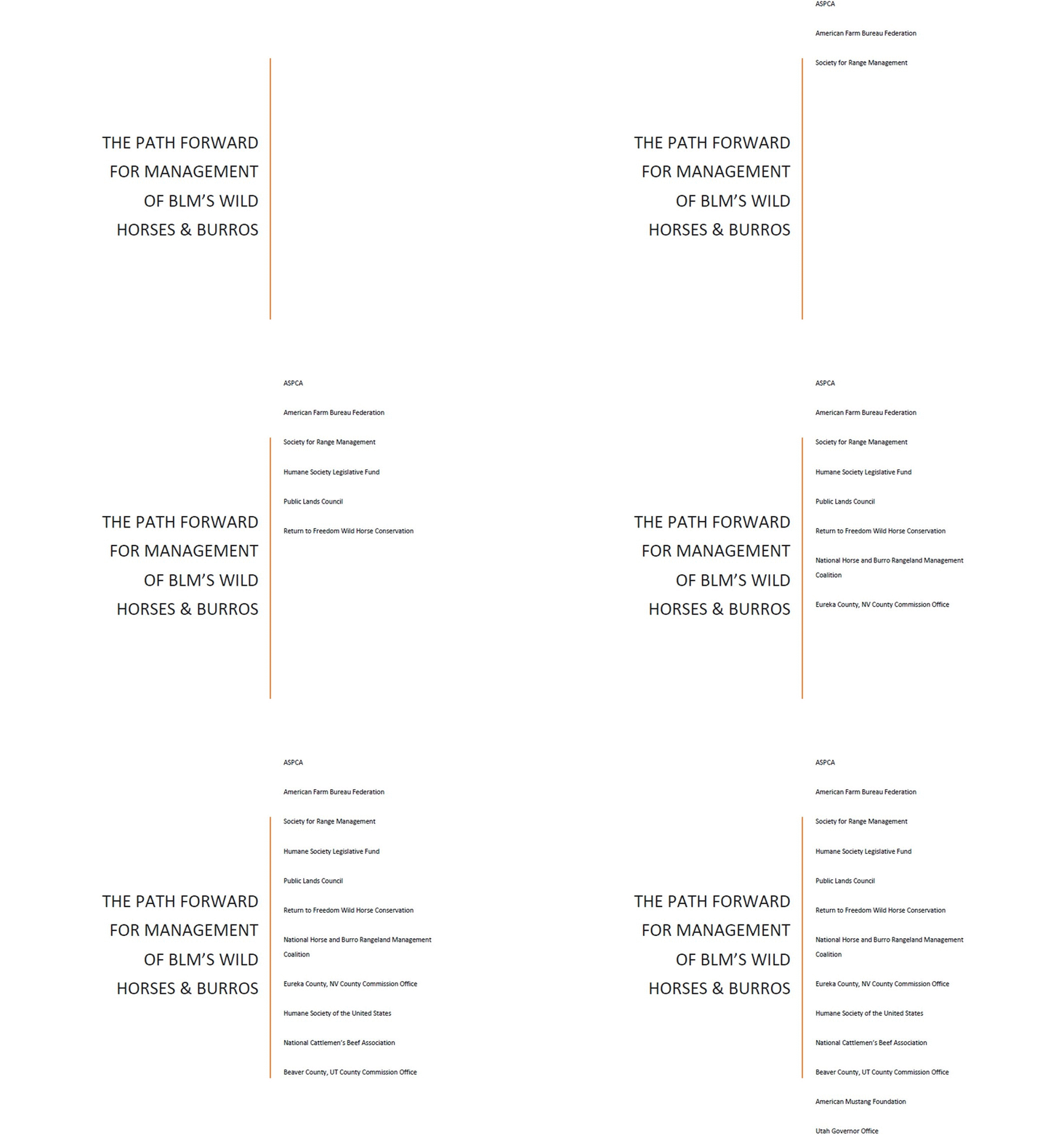
Path Forward Signatories

Notably absent from the signatories are drillers and miners, the supposed boogeymen of western rangelands.

But there are dozens of ‘advocacy’ groups that can be added to the list—always begging for your money—so they can make sure those forage allocations never go any higher.

They, like the public-lands ranchers, are enemies of America’s wild horses.

Confusion DR Setting New Precedent in WH Management?

The Decision Record issued yesterday states that “…sterilization is the minimum feasible level of management possible for the Confusion HMA.”

Section 2.2.4 in the Final EA for the Gather Plan indicates that the procedures would be carried out at a private facility and would not be open to public observation.

This is unacceptable.

In the future, writers of new gather plans will only need to point to this one to justify their ill-conceived ideas.  Each step in the process moves the program farther from its original charter, which is to manage the land principally for wild horses.

NOTE: The documents were combined into one file.  The Decision Record is not searchable but the Final EA is.

RELATED: Confusion Roundup Pending.

Cattle and Horses

South Steens Follow-Up

At the conclusion of the roundup, BLM reported that 62 studs had been captured along with 103 mares.  Do those numbers look like they came from a herd that’s 50% males, 50% females?

The question can be answered with the most rudimentary of statistical calculations, where n = 165 and p-bar = .5.

The observed values of 62 and 103 fall outside the calculated limits of 63.2 and 101.8.

Therefore, the answer is ‘No.’  An assignable cause should be sought.

One possibility is that mares prefer private property.  Another possibility is that the contractor targeted family bands.  That might explain the rather large percentage of foals captured (24.3% of the total).

Or perhaps the herd was not composed of 50% males and 50% females.  Do studs die off at an early age, leaving the mares and foals behind?

Would a sex ratio of 40% males and 60% females be considered normal?  If so, then attempts to skew it in the other direction would be considered malicious, interfering with a natural process, just like PZP darting.

But it makes sense in an age where ‘management at the minimum feasible level’ has been replaced with ‘management primarily for livestock,’ privately owned, of course.

RELATED: South Steens Roundup Ends.

Wild Horse Management

Axtell Tour Set for Mid Month

A public tour of the off-range corrals in Axtell, UT will occur on October 15, according to a BLM news release published today.

The facility currently houses animals from the Frisco, Shawave and Sulphur roundups.

The government removes wild horses from western rangelands and places them in facilities like this at a cost of roughly $5 per day per horse so it can collect about four and a half cents per day for each cow/calf pair that replaces them.

Taxpayers cover the difference and the ranchers get rich.