New Form Streamlines WHB Adoptions and Sales

Two applications have been combined into one, according to a BLM staff report posted yesterday.  The photo supplied with the announcement suggests that this will appeal to those who can’t get a horse to do anything without shoving multiple bits in his mouth?

A horse does what he has to do to save his life, don’t confuse it with your ability, my dear.

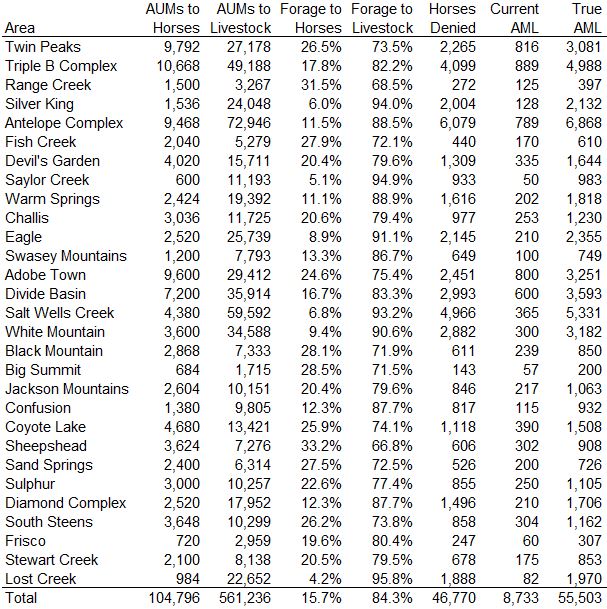
Keep in mind that the number of excess horses and burros on public lands in the western U.S.—animals destined for the WHB outplacement program—is directly related to the number of privately owned cattle and sheep allowed thereon, and that WHB stocking rates are often good indicators of magnitude of the problem.

Thriving Ecological Balance-3

Another Lesson from Industrial Quality Control

The analyst, looking at data from a process, faces two problems:

  • Searching for trouble that doesn’t exist
  • Overlooking trouble that does exist

The statistical methods used by Western Horse Watchers are designed to minimize the losses from these mistakes.  There are no probabilities, no underlying distributions.

The formulas help you decide, by calculation, if the results from a process should be attributed to chance or whether they should be associated with one or more assignable causes (nameable, knowable, findable).

Do these data look like they were produced by a simple random process?

If you’re talking about the Assateague herd, the answer is ‘No.’

Data from the recently concluded gather at Nevada WHR look like they were.

This doesn’t mean that wranglers weren’t on horseback cutting mares from the herd, to skew the sex ratio, there’s just no evidence of that in the data.

RELATED: A Lesson from Industrial Quality Control.

In Praise of PZP

Refer to this guest column, appearing this morning in the Las Vegas Sun.

If you believe that most of the problems on public lands in the western U.S. are due to privately owned livestock, why would you promote a technology associated with wild horse overpopulation?

The writer cites AWHC’s war on the Virginia Range mustangs as a PZP success story, but does not mention the disastrous long-term effects of PZP on the Assateague herd or the recent court order requiring the EPA to reconsider its registration of the pesticide.

Extended use, necessary for maintaining AMLs, leads to sterilization.  The horses are said to be ‘self boosting.’

PZP doesn’t protect wild horses, it prevents them.

While that might appeal to some, the idea does not have broad support among ranching interests because darted mares still eat.  Removal, the centerpiece of the glorious ‘Path Forward,’ is still the best option.

RELATED: Management of Western Rangelands in 2018, Livestock Grazing in Nevada.

AEA Ties PZP Amendment to Wild Horse Darting Machine

Refer to this press release by American Equine Awareness, issued yesterday.

Should Congress direct some of the money to a pilot program that tests the new system, so it can be refined for commercial use?  Would the Rolling Stones support the idea?

The House spending bill, which includes the amendment, still has to be considered by the Senate.

RELATED: If the PZP Amendment Carries, How Will the Money Be Used?

Cutting Costs of WHB Program

Consider two HMAs, each starting off at low end of AML.

HMA1

  • AML 50 – 100 wild horses

HMA2

  • AML 500 – 1,000 wild horses

Both HMAs will need to be gathered in five years.  Fifty wild horses will need to be removed from HMA1 and 500 from HMA2.

Which operation will cost less?  Which one will require more off-range holding?

If the goal is to save money, zero out all the HMAs and end the WHB program.

RELATED: Best Way to End Roundups?

PZP Amendment Discussed

Refer to this 13-minute interview posted today by Nevada Public Radio.  The segment about wild horses ends at 8:35.

The amendment is turning out to be a cousin of the glorious ‘Path Forward,’ another opportunity for ‘advocacy’ groups to throw in with the public-lands ranchers.

How exactly does the legislation fix the resource management plans that divert most of the forage on public lands to privately owned livestock?

RELATED: If the PZP Amendment Carries, How Will the Money Be Used?

Best Way to End Roundups?

Get rid of the horses.

The FY 2021 spending bill approved by the House last week includes the $11 million PZP Amendment, an idea so good that even the Rolling Stones would support it.

Anybody who reads these pages knows that overpopulation is not the problem, but the big-name ‘advocacy’ groups are trying to convince you otherwise.

This article by Nevada Current, published yesterday, is just one example.

What you’re getting from these groups is capitulation to the ranching agenda, as seen in the disastrous ‘Path Forward.’

They’re trying to ensure that livestock operators receive seventy, eighty, ninety percent or more of the authorized forage on land set aside for wild horses.

Don’t give them a penny!

RELATED: House Passes PZP Amendment to FY 2021 Spending Bill.

Cattle and Horses

Letter Criticizes BLM Opinion Piece, Pushes PZP

There are four million permitted cattle and sheep on public lands in the western U.S., according to the writer of a letter to the Las Vegas Review-Journal, compared to 81,000 wild horses, but the horses need to be managed with PZP.

After all, it’s been used for 30 years.

Where?  Assateague Island.  Many wild horse ‘advocates’ point to the area as a paragon of wild horse management but the results have been disastrous.

RELATED: BLM Opinion Piece Acclaims ‘Path Forward,’ Ignores Livestock.

What is an Excess Horse?

The current population at Saylor Creek is 131 wild horses.  The AML is 50.  How many excess horses are present?  The herd is 2.6 times over AML.

There are 81 excess horses on the HMA, per current wisdom.  It’s overpopulated.

The herd requires 13% of the authorized forage on the HMA but you’re not supposed to know that.  When the roundup ends, the horses will only need about 5%.

RELATED: Comments on Saylor Creek Wild Horse Roundup.

Statutes and Regulations

Exhibit A

16 USC 1332, Definitions, WHB Act, a duly enacted statute.

Paragraph (c) defines “range” as “the amount of land necessary to sustain an existing herd or herds of wild free-roaming horses and burros” that’s “devoted principally but not necessarily exclusively to their welfare.”  It stands as it did in 1971.

Paragraph (f), which defined “excess animals” as those “which must be removed from an area in order to preserve and maintain a thriving natural ecological balance and multiple-use relationship” did not appear in the original Act.  It was added by PRIA.

Exhibit B

CFR 4710.3-2, Wild horse and burro ranges, Part 4700, Subpart 4710, a federal regulation.

Accordingly, herd management areas, a term that did not appear in the original Act, “may also be designated as wild horse or burro ranges to be managed principally, but not necessarily exclusively, for wild horse or burro herds.”

Exhibit A lays down the law.  Exhibit B makes it tentative.

Which one prevails?  Can a regulation override a statue?

Thriving Ecological Balance-3

Sulphur Roundup in the Works?

A project appears in BLM’s NEPA register (sometimes referred to as ‘ePlanning’) but no documents have been posted.

There are three levels of analysis in the NEPA process: Categorical Exclusion (CX), Environmental Assessment (EA) and Environmental Impact Statement (EIS).  Wild horse management actions often fall into the middle category but major changes, such as the Rock Springs RMP Amendments, require an EIS.

A project involving wild horses and burros may begin with a scoping request, to receive input from the public, followed by staff work to formulate an action plan and draft an environmental assessment.  The EA looks at the consequences of a preferred action and one or more alternatives.

The preliminary plan and EA are posted for public review and may be revised in light of substantive comments.

If there are no major issues, a decision record and finding of no significant impact may be is issued, allowing the plan to go forward.  This does not mean the roundup starts the following week!  There are priorities and funding is not unlimited.  The plan may face legal challenges.

The process can take several years to complete although it may be shortened or bypassed altogether in the case of emergencies.

The Sulphur HMA is in western Utah on the Nevada border.

Public-Lands Ranchers May Need More Forage?

A spokesman for the Public Lands Council said earlier this week before the Senate Committee on Energy and Natural Resources that “There may be a need for access to additional forage, including vacant allotments or other available allotments that were not grazed during the summer season.”

His testimony concerned the effects of COVID-19 on public-lands ranchers, according to a news release dated July 23.

He did not indicate where those underutilized allotments would be found but almost certainly could offer a few suggestions.

Western Horse Watchers was unable to find a statement in the organization’s news releases condemning the recent PZP Amendment to H.R. 7608, a spending bill for FY 2021 now under consideration in the House.

The amendment has the full support of AWHC.

RELATED: PLC Wants to Change Image of Public-Lands Ranching.

House Passes PZP Amendment to FY 2021 Spending Bill

Refer to this news release issued today by Animal Wellness Action.  The full bill will be considered by the House tomorrow.

The amendment requires the BLM to use $11 million from the FY 2021 WHB budget to apply PZP to wild horse herds.  It does nothing to stop the misappropriation of resources that’s forcing them off western rangelands.

The Senate will take up its own spending bill in the coming weeks or months.

RELATED: Swasey Wild Horse Fatality Justifies Contraceptives?

Comments on Saylor Creek Wild Horse Roundup

The stocking rate allowed by plan is 0.5 wild horses per thousand acres.  That should raise an eyebrow.  The plan assigns 95% of the authorized forage on the HMA, omitting wildlife, to livestock, with the balance to horses.

It’s one of the best examples of mismanagement in the WHB program.

The pre-gather population of 131 horses is 2.6 times above AML, yet it represents just 13% of the carrying capacity of the land.

Unlike Swasey, which reached its capacity, the HMA is not overpopulated, at least not with horses, so what’s driving the roundup?  What’s the rationale for contraceptives?

Could it be that the herd was approaching the minimum recommended size for genetic viability?  Or might it be the attitudes, loyalties and beliefs of those who wrote and approved the management plan?

RELATED: Saylor Creek Roundup Pending.

Thriving Ecological Balance-3

Swasey Wild Horse Fatality Justifies Contraceptives?

A press release issued today by AWA and AWHC, in the wake of a death yesterday during the Swasey wild horse roundup, calls for an $11 million expenditure in 2021 to dart wild horses with PZP.

They need better protection, according to the writers.

Contraceptives mean they won’t even be born—never to be harmed by roundups—a strategy that dovetails perfectly with approved plans to divert most of their food to privately owned livestock.

The announcement suggests that AWHC was the client behind the opinion piece that appeared in several publications on Friday.  Whose side are they on?

RELATED: Swasey Progress Report Day 4.

BLM Opinion Piece Acclaims ‘Path Forward,’ Ignores Livestock

“Now is the time to chart a bold new course for the management and protection of the horses and burros and prevent unnecessary degradation to their habitat,” according to the writer of a guest column appearing this evening in the Las Vegas Review Journal.

The current population of 95,000 wild horses and burros on BLM-managed public lands is more than three and a half times what the land can support [given the amount of resources we’ve diverted to privately owned livestock].

He forgot that part.

AWA Urges Lawmakers to Accept PZP for Wild Horses

Animal Wellness Action, a lobbying group in Washington D.C., said yesterday in an opinion piece published by the Pagosa Daily Post that “lawmakers have the opportunity to land on the right side of history – and the American taxpayer – by requiring BLM to implement PZP contraceptive in 2021.”

Never mind that the EPA was ordered to reconsider the registration of the pesticide earlier this year.

And you should ignore the Assateague census results that show its long-term effects on wild horse herds.

Lobbyists do as their clients require.  In this case, a photo of a wild horse roundup, provided by AWHC, was included.  Might they be the client?

That group has thrown in with the public-lands ranchers.  They’re using your hard earned donations to do the rancher’s dirty work, which is to ensure that seventy, eighty, ninety percent or more of authorized forage on lands set aside for wild horses goes to privately owned livestock.

Don’t pay attention to their words, pay attention to their deeds.

Thriving Ecological Balance-3