Titus Admits Helicopter Ban Won’t Help Wild Horses

Refer to the audio segment posted today by KNPR Radio of Las Vegas.

The herds must still be managed (for the benefit of the public-lands ranchers).

There will be fewer injuries (but there will still be roundups).

Management plans (that favor the ranchers) won’t change.

Just use a more humane approach (but keep the gravy train going).

Resource enforcement goal before the ban: 22,000 captured and 19,000 removed.

Resource enforcement goal after the ban: 22,000 captured and 19,000 removed.

RELATED: Anti-Helicopter Chatter Too Far Downstream to Help Wild Horses.

Group Uses Pancake Deaths to Sell Montana Solution

As if right on cue, the executive director of the Campaign Against America’s Wild Horses told FOX 5 News of Las Vegas in a report posted yesterday that her group supports the ill-advised plan to end helicopter roundups and the use of fertility control vaccines to eradicate wild horses.

Ranchers in the Pancake Complex receive over five times more forage than the horses, yet this woman, and other like her, want to target the horses.

RELATED: Anti-Helicopter Chatter Too Far Downstream to Help Wild Horses.

Nevada Farm Bureau Opposes Helicopter Ban

The group, which represents the interests of farmers and ranchers in the state, said in news release posted today by the Elko Daily Free Press that HR 6635, legislation that would ban the use of helicopters in wild horse and burro roundups, would seriously thwart the efforts of the BLM to achieve AMLs as well as restore the condition of rangelands that provide habitat for wildlife and multiple-use stakeholders.

Helicopter roundups are the only cost-effective method available for gathering the necessary number of animals over vast and difficult terrain, according to the writers, who did not explain that AMLs are usually small relative to the available resources.

Western Horse Watchers has not seen any critiques of the proposal by groups representing drilling and mining interests.

RELATED: Anti-Helicopter Chatter Too Far Downstream to Help Wild Horses.

Lots to Celebrate at Sulphur HMA, If You’re an Advocate

Here are some of the highlights:

  • No foals have been reported five days into the roundup
  • The herd is getting smaller, without the aid of helicopters
  • The death rate is probably increasing, as explained here
  • PZP and GonaCon will stabilize the birth rate, which appears to be zero
  • Livestock receive 77.4% of the authorized forage, neglecting wildlife
  • Around 850 horses have been displaced from the HMA by permitted grazing
  • The HMA has a herd management area plan (HMAP)

The advocates are pleased with these results.  The herd is well on its way to extinction, with benefits accruing to the public-lands ranchers.

This is what you’re supporting when you give them money.

RELATED: Youngsters Hard to Find at Sulphur HMA.

Youngsters Hard to Find at Sulphur HMA

Figures for Day 4 of the roundup show zero foals captured to date.

No Foals at Sulphur HMA 02-12-22

With no new blood hitting the ground, the herd will shrink without the aid of helicopters and the ranchers will be able to enjoy everything their allotments have to offer.

How much longer before the advocates point to the HMA as a paragon of wild horse management?  It even has a herd management area plan (HMAP)!

RELATED: Sulphur Roundup Day 3.

Anti-Helicopter Chatter Too Far Downstream to Help Wild Horses

A report posted yesterday by the Las Vegas Review-Journal says lawmakers want the BLM to replace helicopters with wranglers and spend more money on fertility control to manage (i.e., inhibit) population growth.

The proposal does not address the cause of roundups: Resource management plans that put ranching interests far above those of the horses.

It’s a stupid idea, prompted, at least in part, by the advocates.

If legislators want to help America’s wild horses, let them unwind all of the changes to the WHB Act and restore it to its original form.

RELATED: End Helicopter Roundups?

Crocodile Tears for the Horses

The advocates are trying to convince you that they care about wild horses, by protesting the BLM’s resource enforcement goals for FY 2022, while they’re getting rid of as many as possible with PZP.

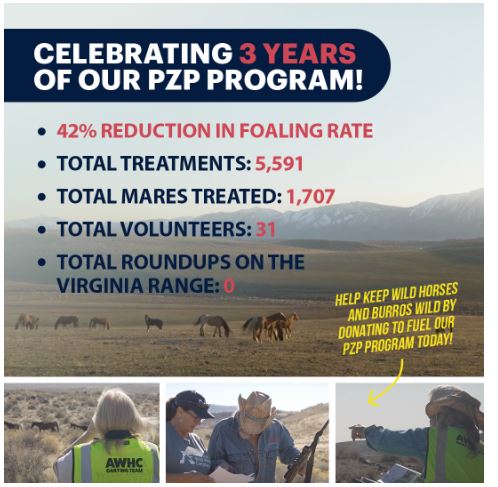
The Virginia Range darting program, sponsored by the Campaign Against America’s Wild Horses, is equivalent to five Desatoya roundups every year.

Similar programs are taking root in other areas.

Advocates are the Predators 11-30-21

In most cases, helicopters effect large changes in herd sizes over a few days or a few weeks, with the advocates protecting the ranchers after the fact in a mopping up role.

But on the Virginia Range, the advocates have been given authority for the entire operation, with goals to be achieved over a much longer timeframe, mostly by attrition.

What about accountability to the public?  Western Horse Watchers has not seen any reports on deaths or injuries attributable to the field work, changes in herd behavior due to the increased presence of humans in their habitat, or trends in the sex ratios and death rates of the bands.

We don’t even know the final population target.

RELATED: Can Darting Programs Compete with Helicopter Roundups?

Roy Takes Anti-Horse Message to Horse Tales

The column begins on page 8 of the January edition.

In typical fashion, the executive director of the Campaign Against America’s Wild Horses feigns outrage at the government’s FY 2022 resource enforcement goals, which will take 19,000 wild horses and burros off the range, while praising the fertility control programs in Colorado and Utah that make sure the herds never bounce back.

The ranchers couldn’t have asked for a better stooge.

RELATED: Criticize Livestock, Dart Horses.

Groundhog Sees Shadow, Delay of 2022 Turnout Season

With six more week of winter on the way, livestock operators, eager to access the AUMs on your public lands, especially in areas set aside for wild horses and burros, may have to wait a bit longer until conditions improve.

One thing they won’t have to face this year is the rising cost of feed.

The advocates, allies of the bureaucrats and ranchers, look to the new year with guarded optimism, knowing that Congress has provided funding for the Montana Solution, which protects livestock, not the horses and burros.

Grazing Fee Unchanged in 2022

The price of hay has climbed 32% in this area since July and equestrians are now paying around $125 per AUM to feed their horses, but the public-lands ranchers will continue to pay $1.35 per AUM, according to today’s news release.

The grazing program insulates the ranchers on the cost side from the realities of a free market, as noted previously.

By moving horses into feedlots and livestock onto the range, taxpayers bear the burden of rising feed prices, not the ranchers.

On the Necessity of Roundups

An opinion piece published Thursday by the Reno Gazette Journal, in response to a story appearing the day before, claims that the reporter failed to explain why the BLM continues to aggressively remove wild horses from western rangelands.

The response didn’t either, so lets take a closer look.

Overpopulation, excess animals.  The terms appear in the original statute but were not clarified until 1978, when Appropriate Management Levels were introduced.

AMLs are small relative to the available resources because most of them have been assigned to privately owned livestock.  There is nothing in the current statute that says they must correspond to 20% or less of the authorized forage, but that’s how they’re structured.

Grazing fees.  Public-lands ranchers pay about five cents on the dollar to feed their animals, compared to the going rate.  The grazing program insulates them on the cost side from the realities of a free market.

Public-lands ranching is government dependency and redistribution of wealth, which the writer overlooks.  State and federal agencies operate taxpayer-funded programs that alleviate adverse conditions, improving the ranchers’ fortunes.

Ranching income and profitability are inversely related to the number of horses allowed on the range, contrary to the writer’s claim.  By getting rid of the horses, roundups help the ranchers access all of the AUMs on their permits.  The advocates reinforce the effort with their darting programs.

Land ownership.  The public acres in an allotment or HMA or WHT belong to the American people, not the permittee, as implied in the commentary.  Grazing is a privilege, not a right.  In the U.S., the people tell government what to do, not the other way around.

If the ranchers cited in the article couldn’t graze those allotments due to lack of forage, did they leave the profession?  Or did they continue operations on rented pastures or their deeded acres, importing feed as necessary?

If they can do that during droughts and off-seasons, why not do that year around?

The writer did not cite any adverse impacts to drilling and mining in Nevada attributable to wild horses.

Pancake Judge Appointed by Barack Obama

She was confirmed by the U.S. Senate in 2012, according to the article in Wikipedia, and serves as the Chief Judge of the United States District Court for the District of Nevada in Reno.  Here she poses with the instigator of the Burns Amendment, now deceased.

Du and Reid 01-29-22

Rulings in 2020 regarding mail-in balloting suggest she leans left politically, which was almost certainly a prerequisite for her nomination.

RELATED: Judge Rejects Advocates’ Claims, Won’t Halt Pancake Roundup.

Thriving Ecological Imbalance at Dishpan Butte HMA

At the upper end of the AML, the 100 horses allowed plan receive 8% of the authorized forage, neglecting wildlife, as noted earlier today.

At the low end of the AML, the 50 horses allowed by plan receive 4% of the authorized forage, sometimes referred to as ‘their food.’  The remainder goes to privately owned livestock.  This is the goal of the North Lander resource enforcement plan.

The BLM says the HMA is overpopulated with 270 wild horses, while it authorizes privately owned livestock equivalent to 1,133 wild horses in the same area, on top of the 100 horses allowed by plan.

Without changes to the resource management plan(s), a herd management area plan (HMAP) could only ratify and reinforce the lopsided forage allocations that benefit ranching interests at the expense of our wild horses.

Thriving Ecological Balance-3