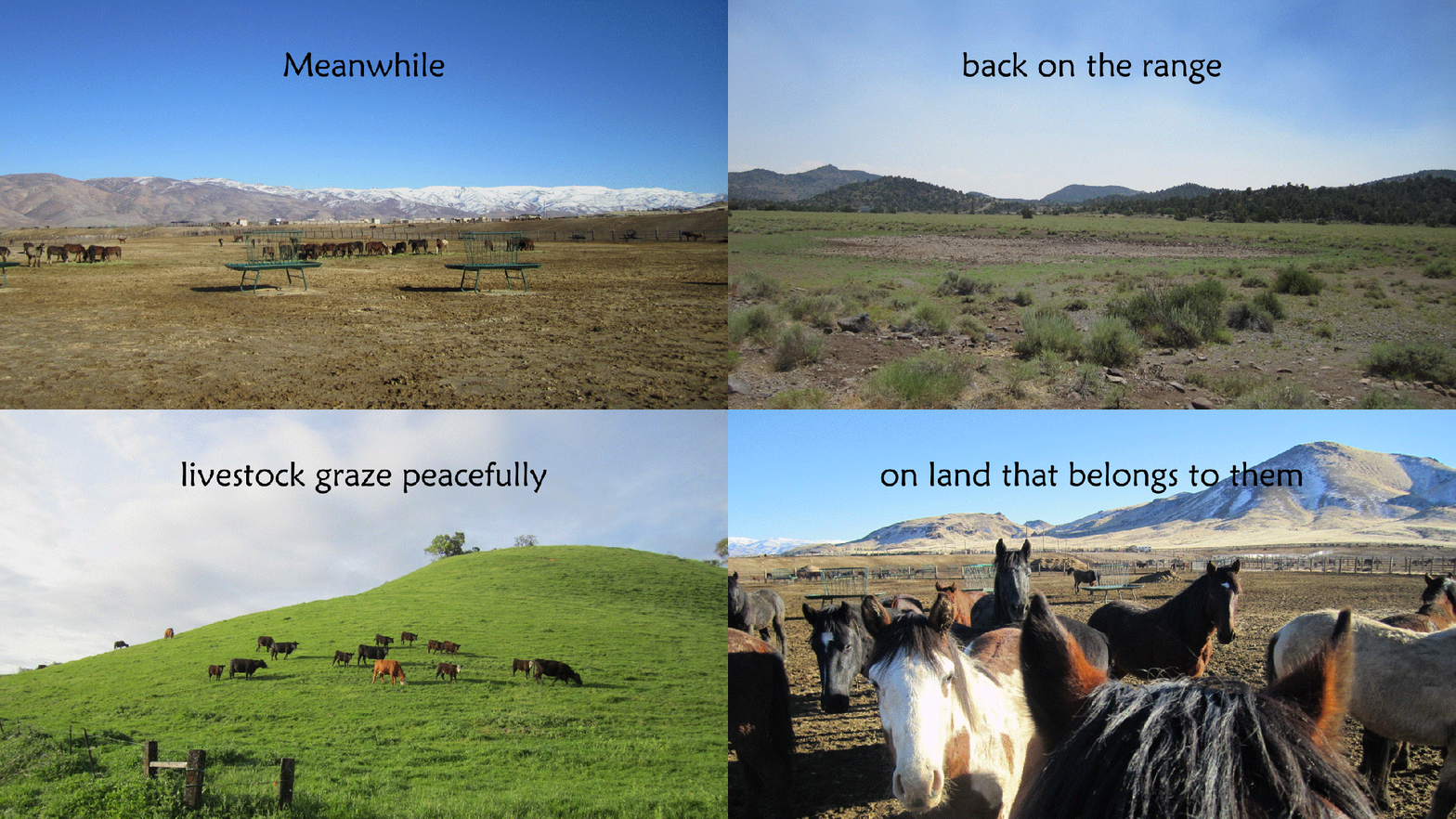
Stocking Rates in the Great Basin

A comment received yesterday on the forage supply and demand post said the government allows one cow per 20 acres but did not say where.

Most of the grazing discussion on Western Horse Watchers involves the Great Basin, characterized by a desert climate, because that’s where most of America’s wild horses are found.

The stocking rate in the comment, which works out to 50 cows per thousand acres, seems rather high for the Great Basin.  That’s equivalent to fifty wild horses per thousand acres—too high for year-round grazing in the high desert.

The highest stocking rate encountered on these pages is on the Virginia Range, ten wild horses per thousand acres.

Fractional stocking rates—less than one wild horse per thousand acres—are not uncommon in HMAs where large amounts of forage have been diverted to privately owned livestock.

The target stocking rate across all HMAs is one wild horse per thousand acres.

In an allotment, which is often divided into pastures, higher stocking rates may be allowed for shorter periods of time.  Pasture rotation prevents overgrazing, at least in theory.

But it doesn’t explain why so many allotments are in the Improve category.

RELATED: Assessing Stocking Rates, Allotment Categories Explained.

Eagle Roundup Day 35

The incident began on January 6.  Gather stats through February 9:

  • Horses captured: 1,004, up from 977 on Day 33
  • Goal: 1,131
  • Returned: 0
  • Deaths: 27, up from 23 on Day 33
  • Shipped: 895, up from 848 on Day 33

One death occurred on Day 34 due to pre-existing conditions.  Three deaths occurred on Day 35, one related to the roundup and two as a result of pre-existing conditions.

The overall death rate is now 2.7%, up from 2.4% on Day 33.  Few if any deaths would occur if the roundup didn’t happen.

Two more foals were caught since the last report, bringing the total to three.  Roughly 45% of captured adults are male and 55% are female.  Some of the mares are probably within a few weeks of foaling.  Some may have foaled in the off-range corrals.

The gather page says 896 horses shipped.

Body condition scores are not known.

The location of current operations is not known.  Three HMAs are involved in the roundup.

The number of unaccounted-for animals is 82, down from 106 on Day 33.

Some of the mares will be treated with contraceptives and returned to the range but no such activity has been reported.  Some may receive GPS radio transmitters.

Gather activity will probably conclude this week.

RELATED: Eagle Roundup Day 33.

Silver King Roundup Day 3

The incident began on February 7.  Gather stats through February 9:

  • Horses captured: 162, up from 41 on Day 1
  • Goal: 283
  • Returned: 0
  • Deaths: 0, no change from Day 1
  • Shipped: 39, up from 0 on Day 1

No foals have been caught to date.  Roughly 48% of captured adults are male and 52% are female.  Some of the mares are probably within a few weeks of foaling.

Body condition scores are not known.

The number of unaccounted-for animals is 123.

Some of the mares will be returned to their home range after receiving GonaCon, a contraceptive that may actually work like a sterilant.

Gather activity will likely conclude this week.

RELATED: Silver King Roundup in Progress.

Holy Grail of Wild Horse World?

It would be skeletal remains between 500 and 10,000 years old, the timeframe when, supposedly, there were no horses in North America.

The wild horse narrative would fall to the ground.

One such discovery was the subject of an episode several years ago of the now-defunct Mustang Matters radio program hosted by America Matters Media.  The remains were found during road construction in Nevada and were quickly disappeared.

Classifying horses as an indigenous species would change many things, especially on western rangelands.

RELATED: Wild vs. Feral: Are America’s Horses a Re-Introduced Species?

Comment Period for Surprise Complex EA Almost Over

Public input on the Draft EA will be accepted until February 14.

Concerns about resource allocations and management priorities, although valid, should not be submitted, as they are outside the scope of the project.

If you want to help America’s wild horses, don’t focus on the horses.

The PZP zealots focus on the horses.

A gather plan is too late, too far downstream, to be of any benefit to these animals.

You have to look upstream in the management process.

RELATED: Management Priorities at Surprise Complex.

Eagle Roundup Day 33

The incident began on January 6.  Gather stats through February 7:

  • Horses captured: 977, up from 883 on Day 31
  • Goal: 1,131
  • Returned: 0
  • Deaths: 23, up from 22 on Day 31
  • Shipped: 848, up from 749 on Day 31

One death occurred on Day 32 due to pre-existing conditions.  The overall death rate is now 2.4%, down slightly from 2.5% on Day 31.

One foal has been caught to date.  Roughly 45% of captured adults are male and 55% are female.  Some of the mares are probably within a few weeks of foaling.  Some may have foaled in the off-range corrals.

The gather page says 849 horses shipped, which does not match the sum of the figures supplied therewith.

391 + 456 + 1 ≠ 849

Body condition scores are not known.

The location of current operations is not known.  Three HMAs are involved in the roundup.

The number of unaccounted-for animals is 106, down from 112 on Day 31.

Some of the mares will be treated with contraceptives and returned to the range but no such activity has been reported.  Some may receive GPS radio transmitters.

The roundup will likely conclude this week.

RELATED: Eagle Roundup Day 31.

Beneficiaries of Rock Springs RMP Amendments?

The Rock Springs Grazing Association has the largest share of the forage in the Rock Springs allotment, half of which is public land.  Refer to the Allotment Master report from RAS.  Authorization #4904655.

The Authorization Use report puts RSGA’s slice of the pie at 90%.  Scroll down to the middle of page two and look at the number of animals on the permit.

Keep in mind that five sheep have the same resource ‘footprint’ as one cow/calf pair.

RELATED: EIS for Rock Springs RMP Amendments Turns 1 Today.

Binge Grazing at Piceance HMA

Privately owned livestock receive 2.4 times as much forage as wild horses and consume it in one tenth of the time.

The stocking rate allowed by plan for cattle is 23 times higher than that for the horses.

A similar pattern was seen at the Challis HMA in Idaho.

Piceance has numerous oil and gas wells dating back to the 1950s, according to the discussion on page 82 of an EA from 2011.  BLM has photographs of horses napping on well pads during a busy day of industry work and traffic.

The EA did not indicate how many wild horses have been shot dead or rounded up and taken to rendering plants at the behest of oil companies.

RELATED: Piceance Wild Horses Get Short End of Stick.

Piceance Wild Horses Get Short End of Stick

The Piceance-East Douglas HMA covers 190,130 acres in northwest Colorado, including 158,310 acres of BLM land, 5,330 acres of state land and 26,490 acres of private land, according to Section 1.1 an EA from 2011.  Ownership is denoted by tan, blue and white, respectively, in the following map.

The largest section of private land is at the south end of the U-shaped HMA.

Piceance HMA Map Private Land 02-06-21

The old EA was incorporated by reference into a new EA for resource enforcement actions in and around the HMA.  The Proposed Action, featuring roundups and fertility control, is discussed in Section 3 of the new EA.  Supporting documents can be found in the project files.

The number of horses allowed by plan is 235 and the stocking rate allowed by plan is 1.2 wild horses per thousand acres.  The forage requirement is 2,820 AUMs per year, so the land must be able to produce at least 14.8 AUMs per year per thousand acres.

The HMA intersects four allotments.  Table 3-14 in the old EA provides the total acreage inside the HMA for the public portions only.  Map 3-4, reproduced below, shows the allotments but does not distinguish between public and private lands.

However, Map 3-5 does.  Pastures on the west end of Yellow Creek and Square S overlap the private area, along with a small portion of Cathedral Bluffs, suggesting that the HMA is 100% subject to permitted grazing
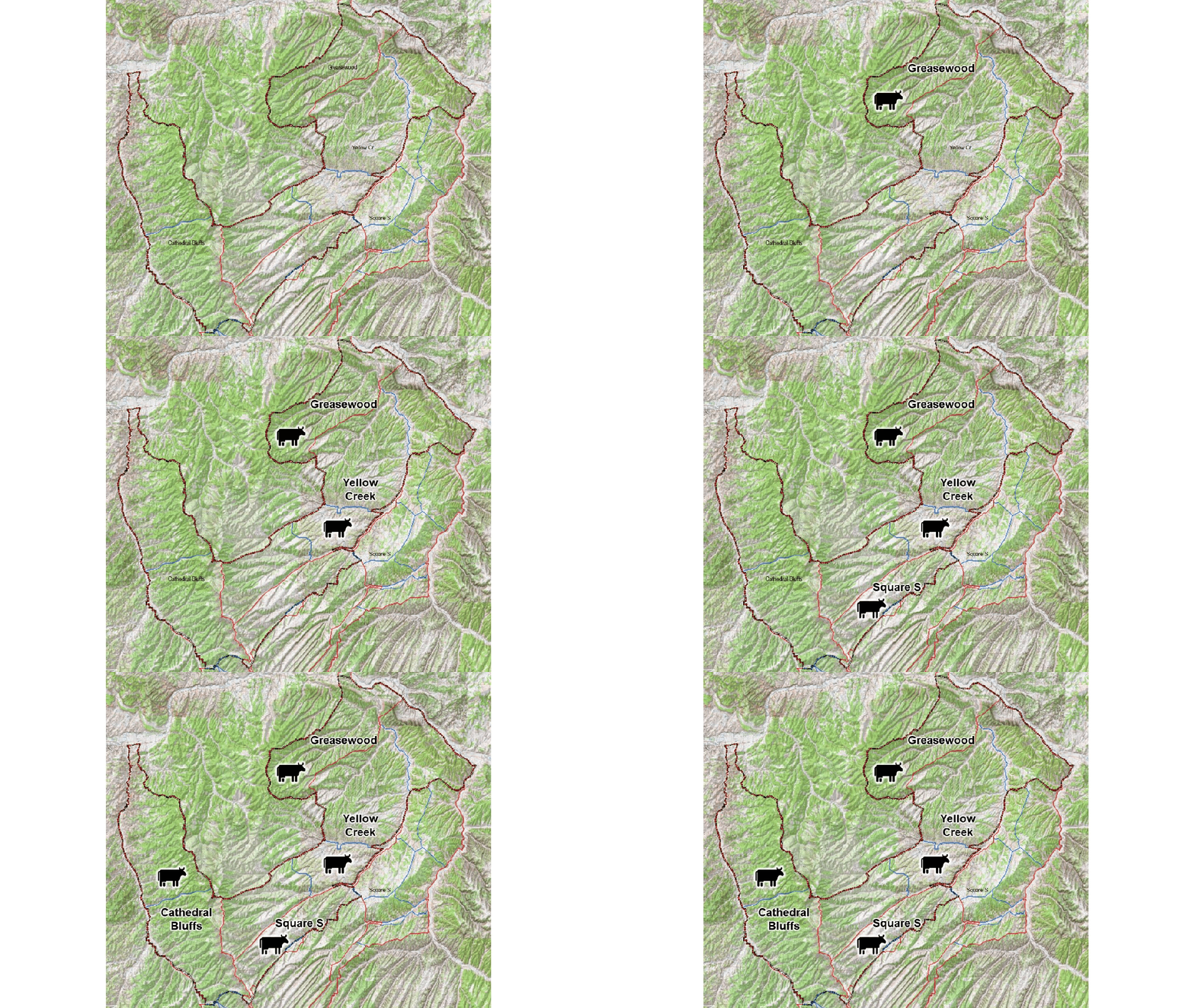
Piceance HMA Allotment Map 02-06-21

Although the total area available to livestock inside the HMA may be 190,130 acres, neither EA provides data for the private portions of the allotments.  Therefore, the following calculations will be based on the public portions only.

Allotment sizes and active AUMs were taken from the Allotment Master report in RAS.

Allotment acreage, grazing seasons and forage amounts inside the HMA were developed from data in Tables 3-14 and 3-15 of the old EA, updated per the Authorization Use report from RAS.
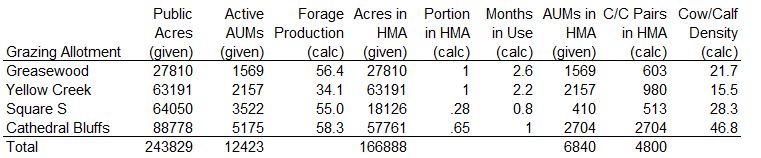
Piceance HMA Calcs 02-07-21

Land in the Greasewood allotment must be able to produce at least 1,569 ÷ 27,810 × 1,000 = 56.4 AUMs per year per thousand acres to support livestock grazing in that area.  Forage production rates in the other allotments are of similar magnitude, exceeding the rate for horses by an appreciable margin.

The total authorized forage for livestock on public lands inside inside the HMA is 6,840 AUMs per year.  If the private areas were included, the number would likely be higher.

The Greasewood permittee would have to place 603 cow/calf pairs in the allotment to graze off 1,569 AUMs in a 2.6 month grazing season.  The total estimated number of cow/calf pairs on public lands inside the HMA is 4,800.  The overall stocking rate is 4,800 ÷ 166,888 × 1,000 = 28.8 cow/calf pairs per thousand acres.

The weighted average grazing season inside the HMA is 1.4 months per year.

These figures are compared in the following charts.

Piceance HMA Charts 02-07-21

Although the grazing season is short, cattle are turned out at a high stocking rate, perhaps mowing down everything in sight, which would explain why the horse population must be held to such a small number.

The HMA is managed primarily for livestock, with the horses receiving just 29% of the authorized forage, neglecting wildlife.

The forage assigned to livestock would support an additional 570 wild horses, for a True AML of 805.

The current population, estimated to be 838, includes 33 excess horses, not 603.

“The need for a roundup and fertility control program is not as great as we originally thought.”

RELATED: Decision Expected Next Week in Piceance-East Douglas EA?