Did any of the signatories to the ‘Path Forward‘ withdraw their support for the rancher-friendly plan?
What about the signatories to the PZP Manifesto?
Any prodigal sons out there?
Didn’t think so.
RELATED: Quick Note on ‘Path Forward.’

Western Horse Watchers Association
Exposing the Hypocrisy, Lies and Incompetence of the Wild Horse Advocates
Did any of the signatories to the ‘Path Forward‘ withdraw their support for the rancher-friendly plan?
What about the signatories to the PZP Manifesto?
Any prodigal sons out there?
Didn’t think so.
RELATED: Quick Note on ‘Path Forward.’
Did Rush Limbaugh achieve the beatific vision? We don’t know.
For the faithful, the journey to heaven will likely pass through purgatory.
For the faithless, the road almost certainly goes straight to hell.
What we do know is that all men will be held to the same standard and only the Catholic Church has the fullness of the truth.
RELATED: Life Without Limbaugh, Last Four Things.
The Virginia Range is an outlier.
Not because most of the land is privately owned or that the horses are managed at the state level, but because of the stocking rate.
The article in Tahoe Quarterly noted that a survey conducted in early 2018 (when the Nevada Department of Agriculture wanted to transfer ownership of the horses to a private entity) found approximately 2,900 wild horses in the area. The article also noted that the Virginia Range covers around 300,000 acres.
Those numbers yield a stocking rate of roughly ten wild horses per thousand acres.
NDA says the range can support 600 horses at most, with 300 horses representing the ideal amount, according to the story.
That last figure yields a stocking rate of one wild horse per thousand acres, in line with the target rate for wild horses on federal lands.
Now you have a driver for a fertility control program—in lieu of roundups.
The largest landowner in the area, Blockchains LLC, instigator and would-be beneficiary of the Storey County autonomous zone, pushed for the darting program.
And the turncoats at AWHC were only too eager to help.
One woman, commenting on the use of PZP in a Facebook page for the Fish Springs horses, located a few miles south of the Virginia Range, said “Hey, look at it this way, they get more sex without the consequences!”
This is what passes for advocacy in the wild horse world.
You can’t have government telling the people that the land can only support one wild horse per thousand acres when the Virginia Range is carrying ten. Not when you’re biased in favor of ranching interests.
The program is a disgrace and an insult to Velma’s legacy.
RELATED: Virginia Range 70 Years Later.
The incident happened this morning at the Glen Grove Equestrian Center in Morton Grove, IL, according to a story by the Chicago Tribune. Authorities said the failure was the result of heavy snowfall. No people or animals were hurt.
The incident began on January 6. Gather stats through February 15:
One death occurred on Day 37 as a result of the roundup and another on Day 41 due to pre-existing conditions.
The overall death rate is 2.7%, same as Day 35.
Three foals have been caught to date. Roughly 45% of captured adults are male and 55% are female. Some of the mares may have foaled in the off-range corrals.
The gather page says 28 deaths and 940 horses shipped.
The operation has liberated 12,840 AUMs per year for other mandated uses in the Complex. Demand for water has been reduced by an estimated 10,700 gallons per day.
Body condition scores are not known.
The location of current activity is not known. Three HMAs are involved in the roundup.
The number of unaccounted-for animals is 102, up from 82 on Day 35.
Some of the mares will be treated with contraceptives and returned to the range but no such activity has been reported. Some may receive GPS radio transmitters.
RELATED: Status of Eagle Roundup?
No activity has been reported since February 11, Day 37, with 1,020 horses captured, 940 shipped and 27 deaths.
The operation has liberated 12,240 AUMs per year for other mandated uses in the Complex.
The number of unaccounted-for animals is 53. The gather page does not say if the incident is over.
The Red Desert roundup ended with 359 unaccounted-for horses in November 2020.
RELATED: Eagle Roundup Day 35.
The incident began on February 7. Gather stats through February 15:
No deaths occurred on Days 8 and 9. The overall death rate is now 1.2%, down from 1.4% on Day 7.
No foals have been caught to date. Roughly 47% of captured adults are male and 53% are female.
The operation has liberated 3,012 AUMs per year for other mandated uses in the HMA.
Body condition scores are not known.
The number of unaccounted-for animals is 34, down from 37 on Day 7.
Some of the mares will be treated with contraceptives and returned to the range, but no such activity has been reported. The effect on pre-born foals is not known.
Data quality has been good.
RELATED: Silver King Roundup Day 7.
The Rock Springs Grazing Association, petitioner in the consent decree and instigator of the RMP amendments, owns some of the land it uses in the Wyoming checkerboard and leases other parcels, originally from the Anadarko Corporation, which was acquired by Occidental Petroleum. Occidental sold the land to Orion Mine Finance in 2020.
What would happen if Orion told RSGA that the land is designated for wild horses?
The Virginia Range is ‘ground zero’ in the wild horse preservation movement.
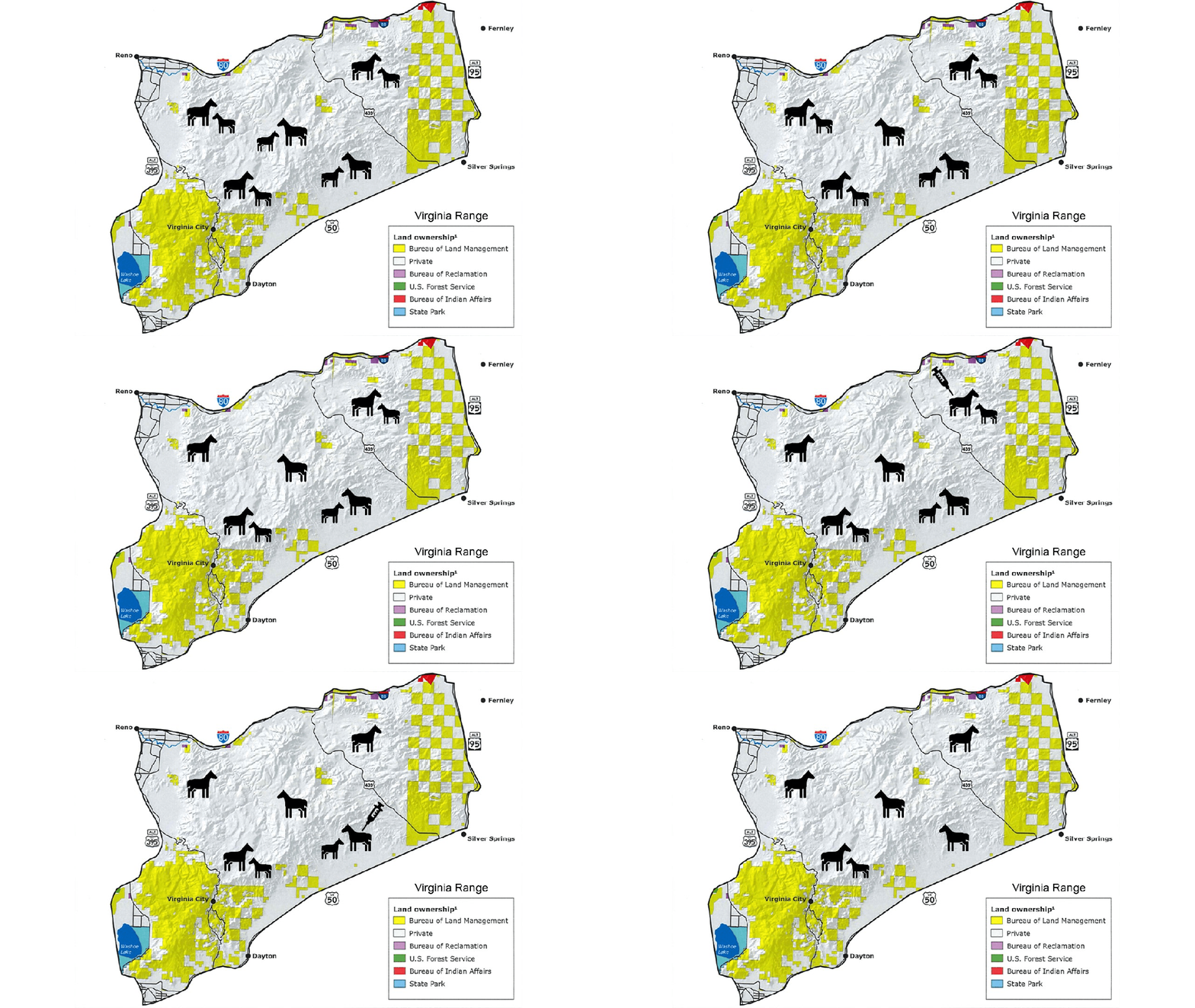
Today, it is home to the largest darting effort in the country, sponsored by the ringleader and standard-bearer of the wild horse prevention movement, the American Wild Horse Campaign.
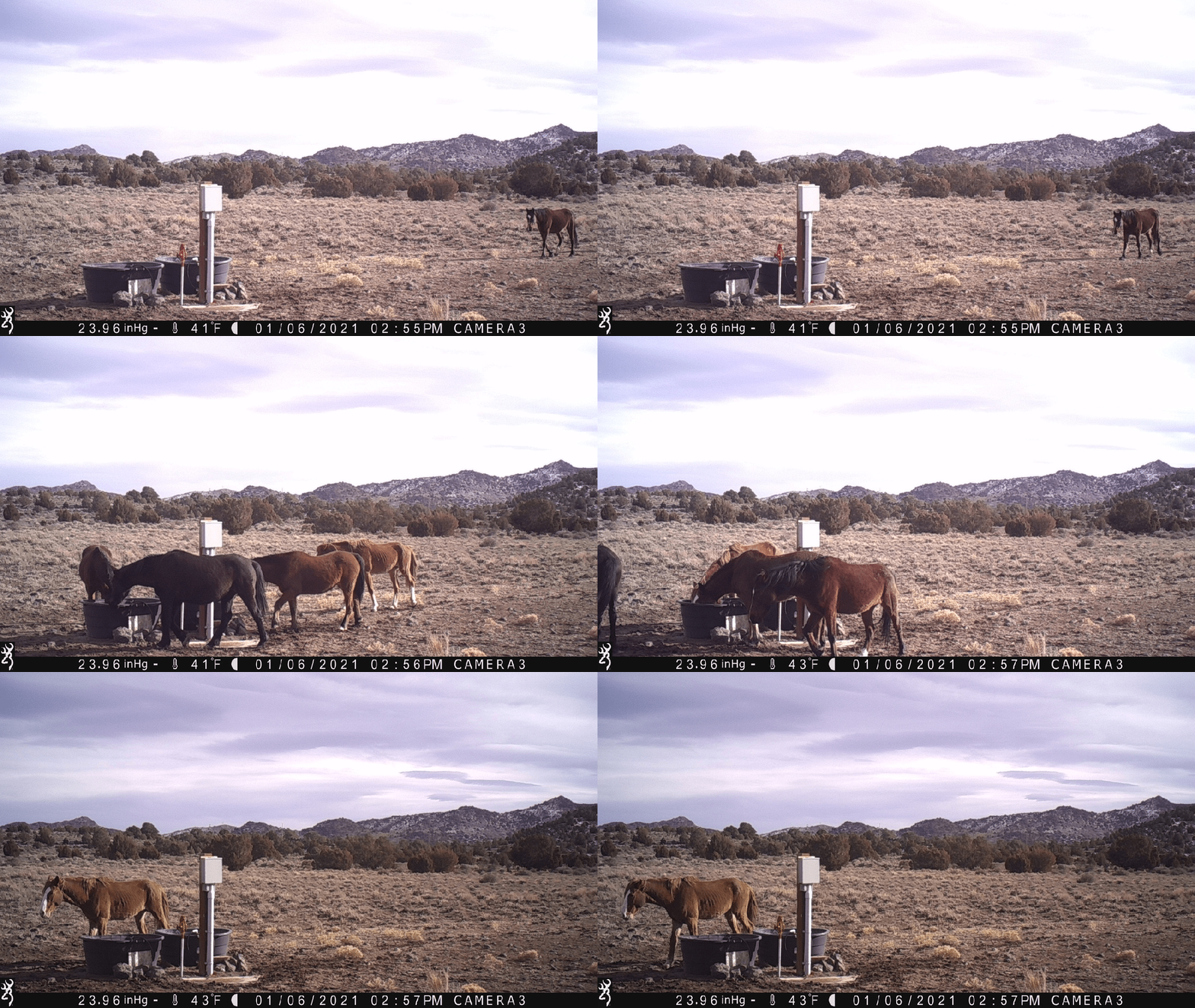
An undated article appearing in the winter 2020-2021 edition of Tahoe Quarterly leads the reader from Velma’s first encounter with the mustangers in 1950 to the current fertility control program, which has no adverse effects according to an adherent interviewed for the story (see trailcam photos below).
Along the way, it considers rangeland health, including comments by J.J. Goicoechea, a proponent of the rancher-friendly ‘Path Forward,’ a plan for achieving and maintaining AMLs on public lands inhabited by wild horses.
That means eighty to ninety five percent of the forage going to the ranchers.
Western Horse Watchers was able to find two grazing allotments associated with Mr. Goicoechea and his father, Pete, one managed by BLM’s Tuscarora Field Office and the other by the Bristlecone Field Office.
The Allotment Master reports [Tuscarora | Bristlecone] show both in the Improve category, with the Goicoecheas holding most of the active AUMs in each allotment.
RELATED: Allotment Categories Explained, The Experiment Is a Success!

In eastern Arizona with acemannw.
These guys need 4 × 12 = 48 AUMs per year. Forage supply is another question.
The incident began on February 7. Gather stats through February 13:
Helicopters were grounded on Day 7 due to weather.
One horse was put down on Day 6 as a result of pre-existing conditions. The overall death rate is now 1.4%, up from 1.0% on Day 5.
No foals have been caught to date. Roughly 48% of captured adults are male and 52% are female.
Body condition scores are not known.
The number of unaccounted-for animals is 37, down from 114 on Day 5.
Some of the mares will be treated with contraceptives and returned to the range, but no such activity has been reported. The effect on pre-born foals is not known.
Data quality has been good.
RELATED: Silver King Roundup Day 5.
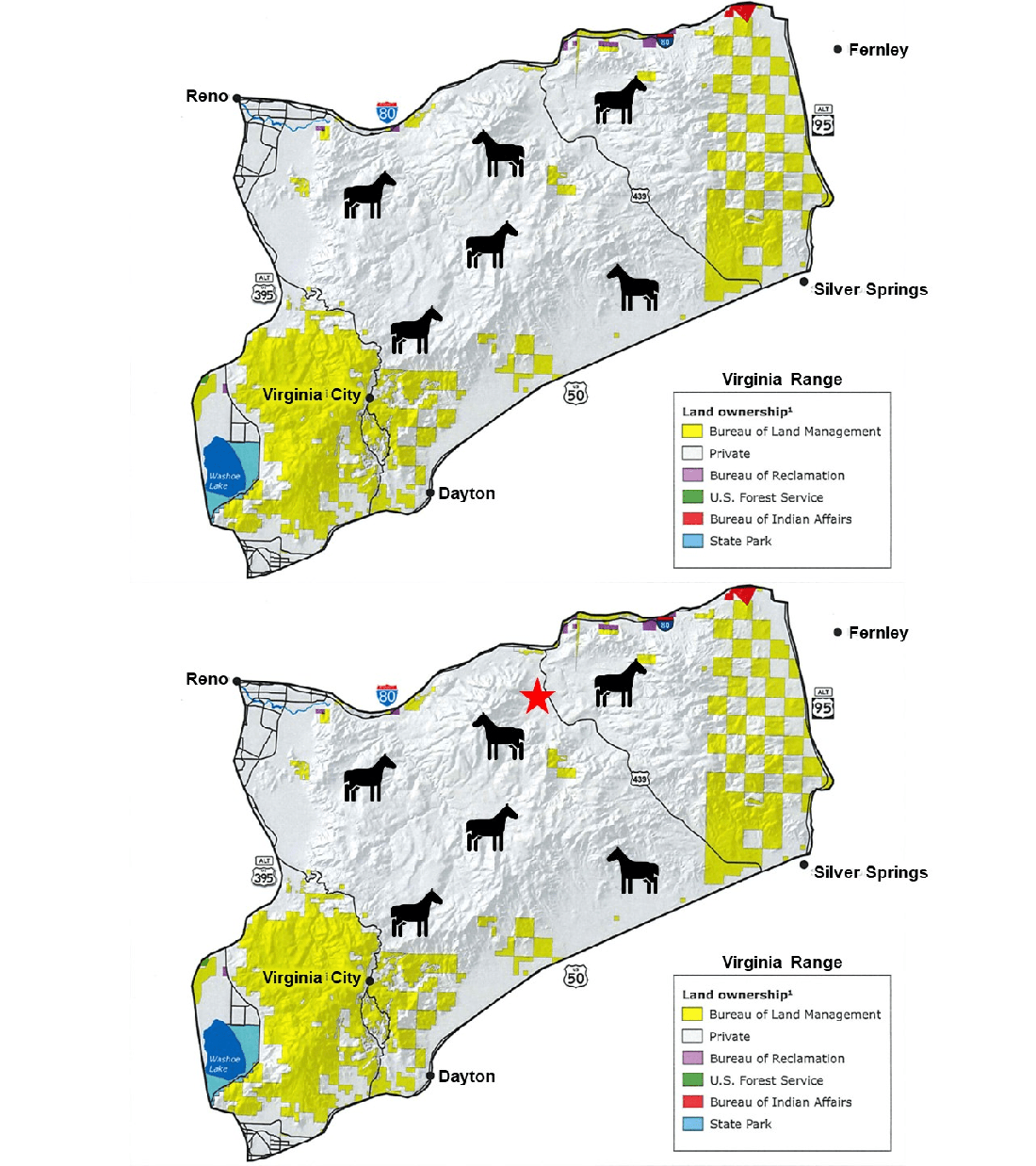
The project was picked up today by Drudge. Both links pointed to a report by AP News that referred to the area as an ‘innovation zone,’ where companies would have powers like those of county government.

The story did not mention that the property, around 67,000 acres, is also inhabited by the Virginia Range mustangs.
RELATED: Horses of the Autonomous Zone.
You can’t make this stuff up. The one-horse pony forces his way into office, then criticizes the Burmese military for doing the same thing.
Talk about the pot calling the kettle black.
The stories have common elements.
The voters did not remove Donald Trump from office, they affirmed his second term.
Nobody’s doing anything about it. You’re not even allowed to talk about it.
Just like the wild horse world.
Be a good advocate. Don’t talk about privately owned cattle and sheep. Forget about resource allocations and management priorities on western rangelands.
Keep pushing for contraceptives, sanctuaries and relocation of wild horses into remote wilderness areas, so their food can be sold to public-lands ranchers.
The Draft EA for resource enforcement actions in the Desatoya HMA says on page 61 (of the pdf) that off-range pastures are usually located in grass prairie regions of the United States, such as Oklahoma, Kansas, Iowa, Missouri, Nebraska and South Dakota.
Forage production is higher than the arid rangelands of the western U.S., with an average stocking rate of ten acres per animal. That’s 100 wild horses per thousand acres, compared to an average rate on all HMAs of one wild horse per thousand acres.
Those same pastures should be able to support 100 cow/calf pairs per thousand acres.
The carrying capacity of the land may be different.
Ideally, stocking rates should be less than carrying capacities, from a sustainability viewpoint, and carrying capacity may vary from year to year, depending on rainfall, soil conditions and other factors.
RELATED: Stocking Rates in the Great Basin.
Everybody wants to bash the BLM for mismanagement of America’s wild horses and burros, and rightly so.
Eighty percent or more of their food diverted to public-lands ranchers, with numerous roundups and growing numbers in long-term holding as a consequence.
Nobody wants to point a finger at the PZP zealots, and the so-called advocacy groups, who rank #2 in terms of their impact on those animals.
Nobody except Western Horse Watchers.
Just received an email titled ‘Nine Ways Socialism Will Morally Bankrupt America.’
Didn’t read it. The country already is morally bankrupt.
Where do you think the contraceptive mentality comes from in the wild horse world?
One hundred years ago, people would have gasped at the idea.
Gather operations through February 11 yielded 201 wild horses but no foals.
Do those numbers look like they came from a herd that’s growing at a rate of 20% per year? Or is it just too early in the foaling season?
As in the Eagle roundup, the majority of captured animals are female but what does that tell you about the herd at large?
RELATED: Wild Horse Growth Rates.
The incident began on February 7. Gather stats through February 11:
Two deaths occurred on Day 5 as a result of pre-existing conditions. The overall death rate is now 1.0%.
No foals have been caught to date. Roughly 47% of captured adults are male and 53% are female.
Body condition scores are not known.
The number of unaccounted-for animals is 114, down from 123 on Day 3.
Some of the mares will be returned to the range after treatment with contraceptives, but no such activity has been reported. The effect on pre-born foals is not known.
Data quality has been good.
Gather activity will likely conclude this week.
RELATED: Silver King Roundup Day 3.


