Deerwood Ranch Open House Next Month

The privately owned off-range pasture west of Laramie, WY will open its doors to the public on June 10, according to a story dated May 30 by This Is Laramie.

The ranch, listed as “Centennial” in the Off-Range Facilities Report, has a capacity of 350 excess animals, horses displaced from their lawful homes by permitted grazing.

It was threatened but not damaged by the Mullen Fire in 2020.

How Many Wild Horses Can the Black Mountain HMA Support?

The Draft EA for pest control actions in the Owyhee Front states in Section 1.1 that the HMA intersects the Hardtrigger, Rabbit Creek and East Reynolds Creek allotments.

The National Data Viewer indicates a small amount of overlap on the west side with the Reynolds Creek allotment but that will be ignored.

Black Mountain HMA with Allotments 05-30-23

The HMA covers 50,904 total acres in western Idaho, including 47,434 public acres, according to the 2023 HA/HMA Report.

The 60 horses allowed by plan require 720 AUMs per year.

The stocking rate allowed by plan is 1.3 wild horses per thousand public acres.

The current population is thought to be 104, according to Table 1 in the EA, plus this year’s foal crop.

There are three layers of forage demand in the HMA: Horses, livestock and wildlife.

  • The carrying capacity of the HMA, referred to on these pages as the True AML, depends on the horse and livestock layers
  • The True AML represents the number of horses the HMA could support if it was managed principally for them, as specified in the original statute
  • Overpopulation means more horses than allowed by plan, not necessarily more horses than the land can support
  • The livestock layer represents horses displaced from their lawful home by permitted grazing, now in off-range holding
  • The allotments mean the HMA is used for animal agriculture, a purpose for which the fertility control pesticides were not registered
  • Persons who apply the products in this manner should be investigated by law enforcement, along with those who authorize them
  • The “vaccines” are on the same EPA list as toxic chemicals

The Allotment Master Report provides acreage, management status and active AUMs.

Black Mountain Allotment Calcs 05-30-23

The allotments are in the Improve category.

They offer a weighted-average 62.3 AUMs per year per thousand public acres, equivalent to 5.2 wild horses per thousand public acres.

This is on top of the 1.3 wild horses allowed by plan.

Therefore, the True AML should be around (1.3 + 5.2) × 47,434 ÷ 1,000 = 308, 5.1 times higher than the current AML.

The stocking rate at the new AML would be 1.3 + 5.2 = 6.5 wild horses per thousand public acres, considerably higher than the target rate of one wild horse per thousand acres associated with a thriving ecological balance (27,000 animals on 27 million acres).

The number of horses displaced by permitted grazing is 308 – 60 = 248, about 0.4% of those in off-range holding.

If you performed this analysis for every HA/HMA/WHT—better yet, the government reported the forage assigned to livestock in every HA/HMA/WHT—you’d find that all of the off-range corrals and long-term pastures could be emptied several times over by ending permitted grazing in areas identified for wild horses.

The HMA is managed primarily for animal agriculture, with livestock receiving 80% of the authorized forage, neglecting wildlife.

In a nutshell, the land-use plan allows 60 wild horses in the HMA, plus livestock equivalent to 248 cow/calf pairs, seven days a week, twelve months per year.

The True AML can be achieved by confining the ranchers to their base properties in a year-round off season.

The Wild Horse Fire Brigade, established by a rancher for the benefit of ranchers, would move the horses to a remote wilderness area not particularly suited to livestock grazing, giving the permittees access to all of their food.

RELATED: Owyhee Resource Enforcement Plan Out for Review.

Thriving Ecological Balance-3

CAAWH Demonizes Hunters and Ranchers, Canonizes Self

In a news flash carried by Lucky Three Ranch, the Campaign Against America’s Wild Horses blamed hunters, trappers and ranchers for the demise of SB90, while it fought hard to advance the legislation.

Problem is, with the exception of the occasional rogue act, hunters, trappers and ranchers aren’t getting rid of any wild horses.

But CAAWH is, by the hundreds, every year, with its favorite pesticide.

They call it “a better way.”

If you add the efforts of its affiliates and offshoots, the total could go into the thousands, rivaling the largest of roundups.

Who’s the greater threat to wild horses?

RELATED: SB90 Postmortem.

Standing Up for Wild Horses on Virginia Range 06-18-22

Comments Invited on Owyhee Resource Enforcement EA?

Like the advocates, the bureaucrats have their own vocabulary to conceal the long-term goals of their land-use plans.

For example, consider this article in the Idaho Press about the Owyhee pest control project, written by a public affairs specialist with the BLM.

Healthy horses on healthy rangelands, or any variant thereof, means most of their food has been assigned to privately owned livestock and ranchers have unfettered access thereto.

The purpose of the project is to achieve and maintain AMLs, which are small, in most cases, relative to the available resources.

Helicopters are the preferred method for “Achieve.”  They are the fastest and most efficient way of shifting resources from the pests to their rightful owners.

Fertility control pesticides such as GonaCon Equine and Zonastat-H, which appear on the same EPA list as toxic chemicals, are often used for “Maintain.”

When commenting, remember that projects like this do not allocate resources.

They cannot change resource allocations.

They enforce resource allocations already on the books, so don’t ask the BLM to end permitted grazing and reassign the AUMs to the horses.  It’s a valid concern but outside the scope of the project.

On the other hand, application of restricted-use pesticides to suppress populations that interfere with animal agriculture is outside the scope of their registrations.

That’s not just a comment, but an allegation of wrongdoing by those involved.

There is considerable dietary overlap between wild horses and livestock, as noted in Section 1.1 of the Draft EA, and if you don’t beat down the horse populations after the helicopters cram them into their little boxes, the poor ranchers will gradually lose access to their birthright.

RELATED: Owyhee Resource Enforcement Plan Out for Review.

Unauthorized Use of Pesticides 05-24-23

How Many Wild Horses Can the Hardtrigger HMA Support?

The HMA intersects the Elephant Butte, Rats Nest, Reynolds Creek, Shares Basin and Hardtrigger allotments, as stated in Section 1.1 of the Draft EA for pest control actions in the Owyhee Front.

The National Data Viewer shows the arrangement.  Click on image to open in new tab.

Owyhee HMAs with Allotments 05-28-23

The allotments represent another layer of forage demand in the HMA, probably the largest, in addition to that of wildlife and wild horses.

  • The carrying capacity of the HMA, referred to on these pages as the True AML, depends on the wild horse and livestock layers
  • The True AML represents the number of horses the HMA could support if it was managed principally for them, as Velma and the 92nd Congress intended
  • Overpopulation means more horses than allowed by plan, not necessarily more horses than the land can support
  • The livestock layer represents horses displaced from their lawful home, now stockpiled in off-range holding
  • The allotments mean the HMA is subject to animal agriculture, a purpose for which the fertility control pesticides were not registered
  • Those who apply the products in this manner should be investigated, along with those who authorize them

Tables 5 and 6 in the EA refer to the Wildcat allotment, not Rats Nest, and include two other allotments that overlap the HMA in negligible amounts.

The HMA covers 69,910 total acres in western Idaho, including 62,149 public acres, according to the 2023 HA/HMA Report.

The 130 horses allowed by plan require 1,560 AUMs per year.

The stocking rate allowed by plan is 2.1 wild horses per thousand public acres.

The Allotment Master Report provides acreage, management status and active AUMs.

Hardtrigger Allotment Calcs 05-28-23

All five allotments are in the Improve category.

The allotments offer a weighted-average 96.5 AUMs per year per thousand public acres, equivalent to eight wild horses per thousand public acres.

This is on top of the 2.1 wild horses allowed by plan!

Therefore, the True AML should be around (8.0 + 2.1) × 62,149 ÷ 1,000 = 628, 4.8 times higher than the current AML.

The current population is thought to be 101, plus this year’s foal crop, according to Table 1 in the EA.

The number of horses displaced from the HMA by permitted grazing is 628 – 130 = 498, about 0.8% of those in off-range holding.

The HMA is managed primarily for animal agriculture, with livestock receiving 79% of the authorized forage, neglecting wildlife.

In a nutshell, the land-use plan allows 130 wild horses and livestock equivalent to 498 cow/calf pairs in the HMA, seven days a week, twelve months per year.

The True AML can be achieved by confining the ranchers to their base properties in a year-round off season.

The Wild Horse Fire Brigade would move the horses to a remote wilderness area, not particularly suited to livestock grazing, giving the ranchers access to all of their food.

The HMA does not have an HMAP.  If it did, the document would comply with the forage allocations above.

RELATED: Owyhee Resource Enforcement Plan Out for Review.

Forage Allocations in HMAs

Avis Talks about Wild Horses, Skirts Issue of Fertility Control

In the following interview with Ed Bernstein of Las Vegas, Avis points out correctly at 12:50 that AMLs are small, deliberately set so the herds are genetically unsustainable.

While that may be true in some cases, AMLs are small relative to the available resources, with few exceptions, so ranchers can access most of the food in the lawful homes of wild horses.  That is the first major issue.

She mentions fertility control at 17:08 but qualifies it with “irreversible,” giving wide berth to products the advocates deem “reversible,” such as Zonastat-H.

Unfortunately, reversible fertility control “vaccines” don’t exist.  Damage begins with the first injection, and the cumulative effect after a few years is sterility.

The advocates know that, and have always known that, yet they lie about it so you’ll continue your financial support.  That is the second major issue.

They are frauds, stalking their cherished herds with clipboards, tablets and darting rifles, while you pay for their groundbreaking work.

RELATED: Avis Points to “Massive Priority” Affecting America’s Wild Horses.

Salt River Herd in Jeopardy Before CBD Legal Action

The Salt River Wild Horse Darting Group said in a news release dated May 25 that the herd is not ruining the environment, yet they are trying to get rid of them by poisoning the mares with a restricted-use pesticide.

This has been going on for several years, long before a coalition including the Center for Biological Diversity filed suit calling for their removal.

The advocates believe it’s one of the best managed herds in the United States, with a rescue program, a fencing program and a fertility control program that’s reduced the birth rate of their beloved herd from 100 foals a year to just one or two per year.

They are proud of this.

Instead of raising the bridge, they’re lowering the water, and you’re supposed to be angry with a coalition seeking a reduction in herd size, not a group that’s actually reducing the herd size.

RELATED: Coalition Sues Forest Service Over Salt River Horses.

For Your Beloved Ants and Roaches 10-08-22

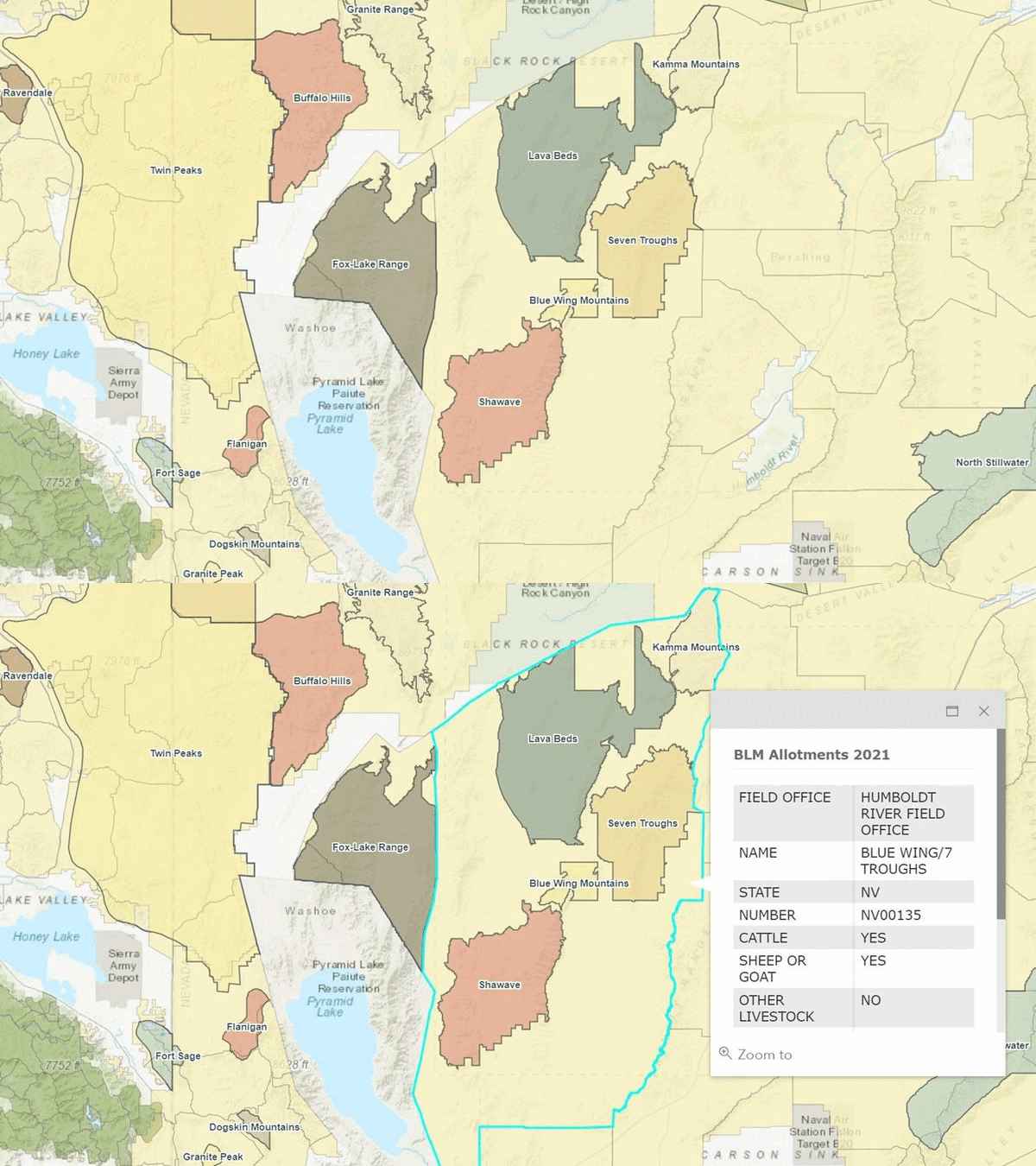
WHBAB Educational Tour Set for Blue Wing Complex

Participants must register in advance according to today’s news release.

The Complex lies within the massive Blue Wing / Seven Troughs Allotment.

Only one of the four permittees will be active on the date of the tour.

The other three are in their off seasons.

You may want to ask your tour guide how resources have been allocated between wild horses, livestock and wildlife.

Five HMAs are affected.

RELATED: WHBAB Meeting Returning to Traditional Format.

Blue Wing Complex Allotment Map 07-30-22

Economic Benefits of Multiple Use in FY 2021

A new report shows economic output on BLM lands in FY 2021.

It was announced in a blog post dated May 23.

Which states lead the way in each category?

  • Grazing – Idaho
  • Timber – Oregon/Washington
  • Recreation – Utah
  • Renewables – California
  • Coal – Wyoming
  • Nonenergy Minerals – Nevada
  • Oil and Gas – New Mexico

The least valuable use of public lands, in terms of economic output, is livestock grazing and the greatest is oil and gas production.  Click on image to open in new tab.

An interesting exercise would be to compute economic output per acre used and show the results in a bar graph.

Economic Output of BLM Lands in FY 2021 05-26-23

Foal-Free Friday, Reinforcing the Status Quo Edition

The Colorado Wild Horse Project, now state law, codifies wild horse eradication with restricted-use pesticides.

How many RMPs will change as a result of the new statute?

How many AMLs will increase?

How much land will be returned to the horses?

None.

The new program will help the BLM achieve and maintain AMLs, without the use of helicopters, at least in theory, giving ranchers unfettered access to cheap feed in the lawful homes of wild horses.

RELATED: Foal-Free Friday, Discussing the Undiscussables Edition.

Cattle and Horses

Salt River Advocates Accuse Forest Service of Harming Foals!

A news release dated May 25 by the Salt River Wild Horse Darting Group claims the agency has set up traps in the Apache Sitgreaves National Forest to capture wild horses at the height of foaling season.

Volunteers with Alpine Wild Horse Advocates, an offshoot of SRWHDG, documented the effort, complete with salt blocks and alfalfa pellets.

Last year the Forest Service rejected their offer to poison the mares with their favorite pesticide, and now they’re seeing a growing population, according to the advocates.

Do not be deceived as they feign concern for the horses.

Like their sponsors at the Campaign Against America’s Wild Horses, they hate them.

They hate foals.

They hate families.

They hate reproduction.

They think they have a better way and they want you to pay for it.

RELATED: Salt River Advocates Mobilize in Favor of Alpine Ranchers.

Students Learn About Darting 10-26-22

WHBAB Meeting Returning to Traditional Format

The preliminary agenda appearing in today’s announcement indicates that Day 1 will be devoted to an educational tour of an unnamed HMA in Nevada.

The event will be open to the public.

A good candidate would be the Pine Nut Mountains southeast of Carson City, an hour to the south, where advocates affiliated with the Campaign Against America’s Wild Horses are poisoning the mares with a restricted-use pesticide.

The Virginia Range, where CAAWH operates its flagship darting program, is closer to Reno but most of the land is privately owned and the Nevada Department of Agriculture is responsible for the horses.

On the bright side, the Pine Nut Mountains may offer an opportunity for Board members to observe local volunteers applying an EPA-registered pesticide

Curiously, Day 2 begins with a closed session on ethics, which should include conflicts of interest.

A notable case is that of Tammy Pearson, a Board member and public-lands rancher whose personal fortunes are tied, inversely, to the presence of wild horses in Utah.

RELATED: WHBAB Meeting Next Month.

It’s Back: Helicopter Ban for 2023

The bill would not end wild horse removals from public lands, an idea that keeps livestock operators up at night.

Instead, it would achieve more humane and cost-effective methods to gather equine populations, according to a story posted today by the Las Vegas Sun.

The text has not appeared at Congress.gov as of this evening.

Last year’s version was nicknamed the Save a Horse, Hire a Cowboy Act.

Everything went south when film from the Buffalo Hills roundup showed a wrangler—a hero in the new management method and a steward of our public lands—abusing a foal!

RELATED: New Tagline for Helicopter Ban.

Colorado Wild Horse Project Helps Ranchers, Not Horses

The state is now in the business of achieving and maintaining AMLs with pesticide-laced darts, according to a story by The Daily Sentinel of Grand Junction.

As of this morning, the bill status says “Passed,” not “Became Law,” but an approved version dated May 20 has been posted to the Session Laws tab.

All four of the state’s HMAs are targeted:

  • Sand Wash Basin – Zonastat-H
  • Piceance – GonaCon Equine
  • Little Book Cliffs – Zonastat-H
  • Spring Creek Basin – Zonastat-H

These products appear on the same EPA list as toxic chemicals.

Using them to control free-roaming herds that interfere, or could interfere, with animal agriculture is outside the scope of their registration.

In “woke” America, truth takes a back seat to ideology.

Although you stopped the roundups, you’re still getting rid of the horses, but you can feel good about it.

RELATED: Colorado Wild Horse Project to Become Law Tomorrow?

Unauthorized Use of Pesticides 05-24-23