The Senate Agriculture & Natural Resources Committee passed the bill on April 20 by a vote of 5 to 1, according to a report posted this morning by Colorado Politics.
The measure was referred to the Committee on Appropriations.
In an attempt to sell poison as medicine, Amendment L.002 changed “FERTILITY CONTROL METHODS” to “IMMUNOCONTRACEPTIVE FERTILITY CONTROL VACCINES.”
The fertility control program would manage the herds through “humane, nonlethal and safe fertility control methods,” and would ban the use of lethal population management or surgical sterilization.
Chemical sterilization is OK, apparently.
How do you know that SB23-275 is bad for wild horses?
The advocates think that by putting “humane” in front of terms like “management,” “fertility control,” “outcomes” and “alternatives to helicopters” you’ll think they’re a voice for wild horses.
Similarly, if they put “humanely” in front of “reducing the herd size,” you’ll agree with them that not only is getting rid of wild horses acceptable, it’s the right thing to do and you should be paying for it.
The ranchers couldn’t have asked for a better bunch of hucksters.
Although 215 trespass horses have been trapped and removed in the past year, the Forest Service hasn’t made a dent in the overall numbers, according to a report dated April 21 by the White Mountain Independent.
A spokesman said the Forest Service will likely have to enter into a long-term contract to keep the herd from rebounding.
What do you suppose that might involve?
Advocates with the Salt River Wild Horse Darting Group, an affiliate of the Campaign Against America’s Wild Horses, a leader in the wild horse removal industry, have already offered to get rid of the herd with a safe, proven and reversible fertility control program that sterilizes the mares in four to five years.
The contract would likely amount to a memorandum of understanding or zero-dollar purchase order.
Donors to these organizations would foot the bill, not taxpayers.
Ranchers in the area, the leading beneficiary of the effort, could pick up an easy tax deduction.
Operations will be suspended for 45 days effective May 1, according to a story dated April 21 by Military.com.
The unit employs military working horses as escorts during funerals at Arlington National Cemetery.
Given their mission, you’d think they’d be treated like royalty, but they live in small lots covered with excrement, suffer from illness and are fed low-quality hay.
The agency proposes to add seven active ingredients to its list of approved ingredients, according to a Draft EIS posted to ePlanning on March 10.
The new products are discussed in Section 2.2.
The project folder includes a scoping report, also released on March 10.
The comment period ends June 5. Online comments are not being accepted at this time.
No online public meetings have been scheduled as of today.
Invasive plants can develop resistance to herbicides over time, according to yesterday’s news release, so new active ingredients are developed to overcome such problems.
The civil complaint, brought by the owner of a ranch that covers public and private parcels in the Wyoming checkerboard, follows criminal trespass charges that were dropped last year.
The ranch owner wants the judge to declare that the hunters trespassed, then leave it for a jury to determine later how much they should pay in damages, according to a story dated April 18 by WyoFile.
The hunters want the suit dismissed completely, arguing that the Unlawful Inclosures Act of 1885 prevents landowners from fencing others out of public lands or using threats and intimidation toward that end.
The case could establish precedent in claims involving access to 8.3 million acres of “corner-locked” public lands in the American West.
The plaintiff believes the corner-crossers devalued his ranch by $7.75 million, not by setting foot on his property, but by crossing its air space!
Damages could go as high as $9.4 million.
The story did not indicate if the plaintiff had sued any commercial airlines for flying over his property.
The population estimate as of March 1 was 82,833, according to a BLM blog post dated April 21, only 499 more than the same time last year.
Permitted grazing, which occurs in most of the areas identified for wild horses and burros, was not mentioned.
Predators are few and far between according to the article, yet the advocates count on them to take out any foals that slip through their darting programs.
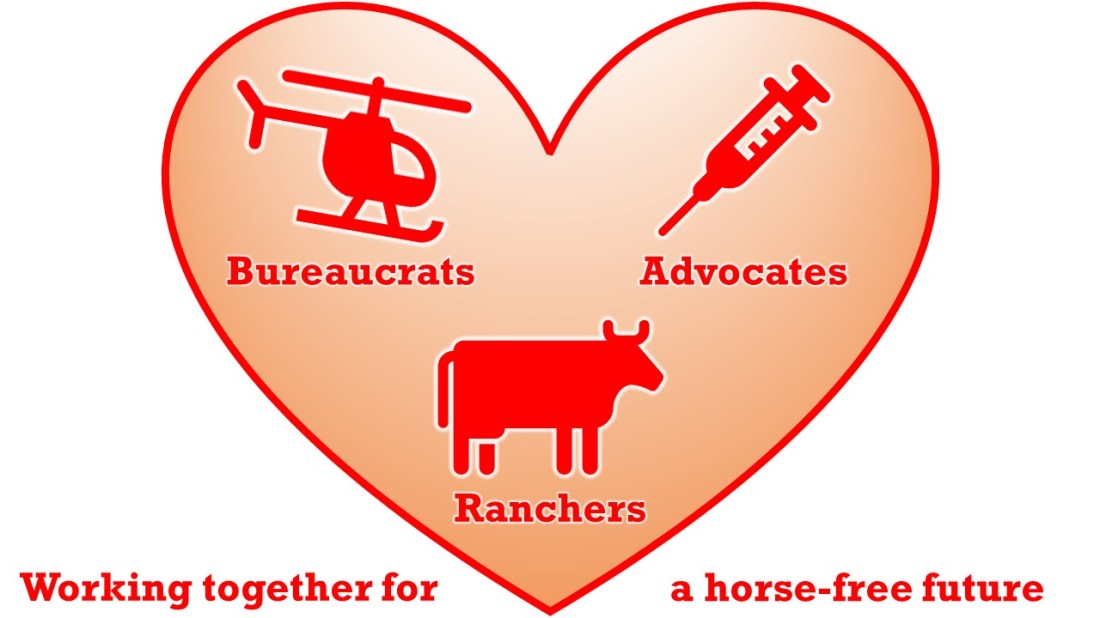
To achieve the goal of managing healthy wild horses and burros on healthy public lands, the bureaucrats beat down the herds with helicopters and the advocates snuff out new life with pesticides, so ranchers can access most of their food and water.
Not exactly what Velma and the 92nd Congress intended.
They’re a native keystone species vital to the health of our public lands, according to a news release on EIN, but we need to drive their numbers down with a restricted-use pesticide so ranchers can access most of their food and water.
Who promotes such legislation? The PZP darters and their allies. Totally self-serving.
If you want to help America’s wild horses, stay home.
His generation tried to fix it, but the solution wasn’t acceptable to the public-lands ranchers, whom he now serves.
Although horses appear in the North American fossil record, he is silent about the predominant nonnative species on America’s public lands, privately owned cattle and sheep, to whom most of the food and water on said lands have been assigned by the bureaucrats, even in the lawful homes of wild horses.
That’s why the off-range corrals are flooded with “excess” animals.
As for predators, the advocates rely on them to take out any foals that slip through their darting programs.
In a similar manner, the advocates are destroying the herds on the Virginia Range, Salt River and the HMAs listed on the latest roundup schedule.
If they told you the truth about their darting programs, the injuries and infections, the increasing death rates, shrinking herds, abnormal sex ratios and sterilization of mares, you’d withdraw your financial support immediately.
So, they conceal their enmity with euphemisms like “safe, proven and reversible,” hoping you won’t catch on.
A philanthropist who has supported many island organizations has offered a matching grant up to $100,000, according to the April 18 update. That means a $5 donation turns into $10, a $100 donation doubles to $200, etc.
The donation total now exceeds $350,000.
The museum has until April 30 to match the developer’s bid of $625,000.
Donations can be made online at this GoFundMe page.
The permittees have asked the BLM to convert 46 sheep AUMs to cattle AUMs, according to the scoping information package.
The allotment covers 2,902 total acres near Salmon, ID, according to the Allotment Master Report.
It is in the Custodial category and does not intersect any HMAs.
The project folder includes a rangeland health assessment.
The Authorization Use Report indicates the grazing seasons are short but the stocking rates are high.
Why look at such projects?
Livestock grazing represents the largest segment of resource supply and demand on America’s public lands, but the advocates won’t talk about it. If they did, the rationale for their darting programs would fall to the ground.
The parcel offers 257 active AUMs on 2,197 public acres, which works out to 117 AUMs per year per thousand public acres, equivalent to 9.7 wild horses per thousand acres.
The bureaucrats and ranchers insist that public lands in the western U.S. can only support one wild horse per thousand acres (27,000 animals on 27 million acres).
You don’t need to wait until permits come up for renewal to get the numbers.
You can locate allotments anytime with the NDV and pull the reports at RAS.
The amended bill, minus the reference to the Virginia Range darting program, cleared its second reading yesterday and the measure was sent for printing, according to the overview on NELIS.
It is now a simple declaration of the wild mustang as the state horse of Nevada.





 Western Horse Watchers Association