You can’t have a conversation about wild horses and burros without having a conversation about privately owned cattle and sheep.
RELATED: Wild Horse Narrative.

Exposing the Hypocrisy, Lies and Incompetence of the Wild Horse Advocates
You can’t have a conversation about wild horses and burros without having a conversation about privately owned cattle and sheep.
RELATED: Wild Horse Narrative.
Table 3.3 in the Final EA for resource enforcement actions shows the eight allotments that intersect the HMA.
Western Horse Watchers was unable to find the Ely Spring Sheep allotment in RAS, although it appears on Map I of the EA (page 9 in the pdf). Ely Springs can be found in RAS but the acreage doesn’t match Table 3.3 so it was omitted.
Of the remaining allotments, five are managed by the Caliente Field Office and two by the Bristlecone Field Office.
The Caliente report shows one allotment in the Maintain category, two allotments in the Improve category and two in the Custodial category.
With most of the acreage coming from public lands, and all of the forage, Western Horse Watchers is unable to explain how those two allotments qualify as Custodial, in view of the 10% rule.
The category masks their condition.
The Bristlecone report classifies one allotment as Maintain and one as Custodial.
Same question for the allotment designated Custodial.
A category for blaming substandard conditions on wild horses and burros doesn’t exist.
Today is Groundhog Day—and Punxsutawney Phil did see his shadow—but the adopted horses are signaling the arrival of spring: They’re shedding out.

The next incident could occur in April, according to a report posted today by KX News of Bismarck, ND. The roundup planned for last year was cancelled.
The original wild horses of TRNP, thought to be descendants of Sitting Bull’s horses, were removed from the area 20+ years ago.
The following video shows some of the effects of darting mares with contraceptives, which are safe and effective according to their adherents.
RELATED: TRNP ‘Culls’ Adopted, Horses of the Badlands.
BLM said today that 283 wild horses will be gathered from the Silver King HMA, starting on or about February 5, due to overpopulation. Up to 25 mares will be treated with contraceptives and returned to the range, for a removal target of 258.
The operation will be carried out with helicopters, according to the news release, and will be open to public observation.
The last roundup ended in late 2018, with 996 horses removed.
The HMA covers 606,000 acres in eastern Nevada and has an AML of 128, for an aimed-at stocking rate of 0.2 wild horses per thousand acres. Refer to Table 1 in the Final EA for resource enforcement actions in the HMA.
The target stocking rate across all HMAs is one wild horse per thousand acres.
As previously discussed, fractional stocking rates may indicate large amounts of forage diverted to privately owned livestock.

The HMA intersects eight allotments, per Table 3.3 in the EA, with five of them offering year-round grazing. The Wilson Creek and Geyser Ranch allotments overlap the Eagle HMA to the east.
Cattle and sheep receive an estimated 24,000 AUMs per year inside the HMA, with just 1,500 AUMs per year assigned to the horses. The HMA is managed almost exclusively for livestock.
The forage allocated to livestock would support an additional 2,000 wild horses, for a True AML of 2,128. The current population of 343 wild horses is well within that range, making the roundup and fertility control program unnecessary.
Captured animals will be taken to the off-range corrals at Palomino Valley.
Gather stats and daily reports will be posted to this page.
The incident began on January 6. Gather stats through January 31:
No gather activity was reported on Days 24 and 25.
One death occurred on Day 24 and two more on Day 26, all attributed to pre-existing conditions. The overall death rate is 2.3%, up from 2.1% on Day 23.
One foal has been caught to date. Roughly 45% of captured adults are male and 55% are female. Some of the mares are probably within a few weeks of foaling. Some may have foaled in the off-range corrals.
Body condition scores are not known.
The location of current operations is not known. Three HMAs are involved in the roundup.
The number of unaccounted-for animals is 121, down from 143 on Day 23.
Some of the mares will be treated with contraceptives and returned to the range but no such activity has been reported. Some may receive GPS radio transmitters.
Data quality on this roundup has been good.
RELATED: Eagle Roundup Day 23.
This year’s event is scheduled for June 11 – 13 at the Murieta Equestrian Center east of Sacramento.
The 2020 Expo was cancelled due to Covid.
Although many activities are expected, a day trip to a nearby HMA will not be one of them. Events involving wild horses will be off the range.
At or near the Heber WHT with Friends of the Heber Wild Horses.
This video, from July 2019, shows some foals on the Maryland side of the island, three years after the fertility control program was shut off. Filmed by Dale Rawlings.
RELATED: R.I.P. Assateague Horse Census?
The document was released for review and comments a year ago today. If the project is approved, it will rank among the greatest losses to America’s wild horses.
The proposed action, Alternative D in the EIS, will effect these changes:
Resources allocated to the horses may be reassigned to wildlife or livestock.
The following image is based on a map in the executive summary in the EIS. The project area is in southwestern Wyoming.
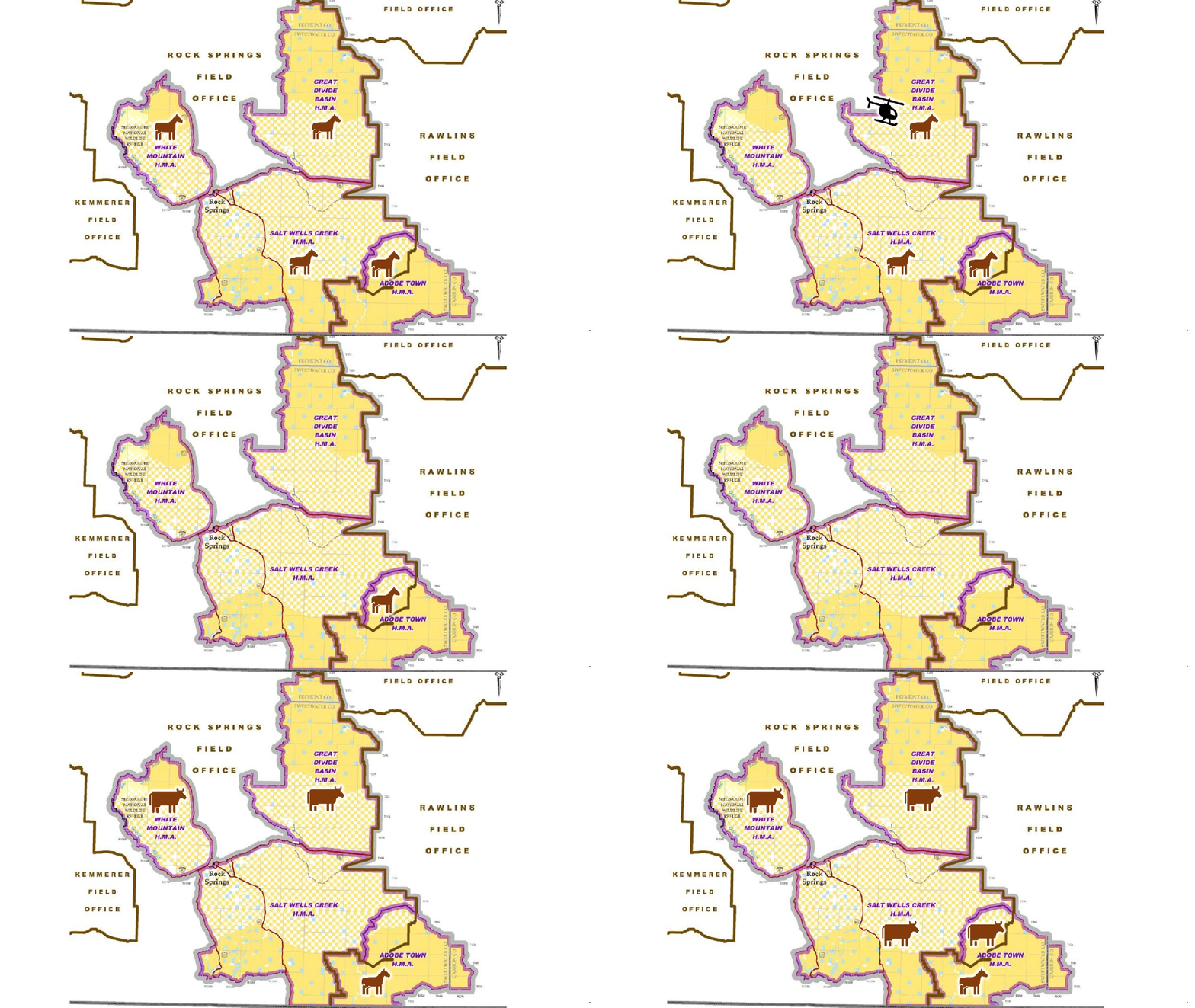
Grazing allotments in the Rock Springs Field Office are shown in this map. Table 3-2 in the EIS shows the allotments that overlap the HMAs.
The allotment master report for the RSFO has 80 listings, including 34 allotments in the Improve category, 17 in the Maintain category and 29 in the Custodial category.
The Rock Springs allotment, in the Maintain category, intersects three of the HMAs.
The largest permit holder, from an AUM viewpoint, is the Rock Springs Grazing Association, instigator of the project. Refer to the executive summary for details.
The terms of the RSGA consent decree and Alternative D in the EIS are not identical.
UPDATE: References to ‘EA’ in this post have been replaced with ‘EIS.’
RELATED: Rock Springs RMP Recap, Allotment Categories Explained.
Refer to this report dated January 29 by the Brainerd Dispatch. Doesn’t seem to matter whether they’re wild or domestic.
If you’re new to the wild horse world, you may not know the difference between an AUM and AML but you need to get up to speed on this stuff as soon as possible. These are not the stated definitions, they reflect current management practices.
AML (Appropriate Management Level) – The number of horses or burros an area can support after diverting most of the resources to privately owned livestock.
HA (Herd Area) – An area identified for wild horses or burros in 1971 but no longer managed for them (AML is zero). Now managed almost exclusively for livestock.
HMA (Herd Management Area) – Usually a subset of an HA, an area identified for wild horses or burros in 1971 but now managed primarily for livestock. Referred to as a Wild Horse Territory (WHT) or Wild Burro Territory (WBT) on Forest Service lands.
WHR (Wild Horse Range) – An area managed principally for wild horses, per the original statute, now accounting for less than two percent of areas where wild horses are still allowed by plan.
AUM (Animal Unit Month) – The amount of forage consumed by one cow/calf pair, one wild horse, two wild burros or five domestic sheep in one month.
RMP (Resource Management Plan) – A document that specifies management priorities on public lands and allocates resources accordingly. AMLs derive from these plans.
EA (Environmental Assessment) – A review of the expected consequences of a proposed action, along with those of one or more alternatives, usually carried out before anything happens in the field. Roundups enforce the resource allocations of RMPs—they cannot not change them—so comments involving forage distribution on EAs for roundups are usually rejected.
EIS (Environmental Impact Statement) – A more in-depth analysis of a proposed action and its alternatives, usually reserved for major changes to the way public lands are managed.
The number of wild horses or burros an area can support, after taking back the resources assigned to privately owned livestock, is usually referred to as the True AML on these pages and represents the sum of the animals allowed plan (AML) and the animals displaced from their home range by domestic livestock, frequently climbing into the thousands.
RELATED: So You Want to Help America’s Wild Horses?

The storms that hit central California earlier this week almost claimed the lives of two horses but they were pulled from neck-deep mud by firefighters and members of a disaster response team, according to a report posted yesterday by the Monterey Herald of Monterey, CA.
Let the usurper and his toadies wither on the vine in the town by the Potomac.
This stuff has been as hard to find as an Assateague horse census, but it’s been back on the shelves for the past few weeks. For bleaching water buckets.

If breeding patterns are determined by the local ‘advocacy’ group, and not the horses, what will be the condition of the herd twenty years from now? Fifty years from now?
Video produced by GregBarber7.
RELATED: Success on the Salt River.
Almost four dozen wild burros lost at the Clark Mountain HA in 2020 and over two dozen wild horses lost at the Heber WHT over the past two years, with plenty of outrage.
But when the PZP zealots get rid of an estimated 600 wild horses in the Virginia Range, there’s high fives and press conferences.
What would be the reaction if they were captured by helicopters?
RELATED: Oil and Mining Companies Can’t Match Impact of PZP Zealots.
The 2021 fee has been set at $1.35 per AUM for the 2021 grazing season, same as last year, according to a BLM news release issued today. The grazing season on public lands runs from March 1 through February 28.
An AUM represents the forage consumed in one month by a cow/calf pair, one wild horse, two wild burros or five sheep. Forage allocations are often specified in resource management plans.
The new fee corresponds to about 5% of the going rate on private lands.
The method of calculation can be found in Section 1905 of the Public Rangelands Improvement Act, 43 USC 37, one of the rancher-friendly statutes that weakened the WHB Act.
RELATED: Grazing Fee Unchanged in 2020.
The incident began on January 6. Gather stats through January 28:
No gather activity was reported on Day 22.
One death occurred on Day 22 as a result of the roundup and three horses were put down on Day 23 due to pre-existing conditions. The overall death rate is 2.1%.
One foal has been caught to date. Roughly 45% of captured adults are male and 55% are female. Some of the mares are probably within a few weeks of foaling. Some may have foaled in the off-range corrals.
Body condition scores are not known.
The HMA of origin was not reported. Three HMAs are involved in the roundup.
The number of unaccounted-for animals is 143.
Some of the mares will be treated with contraceptives and returned to the range but no such activity has been reported. Some may receive GPS radio transmitters.
Data quality on this roundup has been good.
RELATED: Eagle Roundup Day 21.
Eight allotments intersect the two HMAs from Utah involved in the Eagle roundup, Chokecherry and Mount Elinor.
The Allotment Master report for the one administered by the Caliente Field Office in Nevada says it’s in the Improve category.
The report for the seven allotments administered by the Cedar City Field Office in Utah shows four in the Improve category, two in the Maintain category and one in the Custodial category.
At Government Wells, the Custodial allotment, public lands represent 87% of the area and at least 77% of the active AUMs. Western Horse Watchers is unable to explain how it qualifies for that category in view of the 10% rule.
RELATED: Condition of Eagle Allotments?

