Coalition Sues Forest Service Over Salt River Horses

Hunters have joined forces with the Center for Biological Diversity, the group that forced the removal of the “Jumping Mouse” horses last year, alleging that the agency failed to protect the Lower Salt River Recreation Area from hundreds of horses that threaten endangered species habitat, according to a news release dated April 27.

The complaint, filed yesterday in Phoenix, asks the court to vacate and set aside a 2017 Intergovernmental Agreement between the Arizona Department of Agriculture and the Tonto National Forest and a 2023 Salt River Horse Management Plan, an outgrowth of the Intergovernmental Agreement.

The Salt River Wild Horse Darting Group, an affiliate of the Campaign Against America’s Wild Horses charged with thinning the herd, was not named in the case.

The plaintiffs claim there are 600 horses in an area that can only support 28 to 44 and that the current strategy for herd reduction requires too much time.

Horses moved into area from adjoining lands in the late 1970s after the Forest Service terminated livestock grazing in the Goldfield Allotment, according to the complaint.

Sand Wash Permanent Trap Site Rolls Out This Summer

Construction of the 0.1 acre facility would begin on or after June 1, according to the project description in ePlanning.

A DNA was posted yesterday for public review.

The new trap, a constant reminder that horses are not a priority in their lawful home, would be located at the north end of the HMA, in the Sheepherder Spring Allotment.

As of this morning, the project has not been announced at the BLM news site.

The length of the comment period was not specified.

Volunteers with the Sand Wash Advocate Team are competing with the BLM by poisoning the mares with a restricted-use pesticide.

RELATED: Management Paradigm Shifting at Sand Wash Basin?

Sand Wash Basin Trap Site 04-28-23

Revisiting the Hudson Valley Darting Project

What is Zonastat-D?

Zonastat-H, a restricted-use pesticide peddled as a vaccine, sometimes referred to as the Montana Solution, is intended for use on wild horses and burros.

Zonastat-D is Zonastat-H rebranded for use on white-tailed deer.

The EPA approved the labeling amendment in 2017.

The product was applied in the Hudson Valley from 2014 to 2019 by researchers from the Humane Society to sterilize female deer, according to a 2021 story by the Times Union of Albany, NY.

Apparently, the advocates jumped the gun by a few years.

Don’t worry, it was only a minor oversight.

FOAL Mixing PZP 01-18-22

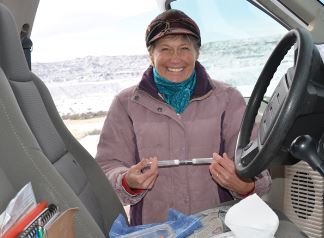
The advocates always follow the rules for handling the product, including the use of chemical-resistant gloves, evident in the photo above.

That they and their allies in the bureaucracy are probably using it in a manner that’s inconsistent with its registration is a topic for subsequent discussion.

RELATED: Progressive Method for Getting Rid of Deer in Liberal Villages.

BLM Completes Railroad Valley Land Withdrawal

Approximately 22,684 acres of public lands in Nye County have been put off limits for a twenty-year period from all forms of mineral entry, according to today’s news release.

The change was prompted by a request from NASA to minimize surface disturbance in the area, which is used for satellite calibration activities.

The nearby Sand Springs West and Pancake HMAs are not affected.

RELATED: What’s Up in Railroad Valley?

Yes, We Have No Authority?

Here is a list of HMAs subject to the Montana Solution, according to the April 18 roundup schedule.

Ask the culprits for a copy of the DOA, or other such document, naming them as designated agents of the federal government.

Please leave a comment if you can fill in the unknowns.

PZP darting also occurs in these areas.  Ask for documentation naming these groups as designated agents of state governments.

The EPA limited application of the pesticide to federal and state governments, among others, and their designated agents.

Restricted-Use Pesticide 04-24-23

Some states may have additional requirements, such as licensing, to procure, possess, apply and dispose such chemicals.

RELATED: Advocates Authorized to Apply Montana Solution?

Advocates Authorized to Apply Montana Solution?

The EPA limits the application of PZP to the DOI and its designated agents, state departments of agriculture and wildlife and their designated agents, federally recognized Indian tribes and their designated agents, Department of Defense and its designated agents, public and private wild horse sanctuaries and reserves, Humane Society of the United States designated agents, and the USDA and its designated agents.

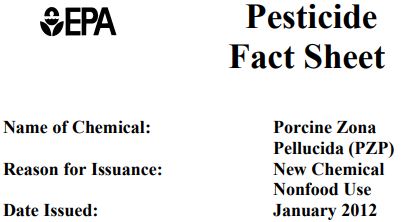
Go to Section 5 in the pesticide fact sheet.

The advocates can get diplomas from the Billings School of PZP Darting and Public Deception but have you ever seen Delegations of Authority from the BLM or Forest Service naming them as their designated agents?

On the Virginia Range, the Nevada Department of Agriculture would grant the DOA.

What about the ponies on the barrier islands?

Ask for copies.

The advocates may be easier to contact than the bureaucrats.

Caisson Platoon Going on Hiatus

Operations will be suspended for 45 days effective May 1, according to a story dated April 21 by Military.com.

The unit employs military working horses as escorts during funerals at Arlington National Cemetery.

Given their mission, you’d think they’d be treated like royalty, but they live in small lots covered with excrement, suffer from illness and are fed low-quality hay.

RELATED: Horses of Caisson Platoon Find New Pastures on BLM Land.

BLM to Trial New Herbicides on Cherished Plants and Weeds

The agency proposes to add seven active ingredients to its list of approved ingredients, according to a Draft EIS posted to ePlanning on March 10.

The new products are discussed in Section 2.2.

The project folder includes a scoping report, also released on March 10.

The comment period ends June 5.  Online comments are not being accepted at this time.

No online public meetings have been scheduled as of today.

Invasive plants can develop resistance to herbicides over time, according to yesterday’s news release, so new active ingredients are developed to overcome such problems.

RELATED: How Do Advocates Treat Their Cherished Horses and Burros?

For Your Cherished Ants and Roaches 08-30-22

Depositions Filed in Wyoming Corner-Crossing Case

The civil complaint, brought by the owner of a ranch that covers public and private parcels in the Wyoming checkerboard, follows criminal trespass charges that were dropped last year.

The ranch owner wants the judge to declare that the hunters trespassed, then leave it for a jury to determine later how much they should pay in damages, according to a story dated April 18 by WyoFile.

The hunters want the suit dismissed completely, arguing that the Unlawful Inclosures Act of 1885 prevents landowners from fencing others out of public lands or using threats and intimidation toward that end.

The case could establish precedent in claims involving access to 8.3 million acres of “corner-locked” public lands in the American West.

The plaintiff believes the corner-crossers devalued his ranch by $7.75 million, not by setting foot on his property, but by crossing its air space!

Damages could go as high as $9.4 million.

The story did not indicate if the plaintiff had sued any commercial airlines for flying over his property.

RELATED: Wyoming Checkerboard Lands Missouri Hunters in Hot Water.

Professor Says His Generation Created Wild Horse Problem?

His generation tried to fix it, but the solution wasn’t acceptable to the public-lands ranchers, whom he now serves.

Although horses appear in the North American fossil record, he is silent about the predominant nonnative species on America’s public lands, privately owned cattle and sheep, to whom most of the food and water on said lands have been assigned by the bureaucrats, even in the lawful homes of wild horses.

That’s why the off-range corrals are flooded with “excess” animals.

As for predators, the advocates rely on them to take out any foals that slip through their darting programs.

Beebe Ranch Fundraiser Adds Matching Gift

A philanthropist who has supported many island organizations has offered a matching grant up to $100,000, according to the April 18 update.  That means a $5 donation turns into $10, a $100 donation doubles to $200, etc.

The donation total now exceeds $350,000.

The museum has until April 30 to match the developer’s bid of $625,000.

Donations can be made online at this GoFundMe page.

RELATED: Beebe Ranch Fundraiser Passes 50% Mark.

Misty of Chincoteague Beebe Ranch Fundraiser 03-23-23

Roundup Schedule Updated

The plan for FY 2023 has expanded considerably, with new goals of 7,194 animals captured and 5,857 removed.

Previously, the schedule was dominated by fertility control programs.

This year there are 16 such programs, compared to 14 in 2022.

Eight incidents were classified as nuisance.

Sand Wash Basin is on the list again, along with Black Mountain and Calico.

Roundups ensure that ranchers receive their allocated share of the food and water in the lawful homes of wild horses and burros.

The advocates snuff out new life with their ruinous darting programs, prolonging the effect of the roundups.

Last Day to Comment on Kirtley Creek Permit Renewal

The permittees have asked the BLM to convert 46 sheep AUMs to cattle AUMs, according to the scoping information package.

The allotment covers 2,902 total acres near Salmon, ID, according to the Allotment Master Report.

It is in the Custodial category and does not intersect any HMAs.

The project folder includes a rangeland health assessment.

The Authorization Use Report indicates the grazing seasons are short but the stocking rates are high.

Why look at such projects?

Livestock grazing represents the largest segment of resource supply and demand on America’s public lands, but the advocates won’t talk about it.  If they did, the rationale for their darting programs would fall to the ground.

The parcel offers 257 active AUMs on 2,197 public acres, which works out to 117 AUMs per year per thousand public acres, equivalent to 9.7 wild horses per thousand acres.

The bureaucrats and ranchers insist that public lands in the western U.S. can only support one wild horse per thousand acres (27,000 animals on 27 million acres).

You don’t need to wait until permits come up for renewal to get the numbers.

You can locate allotments anytime with the NDV and pull the reports at RAS.

Kirtley Creek Allotment Map 04-11-23

Explosion Spares Life of Spirit of the Wild Horse Director

Judy Barnes, founder of the nonprofit, was house-sitting in Santa Fe when the incident occurred, according to a story by KRQE News of Albuquerque, NM.

Her home was destroyed, along with $5,000 worth of horse supplies.

Investigators have not determined the cause.

Barnes has been looking after the free-roaming horses of Wild Horse Mesa for nearly twenty years.

RELATED: Wild Horse Mesa Confirmed.