When you give your horse a kiss, some of her fur sticks to your lips.


Western Horse Watchers Association
Exposing the Hypocrisy, Lies and Incompetence of the Wild Horse Advocates
Around the ranch
When you give your horse a kiss, some of her fur sticks to your lips.
The manufacturer issued a recall on Friday and the FDA issued a warning yesterday, according to a story by AP News.
The product may be contaminated with Clostridium botulinum, an organism that causes botulism.

Hopefully the volunteers at Mustang Camp, destination of the Mesa Verde horses, will inspect the cubes they use to bribe train the animals.
Mom-baby pair adopted 2015.

Nineteen horses have been lost since the strangles outbreak was reported.
The facility has a capacity of 3,500 animals, with 2,617 horses and 29 burros held there as of November 21, according to the BLM Facility Report.
Eight mares and four geldings will be ready for adoption in the next two weeks, according to a story by The Journal of Cortez, CO.
The program features a reverse incentive: You pay them $1,000.
Training consists of bribing them with alfalfa cubes. Traditional methods, such as release of pressure, apparently are foreign concepts to the staff at Mustang Camp.
How is that going to work when you bring one of them home and you’re not a subscriber to their methods?
The report hasn’t been posted to YouTube but you can view it at CBS News.
The compound is listed as “Riverton Prison” in the September facility report.
This chart indicates that public lands in the western U.S. can support many more horses than the government admits and explains why so many are being forced therefrom.
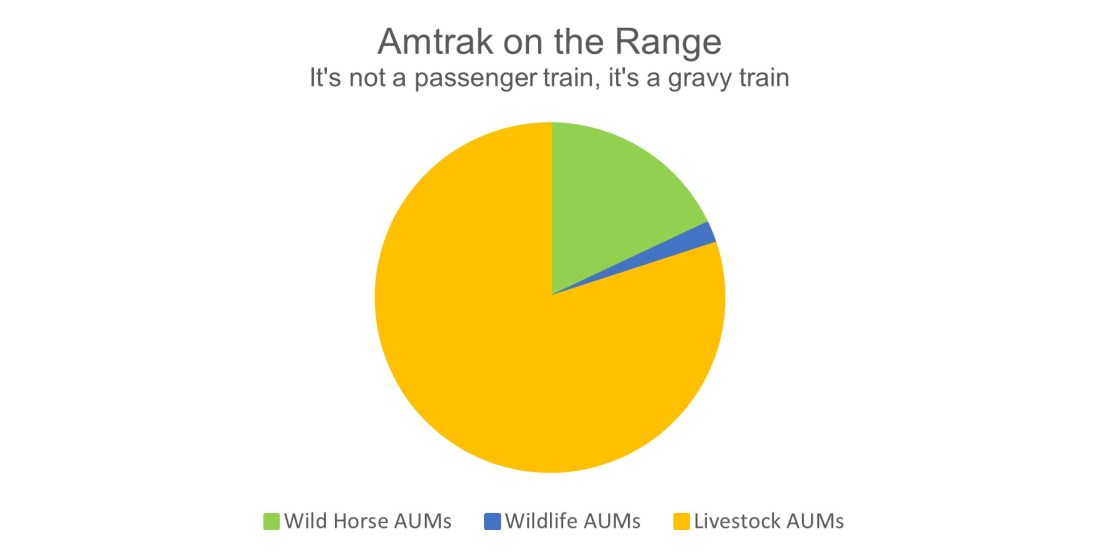
Imagine the possibilities when most of your costs are subsidized by American taxpayers.
The BLM Facility Report refers to it as “Lander,” with a capacity of 225 horses, one of four long-term pastures open to the public.
Unadopted and unadoptable horses, most of whom were removed from their lawful homes in favor of privately owned livestock, are sent there to die.
The Wind River Sanctuary was established in 2016 on the 900-acre Double D Ranch near Lander, WY. Tours are available by appointment.
Contrary to remarks in the video, overpopulation means more horses than allowed by plan, not necessarily more horses than the land can support.
At the North Lander Complex, not far from the sanctuary, livestock receive over seven times more forage than the horses.
The four HMAs in the Complex can support four thousand more horses than the BLM allows, to be achieved by confining the ranchers to their base properties in a year-round off-season and expecting them to pay the going rate to feed their animals.
The film includes footage from the McCullough Peaks HMA, where a similar situation exists, but the advocates are going after the horses with their favorite pesticide, referred to on these pages as the Montana Solution.
The problem is resource management, not humane management.
A bale of alfalfa-grass mix was $36 today, 20 bales minimum, no increase since July.
“That’s great news, I’m voting Democrat.”
But it’s up 89% since July of 2021.
“Forget that, I’m voting Republican.”
RELATED: Price of Hay Unchanged.

A bale of alfalfa-grass mix was $36 today, the same as July and August, 20 bales minimum.
The single-bale price was $37, also unchanged.
The price in July last year was $19 per bale, 20 bales minimum.
The average horse would need five bales per month, putting the cost of feed at $180 per AUM.
The public-lands ranchers currently pay $1.35 per AUM, a price that’s been stuck in a time capsule with only minor adjustments since the 1960s.
Taxpayers pick up the tab for the removal, processing and stockpiling of wild horses, allowing them to profit handsomely from this government giveaway.
One of their greatest fears is paying market rates to feed their animals.
RELATED: Price of Hay Hits New Record.
The slaughterhouse repeatedly violated humane handling practices during two inspections in March, according to a story posted yesterday by Nevada Current.
The facility, operated by the University of Nevada at Reno, lets students get first-hand experience in meat production, retail distribution and packaging.
The University is not known for its friendly attitude toward wild horses.
Bitless is better. Auction begins at 6 PM today, pacific time.
RELATED: R3C Saddle-Started Horses Up for Adoption.
Displaced from their home range by permitted grazing and placed into the inmate training program, two geldings and a mare will be offered in an online auction hosted by the BLM on July 14, from 6 to 8 PM pacific time.
The news release said the animals can be picked up on July 16 by appointment at the Rio Cosumnes Correctional Center in Elk Grove, CA.
Details at the R3C adoption page.
A bale of alfalfa-grass mix was $36 today, 20 bales minimum, up from $30 per bale on June 4, a 20% increase in just four weeks. The single-bale price was $37.
The price was $19 per bale a year ago.
The average horse would need five bales per month, which works out to $180 per AUM.
The $1,000 adoption incentive would keep your mustang fed for five to six months.
The price of forage to the public-lands ranchers has not changed in the past year, $1.35 per AUM.
Better to cram more wild horses into the feedlots and stick the taxpayers with the bill.
RELATED: Hay Available But Unaffordable.
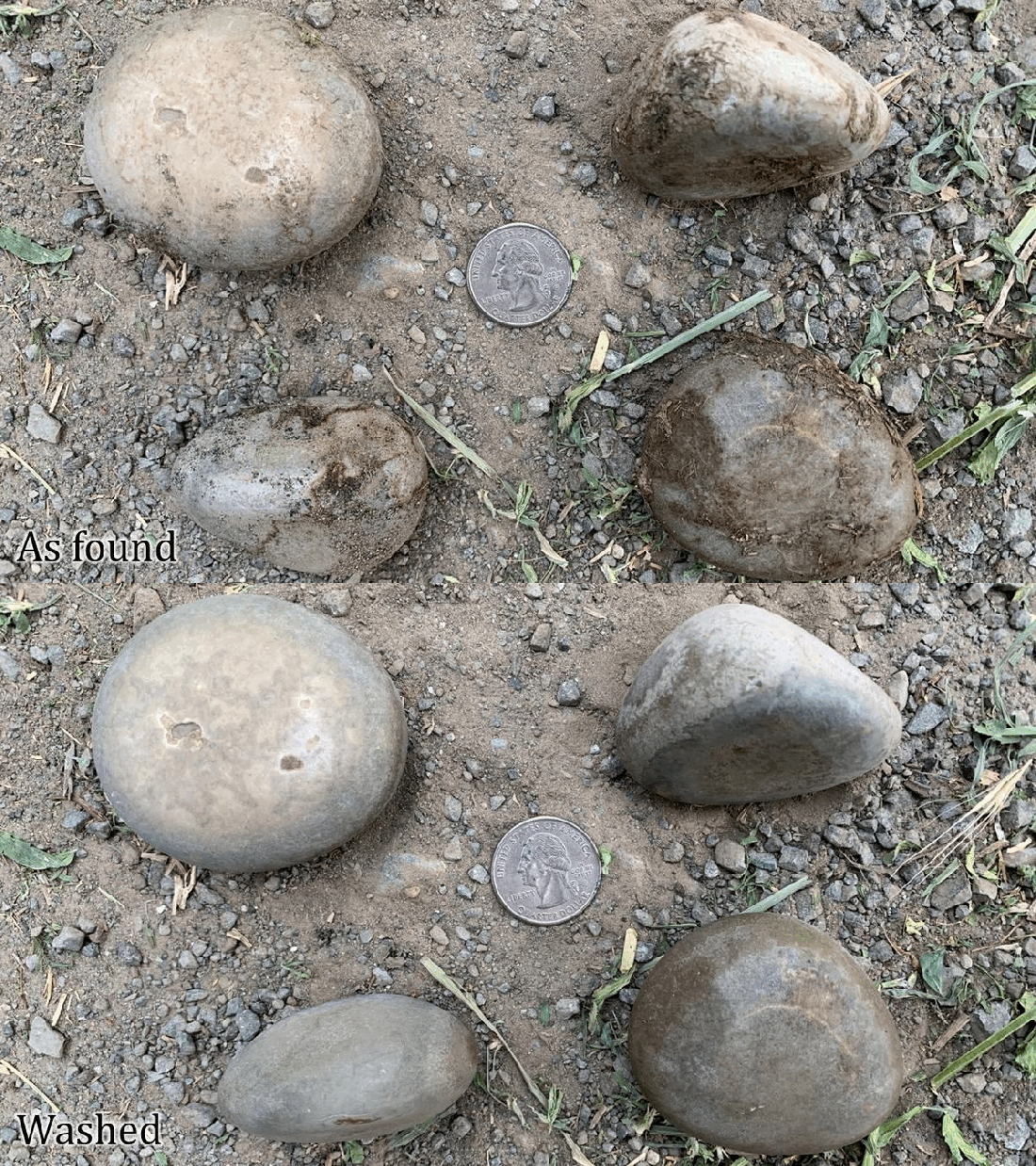
They are mineral accumulations around a foreign object that form round, triangular, or flat stones inside the bowel of a horse, usually over the course of several years.
They originate in the large colon and can lead to colic.
Refer to this Q&A by the UC Davis School of Veterinary Medicine.
The stones in the following photos were passed by a mare earlier this week, two on June 20 and two on June 21.
Symptoms began on June 19, including loss of appetite, restlessness, laying down.
The incident was preceded by diarrhea and appears to be resolving but is not over.
Enteroliths are associated with diets that are high in magnesium and protein, present in alfalfa, a staple for wild horses in off-range corrals.
The mare is a registered Paint and is 12 years old.
The price of alfalfa-grass mix was $30 today, twenty bales minimum. The single-bale price was $31. No shortages or waiting lines observed.
The price last July was $19 per bale, twenty bales minimum, putting the increase at 58% in eleven months.
The average horse would need five bales per month, which works out to $150 per AUM.
The price of forage to the public-lands ranchers over the same period was unchanged, $1.35 per AUM.
The grazing program insulates them from the realities of the market, at least on the cost side, another reason to take more wild horses off the range.
They were rescued and rehabilitated by the Maine State Society for the Protection of Animals but couldn’t be gentled, according to a report posted today by Bangor Daily News, so they’re headed to Skydog in two weeks.
The story said they were captured about two years ago, which may link them to the Saylor Creek or Challis roundups.
They were offered for sale by the BLM, suggesting they were “three strikers,” with a risk of entering the slaughter pipeline, but the buyer tried to give them a second chance.
RELATED: Giving Foals a Chance at Life.
A bale of alfalfa-grass mix was $28 today, 20 bales minimum, compared to $26 on March 5.
That works out to $140 per AUM for the average horse.
The single-bale price was $29.
The price last July was $19 per bale, 20 bales minimum, so the increase over ten months is 47%.
The public-lands ranchers currently pay $1.35 per AUM, the same as they did last year.
With the rising cost of feed and illnesses at the off-range corrals, wild horse adoptions may be heading for a downturn.
RELATED: Price of Hay Jumps Again.
A story dated April 27 by Steamboat Pilot & Today said horses removed from the HMA and held at Cañon City will not be delivered to trainers due to the unidentified illness that’s killed 85 over the last five days.
Horses from other areas will arrive at the Rio Blanco County Fairgrounds today.
Western Horse Watchers suspects that all of the animals at the facility are now unadoptable and may be viewed as a health risk no matter where they’re sent.
The annual training event is organized and operated by ranching interests.
RELATED: Sand Wash Exiles Heading to Meeker Mustang Makeover.
After spending four weeks in a galvanized tub with a heat lamp, these guys graduated to the halfway house last night, a small cage next to the main coop where they’ll spend another four weeks before being turned out with the veterans.
Temperatures dropped into the mid 40s but they survived.
Chicks have to be kept warm until they grow feathers, a process that takes around three weeks.
The cage has wire mesh on the sides but is lined with flakes of hay.
The flock has declined in recent years, mostly because of predation, and egg production is now just four or five per week.
A few years ago, chicks could be purchased for $3 apiece. These were $6 each at the beginning of March.
The price of hay has gone up because of wild horses, according to the Nevada Rangeland Resources Commission. Can we blame this on the horses too? Or should we be looking at the one-horse pony and his illicit administration?

The facility has been closed until a veterinarian determines the animals are no longer showing signs of illness, according to a BLM news release.
It was one of the dropping-off points for horses captured in the Rock Springs roundup.
 Western Horse Watchers Association