It’s listed as Vale/Geldings in the November Facility Report, covering 47,883 total acres, including 41,882 deeded acres, with a capacity of 1,000 horses, plus cattle.
Eight mares and four geldings will be ready for adoption in the next two weeks, according to a story by The Journal of Cortez, CO.
The program features a reverse incentive: You pay them $1,000.
Training consists of bribing them with alfalfa cubes. Traditional methods, such as release of pressure, apparently are foreign concepts to the staff at Mustang Camp.
How is that going to work when you bring one of them home and you’re not a subscriber to their methods?
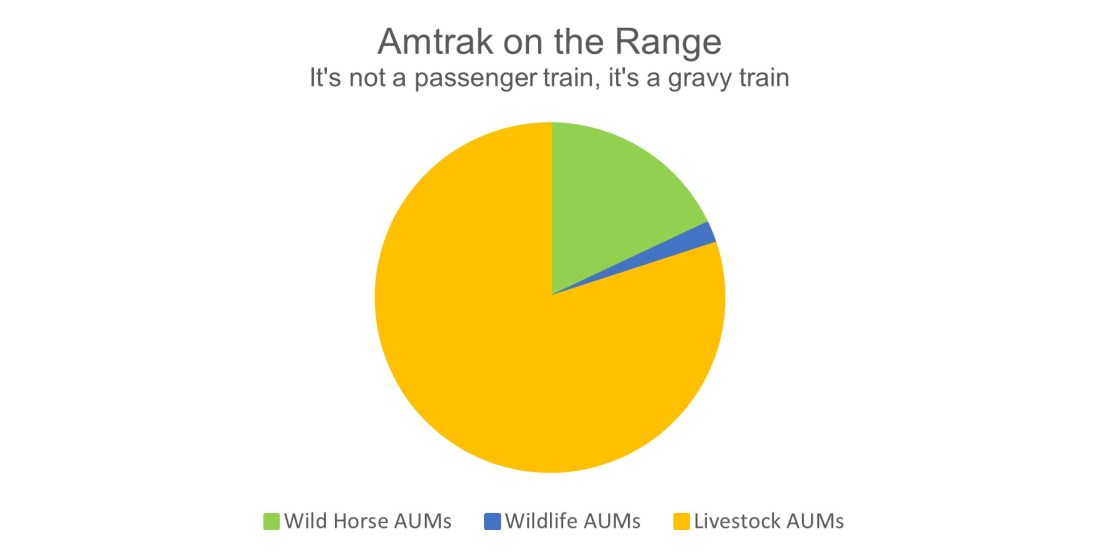
This chart indicates that public lands in the western U.S. can support many more horses than the government admits and explains why so many are being forced therefrom.
Imagine the possibilities when most of your costs are subsidized by American taxpayers.
The four HMAs in the Complex can support four thousand more horses than the BLM allows, to be achieved by confining the ranchers to their base properties in a year-round off-season and expecting them to pay the going rate to feed their animals.
The film includes footage from the McCullough Peaks HMA, where a similar situation exists, but the advocates are going after the horses with their favorite pesticide, referred to on these pages as the Montana Solution.
The problem is resource management, not humane management.
A bale of alfalfa-grass mix was $36 today, the same as July and August, 20 bales minimum.
The single-bale price was $37, also unchanged.
The price in July last year was $19 per bale, 20 bales minimum.
The average horse would need five bales per month, putting the cost of feed at $180 per AUM.
The public-lands ranchers currently pay $1.35 per AUM, a price that’s been stuck in a time capsule with only minor adjustments since the 1960s.
Taxpayers pick up the tab for the removal, processing and stockpiling of wild horses, allowing them to profit handsomely from this government giveaway.
One of their greatest fears is paying market rates to feed their animals.
The slaughterhouse repeatedly violated humane handling practices during two inspections in March, according to a story posted yesterday by Nevada Current.
The facility, operated by the University of Nevada at Reno, lets students get first-hand experience in meat production, retail distribution and packaging.
The University is not known for its friendly attitude toward wild horses.
Displaced from their home range by permitted grazing and placed into the inmate training program, two geldings and a mare will be offered in an online auction hosted by the BLM on July 14, from 6 to 8 PM pacific time.
A bale of alfalfa-grass mix was $36 today, 20 bales minimum, up from $30 per bale on June 4, a 20% increase in just four weeks. The single-bale price was $37.
The price was $19 per bale a year ago.
The average horse would need five bales per month, which works out to $180 per AUM.
The $1,000 adoption incentive would keep your mustang fed for five to six months.
The price of forage to the public-lands ranchers has not changed in the past year, $1.35 per AUM.
Better to cram more wild horses into the feedlots and stick the taxpayers with the bill.
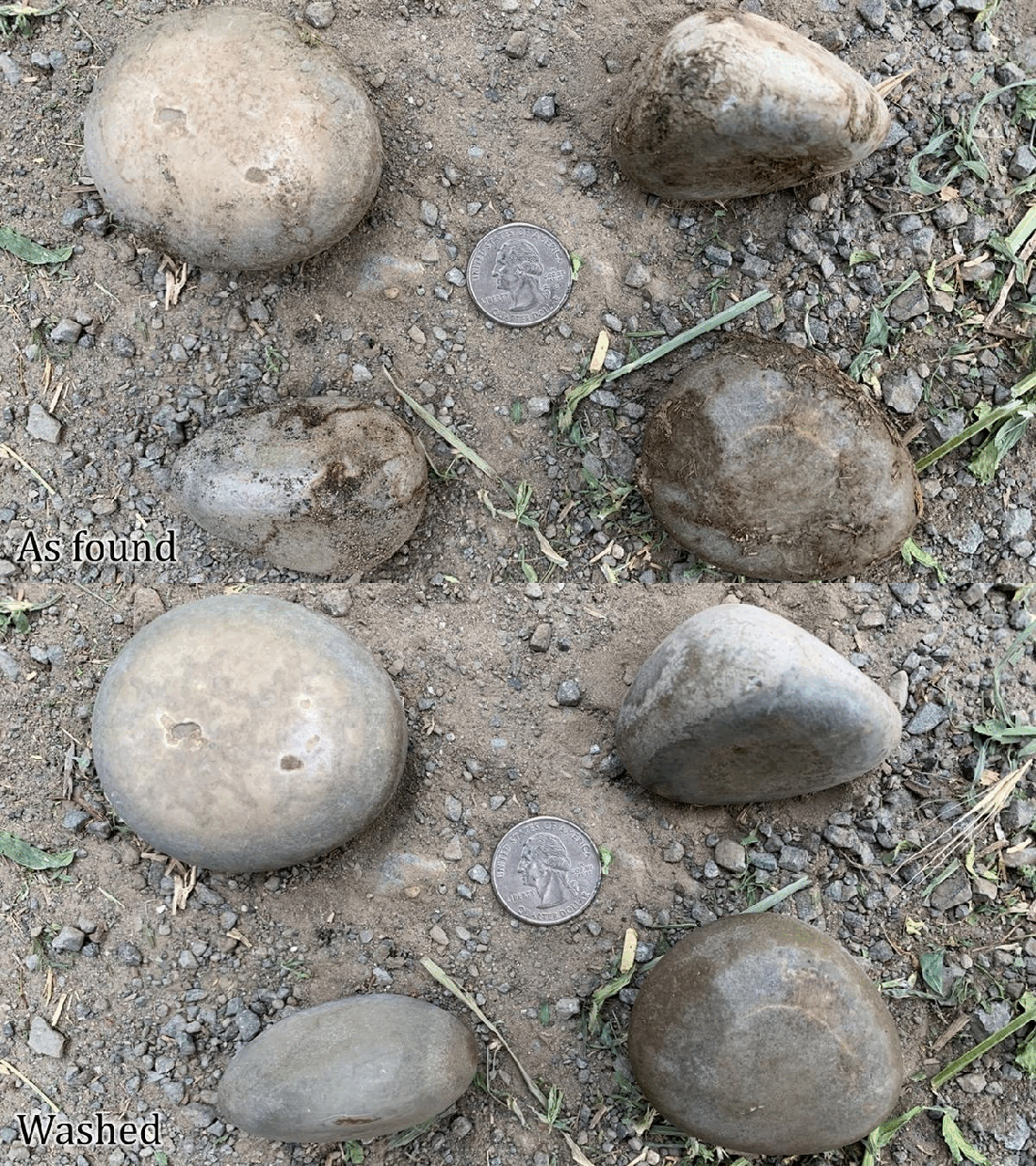
They are mineral accumulations around a foreign object that form round, triangular, or flat stones inside the bowel of a horse, usually over the course of several years.
They originate in the large colon and can lead to colic.
Refer to this Q&A by the UC Davis School of Veterinary Medicine.
The stones in the following photos were passed by a mare earlier this week, two on June 20 and two on June 21.
Symptoms began on June 19, including loss of appetite, restlessness, laying down.
The incident was preceded by diarrhea and appears to be resolving but is not over.
Enteroliths are associated with diets that are high in magnesium and protein, present in alfalfa, a staple for wild horses in off-range corrals.
The mare is a registered Paint and is 12 years old.
The story said they were captured about two years ago, which may link them to the Saylor Creek or Challis roundups.
They were offered for sale by the BLM, suggesting they were “three strikers,” with a risk of entering the slaughter pipeline, but the buyer tried to give them a second chance.
A story dated April 27 by Steamboat Pilot & Today said horses removed from the HMA and held at Cañon City will not be delivered to trainers due to the unidentified illness that’s killed 85 over the last five days.
Horses from other areas will arrive at the Rio Blanco County Fairgrounds today.
Western Horse Watchers suspects that all of the animals at the facility are now unadoptable and may be viewed as a health risk no matter where they’re sent.
The annual training event is organized and operated by ranching interests.