
The project is now on hold according to a report published this evening by Oregon Live.
Category: Commentary
Opinion
BLM Ovary Cutters Sharpening Their Knives?
Sterilization of Warm Springs mares could begin as early as 11/05/18, according to a report published today by The Argus Observer of Ontario, OR. Requests to stop the ‘research’ are being reviewed by the Interior Board of Land Appeals. If a stay is not granted, the Mengeles at Hines will have a green light to carry out their work.
RELATED: Consortium Files Lawsuit to Stop BLM Spay Research.
They’re All Starving
Anti-horse propaganda by Golden Productions, posted 10/31/18.
The footage may be dated. There is no Smith Creek HMA in Nevada (there is a Smith Creek HA but it has no AML). Horses don’t run on allotments, cattle do.
According to the interviewees, the horses are overpopulated, have no natural predators and are not important (refer to the wild horse narrative).
“We don’t have the resources to keep these animals healthy.”
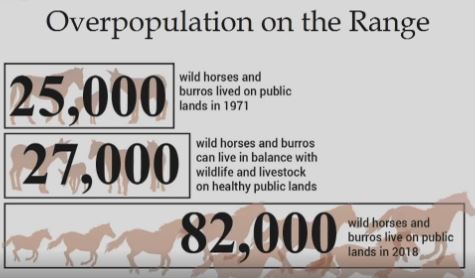
BLM said earlier this year that 82,000 wild horses and burros were present on western rangelands. They graze 24/7, consuming roughly one million AUMs per year (82,000 times 12).
At the WHB Advisory Board meeting last month, one of the presenters indicated that 8.8 million AUMs were consumed by livestock in 2017. They graze six months per year or less, which means there were at least 1.5 million cow/calf pairs on the range (8.8 million divided by 6).
Three million head, privately owned, compared to 82,000 wild horses and burros.
And Now for Something Completely Different
Hot-crazy matrix. Originally appeared on James Yeager’s Tactical Response channel until the do-gooders at Youtube/Google shut it down.
Wild Horses of Oregon
Came across this video in a FB post dated 10/22/18 by Mustang Meg. You can watch it below or go to Vimeo. I agree that the filmmakers did a great job of documenting the issues on western rangelands.
Regarding the caption at 00:45, are 17 HMAs controlled by the BLM in Oregon, plus two WHTs, one of which is jointly managed by the BLM and USFS.
The film presents a range of characters, from Andi Harmon, who reprises the role of Slaughterhouse Sue beginning at 1:05, to Gayle Hunt, a former USFS employee and founder of the Central Oregon Wild Horse Coalition, first appearing at 04:22.
Harmon’s remark at 03:36, ‘Our [not My] biggest issue is not being able to manage them right,’ suggests an allegiance to the livestock industry.
Hunt is a wild horse advocate, for the most part, although it was not apparent to this reviewer until the end of the film.
Keep in mind that all horse behaviors in the video are normal/natural, even when idiots are involved.
The segment at 6:03 shows the essence of their legacy, which must be protected from the PZP zealots, who not only accept the anti-horse agenda but are happy to participate in it. How many of them aborting/contracepting/sterilizing in their own lives?
Remarks by BLM manager Rob Sharp are predictable.
The trailer at 20:42 probably belongs to the Cattoor Livestock Roundup Company, a favored contractor of the BLM. Public-lands ranchers are not the only beneficiaries of declining wild horse populations.
Speaking of livestock, you have to wait until 21:27 to learn about the greatest threat to wild horses and burros on western rangelands. The concept of ‘multiple use’ mentioned by Harmon at 21:45 was not formally sanctioned until 1976, when FLPMA was signed into law. It is one of several amendments to the WHB Act that need to be walked back.

Grazing permit buyouts, mentioned by Hunt at 23:00, deserve further attention.
Next up, starting at 34:26, is the innovative Beaty Butte Wild Horse Training Facility near Adel, OR, founded by the BLM and local ranchers.
It is hard to watch. Horses locked in stalls, separated from others, running continually in the round pen with no release of pressure. Eventually they settle down, not because of trainer skill but because they give up (his words, 37:46).
No patience, no understanding, no relationship. The goal is to cashier as many of them through the program as possible, so more horses can be driven from their homelands, to be replaced with cattle and sheep. Look at them. Bits shoved in their mouths, paraded around like spoils of war, while livestock graze peacefully on land that belongs to them.
The following segment features more horses locked in stalls, standing in their own poop, tripping over lead ropes that should not be there (ditto for the halters).
The film concludes with a piece on the Trainer Incentive Program then transitions back to the forest with a question about wild horse preservation.
How much are we going to regret their loss when it’s too late?
RELATED: BLM Plans Another 100% Gather at Beatys Butte HMA.
UPDATE: Video owner no longer allows embedding. Watch at Vimeo.
And Now for Something Completely Different
Here’s what was going on at the Winterland Ballroom 45 years ago tonight. Country Joe McDonald and the All Star Band.
Can’t Succeed Without the Help of Government
No, this is not a video about public-lands ranching. H/T American Digest, Allie Stuckey.
BLM Removes Wild Horses, Aids Ranchers Affected by Martin Fire
In what can only be described as a shocking development, BLM has moved against the horses in favor of public-lands ranchers, offering assistance to permit holders impacted by the largest wildfire of 2018 in Nevada. Many of the horses that roamed the area were not available for comment.
“BLM is addressing fencing status and needs, helping coordinate Farm Services Administration funding sources, and holding individual meetings with permittees about future grazing needs and feasibility within the fire perimeter.”
The fire affected seven grazing allotments and eight permittees n the Winnemucca District. The number of affected grazing allotments and permittees in the Elko District was not provided.
The fire started near Paradise Valley, NV in early July and spread eastward across the Little Owyhee and Owyhee HMAs. An emergency gather was ordered for September.
If you were thinking that maybe the BLM might be biased a little in favor of the livestock industry, this announcement should remove all doubt. Their priorities should now be obvious to even the casual observer.
Things to Do in November
Vote liberals out of office, both sides of the aisle. Don’t let freedom, ruggedness and self-reliance be replaced with weakness, vulnerability and dependence on government.
Media Silence on Spruce-Pequop Incident Continues
Still no national news coverage of wild horse massacre at Spruce-Pequop HMA in late August. If conservatives were involved, you would have heard about it weeks ago.
RELATED: BLM Thinks Spruce-Pequop Massacre was Humane.
UPDATE: See these remarks from The Cloud Foundation that appeared today in The Desert Independent.
Fate of Devil’s Garden Horses?
In a guest column appearing today in the Redding-based Record Searchlight, the writer worries about the fate of captured horses but doesn’t say anything about the reasons for their removal.
Yep, it’s okay to pull them off the range and give more of their land and forage to livestock, just don’t ship them to slaughter.
The greatest threat to wild horses and burros is public-lands ranching, not oil and gas exploration, not mineral extraction, not timber harvesting.
The government serfs, along with their allies at the BLM and USFS, are laughing at you, dear, because you focus on symptoms not on causes.
Stop the Roundups, Fertility Control is Better!
Todd Gloria, a member of the California State Assembly, has written a letter to the USFS demanding an end to the Devils’s Garden wild horse gather, according to a report that appeared yesterday in East County Magazine. It was signed by 22 of his legislative colleagues (most of whom are liberals).
Links in the story point to the site of an ‘advocacy’ group known for its unwavering support of fertility control for horses. To see how that method stacks up against other herd management practices, take this quiz. Match a technique on the left with a result on the right. Take as much time as you need.
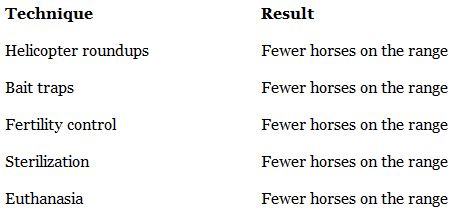
If your answers look like this, you are correct!

Another advantage of these techniques is that they they align with the overpopulation narrative and leave more forage on western rangelands for livestock.
If you think wild horse advocates should be pushing for changes that work to the benefit of the horses, you’re in the minority. Refer to the list in this post for some ideas.
WHBAB Day 3: Achieve AMLs or Else
This story by The Salt Lake Tribune has a summary of today’s proceedings. Public comments were taken in the afternoon session. This was the final day of the meeting.
The enmity toward wild horses and burros was astonishing.
Multiple use was cited as the justification for a variety of activities on lands set aside for WHB, such as energy development, livestock grazing and timber harvesting. Except when adverse conditions are found, such as soil erosion and missing vegetation. Then it’s single use—all problems are caused by the horses.
Claims were made that AMLs represent the carrying capacity of the land. If that was true, there could be no livestock grazing on HMAs.
An argument was advanced that livestock can’t be removed from public lands because it would ruin the lives of the ranchers. Sadly, manufacturers of buggy whips, vacuum tubes and carburetors, along with their workers, were not available for comment.
Neither were the coal miners displaced by the wind farms of an earlier presentation.
USFS: Removing Modoc Wild Horses Good for Environment
An opinion piece that appeared yesterday in the Redding-based Record Searchlight was written by a spokesman for the USFS to ‘correct some inaccuracies.’ However, it fails to mention that the Devil’s Garden WHT falls within permitted livestock allotments.
So much for accuracy.
Removing wild horses from HMAs and WHTs is good for the public-lands ranchers, their overlords, cheerleaders and political allies.
That is the implication of other statements in the piece, such as ‘reducing competition for limited food, water, and habitat’ and ‘communities that also depend on these lands.’
WHBAB Day 2: Back to the ‘Fast Disappearing’ Days
The low water mark of the morning session came when Barry Perryman, a new member of the Advisory Board, suggested that the BLM find additional reasons to remove wild horses from public lands, such as the protection of threatened species (e.g., sage grouse or desert tortoise).
The highlight of the afternoon session was a remark by Ginger Kathrens, during a review of the BLM Report to Congress, that the proposed actions would take wild horse populations back to ‘fast disappearing’ levels, a reference to the preamble of the WHB Act of 1971.
If your belief at the beginning of the day was that the BLM wants more players from Team H off the field and more players from Team L on, nothing was offered in the day’s proceedings to convince you otherwise.
Feinstein Tries to Stop Devil’s Garden Roundup
She knows how to do it.
Leak an embarrassing story about a central figure in the operation. Employers nowadays are obsessed with diversity and inclusion, so it’s entirely plausible that someone involved has engaged in lewd behavior.
Stop asking questions about the carrying capacity of the land, appropriate population levels, competition on public lands with privately owned livestock, and what steps will be taken to ensure the safety of the horses. Those topics are irrelevant.
See the report posted yesterday by The Sacramento Bee.
RELATED: Not One Word About Livestock at Devil’s Garden WHT.
WHB Advisory Board Tours Onaqui Mountain HMA
The WHB Advisory Board meeting in Salt Lake City kicked off yesterday with a field trip to the Onaqui Mountain HMA. BLM staff hosted the tour, eager to associate any and all conditions with the horses. Refer to this report by Deseret News.
It’s like climate change. Whatever the perceived malady, blame it on the horses. Mud or no mud, vegetation or no vegetation, wildlife or no wildlife, ascribe it to the horses.
Don’t mention livestock, don’t mention multiple use.
Recite the wild horse narrative as often as possible.
Cover for the public-lands ranchers.
Polls show that 80% of Americans want these animals protected and preserved.
Do think that will have any effect on the anti-horse juggernaut that has rolled across western rangelands since Trump was elected?
Antelope / Goshute Roundups Make the Headlines
A syndicated report has been picked up by major news outlets regarding the second wild horse gather at the Antelope Valley and Goshute HMAs in eastern Nevada. Refer to this article in the Beaumont Enterprise for example. Here’s what they have in common:
- Unquestioned acceptance of statements regarding wild horse populations
- Erroneous reporting of the number of horses removed
- Animal deaths not mentioned
Although the stories hint at the role of livestock in the debacle, they fail to acknowledge that all of this is happening on lands set aside for the horses.
RELATED: BLM Ends Antelope Valley and Goshute Gathers.
WHB Advisory Board Meeting Starts Tomorrow
The meeting on Day 2 and Day 3 will be livestreamed according to a report posted yesterday by KSL in Salt Lake City.
The theme of the meeting will be wild horse and burro overpopulation. Not that it’s true, but an excuse is needed for removing more of these animals from lands set aside for them.
Who’s pushing that? The National Horse and Burro Rangeland Management Coalition, a livestock advocacy group. See this position statement in Ag Daily, posted 10/05/18.
“Overpopulation of horses and burros continues to threaten the health of our rangelands and negatively impacts the multiple-use of these public lands.”
Translation: Wild horses are burros are robbing us of forage that could be consumed by cattle and sheep. They have to go.
BLM Posts Agenda for WHB Advisory Board Meeting
Meeting will occur October 9 – 11 in Salt Lake City, agenda posted here.
Topics include:
- Telling the truth about the carrying capacity of the land
- Restoring zeroed-out lands to wild horses and burros
- Allocating more land to the WHB program
- Increasing AMLs
- Introducing new ideas for keeping WHB on the range
- Ending ‘humane management practices’ (contraception and sterilization)
- Investigating misleading statements about WHB overpopulation
- Raising grazing fees for livestock on public lands
- Requiring labels on beef that indicate if it was produced on public lands
- Educating the public about treatment of WHB on western rangelands
- Publishing charts that show how forage is allocated on public lands
- Reviewing upcoming AUM curtailments
- Reviewing plans for restoring horses to areas impacted by fire and drought
- Waiving property taxes on lands obtained for private sanctuaries
- Omitting sales taxes on equipment and supplies purchased for sanctuaries
- Investigating ties between the BLM, USFS and livestock industry
- Exposing the media blackout regarding livestock on lands set aside for WHB
- Discussing the constitutionality of FLPMA (federal ownership of land)
- Nullifying the WHB Act
Not! None of these items are on the agenda.
RELATED: National WHB Advisory Board to Meet Next Month.
 Western Horse Watchers Association