End Public-Lands Ranching

The enterprise has outlived its usefulness.  The west is settled.

Privately owned livestock, the objects of individual and corporate profits, belong on private land.

Public lands set aside for wild horses and burros are managed primarily for cattle and sheep, with few exceptions.

Proponents of contraception, sterilization, sanctuaries and preserves subscribe to that paradigm.

Signatories to the rancher-friendly ‘Path Forward’ are of no use to the effort.

Others, who want to see the horses wild and free, don’t understand the problem.

We have to retrace the steps that destroyed the WHB Act and reverse those changes.

That will happen when you, and millions of others, demand it—the same principle that put the Act on the books in the first place.

Green River Editorial Misses the Point

Refer to this opinion piece posted March 11 by the Green River Star of Green River, WY.

There’s nothing we can do.  The closure of three HMAs in the Wyoming Checkerboard is inevitable, along with the downsizing of a fourth.

“We can’t keep things the same as they have been [on public lands] because the Rock Springs Grazing Association [a private entity] won’t allow it.”

Maybe the White Mountain horses could be managed as a non-reproducing herd.

Nonsense!

The ranchers have outlived their usefulness, as well as the government incentives that keep them in place.

The grazing program overhaul should be the grazing program phase-out.

It’s time to end public-lands ranching and restore the WHB Act to its original form.

RELATED: Rock Springs AML Amendments.

PSA 12-24-19

Note to Sportsmen

A smaller but not insignificant voice against wild horses is that of the outdoorsmen, who argue that the horses are stealing resources from game animals.

In Section 3 of the original WHB Act, Congress ordered the Secretaries of Interior and Agriculture to work with state wildlife agencies to balance the needs of the horses with those of wildlife, especially endangered species.

That language is now in paragraph 1333(a) of the current statute.

Lands set aside for wild horses and burros are to be managed principally for those animals, according to paragraph 1332(c), but only four of them are.

What happened?  Refer to CFR 4710.3-2: The requirement was nullified by the unelected bureaucracy.  Management plans for those areas put the horses in the minority.  That’s why so much money is being spent on roundups, adoption incentives, training programs, fertility controls, off-range pastures, sanctuaries and preserves.

Can a federal regulation trump a duly enacted statute?  If you look at current practices, the answer must be “Yes.”  (If that’s true, our most cherished principles are now on very shaky ground.)

The HMAs and WHTs reviewed on these pages (sidebar on the right under ‘Short End of Stick’) intersect multiple grazing allotments, with most of the resources consigned to privately owned cattle and sheep.  Would you be surprised to learn that most of them are managed that way?

Would the fences that confine the livestock to their allotments impede the movement of horses and wildlife, limiting their access to critical resources?

How many free-roaming horses and burros have to move off their designated areas to find enough food and water?

What types of diseases are transmitted to wildlife by privately owned livestock?

Perhaps the outdoorsmen should look at the data before criticizing the horses.

RELATED: Pneumonia Killing Off Bighorn Sheep in Nevada?

Managed Primarily for Livestock

Refer to this guest column posted today by The Salt Lake Tribune.  If AWHC understands that most of the forage on HMAs has been consigned to privately owned cattle and sheep, why do they keep pushing fertility control?

Contraceptives drive wild horse numbers down—a technique you’d apply if you wanted to manage the land primarily for livestock.

RELATED: Grazing Program Overhaul, Management of Western Rangelands in 2018.

Heber Comment Period Drawing to a Close

Comments on the draft management plan will be taken until March 16, after which it will be finalized by the Forest Service, according to a report posted this morning by the White Mountain Independent of Show Low, AZ.

A problem with the plan is the amount of land dedicated to the WHT—it’s only half the size of the tiny Pryor Mountains WHR in Montana.

If the land can support a stocking rate of five wild horses per thousand acres, and the minimum herd size is 150 per Section 4.4.6.3 the Management Handbook, then the WHT should contain at least 30,000 acres, with an AML of 150.

Public-lands ranchers, referred to by some as “stewards of the forest,” would oppose any such move.  They are trying to paint themselves as victims of the process, typical for government dependents.

Groups that represent them were unwilling to go on record for the article.

Some advocates say the plan is nothing more than a thinly veiled attempt to eradicate the herd.

One thing is for sure: Unlike the ranchers, wild horses have no friends in government.

RELATED: Disposition of Heber ‘Excess’ Horses?

What Can the BLM Do With an Extra $21 Million?

Back in December, Congress awarded an additional $21 million to the BLM to further address the wild horse ‘problem,’ courtesy of the ill-conceived ‘Path Forward.’

Keep in mind that most of the affected lands were set aside for the horses and that the agency involved is responsible for their protection.

Q. How many wild horses could be removed with the additional funding?

A. Given a cost of roughly $1,000 to gather and process one animal, as many as 21,000 could be removed beyond what the BLM had already anticipated in FY 2020.  This does not mean the agency has the capacity in its outplacement programs to handle that many horses.  Probably not.  So let’s reduce the number to 10,000.

Q. Which areas would be targeted first?

A. Given the agency’s bias toward livestock grazing, which existed before FLPMA, HMAs where the poor ranchers are suffering from AUM cutbacks (because of the horses) would likely be at the top of the list.

Q. What economic benefits might accrue from the $21 million expenditure?

A. The government could receive up to $162,000 per year in incremental grazing fees from the ranchers to whom the ‘liberated’ forage is sold (10,000 horses × 12 months per year × $1.35 per AUM).

Q. Are there any other economic benefits?

A. Not to the government, only the cost of warehousing that many more horses, about $2 per day per head.  The ranchers would benefit, of course, but they’re not the ones spending the $21 million.  Think of it as redistribution of wealth: From your pocket to theirs, assuming you pay federal taxes.

Q. Could the expenditure be described as an investment in America’s future?

A. No.  There is no payout and no rate of return.  It’s negative cash flow all the way.  You don’t spend $21 million up front so you can spend an additional $7.1 million annually after that ($162,000 per year – 10,000 horses × $2 per day × 365 days per year).

Q. I thought the ‘Path Forward’ would cut costs and reduce government spending?

A. It’s not about saving money.  There are no plans to close departments, sell buildings and lay people off when AML is achieved.  It’s about enriching the public-lands ranchers and those who operate off-range pastures, sanctuaries and preserves.

RELATED: Wild Horses: Existential Threat to Ranching Agenda.

New Grazing Season!

Rejoice and be glad!  The 2020 grazing season starts tomorrow, with fees stuck in a time capsule since the 1960s.

Pray for good weather and abundant forage (not for the stupid horses) and that the ranchers will always be insulated from the realities of a free market, at least on the cost side.

May they never be forced off the public lands and have to pay (OMG) the going rate to feed their livestock.

RELATED: Grazing Fee Unchanged in 2020, Cost of Feed?, Grazing Fee Defies FLPMA.

Wild Horses: Existential Threat to Ranching Agenda

Is the government ramping up its rhetoric about wild horses, ahead of the next installment on the disastrous ‘Path Forward?’

Back in October the acting director of the BLM said wild horses were the greatest threat to America’s public lands.

In December, Congress authorized an additional $21 million to deal with the ‘problem,’ contingent on the development of a game plan.

Now they have to soften up the target—which is not the horses—it’s you.

The ranching cabal wants the herds cut by 70%.

The government is happy to indulge them.

And they want to do it with your approval.

PSA 12-15-19

Laramie County Commissioners Looking for Cover?

The video posted yesterday about the grazing program overhaul highlights the conflicts of interest that permeate the management of public lands in the western U.S.

Residents near the proposed horse-feeding operation in Laramie County, WY rejected the idea and so did the planning commission.

The county board of commissioners must now decide if a rule change favoring the developers of the facility will be approved.

At their meeting earlier this month, commissioners tabled the amendment, in hopes of finding an odor propagation model that will corroborate public concerns.

They are probably under considerable pressure to give the right answer, meaning they must ignore the wishes of the people and do as the swamp requires.

Next meeting is March 3, with the final decision postponed until at least April 7.

RELATED: Laramie County BOC: Consent of Governed Notably Absent.

PSA 01-01-20

Grazing Program Overhaul

Panel discussion of issues facing the poor ranchers in Utah.

Concerns not addressed in the video:

  • Water sources commandeered for personal gain
  • Fences that impede the movement of other animals, limiting access to critical resources
  • Grazing fees stuck in a time capsule since the 1960s
  • Stocking rates that would destroy the land in a single season if it wasn’t for pasture rotation
  • Rape and pillage sold as environmental stewardship
  • Transmission of diseases to wildlife by domestic livestock (e.g., bighorn sheep)
  • Wild horses forced off their home range so their food can be sold to the ranchers, courtesy of American taxpayers
  • Consumers unable to tell if they’re buying range-fed beef
  • Conflicts of interest by those who manage and monitor the programs

How can they defend any of this?

RELATED: BLM to Modernize Grazing Regulations on Public Lands.

Heber KMIs

What does the new plan look like in terms of key management indicators?

Data from the AML rationale document for the Heber WHT:

  • 19,700 acres available
  • 1,248 AUMs allocated to horses
  • 506 AUMs assigned to privately owned livestock

Other values needed to compute the KMIs:

  • 12 month grazing season for horses
  • 5.6 month grazing season for livestock (determined elsewhere)
  • 600 pounds dry weight per AUM (assumed)

Herd size

  • 104 horses allowed by plan (1,248 ÷ 12)
  • 90 cow/calf pairs allowed by plan (506 ÷ 5.6)

Stocking rate

  • 5.3 horses per thousand acres (104 ÷ 19,700 × 1,000)
  • 4.6 cow/calf pairs per thousand acres (90 ÷ 19,700 × 1,000)

Resource loading

  • 3.2 pounds per acre per month for horses (1,248 × 600 ÷ 19,700 ÷ 12)
  • 2.8 pounds per acre per month for livestock (506 × 600 ÷ 19,700 ÷ 5.6)

Would you say that the WHT is managed principally for wild horses?

During the grazing season, no.  During the off season, when livestock values drop to zero, yes.

Many of the horses currently inhabiting the area will have to be removed to achieve these targets.

RELATED: Forest Service Invites Comments on Heber Management Plan.

Letter Hits Symptoms, Avoids Causes of Wild Horse ‘Problem’

Many people in the west understand the “ridiculous horse-feeding program,” but many in Congress and the rest of the nation do not, according to an opinion piece appearing yesterday in The Richfield Reaper of Richfield, UT.

Points discussed in the letter:

1. Almost 90,000 wild horses and burros inhabit ten western states but the government says the number should be about 27,000.

  • The land, which was set aside for wild horses and burros, can support way more than 27,000 of them but the government has consigned most of their resources to public-lands ranchers.
  • Which paragraph in the statute sets the limit at 27,000?
  • The land is to be managed principally for WHB, according to the Act, but a federal regulation says ‘we’ll do that if we feel like it.’

2. Warehousing of wild horses and burros costs $81 million a year.

  • Why are they in long-term holding?  See Point #1.
  • The government spends roughly $50 million per year to stockpile those animals so it can receive a few million dollars per year in grazing fees.  If money and economic viability were the issues, the ranchers would have been shown the door years ago.

3. Distributors in the United States spent nearly $2.1 million in 2017 importing horse meat from Canada to feed carnivores in U.S. zoos.

  • Shameful.  The ranchers could be donating a small percentage of their output to help the poor zookeepers.  What do you do for a living, madam?

4. Last year, the BLM began paying individuals a $500 incentive at the time of adoption and another $500 after the adopter takes title of the animal.

  • The goal is to cashier as many animals through the program as possible, so more can be removed from the range and their food sold to the ranchers.  See Point #1.

5. With so many horses in long-term holding, roundups will only exacerbate the problem and cost millions for taxpayers.

  • Correct, because roundups treat the symptoms, not the causes.  See Point #1.

Solutions are always aimed at causes.  They stop unwanted events.  We must have solutions to polio and smallpox because you don’t see them any more.

The answer, according to the writer, is to reopen the slaughter pipeline by overturning laws that prevent it.

How do you know it’s not a solution?

Because it guarantees that more and more horses will be coming off the range, bringing the ranchers closer and closer to the promised land.

PSA 12-07-19

Eagle Roundup Day 32

Cumulative totals through 02-16-20, per the BLM roundup page for the Eagle Complex:

  • 1,385 animals gathered
  • 16 deaths (1.1%)
  • 623 studs (45.1%)
  • 757 mares (54.9%)
  • 5 new foals (2019 foals counted as adults)

The range between males and females is still outside of statistical limits corresponding to n = 1,380 and p-bar = .50.  The proportions of mares and studs don’t look like they came from a process that produces 50% of each.

The thriving ecological balance is now only 215 wild horses away (1,700 horses to be gathered − 100 to be returned − 1,385).

The forage allocated to livestock on the Eagle HMA, which represents about 88% of the Complex, would support over 2,000 wild horses, making the roundup unnecessary.

The government is probably spending around $1.5 million on the operation, which won’t increase the permitted AUMs, but it can lead to relaxation of AUM restrictions that were put in place because of the horses.

The incremental revenue will be no more than $26,000 per year (1,600 horses removed × 12 months per year × $1.35 per AUM).

Most of the horses won’t be adopted and will end up in long-term pastures at a cost of $1.2 million per year.

It’s absolutely nuts—the trouble and expense incurred by the government to prop up the public-lands ranchers.  There is no economic benefit, no payout and no rate of return.

“Hey WHW, why do you say no economic benefit?  These roundups create jobs for helicopter pilots, mechanics, wranglers, truck drivers and office personnel.”

Well, that may be true, but economic activity generated by government programs is always offset by a reduction in activity of those from whom the money is confiscated.

That would be you.

The wild horse ‘problem’ arises from government policy—its insistence on giving more and more resources to the public-lands ranchers, on territory set aside for the horses.

IMG_0608

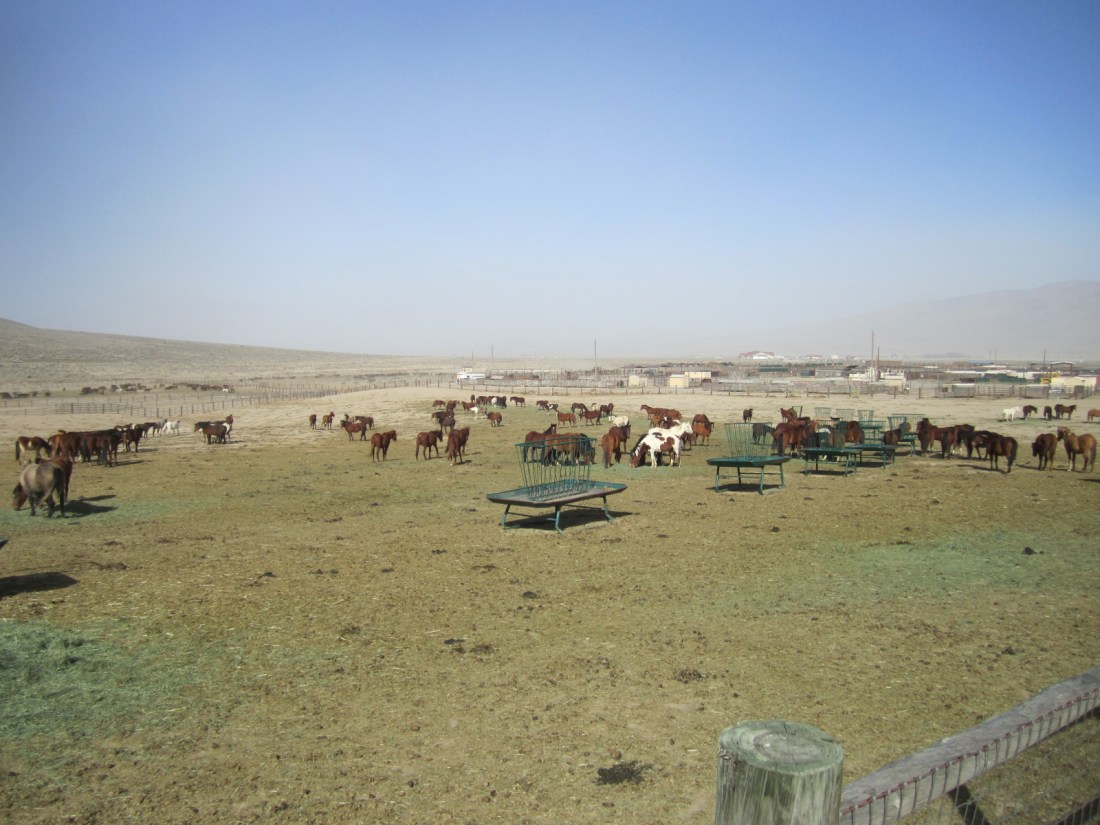
Photo: Studs from the Eagle Complex at Palomino Valley off-range corrals, 02-08-20.

RELATED: Eagle Roundup Day 29, Eagle Wild Horses Get Short End of Stick.

Rock Springs AML Amendments

The post about the four HMAs affected by the Rock Springs RMP amendment indicated that over 13,000 wild horses had been denied a place on their home range because of privately owned livestock.  How would that number be apportioned if the livestock were removed and the forage reassigned to the horses?

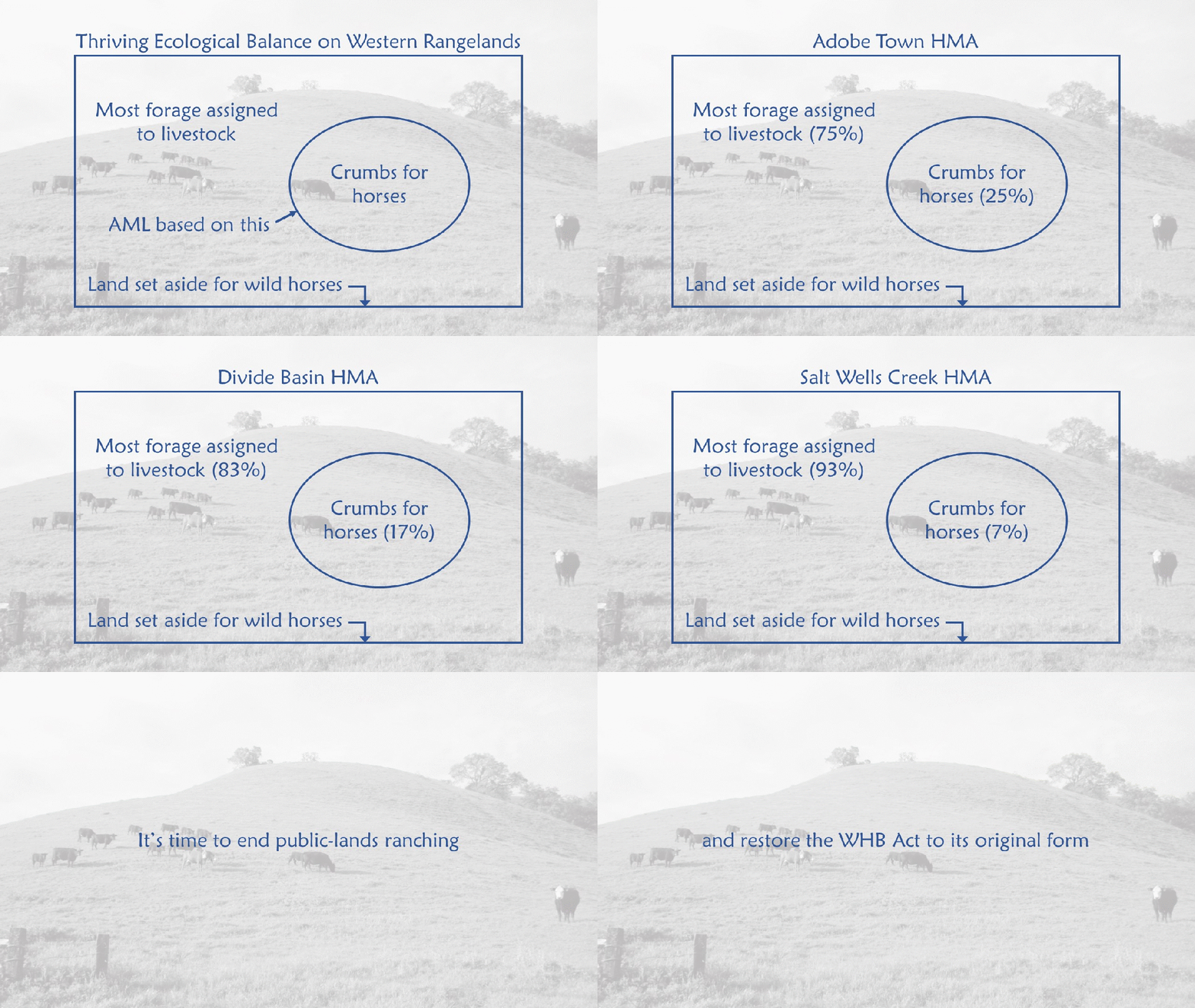
On the Adobe Town HMA, 29,412 AUMs per year consigned to livestock, which would support 2,451 horses (29,412 ÷ 12), for a new AML of 3,251 (800 + 2,451).

On the Divide Basin HMA, 35,914 AUMs per year consigned to livestock, which would support 2,993 horses (35,914 ÷ 12), for a new AML of 3,593 (600 + 2,993).

On the Salt Wells Creek HMA, 59,592 AUMs per year consigned to livestock, which would support 4,966 horses (59,592 ÷ 12), for a new AML of 5,331 (365 + 4,966).

On the White Mountain HMA, 34,588 AUMs per year consigned to livestock, which would support 2,882 horses (34,588 ÷ 12), for a new AML of 3,182 (300 + 2,882).

Are you surprised that AMLs could be this large?  Now do you understand why the government is warehousing so many wild horses, ramping up its outplacement programs, and shifting its messaging to ‘Off the Range?’

Rock Springs RMP Recap

Totals for the four HMAs affected by the proposed RMP amendment:

  • 2,810,951 acres available
  • 24,780 AUMs per year allocated to horses
  • 159,506 AUMs per year allocated to livestock

Other values needed to compute key management indicators for the complex:

  • 12 month grazing season for horses
  • 4 month grazing season for livestock (assumed)
  • 600 pounds dry weight per AUM (assumed)

Herd size

  • 2,065 horses allowed by plan (24,780 ÷ 12)
  • 39,876 cow/calf pairs allowed by plan (159,506 ÷ 4)

Stocking rate

  • 0.7 horses per thousand acres (2,065 ÷ 2,810,951 × 1,000)
  • 14.2 cow/calf pairs per thousand acres (39,876 ÷ 2,810,951 × 1,000)

Resource loading

  • 0.4 pounds per acre per month for horses (24,780 × 600 ÷ 2,810,951 ÷ 12)
  • 8.5 pounds per acre per month for livestock (159,506 × 600 ÷ 2,810,951 ÷ 4)

Livestock receive over six times as much forage than the horses—on lands set aside for the horses.  The stocking rate for livestock is 20 times higher.

Over 13,000 wild horses have been cheated out of a place on their home range because of the livestock, about 25% of the horses now in long-term holding (159,506 ÷ 12).

How many more HMAs would you have to evaluate to account for all of the wild horses in long-term holding?

How many wild horses have been displaced from all of the HMAs because of livestock?

How many mares will have to be darted (with contraceptives) before the government starts managing HMAs and WHTs principally for wild horses, per the statute?

“Hey WHW, that doesn’t make any sense.  You’d be darting mares if you wanted to manage the land primarily for livestock.”

Exactly.

RELATED: BLM FY 2021 Budget Request Targets Wild Horses, PZP Zealots Go Home.

IMG_0562

PZP Zealots Go Home

The government removes wild horses from HMAs not because there are too many of them, but because they’re robbing too much forage from the most noble and deserving inhabitants of western rangelands.

The PZP zealots, who try to pass themselves off as friends of the horses, also want to see their numbers reduced, by widespread application of contraceptives, a process that will turn them into non-reproducing herds.  They are allies of the public-lands ranchers.

RELATED: Contraceptives Are a Back-Door Channel to Sterilization.

PZP Zealots - Allies of the Public-Lands Ranchers

BLM FY 2021 Budget Request Targets Wild Horses

The President’s budget proposal for FY 2021 will take meaningful steps to address the untenable state of the WHB program and the unsustainable proliferation of wild horse herds on public lands, which far exceed what is healthy for the land and has impeded resource availability for other wildlife species, according to a news release issued today.

Not so fast, Chester.

What can’t be defended are the lies of omission about privately owned cattle and sheep on public lands designated for the horses and the amount of forage consigned thereto.

Consider the four HMAs affected by the Rock Springs RMP amendment, discussed at length on these pages over the last few days.

The total is 159,506 AUMs per year, enough to support 13,292 wild horses.  On just four HMAs!  Can you imagine the loss if the pattern is true for the other 173 HMAs?

There is no wild horse population crisis.  There is more than enough for them to eat on western rangelands.

The problem is the public-lands ranchers, their overlords, cheerleaders and political allies—not to mention their fences, which impede the movement of the horses, and the water holes they’ve stolen from them.

Thriving Ecological Balance on Western Rangelands