Livestock Are the Highly Valued Animals, Not Horses and Burros

When wild horse and burro herds are too large, relative to available natural resources, they can cause substantial damage to rangeland forage plants and soils, outcompete native wildlife species for scarce water, spread invasive plant species such as cheatgrass, reduce sage-grouse populations, limit post-fire ecosystem recovery and affect authorized grazing, according to a statement at the bottom of page 3 in the Strategic Research Plan (page 4 in the pdf).

A statement on page 7 (page 8 in the pdf) says the driver of the fertility control research is the large and increasing number of excess horses and burros living on the range, relative to available resources.

These statements are misleading because they suggest the land can’t support the current number of animals.

They should refer to allocated resources, not available resources, and explain to readers that most of them have been assigned to privately owned livestock through a planning process that puts ranching interests far above those of the horses and burros.

A keyword search search of the document yielded these results:

  • Livestock – No occurrences
  • Allotment – 0
  • Grazing – 1
  • Permit – 0
  • Cattle – 0
  • Sheep – 0
  • Allocation – 0
  • Land-use plans – 0

As usual, Western Horse Watchers has to tell the other side of the story.  Don’t expect the advocates to do that, they’re already riding the fertility control bandwagon.

RELATED: Wild Horse and Burro Research Initiative Announced, Origin of AMLs?

Wild Horse and Burro Research Initiative Announced

Development of safe, effective and longer-lasting fertility control methods is at the top of the list, along with the impact of climate change, according to today’s news release.

The research will support goals in a new Wild Horse and Burro Strategic Research Plan, which identifies topics that are the highest priority for improving BLM’s management of these “highly valued animals.”

No need to waste money on the second item, man-made global warming doesn’t exist.

As for the first item, is it consistent with the idea of highly valued animals?

In a statement following his arrest, a man who beat his wife, pushed her down the stairs and left her stranded on the edge of the road said he loves her.

Do you believe him?

If the bureaucrats take away almost half of their land and manage it principally for livestock, assign 85% of the food on the remainder to privately owned cattle and sheep, and use population suppression to keep the resource scales tipped indefinitely in favor of the ranchers, would you say they’re talking about highly valued animals?

Of course not.  You know them by their works, not by their words.

Economics of ‘Path Forward’

If the current population, assumed to be 80,000 horses, is reduced to AML (27,000), the goal of the rancher-friendly plan, and the excess forage is shifted to the ranchers, the revenue increment at current rates would be

(80,000 – 27,000) × 12 × 1.35 = $858,600 per year

The cost to remove 53,000 animals at $1,000 per head would be $53 million.

Few will be adopted, as the system is already flooded with captured animals.

The cost to stockpile them in long-term holding, around $2 per day per head, would be

53,000 × 2 × 365 = $38,690,000 per year

If they are placed in short-term holding the cost would be around $5 per day per head.

The government will spend $53 million initially to get them off the range, plus $39 million annually to care for them, so it can collect approximately $0.9 million per year from the ranchers.

Nobody in the private sector would do that.  There is no net present value, no positive rate of return.  A waste of taxpayer money.

UPDATE: Refer to Attachment 2 in the 2018 BLM Report to Congress for unit costs.

Washington Launches Another Attack on Working People

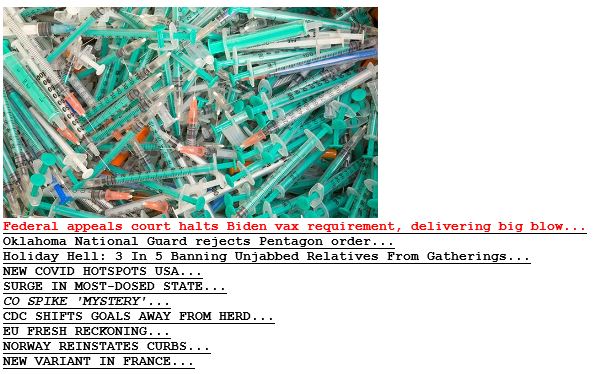
As if rising prices and supply chain disruptions weren’t enough, the one-horse pony and his illicit administration announced on Thursday new rules designed to persuade more Americans to take the clotshots, as described in a story by AP News.

Vaccine Mandate 11-04-21

It’s a fine example of the unelected bureaucracy trying to push us around.  How much longer are we going to put up with this?

The report said the pandemic has killed more than 750,000 Americans, but during the same period approximately two million pre-born kids were slaughtered in their mother’s wombs and he has done nothing about that except challenge those who would try to protect them.

These people are evil and and don’t care about you or your health.  They only want you subjugated to their totalitarian regime.

Wild Horse Management: Protection or Persecution?

A guest column in yesterday’s edition of The Durango Herald has some answers.

Not mentioned in the article is the important work of the advocates, who are trying to get rid of as many wild horses as possible with PZP, helping the government shift more resources to privately owned livestock.

They truly deserve more of your hard-earned money.

RELATED: No Shedding of Tears for the Public-Lands Ranchers!

Love Triangle on Americas Public Lands 08-19-21

Bias in Sand Wash Reporting?

The advocate interviewed for a report earlier this week by the CBS affiliate in Denver said the government should be getting rid of the horses with fertility control instead of helicopters.  Not a surprise but they chose to include it.

Inmates interviewed for a subsequent story, filmed at the off-range corrals in Cañon City, said the horses were better off there.  They may not understand all the issues, but by presenting their opinion, the producers sent the same message: Off the range.

A follow-up report, filmed at the HMA after the roundup, to document the animals that filled the void, hasn’t materialized.

Why was public-lands ranching omitted from the analysis?  Why not discuss the management priorities and resource allocations that put the interests of livestock operators far above those of the horses?

With a little more research, they could tell their viewers that the HMA can support many more wild horses, and that the roundup and darting program would be unnecessary if the ranchers were confined to their base properties and expected to pay market rates to feed their animals.

RELATED: Special Report on Roundup Alternatives Not So Special.

The Myth of Multiple Use

The original WHB Act refers to the term in the definitions:

(c) “range” means the amount of land necessary to sustain an existing herd or herds of wild free-roaming horses and burros, which does not exceed their known territorial limits, and which is devoted principally but not necessarily exclusively to their welfare in keeping with the multiple-use management concept for the public lands;

It’s not the multiple use you know today.  The term was defined in the Multiple-Use Sustained-Yield Act of 1960.

(a) “Multiple use” means: The management of all the various renewable surface resources of the national forests so that they are utilized in the combination that will best meet the needs of the American people; making the most judicious use of the land for some or all of these resources or related services over areas large enough to provide sufficient latitude for periodic adjustments in use to conform to changing needs and conditions; that some land will be used for less than all of the resources; and harmonious and coordinated management of the various resources, each with the other, without impairment of the productivity of the land, with consideration being given to the relative values of the various resources, and not necessarily the combination of uses that will give the greatest dollar return or the greatest unit output.

The MUSY Act is now 16 USC 528-531.  The definitions are in 16 USC 531.  The terms ‘livestock’ and ‘grazing’ do not appear in any of the sections.

The multiple use you know today was defined in the Federal Land Policy and Management Act, 43 USC 35, five years after the WHB Act was signed into law.

The definition, which may have been lifted from MUSY, is in §1702 of Subchapter 1.

(c) The term “multiple use” means the management of the public lands and their various resource values so that they are utilized in the combination that will best meet the present and future needs of the American people; making the most judicious use of the land for some or all of these resources or related services over areas large enough to provide sufficient latitude for periodic adjustments in use to conform to changing needs and conditions; the use of some land for less than all of the resources; a combination of balanced and diverse resource uses that takes into account the long-term needs of future generations for renewable and nonrenewable resources, including, but not limited to, recreation, range, timber, minerals, watershed, wildlife and fish, and natural scenic, scientific and historical values; and harmonious and coordinated management of the various resources without permanent impairment of the productivity of the land and the quality of the environment with consideration being given to the relative values of the resources and not necessarily to the combination of uses that will give the greatest economic return or the greatest unit output.

Wild horses and burros fall into the ‘historical values’ category.  They are not wildlife.

Unlike MUSY, FLPMA went on to define the principal uses of public lands managed by the BLM, putting livestock grazing at the top of the list.

(l) The term “principal or major uses” includes, and is limited to, domestic livestock grazing, fish and wildlife development and utilization, mineral exploration and production, rights-of-way, outdoor recreation, and timber production

Further, public involvement was associated with affected citizens.

(d) The term “public involvement” means the opportunity for participation by affected citizens in rulemaking, decisionmaking, and planning with respect to the public lands, including public meetings or hearings held at locations near the affected lands, or advisory mechanisms, or such other procedures as may be necessary to provide public comment in a particular instance.

That term wasn’t defined.

RELATED: Origin of AMLs?

Tale of Two Interests-1

Origin of AMLs?

The term does not appear in the original statute.

It can be found in the current statute, 16 USC 30, not in the definitions, but beginning in §1333(b)(1).

Footnotes to that section refer to amendments by Public Law 95–514, the Public Rangelands Improvement Act of 1978, a product of the 95th Congress.

The alteration, found in Section 14 of the original Act, authorized the government to get rid of excess animals on an arbitrary and capricious basis.

Appropriate Management Levels, the number of horses or burros allowed by plan, would be achieved by removing or destroying excess animals (bottom of page 6 in the pdf), not by allowing them to fill their niche.  They were to be small, relative to the available resources.

Who benefits from that?

Thriving Ecological Balance-3

RMPs Put Ranching Interests Far Above Those of Wild Horses

You can’t criticize public-lands ranchers about livestock grazing while you’re trying to get rid of wild horses with PZP—the latter helps the former—but the writer of a guest column in today’s online edition of the Wyoming Tribune Eagle does exactly that.

Miniscule AMLs, large amounts of forage assigned to livestock and enforcement actions such as helicopter roundups, fertility control, sex ratio skewing and sterilization have a common origin: Resource Management Plans, sometimes referred to as land-use plans.

If you want to help America’s wild horses, put your darting rifles down and change the plans so HMAs are managed principally for wild horses, not privately owned livestock.

RELATED: Rock Springs Roundup Just Getting Started.

Rock Springs Roundup Just Getting Started

A keyword search of a story posted today by Cowboy State Daily yielded these results:

  • Forage – 0
  • Allocation – 0
  • Livestock – 0
  • AUM – 0
  • Allotment – 0
  • Grazing – 0
  • Permit – 0
  • Consent decree – 0
  • Horses – 23
  • PZP – 7
  • Darting – 2
  • Overpopulation – 2
  • Fertility control – 2

The author didn’t mention the forage assigned to livestock and the number of wild horses displaced thereby.

Are you sure you still want to read it?

RELATED: Rock Springs Roundup Day 19.

BLM Limiting Observation of Rock Springs Roundup?

The Campaign Against America’s Wild Horses alleged on Monday that the agency moved the observation area to a location that blocks the view of the trap, which violates the public’s First Amendment right to observe the federal operation, according to a report posted yesterday by ABC4 News of Salt Lake City.

The group also wants cameras installed on the helicopters to create public transparency and independent oversight for operations that occur out of public view.

The organization and its supporters oppose wild horse roundups but not removals, arguing that the government should be getting rid of them with PZP not helicopters.

The lopsided resource allocations that put the interests of public-lands ranchers far above those of the horses, sometimes referred to as thriving ecological balances, are not on their radar screen.

PZP achieves the same results as the helicopters, in terms of herd sizes, but over a much longer timeframe.  The long-term effects may be worse than the roundups.  But that’s what the advocates bring to the table.

Pancake Gather Plan

State Intervenes in Challenge of Utah Gather Plans

The state recently filed a motion to intervene in a case brought by Friend of Animals against the BLM disputing four of the agency’s management plans that affect wild horses in six HMAs, including Muddy Creek and Onaqui Mountain.

The plans authorize fertility control and roundups over ten-year periods, eliminating public input and oversight, according to a column in The Salt Lake Tribune.

Western Horse Watchers believes the focus is wrong and rejects the statement about oil, gas and mineral extraction projects damaging the environment and contributing to climate change.  While those activities may have an effect on wild horses, it is small compared to the impact of public-lands ranching.

Gather plans don’t change the land-use plans, they enforce them.  By minimizing AMLs and shifting most of the resources to livestock operators, they drive the roundups and other resource enforcement actions, including

  • Fertility control
  • Sex ratio skewing
  • Sterilization
  • Euthanasia

Why not target the land-use plans and the policies and regulations that support them?

Some have been around for over 20 years.  Why don’t they come up for public review on a regular basis or have sunset provisions that necessitate their reauthorizations?

Advocates Don’t See Themselves as Dangers to Wild Horses

Next to the federal government, nobody’s getting rid of more wild horses than they are.

But a column in the current edition of Horse Tales, titled ‘Wild Horse Tales,’ claims the danger is the very people who say they love them.

For example, residents who give them hay when snow arrives.  Others, including your host, who put out water for them.  Then there are those (OMG) who toss apples that might choke them or induce colic.

Don’t they realize they’re putting the lives of those horses at risk?

Every year the advocates knock on doors and try to politely reason with those that are guilty.  They would never try anything like that.

WHC Arrogance 08-13-21

In some cases, the BLM gets a call about horses in someone’s yard, so they set a trap and remove an entire band.  A whole band!

Meanwhile, the advocates are getting rid of hundreds—if not thousands—of wild horses every year with their ruinous darting programs, as they lecture you about endangering their lives with water and apples.

They’re full of crap!

Back on the range, livestock graze peacefully in areas where the horses once roamed, thanks in part to the advocates.

Mid Year Status Report 06-09-21

‘Stay Wild’ Event Next Month

The online fundraiser, benefitting the Campaign Against America’s Wild Horses, will occur on November 4, according to an announcement at the bottom of page 3 in this month’s edition of Horse Tales.

Advocates use the term to signal their support for PZP darting programs.

If we get rid of them they can stay.  Their land will be managed primarily for livestock but we don’t want you to know about that.

Wilson at 2019 WSHE 10-19-21

SCAM ALERT: Stop the Roundups But Not the Removals

A letter about the Rock Springs roundup in today’s edition of the Jackson Hole News & Guide refers to the same site as the letter cited in yesterday’s post about well-meaning individuals led astray by groups masquerading as defenders of wild horses.

The site offers three letters “that can be copy and pasted and sent to your local media, no matter if you live in Wyoming or New York.”  Two of them include exhortations for fertility control.

Who created this site, Keep Wyoming Wyld?

Keep WY Wyld Logo 10-20-21

The browser tab shows the logo of the Campaign Against America’s Wild Horses, an organization consumed by the overpopulation narrative and dedicated to long-term achievement of resource allocations that put the interests of public-lands ranchers far above those of the horses, sometimes referred to as achieving and maintaining AMLs.

RELATED: Management Priorities at Rock Springs HMAs.

Most Wild Horse Advocates Have Never Seen Wild Horse Advocacy

Consider this letter to the editor about the Rock Springs roundup published yesterday by The State Journal of Frankfort, KY.  How could the author look at the data in Tables 1 and 8 of the Final EA and write something like that?

Easy.  She didn’t.  She knows nothing about them.  She was never informed by her sources about EAs, resource allocations and land-use plans.

How many other well-meaning individuals fall into that category?

They may be aware of the ranching advocacy groups, who don’t hide their agenda, but what about the variants dressed up as defenders of wild horses?

The message is always the same: Get rid of them.

The charlatans will tell you that getting rid of them with helicopters is bad, but getting the rid of them with PZP is good.  The process is slower so you need to be patient.

Although timing and methods differ, their goals are identical: Make sure that privately owned cattle and sheep are the primary, if not principal, consumers of resources in areas set aside for wild horses and burros.

RELATED: Management Priorities at Rock Springs HMAs.