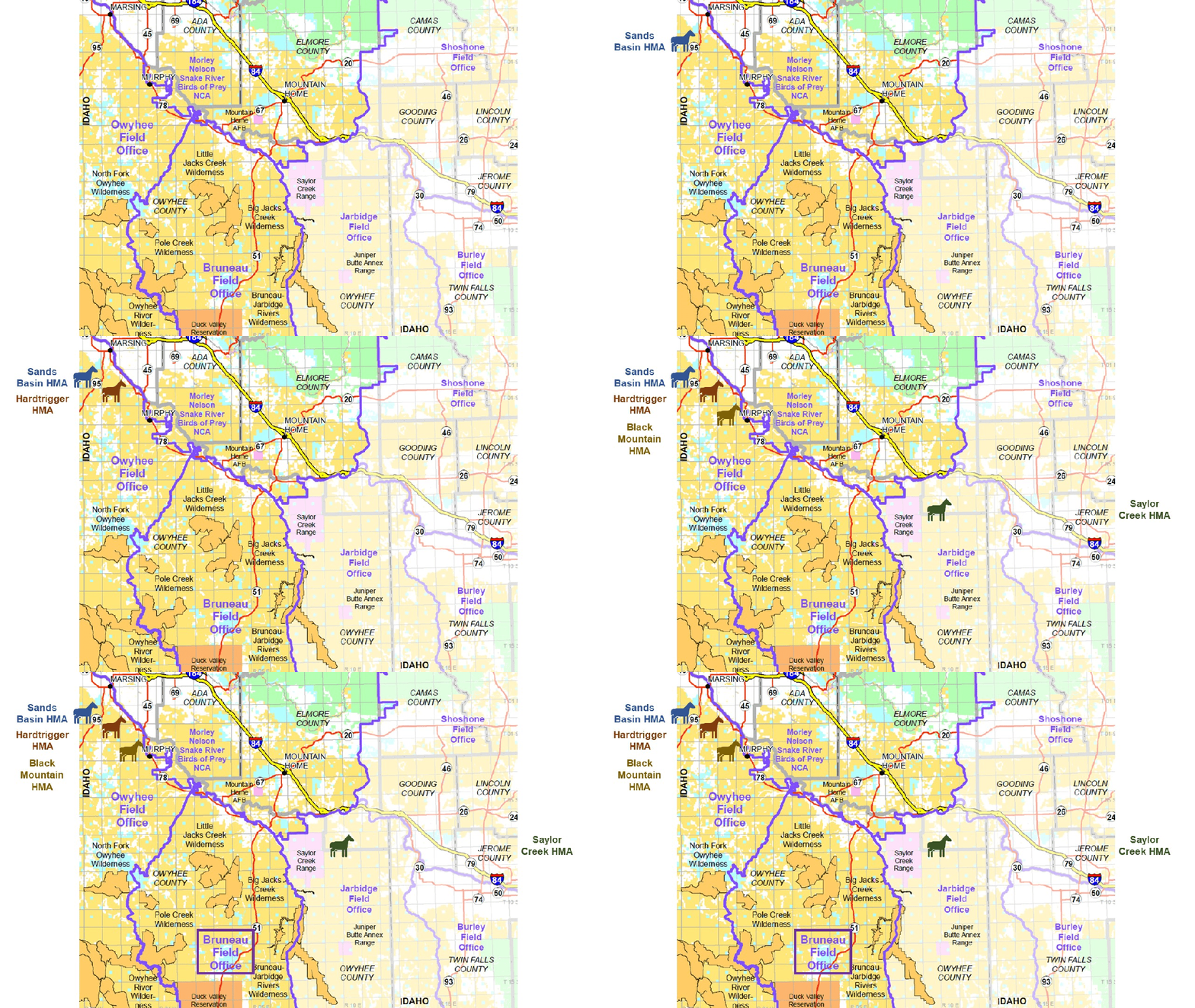
They are areas identified in 1971 for wild horses and burros. Today, most of the HMAs are managed primarily for livestock, while the HAs are managed almost exclusively for livestock. Privately owned, of course.

Western Horse Watchers Association
Exposing the Hypocrisy, Lies and Incompetence of the Wild Horse Advocates
They are areas identified in 1971 for wild horses and burros. Today, most of the HMAs are managed primarily for livestock, while the HAs are managed almost exclusively for livestock. Privately owned, of course.

A letter cited yesterday in a report by The Record-Courier of Gardnerville, NV implied that you don’t have a self-sustaining population if you provide water to wild horses.
Giving them water, other than in an emergency, doesn’t meet the definition of minimum feasible management, according to the letter, but at the Confusion HMA, cutting ovaries out of mares does.
The mustangs inhabit the southern portion of the Pine Nut Mountains HA, an area identified for wild horses in 1971 but no longer managed for them due to inadequate resources.
The area can support permitted livestock grazing, however.
The incident began on December 6. Gather stats through December 13:
Helicopters were grounded on Day 7 due to weather.
One horse was put down on Day 6 and three on Day 8 due to pre-existing conditions, bringing the death rate to 4.6%.
Foals accounted for 15.1% of the horses gathered. Roughly 51% of captured adults were males and 49% were females.
Body condition scores are not known.
The number of horses shipped is 248 according to the gather page. No shipments were reported on Day 8.
The number of unaccounted-for animals is 325 – 0 – 15 – 224 = 86.
RELATED: Delamar Roundup Day 5.
Wild horses should be relocated to remote wilderness areas, to satisfy growing demand for range-fed beef, according to a column published yesterday by the Mail Tribune of Medford, OR. There, apex predators will keep their populations in check and cattle ranchers will be able to enjoy the full benefit of areas set aside for wild horses.
This is nuts. If Equine Elite can buy an 80-acre parcel near Burns, WY to build a high-density animal feeding operation—for horses removed from public lands—why is it unreasonable to expect the ranchers to do that? Many of them already have base properties of several thousand acres.
And why is it unreasonable to expect that lands identified for wild horses in 1971, about 50 million acres, should be managed principally for them, per the original statute?

At the southwest corner of the Virginia Range with Jeff and Michelle.
Haven’t felt like writing very much today, lost one of my horses. He would have been 30 in a few weeks. Didn’t have any papers but was supposedly part thoroughbred. He’s the middle horse in this photo from June 28.

Two more letters have been published in the East Oregonian. Both point to livestock as the problem and neither argues for contraceptives.
Counterpoint #2: Reader response dated December 12.
Counterpoint #3: Reader response dated December 12.
How refreshing. The original column appeared on December 5.
RELATED: Slaughter Debate Continues.
The American Wild Horse Campaign has become the third advocacy group, following Wild Horse Education and Return to Freedom, to oppose the BLM’s plan to sterilize wild mares captured in the Confusion HMA, according to a report posted today by Law Street Media.
RELATED: Confusion DR Setting New Precedent in WH Management?
The case brings three counts of injury and damage to the Plaintiff, to be remedied by enjoining the Defendants from carrying out any aspect of the proposed sterilizations.
RELATED: RTF Tries to Stop Sterilization of Confusion Wild Mares.
The incident began on December 6. Gather stats through December 10:
Three horses were put down on Day 4 and one on Day 5 due to pre-existing conditions, bringing the death rate to 4.2%.
Foals accounted for 14.7% of the horses gathered. Roughly 49% of captured adults were males and 51% were females.
Body condition scores are not known.
The number of horses shipped is 161 according to the gather page. No shipments were reported on Day 4.
The number of unaccounted-for animals as of Day 5 is 117.
RELATED: Delamar Roundup Day 3.
The writer of a letter to the Las Vegas Review-Journal says it’s the easiest and cheapest way to curtail herd growth.
Why would you want to curtail herd growth?
Look at the gather area for the new Desatoya resource enforcement plan, currently out for review. The boundary, denoted in red, extends well beyond the HMA.

When you carve out over 80% of their food and sell it to public-lands ranchers, don’t you think the horses might outgrow the remaining resources fairly quickly and move off the reservation in search of new ones?
That puts them into areas managed exclusively for wildlife and the most noble and deserving inhabitants of America’s public lands: Privately owned livestock.
Return to Freedom filed suit today in federal court to block the plan, according to a news release, arguing that contraceptives should be used to control herd sizes.
The resource allocations and management priorities that leave wild horses with crumbs on public lands in the western U.S., in favor of privately owned cattle and sheep, were not mentioned in the announcement.
The group is a signatory to the rancher-friendly ‘Path Forward,’ a plan to manage wild horse areas primarily for livestock.
That’s what the writer of a letter to the Pagosa Daily Post was told.
As for the number of livestock allowed on America’s public lands, the figure offered by the writer is a fairly good estimate.
The BLM sells about 12 million AUMs per year to public-lands ranchers. If you assume an average grazing season of six months per year, that’s two million cow/calf pairs.
That forage would support one million wild horses, enough to empty all of the off-range corrals and long-term pastures twenty times over.
Point: Column in the East Oregonian dated December 5.
Counterpoint: Reader response dated December 10.
Neither writer mentions the horses displaced from public lands by privately owned livestock. Nearly 2,000 at the Pancake HMA and that’s just one of approximately 200 WHTs and HMAs.
Given that the ranchers pay about five cents on the dollar to feed their cattle, the product should be dirt cheap and good way to help the poor.
Range-fed beef. Yum.
The incident began on November 29. Gather stats through December 9:
Helicopters were grounded on Day 10 and no deaths were reported on Days 10 and 11.
Foals accounted for 24% of the horses gathered. Roughly 40% of the captured adults were males and 60% were females.
The cumulative total is 304, according to the gather page. The discrepancy is probably in the November 30 figures.
Body condition scores on Day 11 ranged from three to five.
The number of unaccounted-for animals is 32. The contractor may be holding them on site.
The collared mare taken to Swasey may have been part of a research project. GPS radios are in use at the Frisco HMA, probably elsewhere.
RELATED: Confusion Roundup Day 9.
BLM announced today the beginning of a 30-day comment period on a draft EA for wild horse management actions over the next ten years.
The Proposed Action (Alternative 1) features roundups, contraceptives, IUDs and sex ratio skewing.
The HMA covers 161,678 acres in central Nevada and has an AML of 180, for a stocking rate of 1.1 horses per thousand acres. The map in Figure 1-1 shows the gather area, denoted by a red boundary. The HMA has been shaded yellow.

The HMA intersects four grazing allotments. The horses allowed by plan receive 2,160 AUMs per year, compared to 9,608 AUMs per year for livestock, according to data in Table 3-2 of the EA.
Comments will be accepted through January 9.
It was signed into law on December 9, 1970, according to a news release by Animal Wellness Action, a lobbying group in Washington, DC.
The WHB Act would not become law for another year.
RELATED: Coming Soon: WHB Act at 50.