Grazing Service Alive and Well at BLM

This article in the Daily Camera of Boulder, CO refers to the anti-horse bias at the BLM, which dates back to its predecessor, the Grazing Service.

But it’s not just horses.  Anything that interferes with public-lands ranching is targeted.

Examples include wildlife, invasive weeds and trees that crowd out forage.

BLM3

The article includes a post-roundup photo of Sand Wash Basin showing hundreds, if not thousands, of sheep dotting the landscape.

But it does not mention the BLM’s partners in the management process, who protect the ranchers after the fact with the Montana Solution.

In the case of Sand Wash Basin, it’s SWAT, a group that helps the agency enforce the RMP that assigns 79% of the available forage to livestock while guaranteeing that the 1,402 horses displaced from the HMA by permitted grazing never come back.

Good job guys, a fine example of the Love Triangle on America’s public lands.

RELATED: No More Large-Scale Roundups at Sand Wash Basin?

Surprises at Sands Basin HMA

The HMA lies mostly within the Sands Basin Allotment according to the Western Watersheds map.

The 64 horses allowed by plan require 768 AUMs per year and the HMA covers 11,724 acres, so the aimed-at stocking rate is 5.5 wild horses per thousand acres, considerably higher than the target rate across all HMAs of one wild horse per thousand acres.

The land must be able to produce at least 65.5 AUMs per year per thousand acres to support the Sands Basin horses.

Sands Basin Allotment Map 04-17-22

The allotment, in the Improve category, covers 13,565 total acres, including 10,883 public acres, and currently offers 558 AUMs per year for livestock, according to the Allotment Master Report.

This means the horses receive more forage than the ranchers!

The percentage of the allotment occupied by the HMA is unknown and the Draft EA may be months away but the forage assigned to livestock inside the HMA has to be less than or equal to 558 AUMs per year.

The allotment must be able to produce at least 41.1 AUMs per year per thousand acres to satisfy the ranchers, enough to support 3.4 wild horses per thousand acres.

The carrying capacity of the HMA, neglecting wildlife, would be 5.5 + 3.4 = 8.9 horses per thousand acres, assuming that forage is evenly distributed across the allotment.

The True AML would be 8.9 × 11,724 ÷ 1,000 = 104, the number of horses the HMA could support if it was managed principally for them.

The horses displaced from the HMA by permitted grazing would be the difference between the True AML and current AML, 104 – 64 = 40, or 3.4 × 11,724 ÷ 1,000.

The current size of the herd is unknown.

RELATED: New Resource Enforcement Plan Coming to Owyhee Mountains?

How to Help Three Fingers and Jackies Butte Horses

Like other HMAs, their AMLs are small relative to the available resources because most of them have been assigned to privately owned livestock.

This is a condition that the PZP fanatics won’t even acknowledge, let alone challenge.

Their mission is to protect the ranchers, not the horses, which is why you shouldn’t be giving them money.

Would Herd Management Area Plans (HMAPs) help?

The BLM allocated forage for livestock in the 2002 Record of Decision for the Southeastern Oregon Resource Management Plan, which was carried forward from the 1984 Southern Malheur Rangeland Program Summary, according to Section 3.2.2 of the Draft EA for resource enforcement actions in the HMAs.

If the HMAPs did not alter the specifications of the RMP, they could only ratify and reinforce current practices, which are biased in favor of the ranchers.

RELATED: How Many Wild Horses Can Jackies Butte HMA Support?

Pancake Gather Plan

CAAWH Marks Three Years on Virginia Range

There is no column in the current edition of Horse Tales by the real estate agent and PZP darter in the Minden/Gardnerville area but there is an acknowledgement by the Campaign Against America’s Wild Horses at the bottom of page 18 about the outpouring of support for their work.

Their goal is to convince the bureaucrats that PZP darting is a viable alternative to helicopter roundups and that there is better way of enforcing the lopsided resource allocations that put ranching interests far above those of the horses.

RELATED: Three Out of Four Americans Duped by Advocates?

Water Improvements Help Heber Hunters and Ranchers

The following video by the Arizona Game and Fish Department discusses the use of habitat enhancement funds on the Heber Allotment, which overlaps the WHT.

The Western Watersheds map shows the arrangement.

Heber Allotment Map 04-16-22

The ranchers also benefit from mining operations, in a way you might not expect, as noted at 1:49.

As for the horses, they weren’t considered in the analysis.

The forage assigned to livestock in the allotment is not known and Western Horse Watchers has not yet discovered an equivalent to RAS for the Forest Service.

Forage density (AUMs per year per thousand acres), is a better indicator of carrying capacity than AMLs.

Rescue of Salt River Stallion Captured on Film

The story begins at 0:52.  The advocates get involved at 3:15.

Why is there a cattle guard in an area frequented by wild horses and why would they offer assistance to an animal they’re trying to eradicate?

The woman on the ground at 4:17 might be wearing a “Stay Wild” cap, a signal to others that she’s down with the Montana Solution.

RELATED: Salt River Stallion Freed from Cattle Guard.

Crocodile Tears at Currituck Outer Banks?

The advocates are devastated, or so they say, according to a post on socialist media.

Advocates Devastated 04-16-22

If you’re a purveyor of the Montana Solution, are you really annoyed by the loss of a wild horse?

The death of Charlie, first foal of 2022, is the latest in a string of incidents in the area.

These are the headlines from the past year!

All of this while the advocates bill themselves as “The Official & Only Non-Profit Protectors of the Wild Horses.”

RELATED: What Will Happen to Mom of New Currituck Foal?

New Resource Enforcement Plan Coming to Owyhee Mountains?

A new project was created in ePlanning yesterday but only a map was posted.

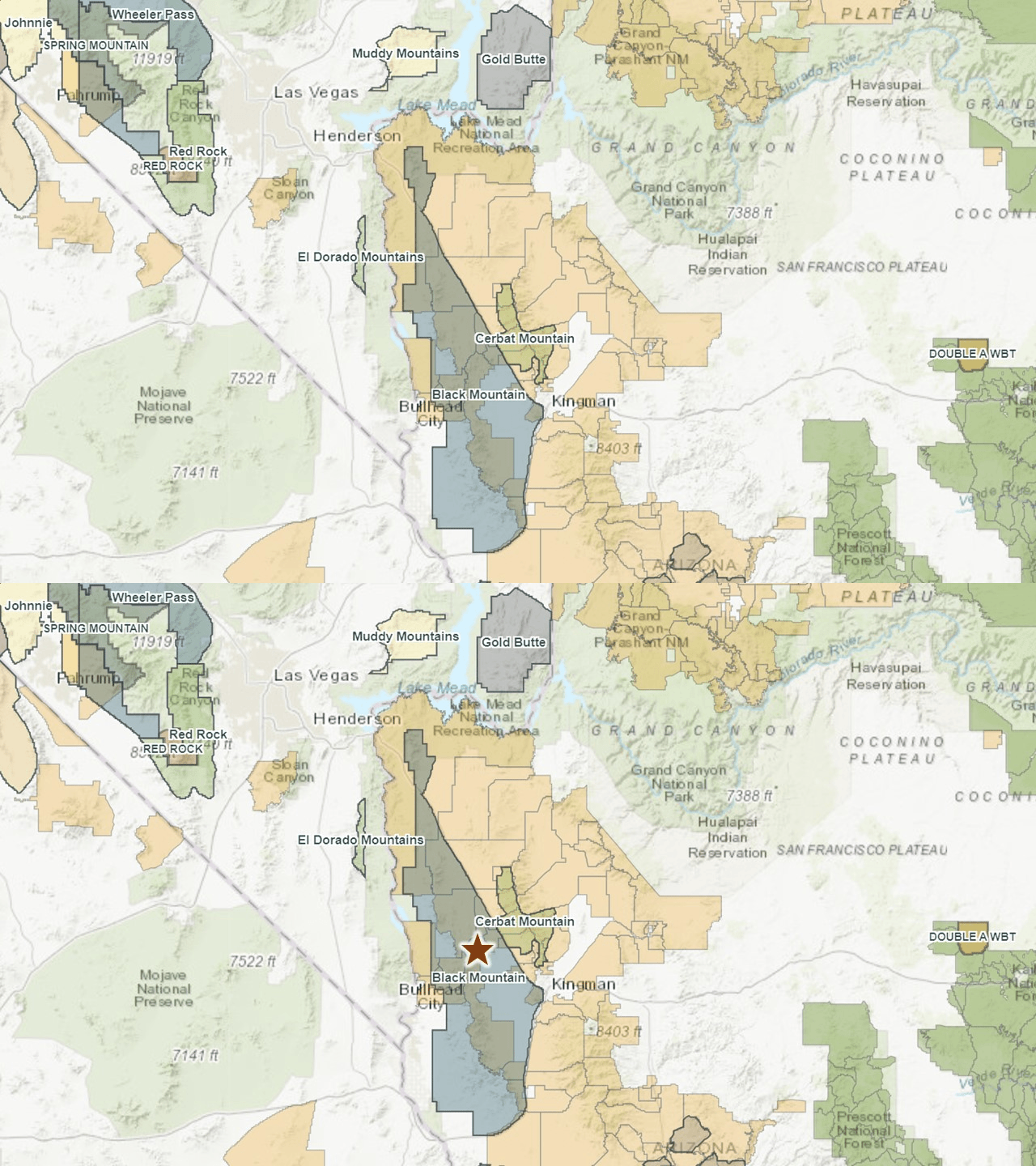
The scope includes the Sands Basin, Hardtrigger and Black Mountain HMAs in western Idaho, with AMLs of 64, 130 and 60, respectively.

All three are subject to permitted grazing, as shown in the Western Watersheds map.

Sands Basin HMA Map 04-15-22

The Proposed Action will likely employ aerial roundups and other forms of population suppression to assure that most of the forage goes to privately owned livestock, as specified in the land-use plan(s).

Many of the horses in the area were removed after the 2015 Soda Fire but some were returned four years later.

How Many Wild Horses Can Jackies Butte HMA Support?

The 150 horses allowed by plan require 1,800 AUMs per year.

The the number of wild horses the HMA can support, if it was managed principally for them as specified in the original statute, referred to on these pages as the True AML, can be found as outlined in this post.

The idea is to shift the forage assigned to livestock back to the horses, which is heresy to the bureaucrats, ranchers and PZP fanatics.

Section 3.2.2 of the Draft EA for resource enforcement actions in Three Fingers and Jackies Butte identifies one grazing allotment that overlaps the HMA.  The Western Watersheds map shows the arrangement.  Click on image to open in new tab.

Jackies Butte Allotments 04-10-22

The Allotment Master Report provides the active AUMs.

Table 6 in the EA indicates that 28.5% of Jackies Butte Summer is inside the HMA.

The forage assigned to livestock inside the HMA is 3,947 AUMs per year, assuming the resource is evenly distributed across the allotment.

Three Fingers and Jackies Butte Allotment Calcs 04-10-22

That amount would support 3,947 ÷ 12 = 328 wild horses.

The True AML is 150 + 328 = 478.

The current herd, thought to include over 200 adults according to Section 1.2 of the EA, is well within this range.  The HMA is not overpopulated and there is no justification for a roundup or fertility control program, which the Proposed Action would implement over a ten-year period.

The stocking rate at the new AML, based on the acreage of Section 1.2, would be 478 ÷ 65,211 × 1,000 = 7.3 wild horses per thousand acres.

Given that the horses currently receive 31% of the authorized forage, neglecting wildlife, the HMA is managed primarily for livestock.

The 328 horses displaced from the HMA by permitted grazing represent about 0.6% of the 55,000 animals in off-range holding.

The number of horses displaced from the Three Fingers HMA was 423 and the True AML was 573, as discussed previously.

RELATED: Status of Three Fingers and Jackies Butte Allotments.

Virginia Range Fence Installation Almost Complete

The Nevada Department of Transportation installed eight miles of four-strand, four-foot livestock fencing along U.S. 50 in the Dayton area to reduce collisions between vehicles and wild horses, according to a report posted yesterday by KOLO News of Reno, NV.

Many more horses have been lost to the advocates than motorists and they are still the greatest threat to the herd, fencing notwithstanding.

RELATED: Fence Installation Next Week on South Edge of Virginia Range.

Advocates are the Predators 11-30-21

Mesa Verde Roundup Continues, Private Placement Begins

The incident began last September, with the capture of one wild horse using low-stress techniques, according to a news release by the Park Service dated October 8.

Now he’s been adopted, as explained in this article by The Journal of Cortez, CO.

The park is known for its cliff dwellings and wildlife.  The horses are described as trespass livestock.

RELATED: Mesa Verde Roundup in Progress.

How Many Wild Horses Can the Three Fingers HMA Support?

The 150 horses allowed by plan require 1,800 AUMs per year.

The True AML, the number of wild horses the HMA could support if it was managed as specified in the original statute, can be found as outlined in this post.

Section 3.2.2 in the Draft EA for resource enforcement actions in Three Fingers and Jackies Butte identifies two grazing allotments that intersect the HMA.  The Western Watersheds map shows the arrangement.  Click on image to open in new tab.

Three Fingers Allotments 04-10-22

The Allotment Master Report provides the active AUMs.

Table 5 in the EA indicates that 28% of Board Corrals is inside the HMA, along with 39.2% of Three Fingers.

The forage assigned to livestock inside the HMA is 1,172 + 3,913 = 5,058 AUMs per year, assuming the resource is evenly distributed across the two allotments.

Three Fingers and Jackies Butte Allotment Calcs 04-10-22

That amount would support 5,058 ÷ 12 = 423 wild horses.

The True AML is 150 + 423 = 573.

The current population, thought to be around 280 adults according to Section 1.2 of the EA, is well within this range.  There is no justification for a roundup or fertility control program, which the Proposed Action would implement.

The stocking rate at the new AML, based on the acreage of Section 1.2, would be 573 ÷ 62,508 × 1,000 = 9.2 wild horses per thousand acres.

Given that the horses currently receive 26% of the authorized forage, neglecting wildlife, the HMA is managed primarily for livestock.

The 423 horses displaced from the HMA by permitted grazing represent about 0.8% of the 55,000 animals in off-range holding.

RELATED: Status of Three Fingers and Jackies Butte Allotments.

What Will Happen to Mom of New Currituck Foal?

She’s reached her quota.  The herd is too important to leave its genetics to nature.

Will the advocates put her back on PZP for the rest of her life or at least until she’s sterile so another mare can have her turn?

From this viewpoint, horses lost to contaminated water, collisions with vehicles, damaged fences, or otherwise removed from the area, are a good thing, they take some pressure off the darting budget.

RELATED: Fourth Foal of Year Appears on Currituck Outer Banks.