Antelope Roundup North, Day 5

The incident began on July 9.  Results through July 13:

  • Scope: Spruce-Pequop, Goshute, Antelope Valley HMAs
  • Purpose: Pest control, resource enforcement, rancher protection
  • Target: Horses
  • Type: Planned
  • Method: Helicopter
  • Category: Cruel and costly*
  • Better way: Poison mares with ovary-killing pesticides*
  • Captured: 202, up from 71 on Day 3
  • Average daily take: 40.4
  • Capture goal: 2,000
  • Removal goal: 2,000
  • Returned: None
  • Deaths: 3, up from zero on Day 3
  • Shipped: 122, up from zero on Day 3

The figures above are based on the daily reports, which may differ slightly from the totals posted by the BLM.

A foal died on Day 5 due to colic and a stallion was put down because of a compound break in his left rear leg.  A foal was euthanized due to lameness.

The death rate is 1.5%.

The capture total includes 69 stallions, 99 mares and 34 foals.

Youngsters represented 16.8% of the animals gathered.

Of the adults, 41.1% were male and 58.9% were female.

A 17% birth rate corresponds to a herd growth rate of 12% per year.

Land managers often use growth rates of 20% per year to predict herd sizes and management actions.

Body condition scores were not provided.

The location of the trap site was not disclosed.

The HMAs and surrounding lands are subject to permitted grazing.

*According to advocates.
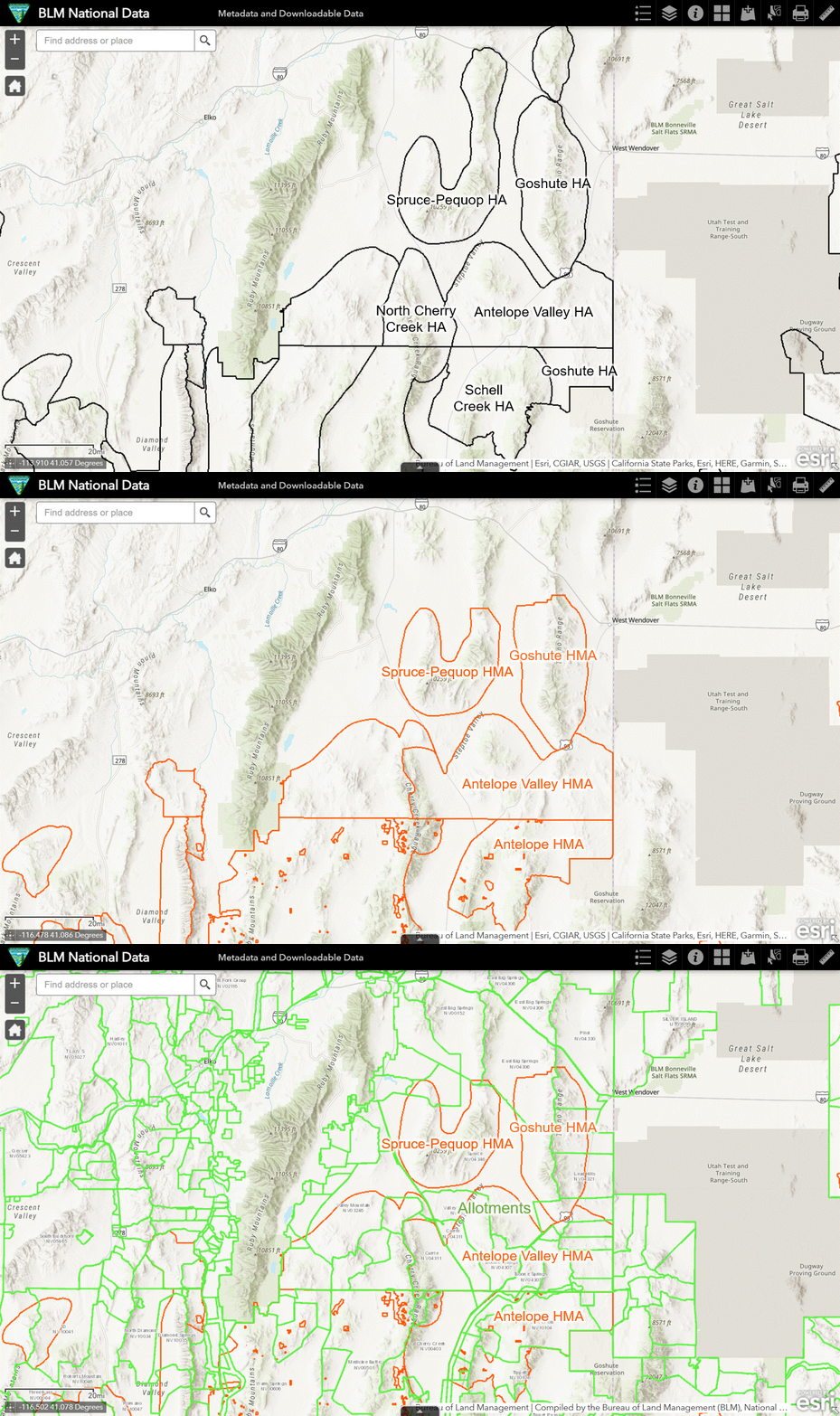
Antelope Complex with Allotments 07-06-23

Day 5 ended with 77 unaccounted-for animals.

There are no plans to treat captured mares with fertility control pesticides and return them to the area.

Other statistics:

  • Forage liberated to date: 2,424 AUMs per year
  • Water liberated to date: 2,020 gallons per day
  • Forage assigned to livestock: Unknown
  • Horses displaced from area by permitted grazing: Unknown
  • True AML: Unknown
  • Stocking rate at new AML: Unknown
  • Horses removed because of drilling and mining: Ask the advocates

Overpopulation means more horses than allowed by plan, not necessarily more horses than the land can support.

RELATED: Antelope Roundup North, Day 3.
PBS Looks at Invasive Species

As usual, the nonprofit is silent about permitted grazing and the presence of livestock in this 12-minute segment about wild horses.

If they were honest about that, their viewers would understand why there are few if any predators in these areas.

They didn’t admit that horses appear in the North American fossil record while cattle and sheep do not.

The roundup scenes were probably filmed last year at the Twin Peaks HMA.

The July 23 report at the BLM gather page mentions a PBS production crew working on “Human Footprint, the Film.”

Video queued up to the mark, just hit go.

RELATED: What PBS Didn’t Tell You About America’s Wild Horses.

Antelope Roundup North, Day 3

The incident began on July 9.  Results through July 11:

The figures above are based on the daily reports, which may differ slightly from the totals posted by the BLM.

The capture total includes 26 stallions, 30 mares and 15 foals.

Youngsters represented 21.1% of the animals gathered.

Of the adults, 46.4% were male and 53.6% were female.

The herd may be growing at a rate of 16% per year, given a birth rate of 21% per year.

Body condition scores were not provided.

The location of the trap site was not disclosed.

The HMAs and surrounding lands are subject to permitted grazing.

Antelope Complex with Allotments 07-06-23

Day 3 ended with 71 unaccounted-for animals.

There are no plans to treat captured mares with fertility control pesticides and return them to the area.

Other statistics:

  • Forage liberated to date: 852 AUMs per year
  • Water liberated to date: 710 gallons per day
  • Forage assigned to livestock: Unknown
  • Horses displaced from area by permitted grazing: Unknown
  • True AML: Unknown
  • Stocking rate at new AML: Unknown
  • Horses removed because of drilling and mining: Ask the advocates

Overpopulation means more horses than allowed by plan, not necessarily more horses than the land can support.

*According to advocates.

RELATED: Antelope Roundups in Progress.

Eureka Base Property Hits Market for $2.75 Million

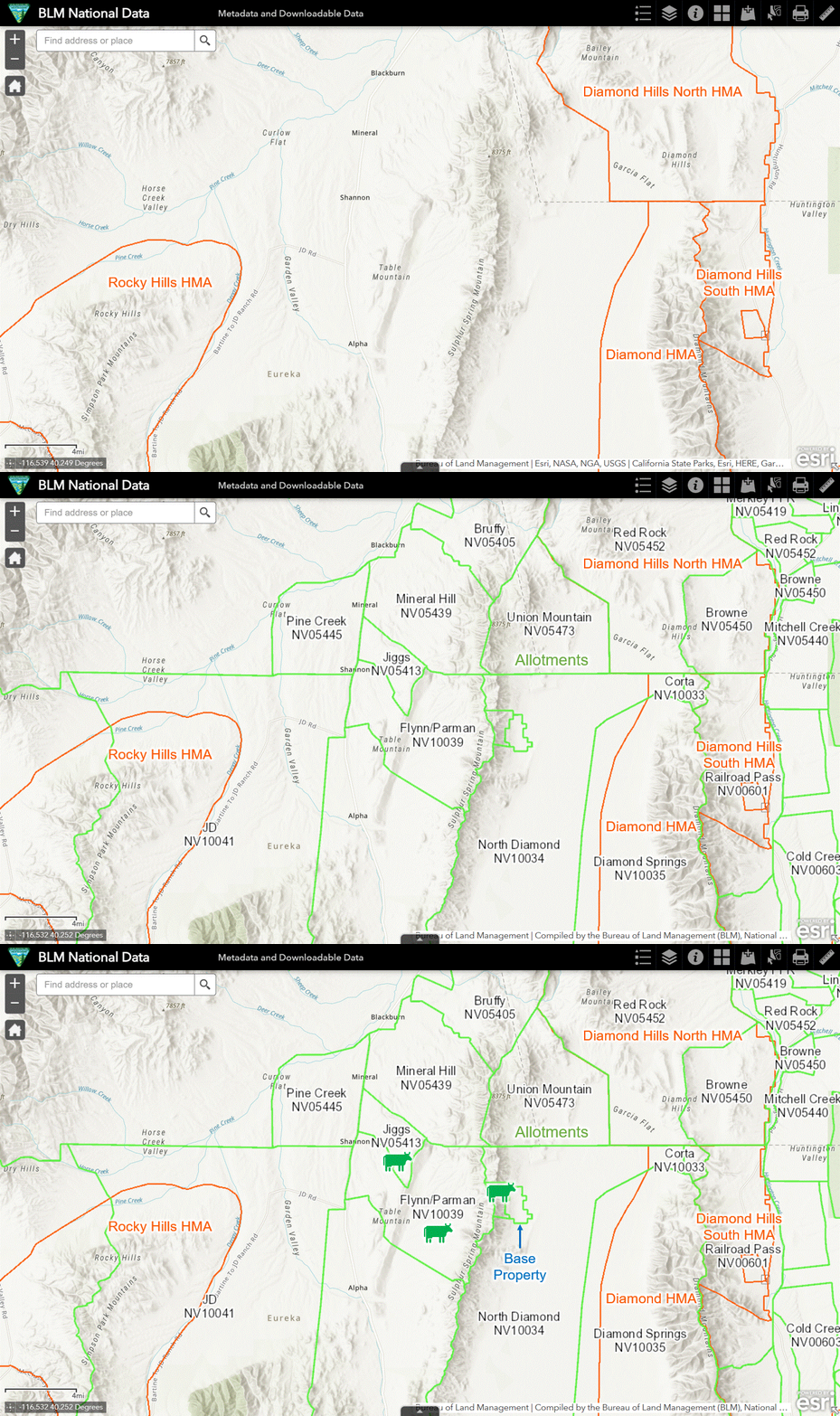
Located between the Rocky Hills and Diamond HMAs, Diamond Springs Ranch covers 994 deeded acres, with grazing preference on three BLM allotments producing 2,100 AUMs per year, according to the listing by Hall and Hall.

The property features 341 acres under three pivots, three mobile homes, a shop, barn and corrals.

Water sources include seven springs, three ponds and two wells.

The agent’s map ties the deeded acreage to the Jiggs, Flynn/Parman and Parman Individual allotments.

The National Data Viewer shows the arrangement.  Click on image to open in new tab.

Diamond Springs Ranch with Allotments 07-12-23

The Allotment Master Report puts Jiggs and Flynn/Parman in the Improve category, with Parman Individual in Custodial (condition unknown).

The Authorization Use Report shows cattle on an 8.5 month grazing season for all three.

Where do the animals go during the off season?  Back to the base property.

The allotments offer a combined 2,124 AUMs per year on 33,303 public acres, enough to support 177 wild horses.

The stocking rate would be 5.3 wild horses per thousand public acres, five times higher than the rate allowed by the bureaucrats (27,000 animals on 27 million acres).

A buyer could petition the BLM for a change in livestock type and season of use, turning the ranch into a wild horse sanctuary, as American Prairie did for bison in Montana.

Think of it as a rewilding project, where you leverage 994 private acres to control 33,303 public acres.  No off season.

RELATED: Yes to American Prairie, No to Mustang Monument.

UPDATE: Added video.

Antelope Roundup South, Day 3

The incident began on July 9.  Results through July 11:

  • Scope: Antelope, Antelope Valley HMAs
  • Purpose: Pest control, resource enforcement
  • Target: Horses
  • Type: Planned
  • Method: Helicopter
  • Category: Cruel and costly*
  • Better way: Poison mares with ovary-killing pesticides*
  • Captured: 270, up from 22 on Day 1
  • Average daily take: 90.0
  • Capture goal: 1,107
  • Removal goal: 1,107
  • Returned: 1, up from zero on Day 1
  • Deaths: 2, up from 1 on Day 1
  • Shipped: 200, up from zero on Day 1

The figures above are based on the daily reports, which may differ slightly from the totals posted by the BLM.

A stallion jumped the trap on Day 2, regaining his freedom.

A foal died in holding on Day 2 due to colic.

The death rate is 0.7%.

The capture total includes 93 stallions, 118 mares and 59 foals.

Youngsters represented 21.9% of the animals gathered.

Of the adults, 44.1% were male and 55.9% were female.

The herd may be growing at a rate of 17% per year, given a birth rate of 22% per year.

Body condition scores were not provided.

The location of the trap site was not disclosed.

The HMAs and surrounding lands are subject to permitted grazing.

Antelope Complex with Allotments 07-06-23

Day 3 ended with 67 unaccounted-for animals.

Mares treated with fertility control pesticides will be returned to the area at a later date.

Other statistics:

  • Forage liberated to date: 3,228 AUMs per year
  • Water liberated to date: 2,690 gallons per day
  • Forage assigned to livestock: Unknown
  • Horses displaced from area by permitted grazing: Unknown
  • True AML: Unknown
  • Stocking rate at new AML: Unknown
  • Horses removed because of drilling and mining: Ask the advocates

Overpopulation means more horses than allowed by plan, not necessarily more horses than the land can support.

*According to advocates.

RELATED: Antelope Roundups in Progress.

Clear Creek Livestock Thrive in Area Unfit for Wild Horses

Clear Creek Ranch, located about 15 miles south of Winnemucca, NV, sold last year to J6 Ranches, according to Pershing County assessor’s records.

The listing by Hall and Hall says it covers 10,457 deeded acres, with grazing preference on 48,370 BLM acres producing 2,995 AUMs per year.

The asking price was $8.9 million.

The base property, described in the following video, lies mostly within the Clear Creek Allotment, which lies within the Sonoma Range HA, an area identified for wild horses.

The National Data Viewer shows the arrangement.  Click on image to open in new tab.

Sonoma Range HA with Clear Creek Allotment 07-11-23

The Allotment Master Report puts Clear Creek in the Maintain category, with 2,931 active AUMs on 48,370 public acres.

That works out to 60.6 AUMs per year per thousand public acres, enough to support five wild horses per thousand public acres.

The BLM insists that public lands in the western U.S. can only support one wild horse per thousand public acres (27,000 animals on 27 million acres).

How many wild horses are allowed in the HA?  None (AML is zero).

As for the amenities, the log cabin is in APN 009-300-28, with other structures and equipment in APN 009-300-27.

Some of the deeded acreage is in Humbolt County, not covered here.

The HA covers 212,587 total acres, including 150,095 public acres.

The current population is 146, according to the March 2023 HA/HMA Report, and the last roundup was in 1987.

RELATED: Winnemucca Base Property Hits Market for $11.2 Million.

Horses of the Coalfields: Tragedy, Nuisance or Tourist Attraction?

A reporter for Lancaster Farming looks at the work of Tinia Creamer and her rescue in a story dated July 8.

As mentioned previously, some horses were abandoned and some were turned out to save money, including stallions, despite an unwritten rule to the contrary.

The area is outside the BLM’s jurisdiction.

The article did not indicate if advocates from western states had offered to pummel the mares with ovary-killing pesticides.

RELATED: Free-Roaming Horses of the Appalachian Coal Mines.

A Day on the Range with the Piceance Advocates

An article posted yesterday by The Colorado Sun tells the story of two volunteers with Piceance Mustangs, a group known for its pro-ranching/anti-horse sentiment.

How much of this is covered on their web site?  None.

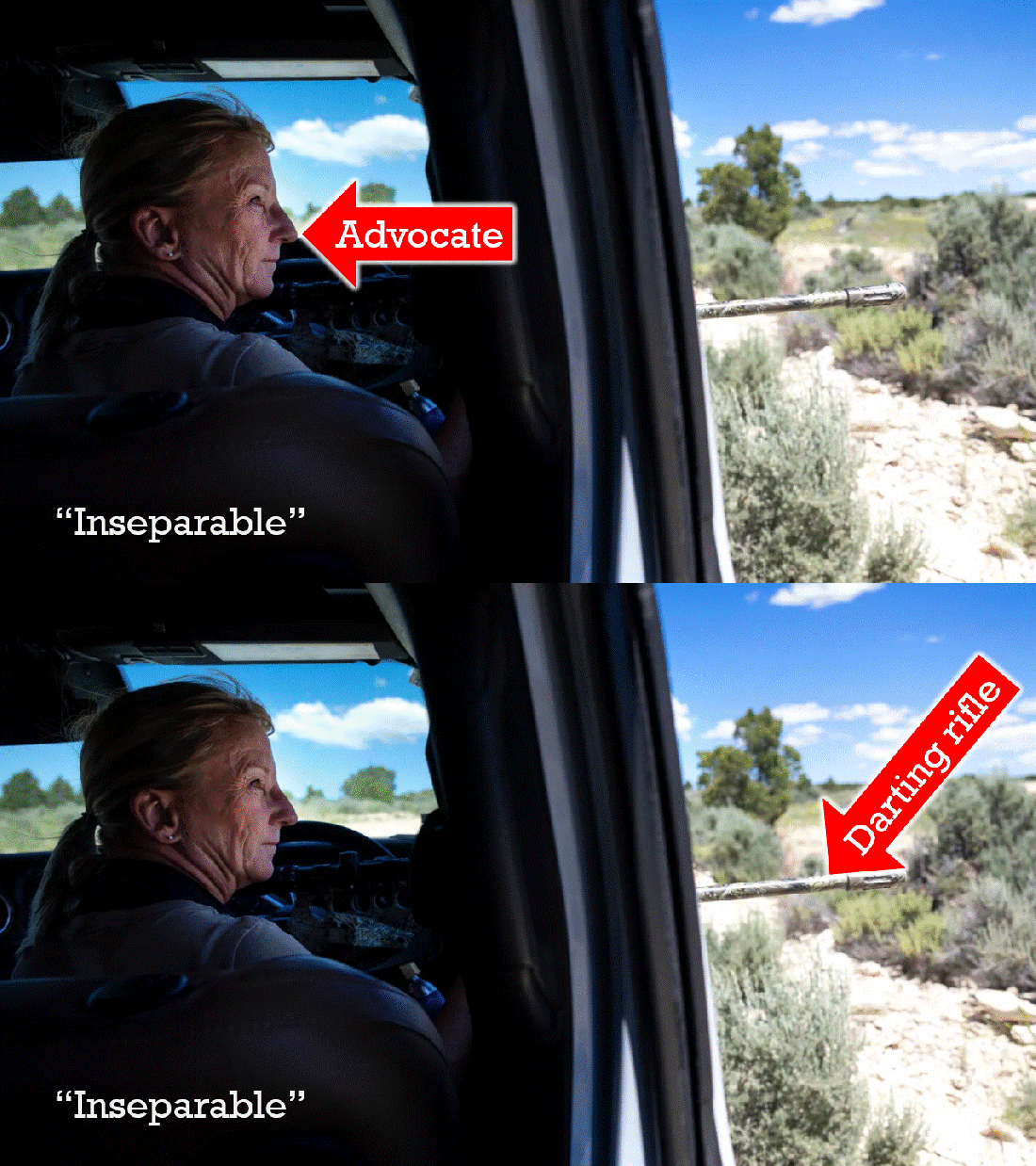
They’ve accidentally darted stallions, who become infertile, lose their mares and end up living alone.

They receive their supplies from the BLM, including the projector, RDDs, rangefinder and pesticide of choice, GonaCon Equine.

The agency will pay them 14 cents per mile if they file travel reports.

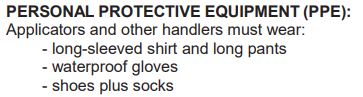
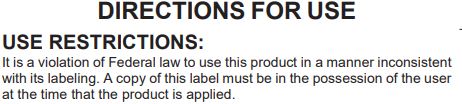
The report provides evidence of unlawful use, such as handling the product without the required PPE.

GonaCon PPE Requirements 07-09-23

Advocate Handles Gonacon without Proper PPE 07-09-23

GonaCon Warning Label 07-09-23

On the bright side, it’s no longer classified as a restricted-use pesticide, so it can be used to control pests that interfere with animal agriculture, even in their lawful homes.

Curiously, the women describe themselves as horse lovers, typical of the advocates.

And, like most advocates, their words never match their deeds.

RELATED: How the Advocates Violate Federal Law.

Calling it a Vaccine 05-01-23

Antelope Roundups in Progress

Trapping began yesterday, with two operations running concurrently.

Antelope North

  • Scope – Spruce-Pequop, Goshute, Antelope Valley HMAs
  • Target – Wild horses
  • Purpose – Pest control
  • Type – Cruel and costly
  • Captured – 22
  • Shipped – 0
  • Deaths – 0

The capture and removal goals are identical, 2,000 each.

Antelope South

  • Scope – Antelope, Antelope Valley HMAs
  • Target – Wild horses
  • Purpose – Pest control
  • Type – Cruel and costly
  • Captured – 128
  • Shipped – 0
  • Deaths – 1

The capture and removal goals are identical, 1,107 each.

A mare was lost on Day 1 due to a fractured neck, probably sustained in a collision with a pipe panel.

A better approach, according to the wild horse advocates, is to poison the mares with ovary-killing pesticides.

The Complex is managed primarily for animal agriculture.

RELATED: Antelope Roundups Announced.

Antelope Complex with Allotments 07-06-23

Western Horse Watchers Banned from Socialist Media?

One data point does not establish a trend but it can certainly indicate an unusual event in the process.

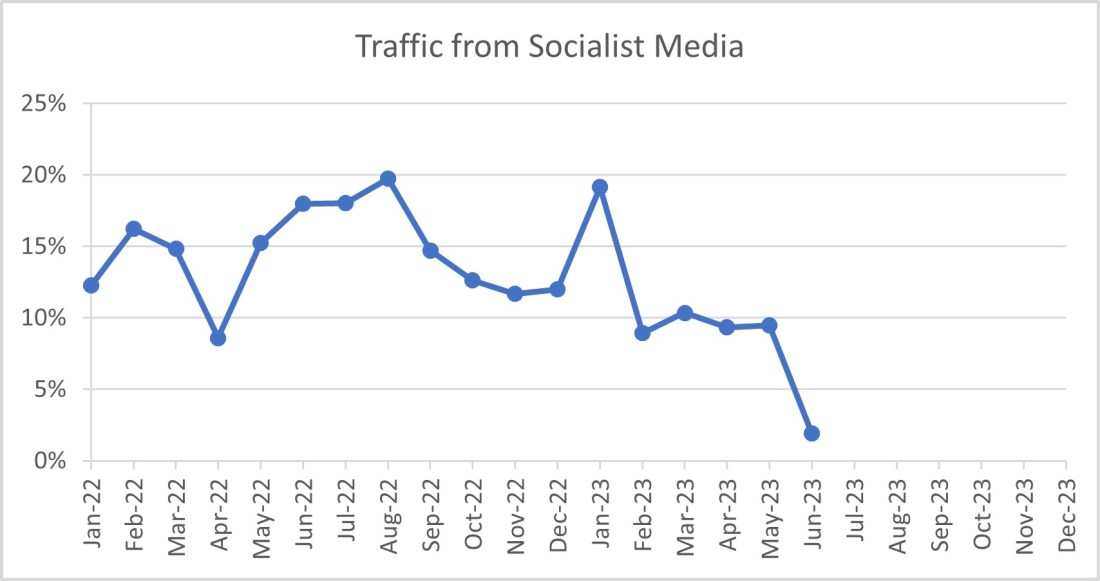
Traffic from Facebook and Twitter averaged 13.6% of the total during the 18-month period from Jan-22 through Jun-23, but dropped sharply last month, accounting for just 1.9% of the total.

A basic statistical calculation of the following form put the June data point outside the limits of random variation.

How to Compute p-chart Limits 02-10-22

As of today, traffic in July amounts to 1.4% of the total.

The fact-checkers in socialist media, sometimes referred to as censors, know a lot about climate change, sodomy, abortion, pedophilia and transvestism, but not much about wild horses, so who put them up to it?

Maybe some of the butthurt advocates who don’t like being called pesticide pushers and don’t want you knowing the truth about their ruinous darting programs?

Perhaps their financial support is drying up as it should.

Or maybe the bureaucrats don’t want their followers learning about mismanagement of resources in the lawful homes of wild horses or the unlawful use of pesticides therein.

Time will tell if the pattern continues.  But this is the type of affirmation you want when you’re going up against the old guard, who in the case of wild horses are mostly frauds.

Traffic from Solialist Media 07-09-23

Antelope Pesticide Test Shows How GonaCon Works

According to the 2015 Final EA for the Water Canyon Wild Horse Growth Suppression Pilot Program, mentioned in the July 5 roundup announcement,

When injected, the GonaCon vaccine targets the reproductive hormone gonadotropin releasing hormone (GnRH) secreted by the hypothalamus of the brain.  Antibodies produced in response to the vaccine inactivate endogenous GnRH, which in turn eliminates stimulation of the pituitary gland and gonads in males or females.  The resulting “immunocastration” renders animals unable to produce reproductive steroids or gametes.

The EA was copied to the project folder in ePlanning with other related documents.

The Proposed Action, Alternative A, called for the use of PZP-22, but the Decision Record authorized Alternative B, similar to Alternative A except the mares would be treated with GonaCon-B instead of PZP-22.

A keyword search of the EPA web site yielded no results for GonaCon-B.

The description of Alternative B (bottom of page 34 in the pdf) refers to the registration of GonaCon-Equine, suggesting a rebranding or reformulation of the product.

A 2017 labeling amendment dropped the restricted-use designation and increased the interval between primer and booster from 30 days to 90 days.

RELATED: Antelope Roundups Announced.

Foal-Free Friday, Battle of the Pesticides Edition

Of the two leading fertility control pesticides for wild horses, Zonastat-H and GonaCon Equine, which product

  • Is classified as restricted use?
  • Is commonly referred to as a vaccine?
  • Must be administered by certified applicators?
  • Can be applied to horses that interfere with animal agriculture?
  • Must be fired from Dan-Inject or Pneu-Dart rifles?
  • Must be delivered in neon orange or green darts?
  • May cause sterility with one or two doses?
  • Cannot be mixed or applied without chemical-resistant gloves?
  • Requires a minimum 90-day interval between doses?

Which one, in view of the pros and cons above, will surpass the other in terms of use?

RELATED: Foal-Free Friday, Managing for Genetic Diversity Edition.

Antelope Roundups Announced

Two news releases appeared yesterday, one covering pest control actions in and around the Spruce-Pequop and Goshute HMAs, as well as a portion of the Antelope Valley HMA, and the other for pest control actions in and around the Antelope HMA and remaining portion of Antelope Valley.

Highway 93 Alt, which runs northeast to West Wendover, serves as the split line for Antelope Valley.

The National Data Viewer shows the arrangement.  Click on image to open in new tab.

Antelope Complex with Allotments 07-06-23

The June 14 roundup schedule suggests they will run concurrently, with start dates of July 9.

Call them resource enforcement actions or rancher protection actions if you’d like.

The HMAs are subject to, and managed primarily for, permitted grazing.

The combined capture and removal goals are 3,107 and 3,107, respectively, with no animals to be returned to their lawful homes.

One of the announcements said 15 mares in the Water Canyon area previously treated with GonaCon Equine will receive another dose of the pesticide before being released back to the range.

Captured animals will be taken to the off-range corrals at Indian Lakes and Palomino Valley.

Gather stats and daily reports for the northern portion will be posted to this page.

Data for the southern portion will be posted here.

The Spruce-Pequop HMA lies mostly within the massive Spruce Allotment, one of the parcels to which Madeleine Pickens obtained grazing preference through the purchase of the associated base property.

The Allotment Master Report indicates most of the active AUMs are held by the Spruce Grazing Association, which Bizapedia ties to a law firm in Elko.  One of the company contacts is Saving America’s Mustangs, a 501(c)(3) nonprofit started by Pickens.

A 2018 roundup in the HMA started with the massacre of eight wild horses.

RELATED: Horses in Antelope Complex Get Short End of Stick.

Another Group Tries to Stop Rock Springs RMP Amendments

Friends of Animals announced on Monday that it has filed suit in U.S. District Court against the BLM for its plan to eliminate wild horses from more than one million acres of public lands in the southwestern Wyoming.

The complaint alleges that nothing in the WHB Act allows the BLM to respond to requests from private landowners to remove wild horses from public lands.

Nevertheless, such requests are common in the scoping and document review phases of wild horse gather projects in ePlanning, with ranchers and ranching advocacy groups among the most vocal.

Section 1334 in the statute authorizes the agency to remove free-roaming horses that stray from public lands onto privately owned land.

RELATED: Another Coalition Tries to Stop Rock Springs RMP Amendments.