Black Mountain Roundup, Part 2, Day 156

The incident began on March 9, a resource enforcement action that follows a wild burro removal in 2020Gather stats through August 11:

  • Burros captured: 369, up from 303 on Day 132
  • Average take: 2.4 burros per day
  • Capture goal: 500
  • Removal goal: 500
  • Returned: 0
  • Deaths: 0
  • Shipped: 306, up from 209 on Day 132

Foals represented 15.2% of the burros gathered.  Of the adults, 59.1% were male and 40.9% were female, not what you’d expect to find in a sample of n = 313 adults taken from a simple random process centered at 50% males / 50% females.

There were 63 burros in the unaccounted-for category at the end of Day 156.

Gather ops are not open to public observation.

Supplemental statistics:

  • AML: 478
  • Pre-gather population: Unknown
  • Forage liberated to date: 2,214 AUMs per year
  • Water liberated to date: 1,845 gallons per day
  • Forge assigned to livestock: 7,333 AUMs per year (estimated)
  • Burros displaced from HMA by livestock: 1,222
  • True AML: 1,700

RELATED: Black Mountain Roundup, Part 2, Day 132.

Conger Roundup Day 3

The incident began on August 11.  Gather stats through August 13:

  • Horses captured: 59
  • Average take: 20 horses per day
  • Capture goal: Unknown
  • Removal goal: 296
  • Returned: 0
  • Deaths: 0
  • Shipped: 27

Foals accounted for 25.4% of the horses gathered.  Of the adults, 40.9% were male and 59.1% were female.

Body condition scores were not reported.

Day 3 ended with 32 unaccounted-for horses.

Supplemental statistics:

  • AML: 80
  • Forage assigned to horses: 960 AUMs per year
  • Pre-gather population: 355
  • Forage liberated to date: 708 AUMs per year
  • Water liberated to date: 590 gallons per day
  • Forage assigned to livestock: Unknown
  • Horses displaced from HMA by livestock: Unknown

RELATED: Conger Roundup in Progress.

Advocates Have Answer to Wild Horse Problem?

If we get rid of them they can stay.  That’s the mentality of Wild Horse Connection, surrogate on the Virginia Range for the Campaign Against America’s Wild Horses.

Specifically, from their web site, “If you work with us, follow the laws, and leave the management of the horses to WHC, then we can keep the horses where they belong.”

They’re PZP zealots, and their ruinous darting program is the centerpiece of a story published today by Courthouse News.

These idiots are also feeding the horses.  It’s like Salt River 2.0 except there’s no river.

WHC Arrogance 08-13-21

Remember, you are inferior and the advocates are superior, in all ways.  Shut up and do as you’re told.

RELATED: Virginia Range Darting Program Coordinator Still Not Named?

West Douglas Roundup Day 19

The incident began on July 26.  Gather stats through August 13:

  • Horses captured: 457, up from 431 on Day 17
  • Average take: 24 horses per day
  • Capture goal: 450
  • Removal goal: 450
  • Returned: 0
  • Deaths: 11, up from 9 on Day 17
  • Shipped: 337, no change from Day 17

The goal has been reached and gather ops have concluded.

One death occurred on Day 18 and another on Day 19, both attributed to pre-existing conditions.  The death rate climbed to 2.4%.  The summary at the gather page shows ten horses lost but the daily reports yield eleven.

Body condition scores were not reported.

Foals accounted for 19.3% of the horses gathered.  Of the adults, 42.5% were male and 57.5% were female.

Day 19 ended with 109 unaccounted-for horses.  Field work will likely continue until all animals are shipped.  None will be returned.

Other statistics:

  • AML: 0
  • Forage assigned to horses: 0
  • Pre-gather population: 450
  • Forage liberated to date: 5,484 AUMs per year
  • Water liberated to date: 4,570 gallons per day
  • Forage assigned to livestock: Unknown
  • Horses displaced from HA by livestock: Unknown

RELATED: West Douglas Roundup Day 17.

Woman in Minnesota Sees What Advocates Can’t—or Won’t

Check out this letter to the Morrison County Record of Little Falls, MN.

Send your donations to her!

Western Horse Watchers believes that all of the off-range corrals and long-term pastures could be emptied three to five times over by ending public-lands ranching in wild horse and burro areas where it occurs.

There would be no excess animals, no overpopulation and no need for PZP darting.

Virginia Range Darting Program Coordinator Still Not Named?

Somebody needs to step up.  How about one of the Sand Wash advocates who won’t acknowledge the presence of livestock in the HMA?

Maybe one of volunteers at the Salt River Wild Horse Darting Group, eager to get away from the tyrant and make a name for himself?

A bureaucrat said there are too many wild horses on the Virginia Range so it’s time to get off your butt and do something about it.

Apply here.

RELATED: Coordinator for Virginia Range Darting Program Not Identified?

Progression of Injuries VR 07-30-21

Antelope Roundup Day 10

The incident began on August 2.  Gather stats through August 11:

  • Horses captured: 814, up from 456 on Day 8
  • Average take: 136 horses per day
  • Capture goal: 2,200
  • Removal goal: 2,200
  • Returned: 0
  • Deaths: 4, no change from Day 8
  • Shipped: 514, up from 343 on Day 8

The death rate dropped to 0.5%.

Foals accounted for 17.2% of the horses gathered.  Of the adults, 45.5% were male and 54.5% were female.

Body condition scores were not reported.

Day 10 ended with 296 unaccounted-for horses.  The contractor is probably holding them on site.

Data quality has been good.

Other statistics:

  • AML: 789 (four HMAs involved)
  • Forage assigned to horses: 9,468 AUMs per year
  • Pre-gather population: 6,032 plus foals
  • Forage liberated to date: 9,768 AUMs per year
  • Water liberated to date: 8,140 gallons per day
  • Forage assigned to livestock: 72,946 AUMs per year (estimated)
  • Horses displaced from HMAs by livestock: 6,079 (12% of off-range holding)
  • True AML: 6,868

RELATED: Antelope Roundup Day 8.

UPDATE: The average daily take should be 81.4, not 136.

West Douglas Roundup Day 17

The incident began on July 26.  Gather stats through August 11:

  • Horses captured: 431, up from 390 on Day 15
  • Average take: 25 horses per day
  • Capture goal: 450
  • Removal goal: 450
  • Returned: 0
  • Deaths: 9, up from 8 on Day 15
  • Shipped: 337, up from 296 on Day 15

Another death occurred on Day 17 due to pre-existing conditions but no details were given.  The death rate is 2.1%.  The summary at the gather page shows eight horses lost but the daily reports yield nine.

Body condition scores were not reported.

Foals accounted for 19.0% of the horses gathered.  Of the adults, 42.4% were male and 57.6% were female.  The gap between stallions and mares continues to widen.

Day 17 ended with 85 unaccounted-for horses.  The operation will likely conclude in another day or two.

Other statistics:

  • AML: 0
  • Forage assigned to horses: 0
  • Pre-gather population: 450
  • Forage liberated to date: 5,172 AUMs per year
  • Water liberated to date: 4,310 gallons per day
  • Forage assigned to livestock: Unknown
  • Horses displaced from HA by livestock: Unknown

RELATED: West Douglas Roundup Day 15.

Any Privately Owned Livestock in Sand Wash Basin HMA?

You might conclude that the answer is ‘No’ based on this story by 9News of Denver.

An emergency roundup, set to begin on September 1, will remove 733 wild horses from the area, according to the latest schedule.  Not enough food and water.  Pay no attention to the condition of the horses in the story.

The horses share the land “with Sage Grouse, Elk, Deer, Pronghorn, Coyotes, Mountain Lions, Badgers, Golden and Bald Eagles, along with Dirt Bikes and ATV Riders,” according the local advocacy group.  No PZP darting either.

Clearly a wild horse heaven.

RELATED: Sand Wash Basin Can Support More Wild Horses?

AIP Lawsuit Moved to Colorado

A case brought by the American Wild Horse Campaign, Skydog Ranch & Sanctuary, Evanescent Mustang Rescue and Sanctuary Inc., Clare Staples and Carol Walker has been transferred from the District of Columbia District Court to the District of Colorado, where a similar case filed by Friends of Animals is pending, according to a report posted today by Law Street Media.

Adoptions and financial incentives are downstream programs.  They help the ranchers, not the horses.

Antelope Roundup Day 8

The incident began on August 2.  Gather stats through August 9:

  • Horses captured: 456, up from 361 on Day 6
  • Average take: 76 horses per day
  • Capture goal: 2,200
  • Removal goal: 2,200
  • Returned: 0
  • Deaths: 4, up from 2 on Day 6
  • Shipped: 343, up from 211 on Day 6

Two horses were put down on Day 8 due to pre-existing conditions, bringing the death rate to 0.9%.

Foals accounted for 18.6% of the horses gathered.  Of the adults, 45.3% were male and 54.7% were female.

Body condition scores were not provided.

Day 8 ended with 109 unaccounted-for horses.  The contractor is probably holding them on site.

Other statistics:

  • AML: 789 (four HMAs involved)
  • Forage assigned to horses: 9,468 AUMs per year
  • Pre-gather population: 6,032 plus foals
  • Forage liberated to date: 5,472 AUMs per year
  • Water liberated to date: 4,560 gallons per day
  • Forage assigned to livestock: 72,946 AUMs per year (estimated)
  • Horses displaced from HMAs by livestock: 6,079 (12% of off-range holding)
  • True AML: 6,868

RELATED: Antelope Roundup Day 6.

UPDATE: The average daily take should be 57, not 76.

Stinkingwater Wild Horses Get Short End of Stick

The HMA covers 85,407 acres in eastern Oregon, including 71,893 BLM-managed acres, 10,898 privately owned acres and 2,615 acres of Bureau of Recreation land, according to the 2017 Final EA for resource enforcement actions therein.

The 80 horses allowed by plan require 960 AUMs per year.

The stocking rate allowed by plan is 0.9 wild horses per thousand acres.

Table 3-4 in the EA supplies information for three allotments inside the HMA.  The total allotment acreage is slightly less than the HMA acreage, so most, but not all, of the HMA is subject to permitted grazing.

The map provided with the project documents shows the arrangement.

Stinkingwater HMA Calcs 08-10-21

The allotments, including current status, were discussed in this post from August 1.

The Texaco Basin permittee would have to place 2,350 ÷ 7 = 336 cow/calf pairs on the allotment to graze off 2,350 AUMs in seven months.

The stocking rate at Texaco Basin would be 336 ÷ 14,558 × 1,000 = 23.1 cow/calf pairs per thousand acres.

The total number of cow/calf pairs inside the HMA would be 1,280, with an overall stocking rate of 15.5 cow/calf pairs per thousand acres.

Western Horse Watchers usually converts AUMs to horses and cow/calf pairs, even if the HMA is designated for burros and/or the allotments are permitted for sheep.  The resource requirements of wild horses and cow/calf pairs are said to be equivalent.

The stocking rates and forage allocations are compared in the following charts.
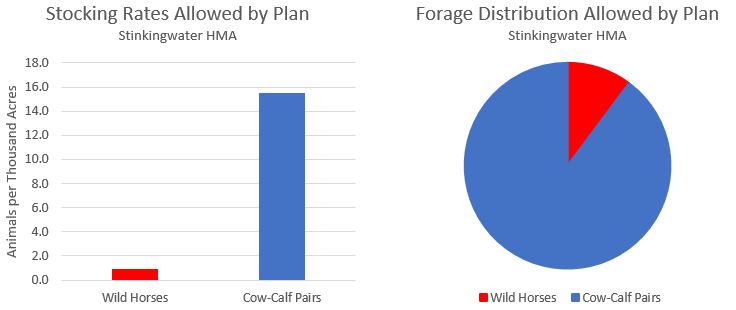
Stinkingwater HMA Charts 08-10-21

The HMA is managed primarily for livestock, contrary to §1332(c) of the statute, with the horses receiving just 10% of the authorized forage, neglecting wildlife.

The forage assigned to livestock would support an additional 705 horses, for a True AML of 785.

The pre-gather population of 450 is well within this range, so there are no excess horses, no overpopulation and no justification for a fertility control program.  As usual, the advocates are wrong.

The 705 wild horses cheated out of a spot on their home range represent 1.4% of the 50,000 horses in off-range holding.

RELATED: Stinkingwater Roundup Starts in Two Weeks.

West Douglas Roundup Day 15

The incident began on July 26.  Gather stats through August 9:

  • Horses captured: 390, up from 344 on Day 13
  • Average take: 26 horses per day
  • Capture goal: 450
  • Removal goal: 450
  • Returned: 0
  • Deaths: 8, no change from Day 13
  • Shipped: 296, up from 250 on Day 13

The death rate is 2.1%.  The summary at the gather page shows seven deaths but the daily reports show eight.

Body condition scores were not reported.

Foals accounted for 18.5% of the horses gathered.  Of the adults, 43.1% were male and 56.9% were female.

Day 15 ended with 86 unaccounted-for horses.

Other statistics:

  • AML: 0
  • Forage assigned to horses: 0
  • Pre-gather population: 450
  • Forage liberated to date: 4,680 AUMs per year
  • Water liberated to date: 3,900 gallons per day
  • Forage assigned to livestock: Unknown
  • Horses displaced from HA by livestock: Unknown

RELATED: West Douglas Roundup Day 13.