House Considers DOI FY 2021 Budget Request

The Secretary of the Interior appeared before the House Interior and Environment Appropriations Subcommittee today to read a prepared statement and answer questions about the President’s FY 2021 budget request.

The priorities for the new year include a “more sustainable Wild Horse and Burro management strategy,” which probably means they want the next installment on the disastrous ‘Path Forward.’

The $21 million authorized for the project in FY 2020 was tied to the development of a game plan, which has not been announced on the BLM news page.

RELATED: What Can the BLM Do With an Extra $21 Million?

BLM Targets Invasive Species

What do wild horses have in common with pinyon pines and juniper trees?

They rob forage from cattle, sheep and big-game animals on public lands in the western U.S., or crowd it out.

Therefore, they have to go.

Who benefits?  Just look at those applauding a new initiative, announced yesterday, that will streamline the review of projects that remove pinyon and juniper trees to allow for sagebrush restoration.

  • President of the Mule Deer Foundation
  • President of the Congressional Sportsmen’s Foundation
  • Director of Communications, Wild Sheep Foundation
  • Beaver County Commissioner (and public-lands rancher)
  • Executive Director, New Mexico Cattle Growers’ Association

The proposal does not include the cutting of old-growth trees, planting of non-native species or application of herbicides, according to the news release.

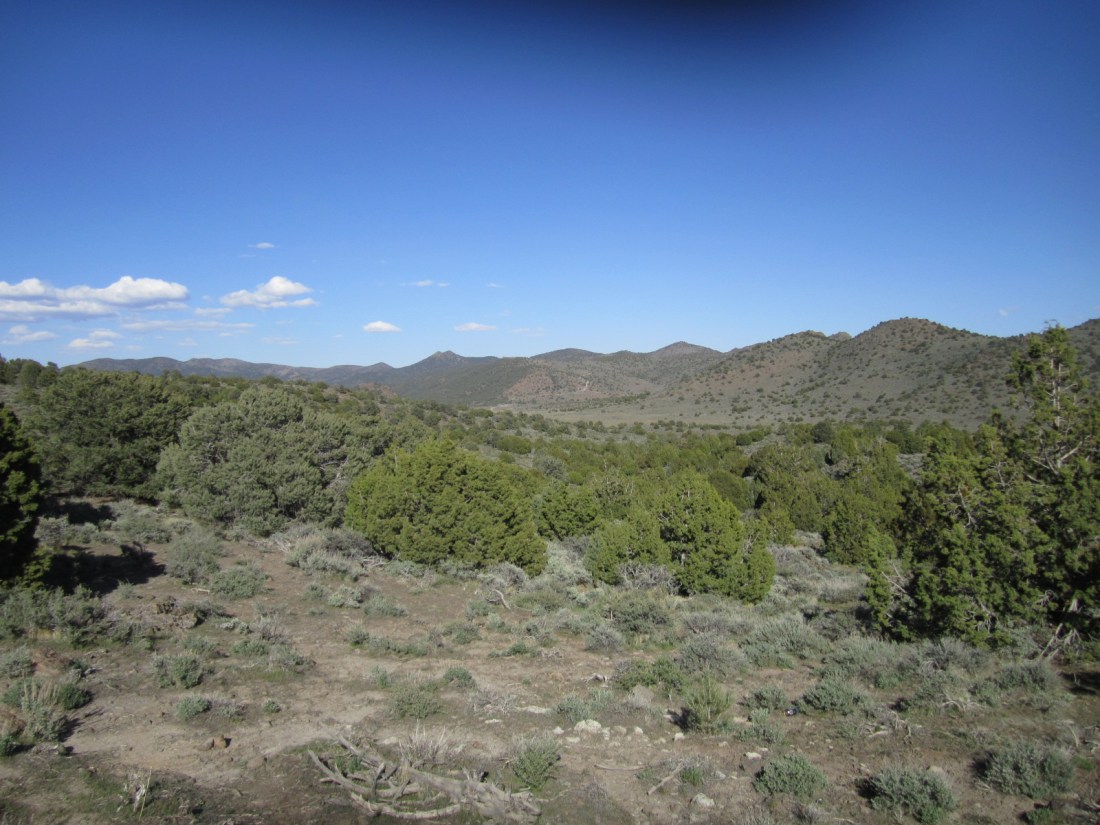
IMG_8870

Photo: Pinyon pines and juniper trees on the Virginia Range, 05-04-19.

BLM Seeks Off-Range Corrals

Today BLM requested proposals for off-range holding facilities in western Nevada and southwestern Idaho that could accommodate 500 to 3,500 wild horses and burros.

The animals would be taken there (after removal from their home range) in preparation for transfer to off-range pastures or adoption and sale events around the county.

Bids will be accepted through April 9.

The current population of horses and burros on public lands in the western U.S. is three times higher than the number the land can sustainably support in balance with wildlife and other uses of the land (code words for privately owned livestock).

RELATED: More Off-Range Pastures Sought for Wild Horses.

PSA 01-01-20

Black Mountain Burros Get Short End of Stick

Refer to Section 1.1 of the EA for the Wild Burro Gather Plan.  Forage in the HMA has been degraded and two grazing allotments don’t meet standards for rangeland health.

The current number of burros exceeds the limit that achieves and maintains a thriving ecological balance vis-à-vis the multiple use and sustained yield mandates for the area.

OK, but what do the numbers tell you about the HMA, the way it’s being managed?

The management plan allows 478 wild burros on the HMA, which contains one million acres.  The aimed-at stocking rate is therefore 0.48 burros per thousand acres.

The forage allocation for the burros would be 2,868 AUMs per year, given that they’re on the range twelve months per year (478 × 12 ÷ 2).

The forage demand of burros is half of that for horses, so their impact on the land cannot be compared directly to livestock.  The forage requirements of horses are said to be equivalent to those of cow/calf pairs, so the comparison will be done on that basis.

The AUM budget won’t change but the AML and stocking rate will.  If the HMA was managed for wild horses, the AML would be 239 and the stocking rate allowed by plan would be 0.24 per thousand acres.

Table 7 in the EA provides data for livestock grazing on the HMA.  A BLM rep contacted by WHW confirmed that the grazing season is 12 months per year.

Six of the sixteen allotments are designated for intermittent use, when forage and other conditions are favorable.  They have been omitted from the calculations.

Note that the stocking rates for livestock (cow/calf densities) are considerably higher than the 0.24 allowed by plan for horses (who are proxy for the burros in this analysis).

Black Mountain Calcs-1

The land grazed continually corresponds to about 22% of the HMA.  The parcels grazed intermittently would bring the total to approximately 50%, as estimated in the original post (linked below).

The total estimated forage available to livestock inside the HMA is 7,333 AUMs per year, computed as the sum of the permitted AUMs for each allotment times the portion of each allotment inside the HMA.  For example, in Big Ranch A, 5,397 × .312 = 1684.

The estimated number of cow/calf pairs inside the HMA is 611, with an average grazing season of 12 months per year (7,333 ÷ 611).

The stocking rate for cow/calf pairs is 2.77 per thousand acres (611 ÷ 220,891 × 1,000).

Horses (burros, actually) receive 28% of the forage, compared to 72% for livestock.

These figures are compared in the following charts.

Black Mountain Charts-1

These indicators tell you that the HMA is managed primarily for livestock.

The thriving ecological balance—to be achieved by the roundup and maintained by one or more population controls—is not a balance at all.

The forage assigned to livestock would support an additional 1,222 burros (7,333 ÷ 12 × 2), for a new AML of 1,700 (478 + 1,222).

If the grazing allotments are fenced and livestock are present twelve months per year, can the burros access the resources on those parcels?

Has the most productive land in the HMA been given to the ranchers?

Would the loss of 72% of their forage explain their movement off the HMA?

If livestock are confined to the allotments by the same fences that keep the burros (and other wildlife) out, why attribute the substandard conditions to them?

Next time you see management actions justified by ‘multiple use’ and ‘sustained yield,’ know that they are code words for diverting most of the resources to privately owned cattle and sheep, minimizing the number of wild horses and burros, while giving the impression that the area is managed according to paragraph 1332(c) of the statute.

The term ‘Potemkin Village‘ comes to mind.

RELATED: Comments Invited on EA for Black Mountain Gather Plan.

PSA 12-07-19

Note to Sportsmen

A smaller but not insignificant voice against wild horses is that of the outdoorsmen, who argue that the horses are stealing resources from game animals.

In Section 3 of the original WHB Act, Congress ordered the Secretaries of Interior and Agriculture to work with state wildlife agencies to balance the needs of the horses with those of wildlife, especially endangered species.

That language is now in paragraph 1333(a) of the current statute.

Lands set aside for wild horses and burros are to be managed principally for those animals, according to paragraph 1332(c), but only four of them are.

What happened?  Refer to CFR 4710.3-2: The requirement was nullified by the unelected bureaucracy.  Management plans for those areas put the horses in the minority.  That’s why so much money is being spent on roundups, adoption incentives, training programs, fertility controls, off-range pastures, sanctuaries and preserves.

Can a federal regulation trump a duly enacted statute?  If you look at current practices, the answer must be “Yes.”  (If that’s true, our most cherished principles are now on very shaky ground.)

The HMAs and WHTs reviewed on these pages (sidebar on the right under ‘Short End of Stick’) intersect multiple grazing allotments, with most of the resources consigned to privately owned cattle and sheep.  Would you be surprised to learn that most of them are managed that way?

Would the fences that confine the livestock to their allotments impede the movement of horses and wildlife, limiting their access to critical resources?

How many free-roaming horses and burros have to move off their designated areas to find enough food and water?

What types of diseases are transmitted to wildlife by privately owned livestock?

Perhaps the outdoorsmen should look at the data before criticizing the horses.

RELATED: Pneumonia Killing Off Bighorn Sheep in Nevada?

Assateague Horse Survey: Any Day Now

NPS still hasn’t posted the results of the February census, at least not at their news site.

Last November, there were 22 stallions and 53 mares on the island (Maryland side).

If you don’t think that’s unusual, go get a pair of dice.  Set one of them aside.  Roll the remaining die 75 times, counting odd (or even) results.

Try coming up with (a) 22 or less such results or (b) 53 or more such results.

Feel free to leave your answers in the comments.

RELATED: Assateague Census in 2020.

Fertility Control Study Approved

BLM issued a Decision Record and Finding of No Significant Impact today for the testing of a contraceptive thought to be effective for three years.

The research will evaluate the efficacy of the vaccine against two oocyte growth factors, and if it can produce long-term infertility from a single dose.

The experiments will be performed on excess wild horses at the Northern Nevada Correctional Center in Carson City, NV.

If successful, the vaccine could help the agency achieve a thriving ecological balance on western rangelands, according to the news release.

RELATED: Comments Invited on Wild Horse Fertility Control Study.

Thriving Ecological Balance Rev 2

Managed Primarily for Livestock

Refer to this guest column posted today by The Salt Lake Tribune.  If AWHC understands that most of the forage on HMAs has been consigned to privately owned cattle and sheep, why do they keep pushing fertility control?

Contraceptives drive wild horse numbers down—a technique you’d apply if you wanted to manage the land primarily for livestock.

RELATED: Grazing Program Overhaul, Management of Western Rangelands in 2018.

Heber Comment Period Drawing to a Close

Comments on the draft management plan will be taken until March 16, after which it will be finalized by the Forest Service, according to a report posted this morning by the White Mountain Independent of Show Low, AZ.

A problem with the plan is the amount of land dedicated to the WHT—it’s only half the size of the tiny Pryor Mountains WHR in Montana.

If the land can support a stocking rate of five wild horses per thousand acres, and the minimum herd size is 150 per Section 4.4.6.3 the Management Handbook, then the WHT should contain at least 30,000 acres, with an AML of 150.

Public-lands ranchers, referred to by some as “stewards of the forest,” would oppose any such move.  They are trying to paint themselves as victims of the process, typical for government dependents.

Groups that represent them were unwilling to go on record for the article.

Some advocates say the plan is nothing more than a thinly veiled attempt to eradicate the herd.

One thing is for sure: Unlike the ranchers, wild horses have no friends in government.

RELATED: Disposition of Heber ‘Excess’ Horses?

Laramie County Commissioners Discuss CAFO!

The March 3 meeting was interrupted briefly after the February 18 minutes had been approved to shuffle roles in response to the resignation of the chair.

Although the high-density horse feeding operation proposed by Equine Elite was not on the agenda, it was discussed at the conclusion of regular business.  You can watch the proceedings beginning at 12:58 in this video.

Developers of the facility have asked the county for a rule change that will silence the voices of many who oppose the project.

The planning department has drafted a new rule based on an odor propagation model developed by the University of Nebraska – Lincoln.

Commissioners asked for a public hearing on March 17 to formally consider the proposal and receive stakeholder comments.

A decision will not be rendered until April 7, at the earliest.

Minutes of the meeting have not been posted as of today.

RELATED: Laramie County Commissioners Meet This Week.

Comments Invited on EA for Black Mountain Gather Plan

BLM announced today the opening of a 30-day comment period on an Environmental Assessment for the Black Mountain Wild Burro Gather and Population Control Plan.

The HMA covers approximately one million acres in northwestern Arizona, including the old mining town of Oatman.  The AML is 478, for an aimed-at population density of 0.5 burros per thousand acres.  See Table 1 in the EA.

Black Mountain HMA Map-1

The current population is thought to be around 2,200.

The HMA intersects fourteen grazing allotments, although some of them are not active, according to Table 7.  Figure 15 in Appendix C indicates that roughly half of the HMA is subject to permitted livestock grazing, maybe a bit more.

The forage allowance for burros is half of that for horses.  If horses roamed the HMA, the plan would need to allocate 5,736 AUMs per year (478 × 12).  Given that the land was set aside for burros, the forage allocation would be 2,868 AUMs per year.

Comments can be submitted at the project documents page.  Substantive only, please.