Hypothesis Revisited

This statement appeared on these pages back in November:

The number of wild horses and burros in off-range holding (around 50,000) can be explained by the misappropriation of forage on just a few dozen HMAs.

How’s the theory holding up?

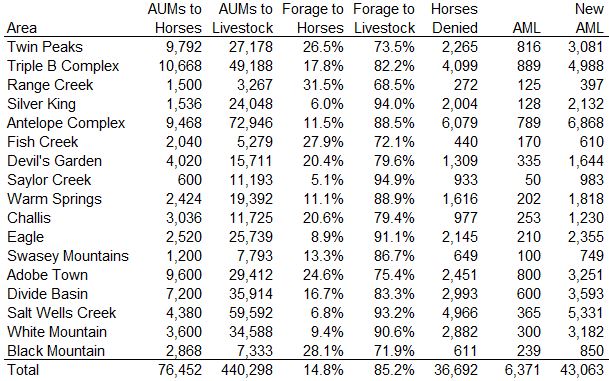
Let’s look at the numbers for the areas reviewed in a series of posts called ‘Short End of Stick’ (refer to sidebar on the right).  All calculations were based on horses and cow/calf pairs, even in areas designated for burros and sheep.

Short End of Stick Calcs-1

In the seventeen areas reviewed so far, 36,692 wild horses have been denied a spot on their home range because of privately owned livestock.  That’s about 73% of the horses in off-range holding.

How many more areas would need to be reviewed to bring the total to 50,000?  If the pattern holds, only about six.  So the theory seems to be correct.

Note that livestock receive 85% of the forage overall, with 15% to the horses—on land set aside for the horses.

If livestock were removed, the total AML (for the 17 areas) could be increased from 6,371 to 43,063.  A warrant for contraceptives can not be found in these data.

Thriving Ecological Balance Rev 2

Assateague Herd Declines in Latest Census

WBOC News of Salisbury, MD reported this morning that the March 2020 survey yielded 21 stallions and 51 mares, for a total of 72, compared to 76 in March of 2019.

One new foal was observed but its sex was not provided.  A few more foals may appear in the coming weeks.

The herd (Maryland side of the island) is subject to humane management practices and has been cited as a paragon of wild horse management by some ‘advocates.’

Assateague Census Chart March 2020-1

The chart tells you that the latest results cannot be produced by a simple random process centered at 50% males / 50% females.  Accordingly, one or more assignable causes should be sought.

Why is the sex ratio skewed in favor or females?  Why do males have a high mortality rate?  Is the management program making things better for the horses or worse?

The upper and lower limits of the chart are computed from basic statistical formulas, where p-bar = .50 and n = 72.

RELATED: New Assateague Foal.

Laramie County Commissioners Special Meeting This Week

Commissioners will meet on March 25 to fill a vacancy on the Board.  Refer to the agenda for more information.

The Board is currently considering, among other things, a rule change that will allow the construction of a high-density horse feeding operation near Burns, WY, despite the objections of nearby residents and the county Planning Commission.

With the impending closure of three HMAs in the western part of the state, and the downsizing of a fourth, the facility would be very convenient to the BLM.

RELATED: Laramie County Commissioners Favor Rule Change?

NYT Looks at Wild Horse ‘Crisis’

The story takes place on the Challis HMA during the November, 2019 roundup.

Channeling the January, 2020 article by The Christian Science Monitor, it portrays the horses as thieves—depriving the poor ranchers of critical resources—on land set aside for the horses.  Of course, they forgot to mention that part.

On the edge of the wild horse range in Challis in central Idaho, Jackie Ingram, a rancher, has shared 168,700 acres of public land with the mustang herds for 46 years.  Each spring her family drives hundreds of Black Angus cattle up a steep road through Spur Canyon to graze the high, windswept hills on Bureau of Land Management land.

In some years, she said, the wild horses left so little grass to eat that other wildlife disappeared, and her family had to cut back their cattle herd.

In section 3 of the original WHB Act, Congress ordered the Secretaries of Interior and Agriculture to work with state wildlife agencies to balance the needs of the horses with those of wildlife, especially endangered species.

There was no provision for livestock.

Everything was wrecked in 1976 by FLPMA, the ‘No Rancher Left Behind Act,’ which codified ‘multiple use’ on western rangelands, including areas designated for wild horses and burros, giving priority to privately owned livestock.

It also sanctioned helicopter roundups.

Subsequent changes to the WHB Act have left it ineffective, no longer affording the protections sought by Velma.  That’s why you have 50,000 horses in off-range pastures.

The Challis HMA, with the highest stocking rates for cattle seen on these pages, is a fine example (see linked post below).

Wild horse welfare groups argue that the crisis is largely invented.  They say the government sets its population targets artificially low to justify mass removals that serve the interests of cattle ranchers and distract from other public land policies that are far more damaging.

As for contraceptives, the ranchers and the BLM will probably never accept them, because they’re difficult to administer and darted mares still eat.

RELATED: Binge Grazing at Challis HMA.

What’s Up With the Assateague Horse Census?

Results from the February, 2020 survey still haven’t been posted.  Last year they were reported on February 27.

The latest news release, dated March 17, involves the temporary closing of the ranger station and campgrounds.

Results from the November, 2019 survey cannot be produced by a simple random process centered at 50% males / 50% females.

There is something wrong with the herd, yet it is held up by the PZP zealots as the gold standard of wild horse management.

RELATED: Assateague Horse Survey: Any Day Now.

Readers Respond to CSM Hit Piece on Wild Horses

The original article, ignored by WHW, portrayed the horses as thieves—stealing forage from the poor ranchers—on land set aside for the horses.  Of course, they didn’t mention that last part.

Ray Hendrix, the main rancher with grazing allotments on these rangelands, expresses frustration about what the horses are doing to the land.  In late August, he visited what he calls the “lower country,” where he planned to graze some of his 900 cows this winter.  He was thrilled to see abundant “winterfat” – a nutritious shrub that makes for excellent winter forage.

“I thought, this is fabulous.  We’ll turn out this fall and there will be a lot of feed,” says Mr. Hendrix, a no-nonsense rancher in a baseball cap and Carhartt jacket. “Then I go back in October and it’s all gone.  The horses ate it.”

The AML for the Desatoya HMA is 180, which corresponds to a forage allocation of 2,160 AUMs per year.  Those 900 head, assuming they’re actually cow/calf pairs with a six month grazing season, would require 2.5 times as much, typical for HMAs that have almost achieved a thriving ecological balance.

On public lands taken away from the horses, almost everything goes to privately owned livestock, with a few crumbs for wildlife.

Yet, we’re supposed to feel sorry for the ranchers.

In the third letter, the reader argues that “the [Christian Science] Monitor should have published a completely different kind of article – one that exposed the money ranchers receive from the U.S. government.”

That money comes from you, the American taxpayer.

Think of it as redistribution of wealth.  Government confiscates a portion of your wages and uses the money to remove wild horses from their home range.  Their food is sold to the ranchers at fire-sale prices, and they pocket the profits.

Other funds go to wild horse outplacement programs (adoption, marketing, training and long-term holding) and population control programs (contraceptives, sex-ratio skewing and sterilization).

Thus, the WHB program is really just an appendage of the grazing program, designed to clear the range of wild horses and burros so they can be replaced by privately owned cattle and sheep.  Paragraph 1332(c) of the statute be damned.

RELATED: Why the Desatoya Forage Allocation Can’t Be Determined.

PSA 12-15-19

Laramie County Commissioners Favor Rule Change?

The decision was postponed until the May 5 meeting.  Three options are on the table for siting CAFOs—in particular, the wild horse feeding operation proposed by Equine Elite:

  • Leave the setback distance at three miles (current rule)
  • Change the setback distance to one mile
  • Use an odor footprint tool to determine the setback distance

Residents near the proposed feedlot said no.  The Planning Commission said no.

But three of the commissioners appear to be leaning toward a rule change that will allow the facility to be constructed near Burns, WY, arguing that the current setback distance deters agricultural businesses from coming into the county.

A spokesman for the residents said earlier in the meeting that the proposed CAFO is not an agricultural business because it produces nothing for human use or consumption.

He also pointed out that the recommended modeling program has not been calibrated for high-density horse feeding operations.

You can view the proceedings starting at 25:55 in this video.

RELATED: Laramie County CAFO to Be Discussed Next Week.

Black Mountain Burros on Bullhead City Agenda

The City Council was asked this evening to support population control measures on the HMA, because, you know, the animals have been wandering onto private land in search of food and water, causing safety problems.

That they have been cut off from 70% of their forage—so it can be sold to public-lands ranchers—probably has nothing to do with that.

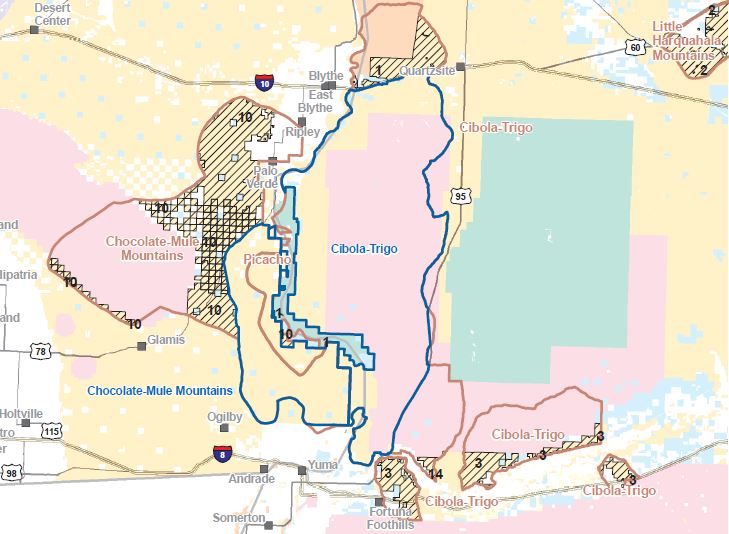
RELATED: Black Mountain Burros Get Short End of Stick.

Pinyon Pine Encroachment?

The announcement earlier this week of a proposed change that will streamline the approval of pinyon-juniper removal projects may have given you the impression that the trees are taking over western rangelands faster than ants at a Fourth of July picnic.

The projects would be carried out in mule deer and sage grouse habitats, with a view toward increased forage production, which could also benefit livestock, according to the Categorical Exclusion Verification Report.

The pinyon pine seen in Nevada can take 50 to 60 years to reach six feet in height and the trees can survive for 600 years or more.  See page 7 in this publication by the University of Nevada Cooperative Extension.

Removal of old-growth trees is not allowed according to the CX Report, but are they the only ones large enough to reduce the available forage?

RELATED: BLM Targets Invasive Species.

IMG_3543

House Considers DOI FY 2021 Budget Request

The Secretary of the Interior appeared before the House Interior and Environment Appropriations Subcommittee today to read a prepared statement and answer questions about the President’s FY 2021 budget request.

The priorities for the new year include a “more sustainable Wild Horse and Burro management strategy,” which probably means they want the next installment on the disastrous ‘Path Forward.’

The $21 million authorized for the project in FY 2020 was tied to the development of a game plan, which has not been announced on the BLM news page.

RELATED: What Can the BLM Do With an Extra $21 Million?

BLM Targets Invasive Species

What do wild horses have in common with pinyon pines and juniper trees?

They rob forage from cattle, sheep and big-game animals on public lands in the western U.S., or crowd it out.

Therefore, they have to go.

Who benefits?  Just look at those applauding a new initiative, announced yesterday, that will streamline the review of projects that remove pinyon and juniper trees to allow for sagebrush restoration.

  • President of the Mule Deer Foundation
  • President of the Congressional Sportsmen’s Foundation
  • Director of Communications, Wild Sheep Foundation
  • Beaver County Commissioner (and public-lands rancher)
  • Executive Director, New Mexico Cattle Growers’ Association

The proposal does not include the cutting of old-growth trees, planting of non-native species or application of herbicides, according to the news release.

IMG_8870

Photo: Pinyon pines and juniper trees on the Virginia Range, 05-04-19.