Desatoya Comment Period Ends This Weekend

The project can not address the underlying problem.  It can only ensure that it goes on for another ten years.  The HMA is managed primarily for livestock.

Concerns about resource allocations and management priorities, although valid, should not be submitted.

According to Paragraph 2 in Section 2.3 in the Draft EA, reducing or eliminating livestock grazing “is contrary to previous decisions which allocated forage for livestock use and would not be in conformance with the existing land use plan nor does it achieve the purpose and need for this EA.”

Shifting forage to wild horses “would not be in conformance with the CRMP [Consolidated Resource Management Plan] and is contrary to the BLM’s multiple-use mission as outlined in the 1976 FLPMA.”

Section 1702 of FLPMA defines ‘multiple use’ as the management of public lands and their resources in a way that best meets the present and future needs of the American people, not a select few.

The EA gives you the impression that the RMP—approved in 2001—can never be changed, but that’s what needs to happen.

RELATED: Commenting On the Desatoya EA.

Hunter/Jumper Prospect?

Filmed near Santa Elena Canyon in Big Bend National Park by Navarre Marshall.  A bit unusual to see an unattached youngster in the wild.  Is there more to the story?

The canyon description ends with this notice: “Illegal border crossings are known to occur in this area.  If you encounter anything that appears illegal, suspicious, or out of place, please do not approach or intervene.  Note the location, description, time, direction of travel, and call 911 as soon as possible.”

Fish Creek Roundup Day 5

The incident began on December 29.  Gather stats through January 2:

  • Horses captured: 198
  • Goal: 195
  • Returned: 0
  • Deaths: 0
  • Shipped: 80

Foals accounted for 18.2% of the horses gathered.  Roughly 54% of captured adults were males and 46% were females.

Body condition scores are not known.

No horses shipped on Days 1, 2, 3 and 5, according to the daily figures.

The number of unaccounted-for animals is 118.  They are probably being held on site, pending the return of 60 horses to the HMA, including 30 mares treated with PZP-22.

Although the target has been reached, the page does not say if gather operations are complete.

RELATED: Fish Creek Roundup Day 3.

Fish Creek Roundup Day 3

The incident began on December 29.  Gather stats through December 31:

  • Horses captured: 140
  • Goal: 195
  • Returned: 0
  • Deaths: 0
  • Shipped: 41

Foals accounted for 18.6% of the horses gathered.  Roughly 52% of captured adults were males and 48% were females.

Body condition scores are not known.

No horses have been shipped according to the daily figures.

The number of unaccounted-for animals is 99.  The contractor is probably holding them on site.

Sixty horses will be returned to the HMA, including 30 mares treated with PZP-22.

The operation will likely conclude in another day or two.

RELATED: Fish Creek Roundup Day 1.

Another Eagle Roundup In the Works

BLM said today that approximately 1,100 wild horses will be removed from the Eagle Complex, starting on or about January 6.  The operation will restore a thriving ecological balance and improve rangeland health, according to the news release.

Three HMAs are affected: Eagle, Chokecherry and Mount Elinor.

The roundup will be carried out with helicopters and will be open to public observation.

Fifty mares will be treated with contraceptives and returned to the range.

The Complex includes 743,000 acres along the Utah-Nevada state line.  The combined AML is 265 and the aimed-at stocking rate is 0.4 wild horses per thousand acres.  The average stocking rate across all HMAs is about one wild horse per thousand acres.

The current population is thought to be around 1,400 horses, including this year’s foals.

Eagle Complex Map Revised

All three HMAs are subject to permitted livestock grazing, as discussed in Section 3.3.5 of the Final EA for resource enforcement actions in the Complex.

Captured animals will be taken to off-range corrals in Sutherland, UT and Sparks, NV.

Gather stats and daily reports will be posted to this page.

The event follows the removal of over 1,600 wild horses less than year ago.

RELATED: Eagle Wild Horses Get Short End of Stick.

Thriving Ecological Balance-3

Fish Creek Roundup Next Chapter In ‘Wild Horse Wars?’

The incident was set to begin this weekend.

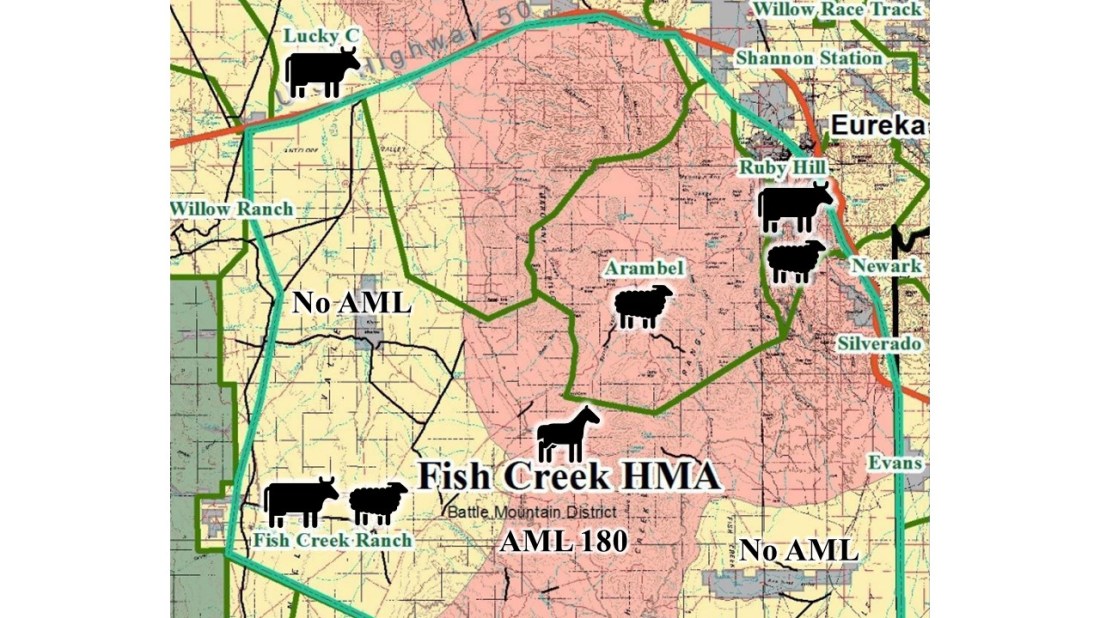
The gather area, based on a map from the 2015 Final EA, includes the Fish Creek Ranch allotment, which is grazed by Borba Land and Cattle LLC, among others, according to a report from the Rangeland Administration System.  Borba receives 52% of the active AUMs on the allotment.

The HMA is shown in pink and the gather area, which extends well beyond the HMA, has a light green border.  The allotments, four of which intersect the HMA, have dark green borders: Lucky C, Arambel, Ruby Hill and Fish Creek Ranch.

Fish Creek Allotments-1

The original piece in The Washington Post begins with a story about Kevin Borba, “a cattle rancher in Nevada.”  He appears in the following video by Protect the Harvest, which ties him to the area.

“The horses ain’t ever going to leave,” he says.

Over 500 were removed last year, with another 135 slated for removal this year, so PTH will need to update the video.  Less wailing and gnashing of teeth, please.

RELATED: ‘Wild Horse Wars’ Pushback.